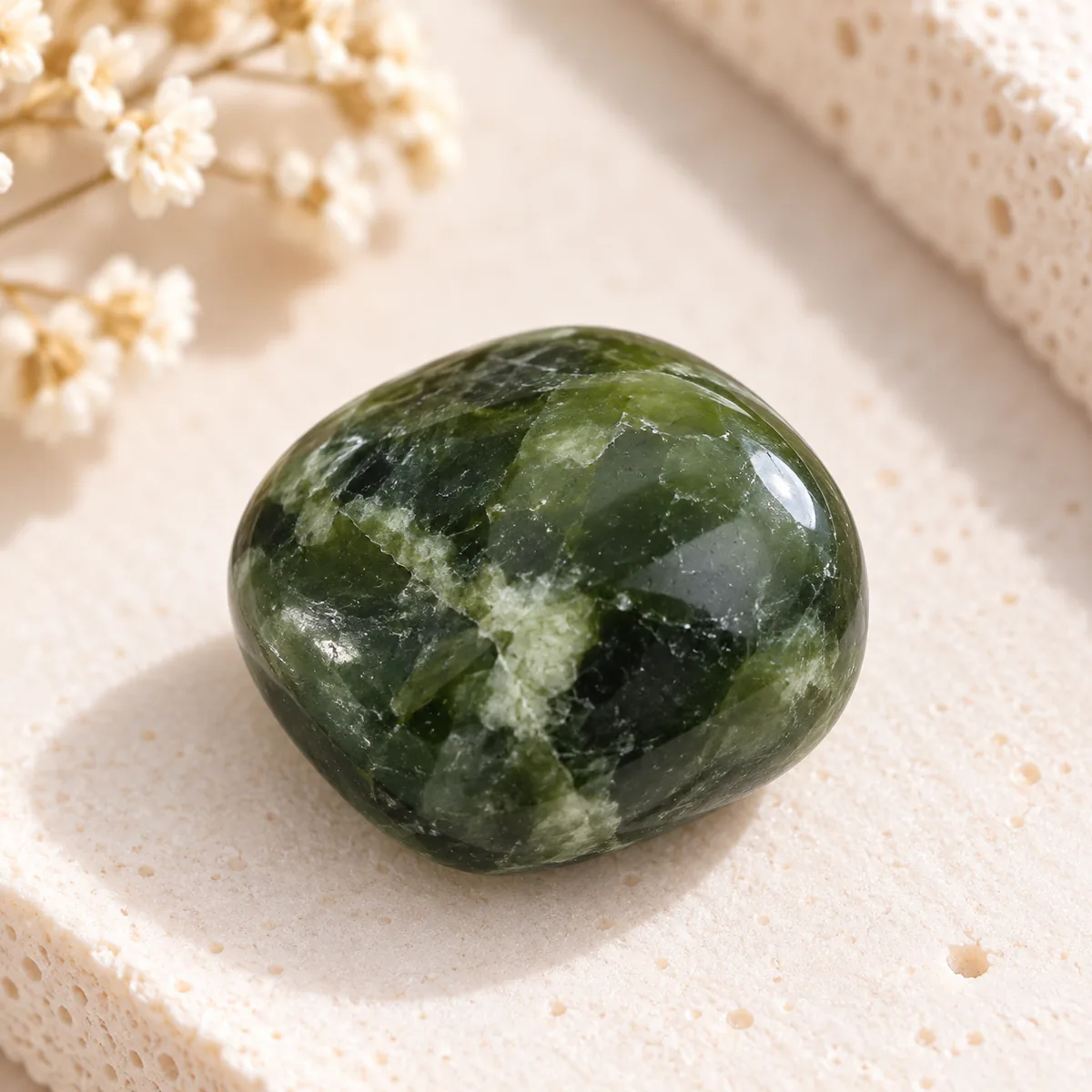
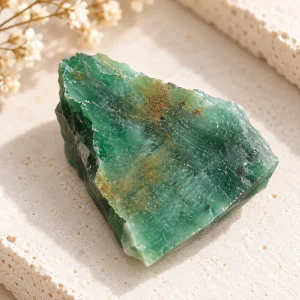
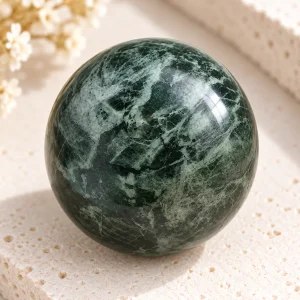
Jade pebble, tumbled and polished, with soft contours, that sits in the palm of your hand. A deep fir green, crossed by moss-green areas and fine light veins.
To keep on a desk or deep in a pocket, or to give without getting it wrong. Every pebble is unique: yours will have its own shape and its own pattern.
A jade pebble, tumbled then polished to a shine, with soft contours, that sits in the palm of your hand. Its green moves from deep fir to moss green, crossed by light veins and a fine network of white lines. A stone to keep close.
In four lines
A tumbled, polished pebble, smooth under the fingers.
A fir green crossed by light veins.
Every pebble is unique: yours will have its own shape and pattern.
A bare stone, which will be weighed whole.
A stone that fits in your hand
This jade pebble has no function, and that is its whole charm. It is made to be picked up, turned between the fingers, set down again. Its edges disappeared in the tumbling, its faces are rounded, and its bright polish catches lamplight as well as window light.
You keep it on a desk, next to a book, on a nightstand, or deep in a pocket. It is a small object your hand ends up reaching for without thinking.
A forest green, veined with light
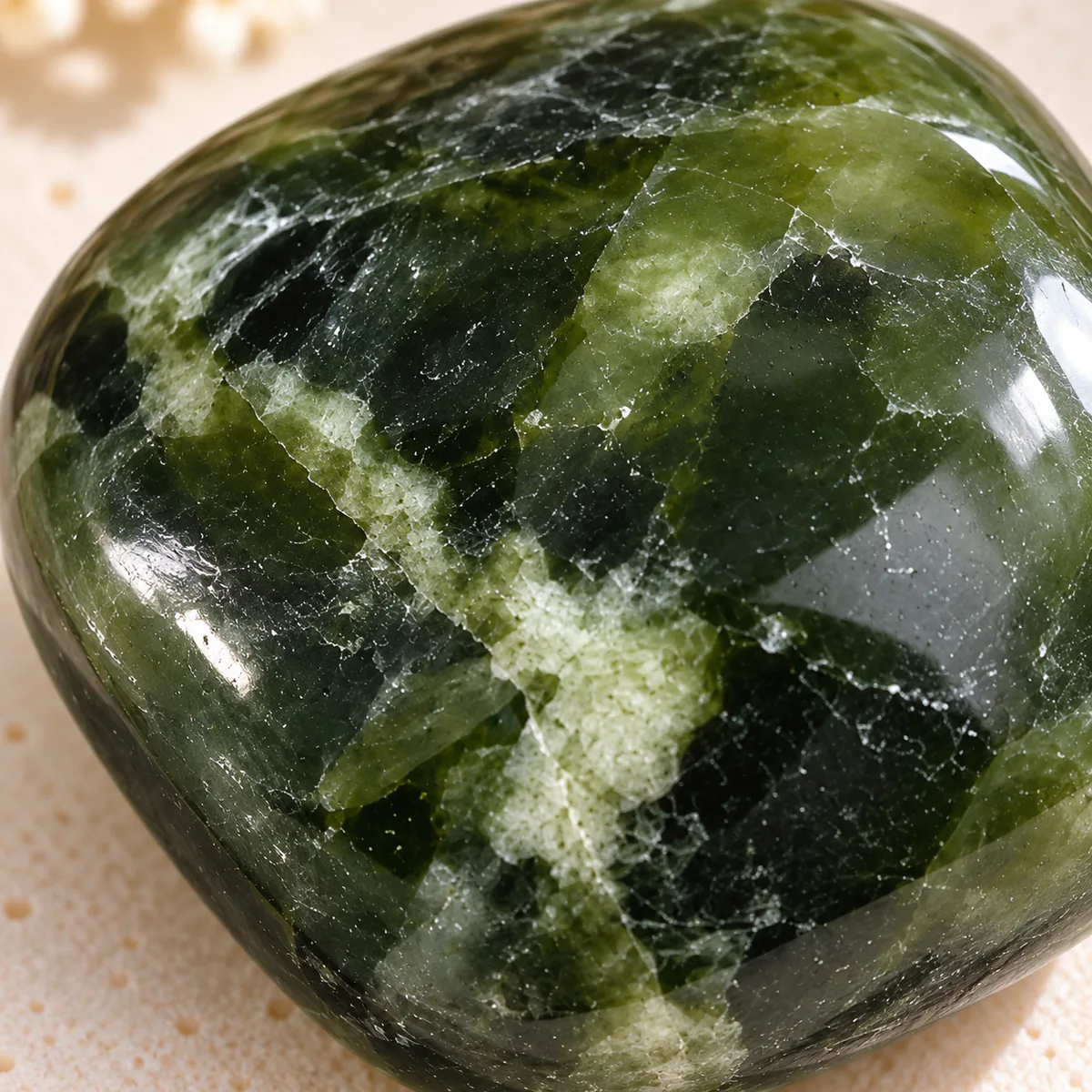
The background is a deep fir green, almost black where the stone is thickest. Lighter areas, moss green and olive green, run through it like breaks in the clouds, and fine white veins trace a delicate network on the surface and deeper inside.
Seen up close, under a lamp, the pebble changes with every face: it is a mineral landscape that fits in your hand.
Every pebble is unique
A pebble is born from tumbling: pieces of stone turn for days with finer and finer abrasives, which round off the corners, then polishing gives them their shine. No two come out the same.
The pebble you receive will look like the one in the photo, but it will have its own shape and its own pattern: more or less veined, more or less light. That is what makes it a personal object, not a mass-produced piece.
A gift that asks for nothing
No size to choose, no taste to guess: a jade pebble suits anyone, a coworker, a relative, someone who loves stones. It slips into a pocket or a drawer, and keeps for years. More ideas for giving jade.
Nephrite, a stone made to be handled
Nephrite is the tougher of the two stones called jade: its interwoven fibers make it resistant to small knocks, which is why it has been carved and handled for thousands of years. It does not mind being handled; it only fears a fall onto a tiled floor. Jadeite or nephrite, what sets them apart, and hardness and toughness.
Caring for it
Lukewarm water and a mild soap from time to time, then dry it with a cloth: the polish stays bright. Never ultrasonic cleaners, steam or solvents. Store it away from hard objects, which could scratch its polish. Care in detail.
Additional information
Stone
Néphrite
Colour
Dark green
Stone shape
Polished pebble
Motif
No motif
Mounting
None
Metal
None
Setting
No setting
Worn by
Unisex
Paired stones
None, jade only
Mineral family
Calcic amphibole
Hardness (Mohs)
6 to 6.5
Reference density
2.90 to 3.03 g/cm³
Toughness
Exceptional, interlocking crystals
Treatment
Not determined
Origin
Outside Burma, country of extraction not confirmed
What tradition attributes to the jade pebble
What follows shifts register, and I say so rather than blending it into the rest of the page. None of it is proven. These are customs and beliefs, old and documented, that I report because they are part of this stone’s history. No object in this shop is sold as a remedy, and I attribute no effect to this one.
A stone of moral virtueIn Confucian thought, jade is associated with qualities of character rather than effects on the body: integrity, constancy, restraint. It is the best documented meaning of all.
River jadeIn Khotan, the finest jades were not taken from the mountain: they were gathered as pebbles in the beds of two rivers, the White Jade River and the Black Jade River. For a long time, the pebble was the form in which jade travelled.
Polished jades in BrittanyMore than six thousand years ago, polished jade axes brought from the Alps were placed in the great burial mounds of Carnac, in the Morbihan. Polished jade is one of the oldest prestige objects in Europe, and it passed through Brittany.
The scholar’s deskChinese scholars kept chosen stones and jade paperweights on their tables, next to the brush and the ink. A stone you look at while thinking is part of the work.
Dispatch within 48 hours of your order being confirmed, for delivery within 14 days from dispatch. I keep no stock in reserve, and I will not promise a date I could not meet.
Shipping Costs
€6.99 whatever the destination, free on orders over €47 to France, Belgium, Switzerland and Luxembourg. The exact amount is shown in your basket before you pay.
The Packaging, and Why It Matters
Every piece travels in its own pouch, kept apart from the others. This is not a question of presentation: the hardness of jade is unremarkable, between 6 and 6.5 for nephrite and 6.5 to 7 for jadeite, and the quartz in ordinary household dust sits at 7. Two pieces of jewellery that travel together arrive marked.
Fourteen Days to Change Your Mind
No need to give a reason. An email is enough to open a return; there is no form to fill in. Return postage is at your expense, unless the piece does not match its listing or arrives damaged.
Lukewarm water, mild soap, a soft cloth. A very soft brush for the hollows of a carving. That is all, and it is enough.
What You Must Never Do, and Why
No ultrasonic cleaners, no steam, no solvents, no heat source. This is not a precaution for show: the treatment status of my pieces is undetermined. My supplier does not know it, and weighing identifies the mineral without telling me anything about a possible resin impregnation. Resin withstands neither heat nor solvents, so every piece is handled as though it might contain some. The information sheet on treatments.
Scratches, and Where They Come From
Jade is tough, meaning very difficult to break: its structure of interlocking crystals resists cracking, and that is what made it usable for axe heads in the Neolithic. Its hardness, by contrast, is unremarkable, 6 to 6.5 for nephrite and 6.5 to 7 for jadeite. The quartz in ordinary household dust sits at 7: that is what dulls a jade, not knocks. The difference between the two.
Day to Day
Put the piece on after perfume and cream, never before. Take it off for housework, gardening and sport, where knocks against hard edges are common. Store each piece on its own, in its pouch. On a strand of beads, the thread wears out before the stone: it gets restrung, and there is nothing abnormal about that.
My name is Jade. French, from Morbihan, living in Tallinn. I choose the pieces and have them mounted: I mine nothing, I cut nothing, and the metalwork is not done by my hand. What I bring is the selection, and with this material that is what decides everything.
I am not a gemmologist, not a lapidary, not a therapist, and I do not claim to be.
I Weigh, I Do Not Certify
Before a listing goes online, I order one example of it for myself. When it reaches me unmounted, I weigh it in air, then suspended from a thread in a glass of water: the ratio of the two masses gives the density, and that figure separates jadeite, nephrite, serpentine and dyed quartzite without ambiguity.
One example per listing, and not every piece. I do not handle the piece that is sent to you, and I would rather write that down than let you believe otherwise. The method, with its three limits.
What I Cannot Know
The treatment status of my pieces. My supplier does not know it, and the scales do not tell me: they identify the mineral, not the resin impregnation. Only infrared spectroscopy in a laboratory would settle it, and I do not have that done. So you will never read “Grade A jadeite”, “Type A” or “untreated” on this site. The information sheet.
Where My Jade Comes From
No Burmese jadeite, and the first reason is legal. Not the one you read everywhere: the JADE Act of 2008 did ban these stones in the United States, but that ban was lifted on 7 October 2016. What applies today dates from 8 April 2021: the US Treasury sanctioned Myanma Gems Enterprise, the state company that controls the Burmese gem trade. So there is no blanket ban, but a US person is not allowed to trade with that entity, and a stone never tells you where it has been. A single supply chain serves ten markets, so it has to hold up in the most demanding of them. When an origin is not confirmed to me in writing, the listing does not state it. My origin charter.