Jade Rings
A domed cabochon that changes with the hour, a solid band carved from the block, a setting in sterling silver or gold plated. Twenty-two jade rings, in jadeite or nephrite, with the mineral named on each one.
A jade ring is chosen by its green, then by its setting. Take your finger size before you order: a ring carved from the block cannot be resized.
AffinerStoneColourStone shape+6
Showing all 22 results
-

Bamboo Jade Ring in White Stone and Silver Tone
50,90 € Choose a size -
Black Jade Band Ring, Solid and Carved from One Block
50,90 € Choose a size -
Black Jade Ring in Polished Dark Nephrite
57,90 € Choose a size -
Carved Jade Ring, a Band Worked All Around
54,90 € Choose a size -
Evil Eye Jade Ring in White Stone, Cut from One Piece
40,90 € Choose a size -
Green and White Jade Ring, a Mottled Band
50,90 € Choose a size -
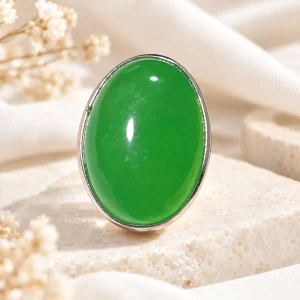
Green Jade Ring, a Jadeite Cabochon
52,90 € Choose a size -
Jade and Gold Ring, a Green Jadeite Cabochon
67,90 € Choose a size -
Jade and Sterling Silver Ring, a Bezel Set Band
64,90 € Choose a size -
Jade Band Ring, Solid Nephrite Carved in the Round
44,90 € Choose a size -
Jade Cabochon Ring, an Oval of Jadeite
47,90 € Choose a size -
Jade Flower Ring, Two Carved Blooms Side by Side
50,90 € Choose a size -
Jade Ring for Women, a Fine Sterling Silver Band
52,90 € Choose a size -
Jade Signet Ring, an Oval Green Jadeite Cabochon
64,90 € Choose a size -
Lavender Jade Ring, a Solid Band
50,90 € Choose a size -
Men’s Jade Ring, a Wide Sterling Silver Band
57,90 € Choose a size -
Oval Green Jade Ring in a Silver Tone Mount
40,90 € Choose a size -
Real Jade Ring, Jadeite or Nephrite
44,90 € Choose a size -
Square Jade and Coral Ring in Chased Silver Tone
50,90 € Choose a size -
Water Green Jade Ring in Openwork Silver Tone
40,90 € Choose a size -
White Jade and Gold Ring with a Small Set Flower
40,90 € Choose a size -
White Jade Ring, a Solid Nephrite Band
62,90 € Choose a size
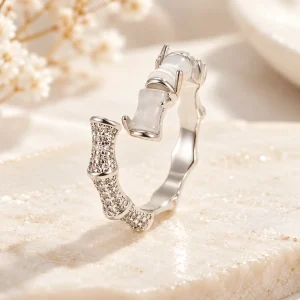
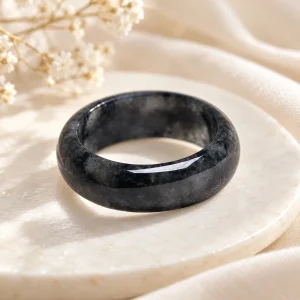
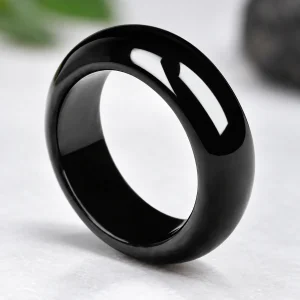
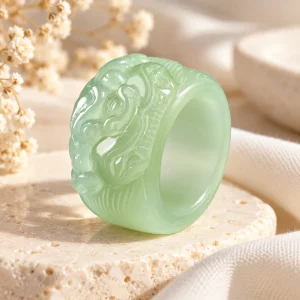
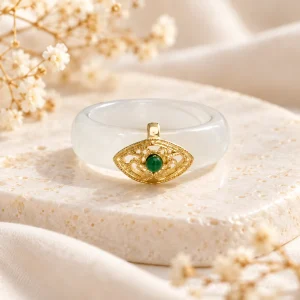
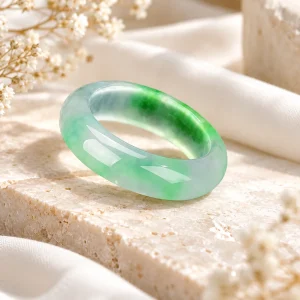
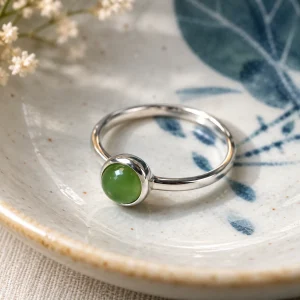
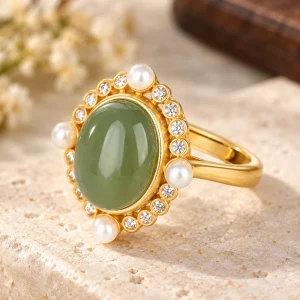
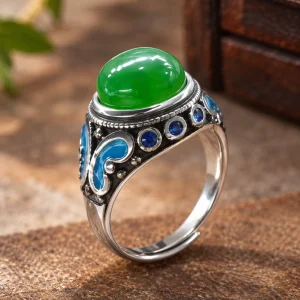
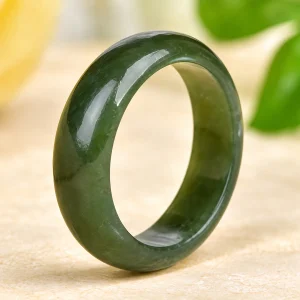
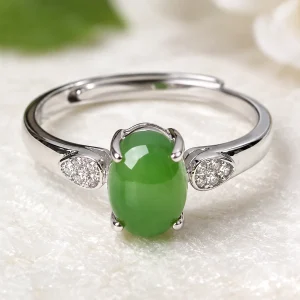
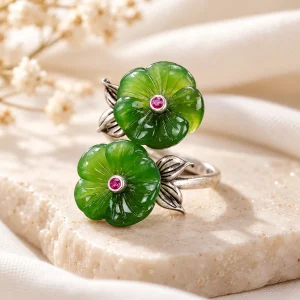
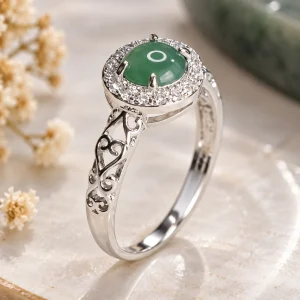
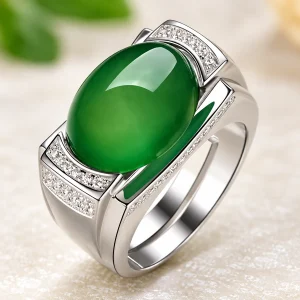
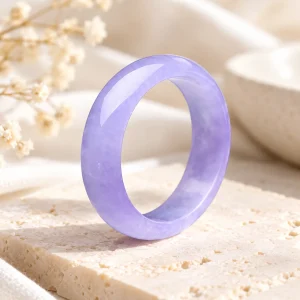
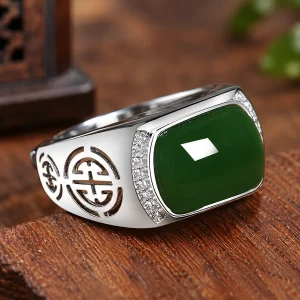
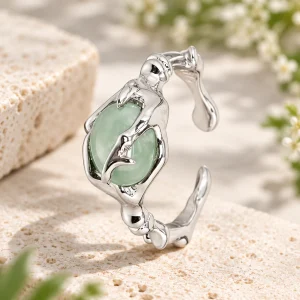
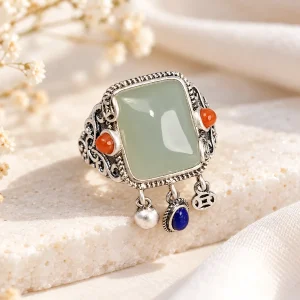
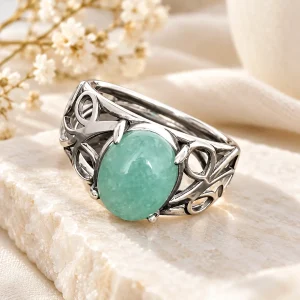
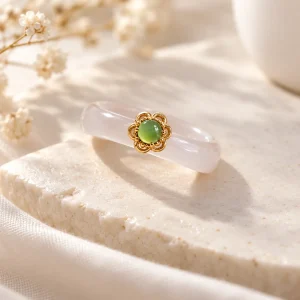
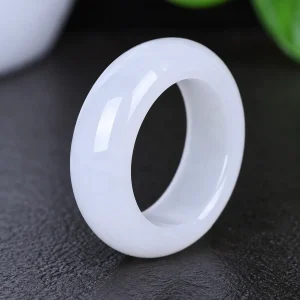
Cabochon, or a band carved from the block
Two mechanics, and they have almost nothing in common.
- The set cabochon
- A domed stone resting on a metal setting. The dome does all the work: the green deepens at the centre and lightens at the edge, and it changes with the time of day. The metal protects the rim, which is the fragile part.
- The solid band
- The whole ring is carved from a single block of jade. No metal, no setting, nothing to snag. It is the most demanding form to wear, and the only one that can never be recut.
A third form exists here, the bezel set band: a metal rim that grips the stone all the way around. It sits between the two, and it is the one I would recommend to anyone who wears a ring every day.
A solid jade band cannot be resized. Neither enlarged nor reduced: jade is too tough to be cut open and soldered back like a metal. The measurement happens beforehand, and it takes two minutes.
In Europe, a ring size is the inner circumference in millimetres: a size 52 measures 52 mm around.
The green, and what makes it change
The green does not come from the same element in each species. In jadeite, the clean vivid green comes from chromium; in nephrite, from iron, which gives the darker, more closed greens. Two equally green rings will therefore not look alike.
On a cabochon, the cut matters as much as the colour. A high dome pulls the eye to the centre and lightens the edges; a flat table with sharp angles darkens the corners. It is visible to the naked eye, and it is why one stone can read as two different greens depending on how it was cut.
There is also a nephrite white here, called mutton fat, and a black that opens into bottle green the moment you turn it toward the window. Jade is not only green, and white is the shade dyed quartzite imitates best.
Silver, gold, and what a metal does to the green
Sterling silver underlines the green without warming it: it is the most neutral metal, and it does not green the finger. Gold plating pulls the green toward the warm side, and suits deep greens better than water greens.
Plated is written plated, on the product page as here. You will never read “gold” on its own on a piece that is not. What gold changes in the way the stone is seen.
Silver darkens over time: that is normal oxidation of the metal, it comes off with a cloth and has nothing to do with the stone. It is not a defect, and for that reason the legal warranties do not cover it.
Genuine, and how I make sure
What is sold under the name jade is very often serpentine or dyed quartzite, under labels that sound serious: “new jade”, “Malaysia jade”, “Korean jade”. None of them means jade.
On a ring the check is harder than elsewhere, because the metal skews the measurement. So I weigh the bare stone of the example, before it is set, when the supplier sends it to me that way. When it reaches me already mounted, I publish no figure at all: writing the gap is better than a plausible value.
| Material | Density |
|---|---|
| Jadeite | 3.25 to 3.36 |
| Nephrite | 2.90 to 3.03 |
| Serpentine | about 2.6 |
| Quartzite, dyed or not | about 2.65 |
The method and its three limits, and how to check a ring you already own.
What that figure does not say: the treatment. A jadeite bleached and then impregnated with resin is still a jadeite, and the resin does not change the mass enough to show. My supplier does not know the status of their stock.
So you will never read “grade A jadeite”, “type A” or “untreated” on these pages: the status is not determined. The information sheet explains it in full.
What sets the price of a jade ring
Neither the size of the stone alone, nor the metal. What you pay for, in order: translucency, meaning how far light travels inside the material, then the evenness of the colour, then the fineness of the grain and the quality of the polish. The species counts too: a jadeite costs more than a nephrite of comparable quality.
A high domed cabochon costs more than a flat table of the same surface, because it takes more material and because the orientation of the cut decides the result. The criteria, one by one, and what explains the spread in market prices.
Wearing it without damaging it
The hardness of jade is ordinary, 6 to 6.5 for nephrite and 6.5 to 7 for jadeite, and the quartz in household dust sits at 7. A ring therefore scratches faster than the rest of your jewellery, because it is the piece that touches everything.
- Take it off for housework, gardening and sport. This is not a style precaution: that is exactly where corner knocks happen.
- Lukewarm water and a mild soap. Never ultrasound, never steam, never solvent, since the treatment status is unknown.
- Store it alone in its pouch. Why one pouch per piece.
What follows changes register, and I flag it rather than blending it into the rest. Nothing here is demonstrated: it is what traditions have attributed to this stone.
The jade ring worn on the right hand, the choice of finger, the meaning given to a stone received as a gift: these usages are old and documented. What tradition puts into jade.
Frequently asked questions
Which ring size should I choose?
The European size is the inner circumference in millimetres: a 52 measures 52 mm around, about 16.5 mm across. Wrap a strip of paper around the base of the finger, check that it passes the knuckle, then measure its length. Measure at the end of the day, never first thing in the morning. The full method.
Can a jade ring be enlarged?
Not if it is carved from the block: jade cannot be opened and soldered back. A metal setting can sometimes be adjusted by a jeweller, but that is not a service I offer. If the size you receive does not fit, the right of withdrawal applies as for any distance purchase.
Are your rings genuine jade?
The mineral is named on every product page, jadeite or nephrite, and the density is published with its date whenever the stone reached me bare. A piece that was neither jadeite nor nephrite would carry its true mineral name and the word jade would not appear in its title. How I measure.
Will the silver darken?
Yes, that is normal oxidation of sterling silver, and it comes off with a jewellery cloth. It does not affect the stone. Avoid liquid silver dips, though, which can reach the jade: with the treatment status unknown, no solvent is risk free.
Jadeite or nephrite for a ring?
Jadeite is slightly harder and more translucent, which suits a cabochon. Nephrite is tougher, so it is safer as a solid band carved from the block. They are two unrelated minerals, separated in 1863. What tells them apart.
Can a jade ring be worn every day?
Yes, provided you take it off for the tasks that knock. Jade takes impact better than most stones, but its polish scratches and a thin rim chips. On a solid band, that is the only real risk.