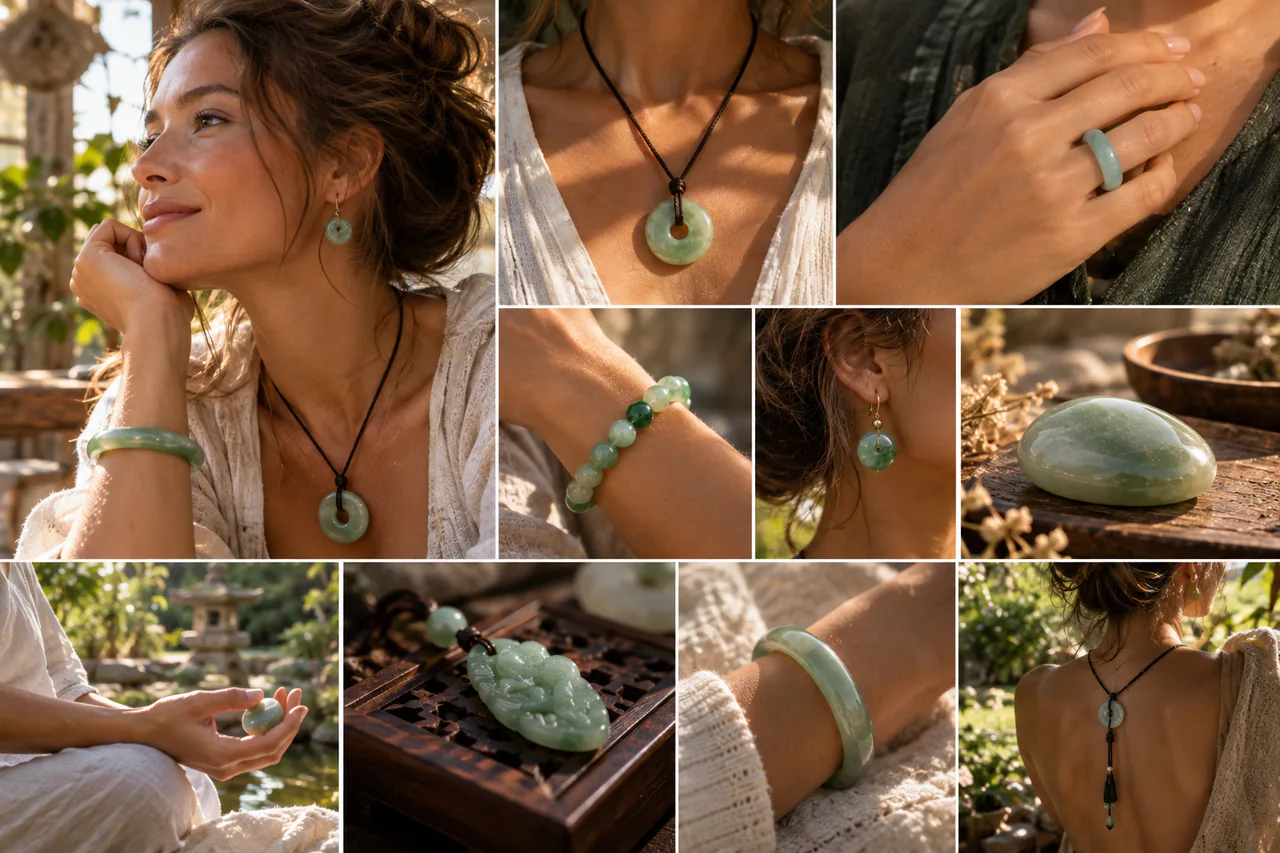
How to Use Jade Stone, and How to Wear It
How to use jade stone when you wear it as jewelry: what water changes, what perfume leaves behind, what is better taken off before sport, what you keep on or not for sleeping, and the case of the bangle, which does not come off.
A piece of jade jewelry is used by wearing it, and almost everything else in the question is a matter of the setting rather than the stone: jadeite and nephrite fear very little, while the metal, the thread and the glue holding them fear chlorinated water, salt and products.
If you came here for the massage roller or the gua sha, this is not the page: those objects have a material of their own, which is not always jade, and I weighed them in jade roller and gua sha. Here, I answer as a jewelry workshop, and a jewelry workshop has only one answer to give.
My name is Jade. I choose jade pieces, have them set, and weigh one example of each reference before it goes on sale. I am neither a gemologist nor a therapist: what follows describes what water, salt and products do to materials, and nothing else.
Water: the shower, the pool, the sea
I start here because the usual answer, take it off, does not say what is being protected from what. Clear water does nothing to the stone: neither jadeite nor nephrite absorbs it. What it reaches is what surrounds them, the metal, the thread, the glue under a cabochon. The two minerals are covered on the jade stone page.
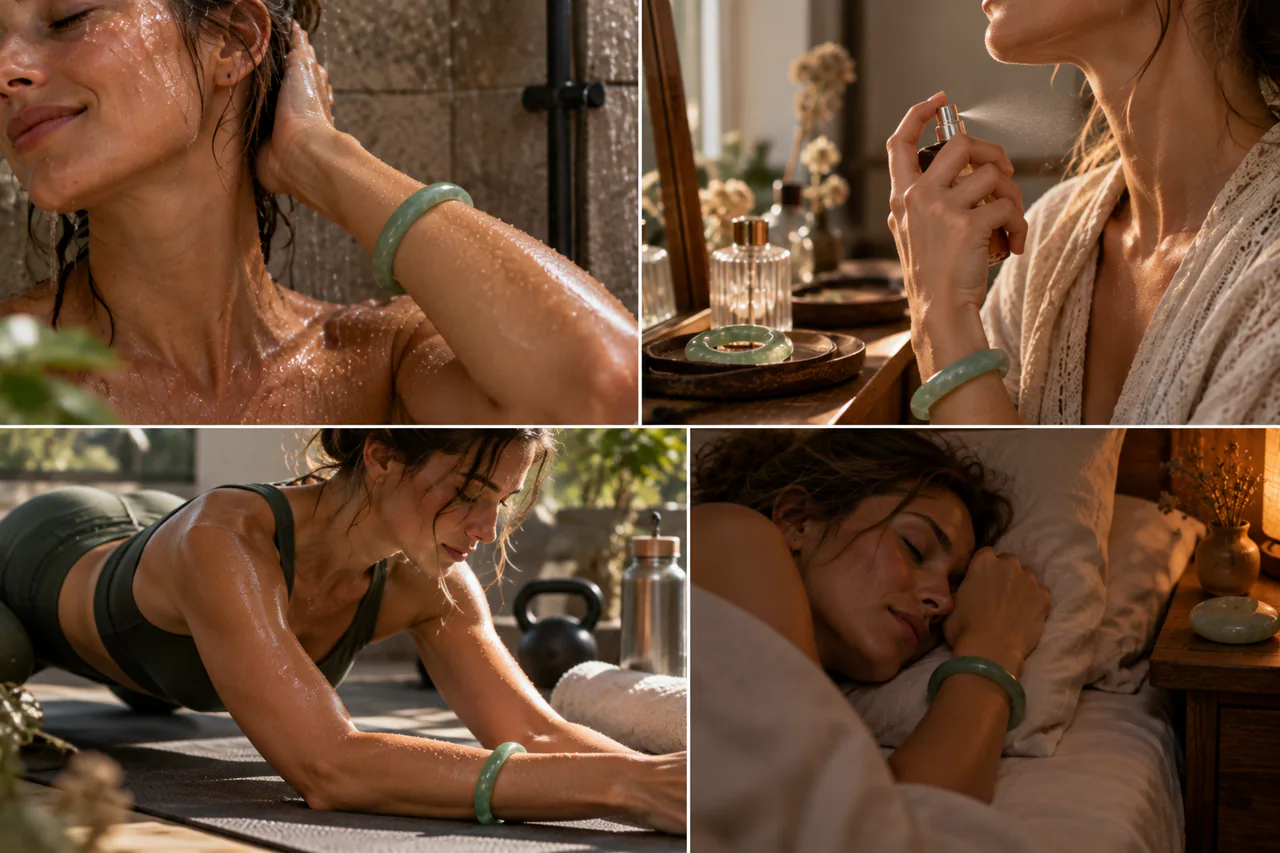
In the shower, the problem is not the water but the shower gel and shampoo, which leave a film in the recesses of a bezel and in the drill hole of a bead. That film does not show on the first day; it shows a few weeks later, when the piece has lost its luster without having been scratched.
At the pool, chlorine attacks 925 silver: it tarnishes it by forming silver chloride, and a fine chain darkens faster than a solid bangle. Gold alloys are not out of reach either, since 18 karat gold contains copper and silver as well as gold. In a chlorinated pool, then, it is the metal that pays, not the stone.
At the beach, two things happen at once. Salt stays in the recesses when the water evaporates, and it crystallizes where it stayed, in a glued joint, under a prong, in the knots of a strand. And sand is quartz, harder than jade: it is the sand that scratches, not the wave (hardness and toughness of jade).
The rule I apply fits on one line: if the piece has been in chlorinated or salt water, I rinse it in clear water and dry it straight away, instead of letting it dry on its own.
One thing I do not know, and would rather put in writing: what a daily shower does over ten years to a piece impregnated with resin. I do not know whether mine are, nor does my supplier, and only infrared spectroscopy would settle it: jade A, B, C, treatment information sheet.
Perfume, cream and hairspray
The stone itself copes very well with perfume. What builds up is a deposit: the alcohol evaporates, the oils and fixatives remain, and they remain where you cannot see them, around a setting, in a drill hole, between two beads. On a textile thread, it is this deposit that turns the thread gray long before it wears out.
The order is enough to settle the question, and it costs nothing. In the morning, the jewelry goes on last, once perfume, cream and hairspray are dry. In the evening, it comes off first. Sunscreen deserves a separate mention: it is greasy, it clings, and sand sticks to it. For the actual washing, the method is in how to clean jade.
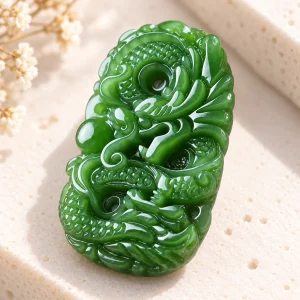
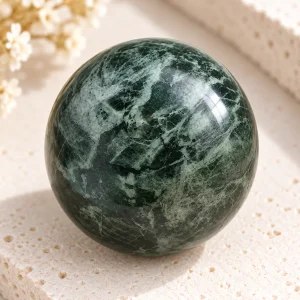
Jade objects available now
Sport, housework, gardening
Three situations people lump together out of habit, even though they do not attack the same thing.
- Sport. Sweat is salty and slightly acidic: that is where silver tarnishes fastest. Add impacts to that. Jade is very tough, which is not the same as invulnerable, and a bangle that hits a cast iron bar can break: a jade bracelet that breaks.
- Housework. Bleach is chlorinated, and heavy-duty cleaners attack metals. Gloves are enough, if you would rather not take the piece off.
- Gardening. Soil is abrasive because it contains sand, and it lodges under a set stone. This is the case where I take it off without hesitation.
Sleeping with it, or taking it off at night
The stone has no reason to suffer at night. The risk is mechanical: a ring that knocks against the bed frame, an earring that catches on the pillow, and above all a strand of beads pulled by the sheet, which strains the thread without your seeing it (the thread and cord of a jade piece). So I keep on what has nothing to catch, a bangle, a simple ring, and take off the rest, into a place of its own rather than in with the other jewelry.
The bangle, which does not come off
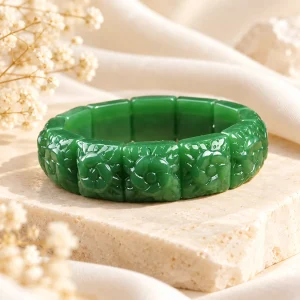
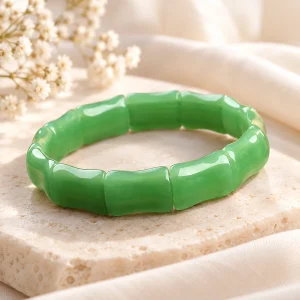
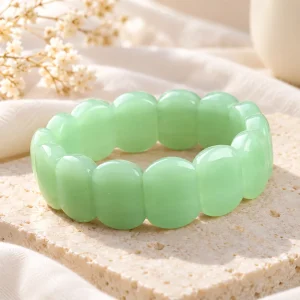
The bangle is the format unique to jade, because the toughness of the material allows a solid ring carved from a single block. It has no clasp, no thread, no glue, no metal. In other words, it has none of the things that, in the rest of this page, fear water. The format you cannot take off is also the one water troubles least, and that is good news rather than a coincidence.
With a bangle, then, the shower question is not theoretical, and the answer is simple: you shower with it on, rinse it in clear water when gel has run over it, and wipe it dry. What threatens it lies elsewhere, and is of two kinds: everyday knocks, a door frame, a car door, the edge of a desk, and beach sand, which scratches a bangle just as it scratches any other stone.
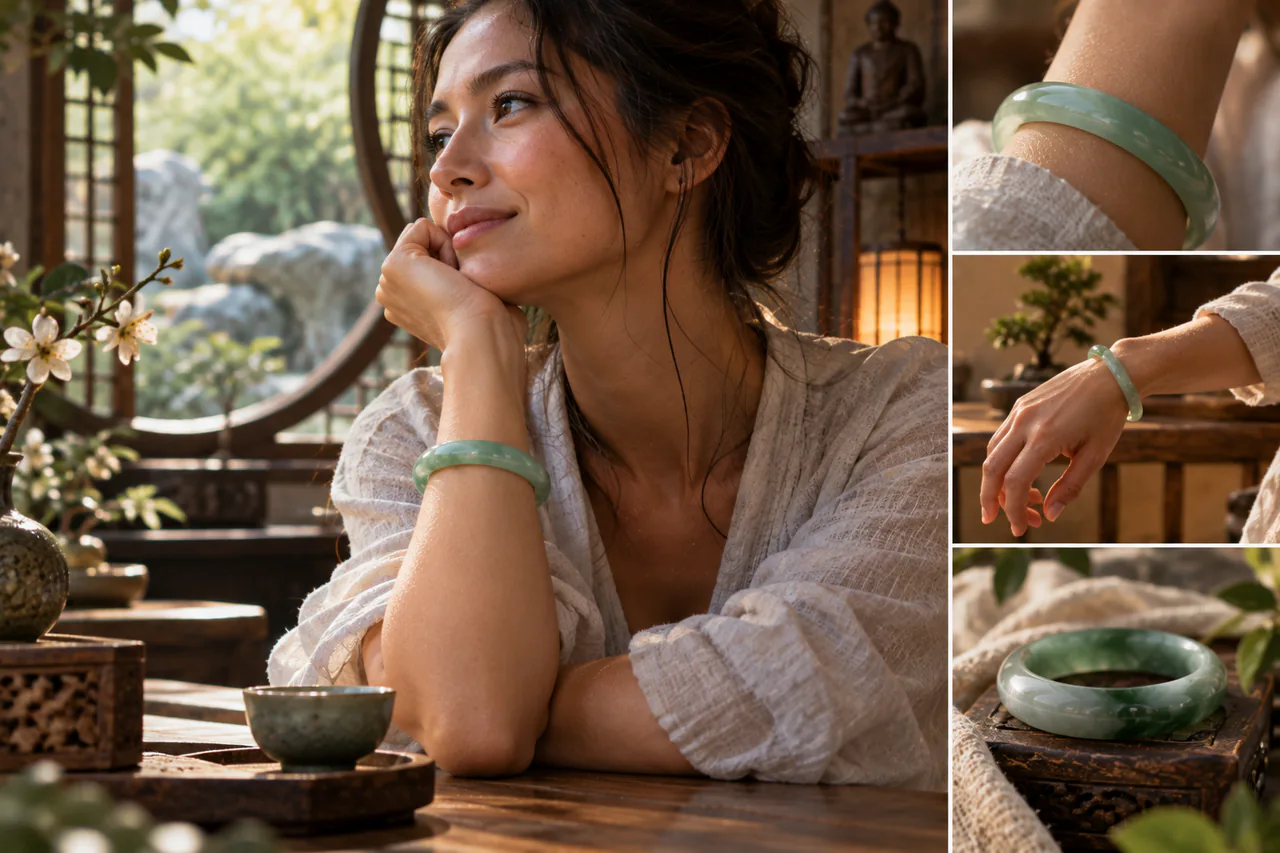
That leaves the real difficulty of the bangle, which is its size. A hand swells with heat, effort and salt, and a bangle that slid on in the morning may refuse to come off in the evening. Do not force it: cold water, a little soap, the hand folded into a cone, and it either passes or it does not. Measuring before you buy avoids most of the problem, and I explain how in measuring your wrist before buying a bangle and in the size guide.
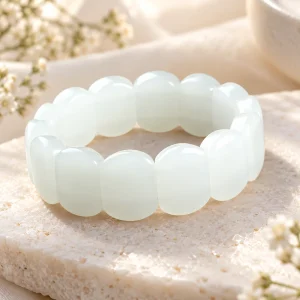
Bracelets whose density I publish
What each setting fears
Since the setting is what decides, I might as well go format by format.
- The solid bangle fears only impacts and its own size.
- The ring fears impacts too, because hands knock into things, and soap that settles under the bezel.
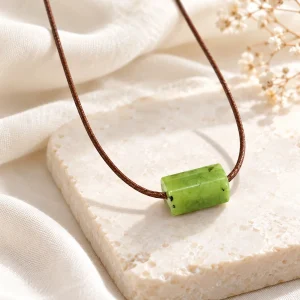
- The pendant on a cord fears for its cord: that is what gives way, and it gives way from rubbing against the bail.
- The strung strand fears for its thread, and fears water and stretching. That is also why I do not publish a density for a strand: the thread enters the measurement and skews it, as the weighing page explains.
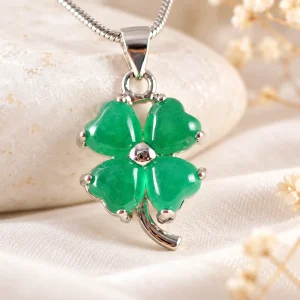
- The set or glued piece fears salt and repeated soaking.
A word on longevity, since jade stands up to daily wear better than most stones. What wears is not the piece but its polish: ordinary dust contains quartz, harder than both jades, and a dry cloth wiped over a dusty piece therefore rubs quartz against jade. A damp cloth first, a dry one after: storing a jade piece.
What not to do to rescue it
A tarnished piece makes you want a drastic fix, and that is where jades get ruined. No ultrasound, no steam. As long as a piece’s treatment has not been determined, you have to assume it contains resin, and resin withstands neither the cavitation of an ultrasonic tank nor the thermal shock of a jet of steam. I do not know the status of mine, and I say so again rather than leave you to guess.
What works is more boring and is enough: lukewarm water, mild soap, a soft cloth, immediate drying (how to clean jade). If the word you were looking for was charge rather than clean, it covers two very different gestures, which I separate in how to charge a jade stone.
The other meaning of the word use
What follows changes register, and I flag it rather than blending it into the rest. Nothing in it is proven: it is what traditions have attributed to this stone.
Some of the people searching for how to use jade stone are not asking how to wear it, but what it is supposed to be for. Traditions are said to have given it uses, placing it on the body, keeping it close, putting it under the pillow, and contemporary authors repeat them. These are attributions, they are reported as such, and a care page is not the place to expand on them: they are gathered in what tradition attributes to jade stone.
What I will not write, here or anywhere else: that a piece of jewelry heals or protects. And yet the word jade comes from a 16th century promise of healing, and that is exactly what I do not sell.
The questions I get asked
Can you keep a jade bracelet on in the shower?
For a solid bangle, yes: it has no metal, no thread, no glue. Rinse it in clear water if gel has run over it, and wipe it dry. For a strung strand or a set piece, better to take it off: it is the thread and the glue that suffer, not the jade.
Should you take it off for the pool or the beach?
Yes, for two different reasons. In a pool, chlorine tarnishes 925 silver and attacks the copper in gold alloys. At the beach, salt stays in the recesses as it dries, and sand, which is quartz, scratches the stone. If the piece has been in the water, rinse and dry it straight away.
Can you sleep with jade jewelry on?
The stone does not care. The risk is mechanical: a strand of beads pulled by the sheet strains its thread, an earring catches, a ring knocks against the bed frame. I keep on what has nothing to catch, a bangle or a simple ring, and take off the rest.
Does perfume damage jade stone?
Not the stone. What happens is a deposit: oils and fixatives stay around the setting and in the drill holes, and they turn a textile thread gray. Put the jewelry on last in the morning, and take it off first in the evening.
What is jade stone used for?
For making jewelry, and that is a workshop’s answer. Historically, it was used for tools before ornaments, because its toughness held an edge, and then for ritual objects. The uses traditions have attributed to it are of another order, reported and not proven: they are in what tradition attributes to jade stone.
Can I clean my jewelry in an ultrasonic cleaner?
No, and this is the point on which I do not compromise. As long as you do not know whether a piece is impregnated with resin, the ultrasonic tank and the steam jet are ruled out: resin withstands neither. Lukewarm water, mild soap, a soft cloth.
Where I checked
What comes from a named source. The hardness of quartz, 7, and those of the two jades, nephrite 6 to 6.5 and jadeite 6.5 to 7, are those of the standard mineralogical literature: I repeat them, I did not measure them, and I do not attribute them to any particular body because I did not take them from a single one. The action of chlorine on silver is basic chemistry, and I give the mechanism without citing a laboratory I have not consulted. The etymology of the word jade, from the Spanish piedra de la ijada, follows the entry in the Dictionnaire de l’Académie française.
What is a dated observation. On September 8, 2026, my supplier confirmed to me that they cannot say whether their goods are impregnated: that is why this page forbids ultrasound instead of merely advising against it. The same day, I looked at what the first page of French results offers for the query “comment utiliser la pierre de jade”: massage roller pages and crystal healing pages, and no guide to wearing a piece of jewelry.
What is my own reasoning. Sorting by setting rather than by situation, the idea that salt crystallized in a glued joint works on it with each cycle of soaking and drying, the morning and evening order: these are deductions about materials, not measurements. I have not followed a piece over ten years, and I do not let anyone believe I have. If you find a mistake here, write to me: I will correct it and note that I did.
In one sentence
How to use jade stone comes down to wearing it, protecting not the stone but what holds it, and the format that shows this best is the bangle, which you never take off and which has no clasp, thread or glue to look after. The pieces are in the shop, and the method that names them is on the weighing page.