Jade Objects
Rollers and gua sha, pebbles, spheres, carved figures, a bare cabochon and a rough block. Nine objects that are not jewelry, and whose mineral is named like everything else.
This is the section where serpentine and dyed quartzite are the market norm. So it is the one where naming the material changes the most.
AffinerStoneColorStone shape+5
Showing all 9 results
-

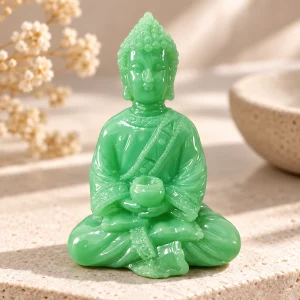
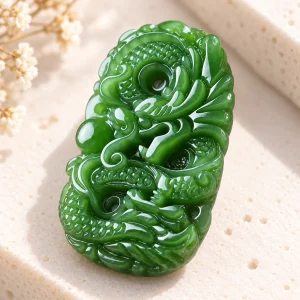
Jade Figurine, a Carved Subject
67,00 € Add to cart -
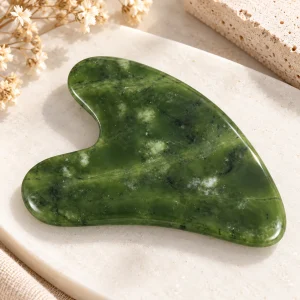
Jade Gua Sha, a Polished Nephrite Plate
34,90 € Add to cart -
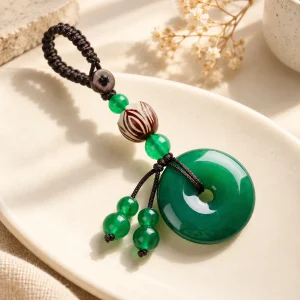
Jade Keychain, a Pierced Nephrite Disc
34,90 € Add to cart -
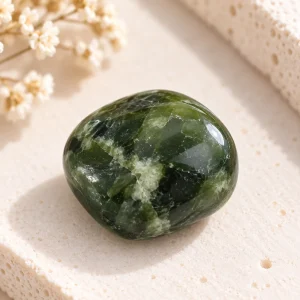
Jade Pebble, Tumbled and Polished Nephrite
37,90 € Add to cart -
Jade Pi Xiu, Carved and Pierced Nephrite
47,90 € Add to cart -
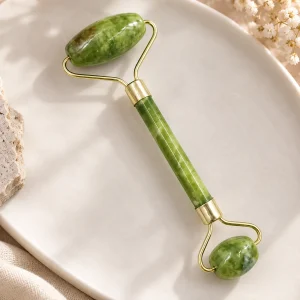
Jade Roller in Green Nephrite
27,90 € Add to cart -
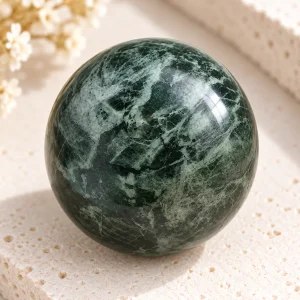
Jade Sphere, Nephrite Polished from One Block
42,90 € Add to cart -
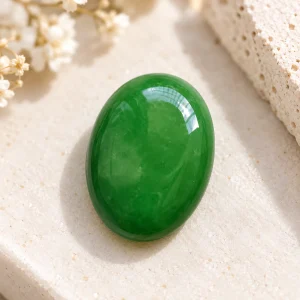
Loose Jade Cabochon in Green Jadeite
32,90 € Add to cart -
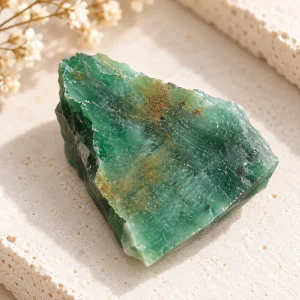
Raw Jade, an Uncut Block of Nephrite
42,90 € Add to cart
Why this is the section where you get cheated most
On a piece of jewelry the material is expensive and the piece is small: the temptation to cheat exists, but it costs something. On a facial care object sold for a few euros, it is the rule rather than the exception.
A roller advertised as “jade” at a very low price almost never is one. What you find instead, in order of frequency: serpentine, under the names “new jade” or “Korean jade”, dyed quartzite, under the name “Malaysia jade”, and sometimes plain glass. None of these labels means jade.
This is not a matter of vocabulary. French decree no. 2002-65 covers the trade in gemstones, not the shape given to the object: a roller sold under the name jade falls under it exactly like a ring. What the text actually says.
What to look at before buying a roller or a gua sha.
What I measure, and what it is worth here
These objects are, paradoxically, the easiest in the whole catalog to verify: they are large, they are bare, and nothing skews the scale. No setting, no thread, no clasp.
| Material | Density |
|---|---|
| Jadeite | 3.25 to 3.36 |
| Nephrite | 2.90 to 3.03 |
| Serpentine | about 2.6 |
| Quartzite, dyed or not | about 2.65 |
A kitchen scale, a thread and a glass of water are enough, and a pebble of several tens of grams gives a far sharper figure than a bead. You can redo the measurement at home on the object you receive, and that is the best use I can imagine for it. The method, with its three limits.
What that figure does not say: the treatment. A jadeite bleached and then impregnated with resin is still a jadeite, and the resin does not change the mass enough to show. My supplier does not know the status of their stock.
The treatment status of these nine pieces is therefore not determined, and you will read neither “grade A jadeite”, nor “type A”, nor “untreated” here. The information sheet explains it in full.
Rollers and gua sha, and what I will not say about them
A jade roller is a polished stone mounted on an axle; a gua sha is a plate of stone polished on both faces. What I can write about them comes down to three verifiable facts:
- the stone is cool to the touch and slow to warm up, because jade conducts heat poorly. It is the only physical property that explains the sensation people describe;
- it is polished with no sharp edge, which is what makes it glide without catching;
- it is tough, so it takes knocks better than a stone with cleavage. The difference between hardness and toughness.
What follows changes register, and I flag it rather than blending it into the rest. Nothing here is demonstrated.
Gua sha is a documented practice of traditional Chinese medicine, and the jade roller belongs to an old history of facial care. I report these usages because they exist, and I draw no promise from them: I attribute to these objects no effect on the skin, on circulation, on the features or on anything else. They are objects of polished stone.
One precaution that follows from the unknown treatment status: never put these objects in the refrigerator or under hot water. If the stone has been impregnated with resin, temperature cycles do it no good, and it is a use many people recommend without knowing.
The carved pieces, and the forms they take up
The Pi Xiu and the carved figures take up old motifs of Chinese culture, whose meanings are documented and often debated. They are looked at as objects, and the carving counts as much as the material: the hollows keep the dark green, the polished reliefs give back an almost greasy light.
What the motifs mean, and the history of jade in China, where nephrite has been worked since the Neolithic.
The bare cabochon and the rough block, and why they are here
Two pieces in this section serve no purpose, strictly speaking, and that is exactly why they are here.
- The unmounted cabochon
- A domed, polished stone, with no claw and no setting. It is the shape the scale works on best, and the one I would recommend to anyone who wants to check my method before buying a piece of jewelry.
- The rough block
- An uncut nephrite, opened on one face only. The skin is dull and gray, and the green appears only at the break: it is the best demonstration of how difficult jade extraction is, and of why you only know what a block contains after opening it.
How jade forms, and where it is found in the world.
Caring for a jade object
The hardness of jade is ordinary, 6 to 6.5 for nephrite and 6.5 to 7 for jadeite, and the quartz in household dust sits at 7. A pebble kept in a pocket slowly loses its polish, which is not a defect but wear.
- Lukewarm water, a mild soap, a soft cloth, a very soft brush for the hollows of a carving. The detail.
- Never ultrasound, never steam, never solvent, and no sudden change of temperature.
- On a roller, the axle and the fitting wear out before the stone: check the play from time to time, and do not overtighten.
- An object left in a drawer with others arrives scratched. One pouch per piece.
Frequently asked questions
How can I tell whether a jade roller is really jade?
Weigh it. It is the easiest object to verify: it is large, it is bare, and its density separates a nephrite at 2.95 from a serpentine at 2.6 without ambiguity. A kitchen scale, a thread, a glass of water. The method, and what else to look at.
Does a jade roller have an effect on the skin?
I have no idea, and I do not claim to. What I can write is physical: the stone is cool and slow to warm, it is polished with no edge, it is tough. Everything else belongs to tradition, which I report without turning it into a promise. The full disclaimer.
Should a roller be kept in the refrigerator?
I advise against it, for a precise reason: the treatment status of these pieces is not determined, and if the stone has been impregnated with resin, temperature cycles do it no good. The stone is already cool by itself. Why I cannot know.
Why sell rough jade?
Because it shows what no photo of a piece of jewelry shows: a dull gray skin, and the green appearing only at the break. It is the best explanation of why jade is hard to buy, including for the people who extract it. How it forms.
Are these objects subject to the same rules as jewelry?
Yes. French decree no. 2002-65 covers the trade in gemstones and not the shape of the object: a gua sha sold under the name jade falls under it exactly like a ring, and the treatment information sheet covers them the same way. The sheet.
Jadeite or nephrite for an object?
Nephrite, almost always, and for a practical reason: it is tougher, so safer on a piece you handle, and it is found in larger blocks. Gem jadeite goes into jewelry, where its translucency commands a price. What tells them apart.