Storing Jade Jewelry: What Really Scratches It
Storing jade jewelry calls for a precaution I have not read on any of the care pages I opened: ordinary dust is harder than the stone. This page covers storage, travel and contact with other jewelry, from the pouch that comes with the order to the bangle you take off to sleep.
What scratches jade jewelry is not an impact, it is quartz: it rates 7 on the Mohs scale, jadeite 6.5 to 7 and nephrite 6 to 6.5, and quartz is everywhere, in the dust on a shelf as in the sand on a beach. A dry cloth wiped over a dusty piece scratches, a pouch shared with other jewelry scratches, the bottom of a bag scratches.
| Material | Hardness, Mohs scale |
|---|---|
| Quartz, the kind in dust and sand | 7 |
| Jadeite | 6.5 to 7 |
| Nephrite | 6 to 6.5 |
This advice goes against jade’s reputation, and the reputation is not wrong for all that: it is about something else. Hardness measures resistance to scratching, toughness measures resistance to breaking, and jade is moderately hard and remarkably tough. That is why people dare carve a bangle from a single block, and it is also why jade gets stored badly, by people who think nothing can harm it: why jade almost never breaks.
My name is Jade, and I run a jade jewelry workshop: I choose the pieces, have them set, and weigh one example of each reference before it goes on sale. I am not a gemologist or a therapist, and what follows rests only on published mineralogy and on what I observe on my own pieces.
The quartz in dust is harder than jade
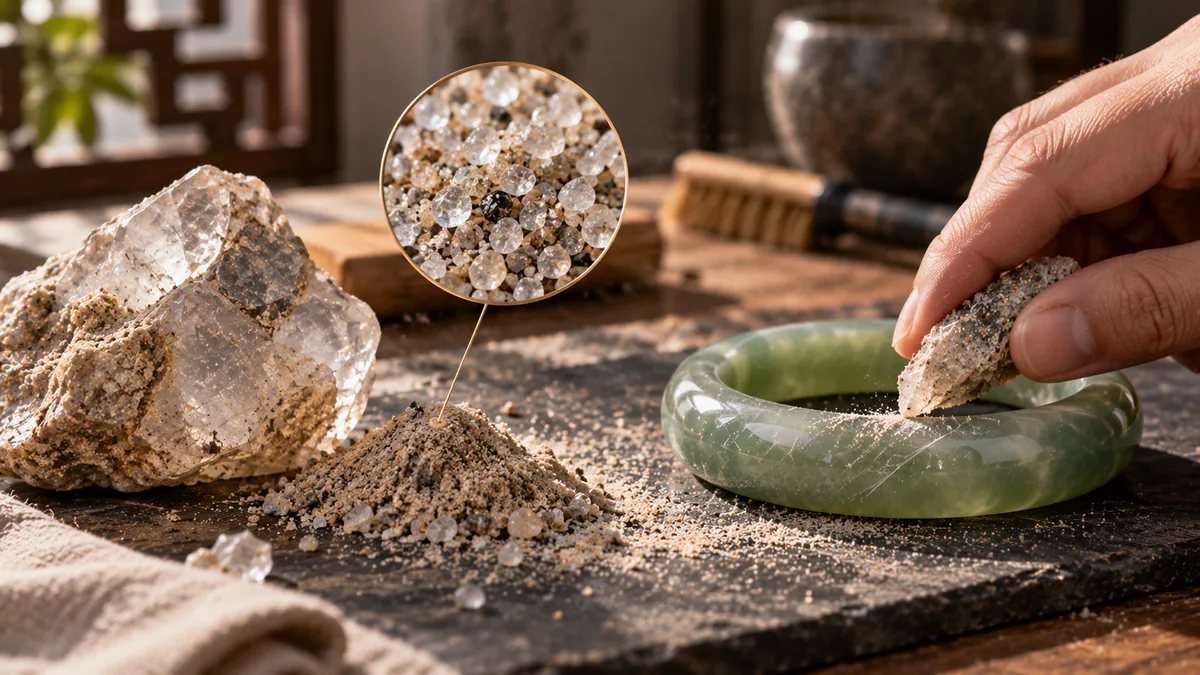
Household dust is not made only of fibers and skin. It contains mineral particles brought in from outside, on shoe soles and through windows, and quartz is one of the most common minerals on the Earth’s surface. A shelf, the bottom of a drawer, the top of a nightstand all carry it.
A scratch is not a spectacular accident: it is a particle harder than the surface, dragged across it under light pressure. One grain and one movement are enough. The whole question of storage comes down to that and nothing else: avoiding dry friction between the stone and a surface that has gathered dust.
The two jades are not in the same position. Nephrite sits clearly below quartz, jadeite almost matches it: with equal wear, a nephrite loses its polish before a jadeite does. You still need to know which one you have, and neither the color nor the price tells you. That is what my scale settles, and the protocol is published on the weighing page; the split between the two minerals is explained on jade stone.
The dry cloth, the habit that damages without showing
It is a common habit, and it works against the stone: picking up a piece that has sat out for a few days and rubbing it with a dry cloth to bring back its shine. The dust caught in the fibers does not fly away; it is pressed against the stone and dragged across it. The cloth becomes a polishing compound whose abrasive you did not choose.
The rule is simple: lift the dust off before touching the stone. A rinse in lukewarm water, or a properly damp cloth, or nothing at all. A dry cloth is only for drying a piece that is already clean, and only by patting.
Full washing, setting by setting, is not the subject of this page: it is detailed in how to clean jade stone. Two prohibitions serve as a summary here: no ultrasonic cleaner and no steam, as long as the piece’s treatment has not been determined.
The jade rings available now
The gift pouch, the bottom of the bag, the toiletry case
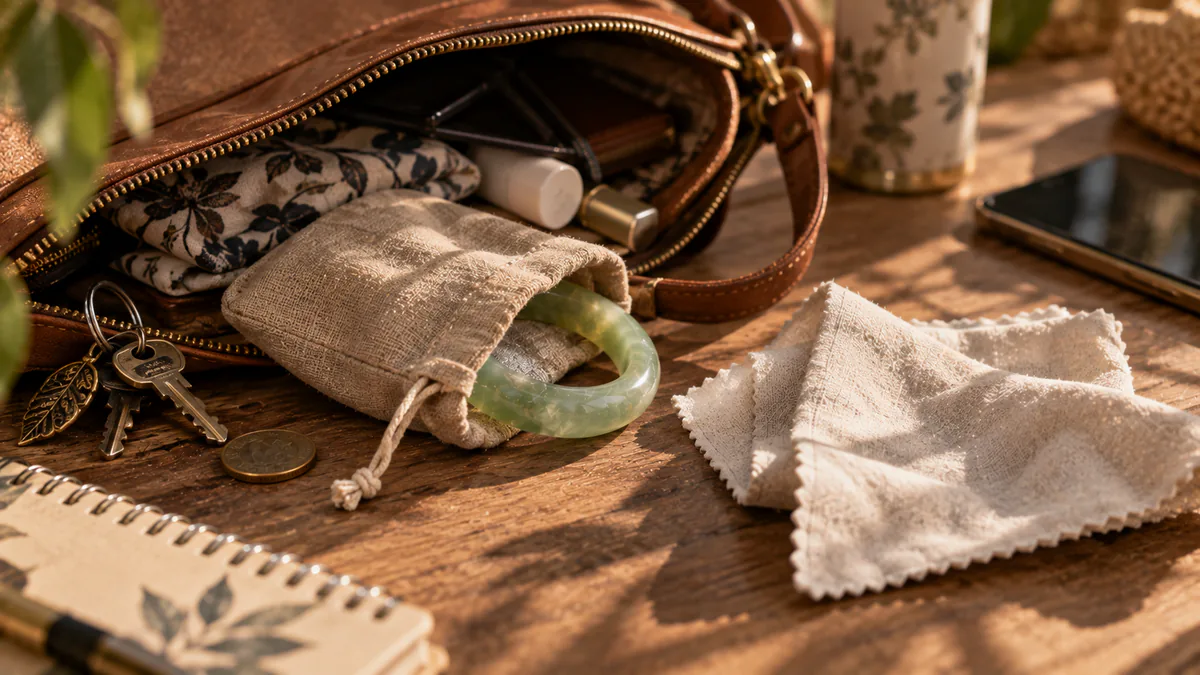
The little organza pouch that comes with a lot of jewelry protects against a knock but not against a scratch. Its mesh is open: it lets dust in, and keeps it. Stored at the back of a drawer, that pouch is not a barrier, it is a reservoir.
The bottom of a handbag is worse, and it gathers everything that scratches: keys, sand, tiny bits of gravel, coins, and the constant movement of walking. A toiletry case adds products to the friction. Jade jewelry has no business in either, not even for an hour.
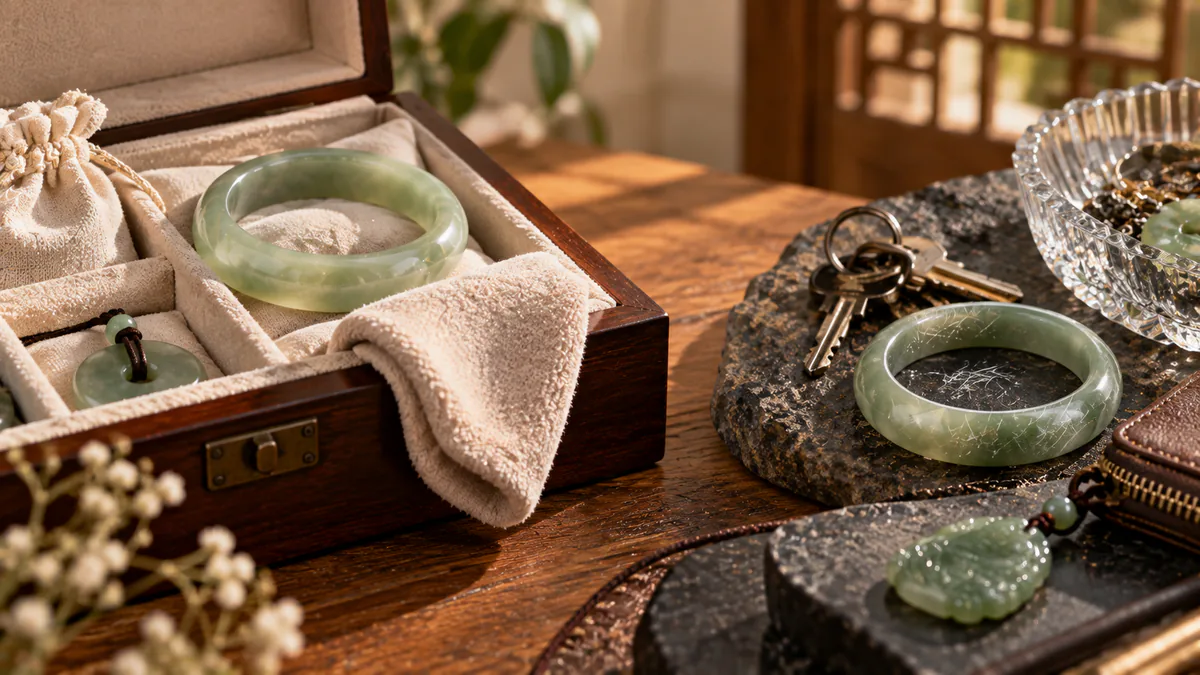
What I do at home comes down to three points: one soft pouch per piece, in a tightly woven fabric rather than an open one, closed; one closed container for the whole lot, rather than an open catch-all tray; and dusting the inside of the container now and then, because dust gets in anyway.
I will not name any brand of box or any care product: I do not sell these items, I have not compared them, and a recommendation I have not tested is worth nothing. What matters is the material and the closure, not the label.
Contact with other jewelry
The reflex is to fear metal. It is the wrong suspect: jewelry gold and silver are clearly softer than jade; they get marked rather than scratch, and they are the ones that suffer from contact.
The real culprits are other stones. Everything in the quartz family rates 7: amethyst, citrine, rose quartz, aventurine. Above that, the topazes, sapphires and diamonds on a ring are harder still: contact always works against the jade. And there is one special case I find rather delicious: a fake jade made of dyed quartzite scratches real jade, precisely because it is quartz. The list of stones sold under the name jade is in jade’s false names.
Two mechanical details often go unnoticed: the clasp of a chain, a small hard part that wanders around a drawer, and a pouch zipper the stone presses against. None of this is dramatic once; all of it counts over five years.
The conclusion works both ways. Jade stored loose also damages what surrounds it: it is harder than the pearls, amber and opals in the same box. Keeping pieces apart protects them all, and that is the advice I put before every other.
Bracelets whose density I publish
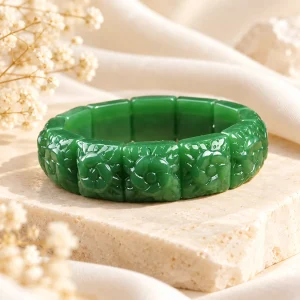
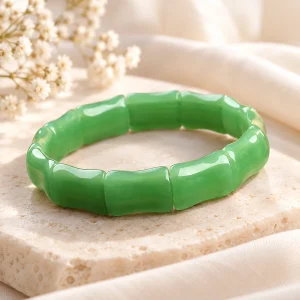
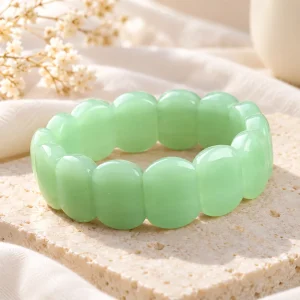
Where to set a piece down at home
Two places come up in almost every broken-jewelry story I am told: the edge of the bathroom sink and the edge of a table. They combine height, a slippery surface and a hard floor. Jade’s toughness absorbs impacts remarkably well, but it makes nothing unbreakable, and a bangle has a thin cross-section that nothing protects: the subject is covered in a broken jade bracelet.
Two places to avoid for another reason, a thermal one: the top of a radiator and the inside of a car in the sun. As long as I cannot say whether a piece has been impregnated with resin, I have to assume it has, and resin likes neither heat nor sudden temperature swings. This is not caution for show: my supplier cannot say whether the goods are treated, my scale cannot tell either, and I explain why in type A, B, C jade and on the treatment information sheet.
That leaves direct, prolonged sunlight behind a window. On a dyed stone, I expect the color to shift, without having measured it: I flag it as a precaution, not as a fact. What dyeing does to jade is described in dyed jade.
The bangle you take off to sleep
A bangle faces two risks, and both are concentrated in the ten seconds when you take it off. It slips as it passes over the hand, and then it has to be put down somewhere. I take mine off sitting down, over the bed or a folded towel, never standing in a bathroom.
For the night, a dish with a soft base on the nightstand is better than the edge of the furniture, and far better than the pile where the watch and rings sleep. A badly sized bangle makes everything worse: too big, it turns and knocks all day; too small, it has to be forced over the hand, which is exactly the riskiest moment. Sizing is explained in measuring your wrist for a jade bangle, and everyday wear in how to use jade stone.
A strand of beads is stored flat
A bead necklace or bracelet hung on a hook keeps its whole weight on the thread, all the time. A strand is stored flat, laid out, not coiled tight: the thread is not under strain, and the beads do not rub against each other under tension.
A pendant on a cord follows the same logic, cord slack, stone laid next to the knot rather than hanging. When a thread or a cord needs redoing is a subject in its own right, covered in the thread and cord of jade jewelry. For a mala, where the number of beads and the knot are part of the object, see the jade mala.
Traveling with jade jewelry
When traveling, jade jewelry is worn or goes in the cabin. The hold adds knocks and handling, and a lost piece cannot be replaced identically when every reference is chosen one by one.
In the luggage, each piece stays in its pouch, and the whole set in a container that will not crush. A car left in the sun at a highway rest stop combines heat and time, and that is exactly where luggage often waits.
Two destinations call for a decision rather than a precaution: the beach and the gym. Sand is largely quartz, which is to say the abrasive this page has been about from the start, and it works its way under a set stone. Locker rooms combine sweat, products and knocks. In both cases I leave the jewelry at home.
What it looks like over the years
A micro-scratch cannot be seen. It is their build-up that shows, and it does not read as lines: it reads as a loss of polish. The surface goes from mirror to satin, light no longer glides over it, and the stone looks dull when it is simply matte. People then think it is dirty, get out the dry cloth, and the cycle starts again.
Polish is one of the criteria I look at in a jade before putting it online, along with color and grain texture: the six criteria are detailed in judging jade quality. It is also why an old piece that was stored well can look better than a recent piece carried around in a bag.
A lapidary can repolish a dulled surface. It is not a trivial step: it removes material, it can soften an edge, and I do not do it myself. I would rather say so than let anyone believe jade can be fixed the way you clean a window.
Questions I get asked
Does jade jewelry really scratch that easily?
More easily than people think, because the quartz in everyday dust rates 7 on the Mohs scale, above nephrite and level with jadeite. These are not scratches visible to the eye, but a slow abrasion that eats away the polish. Jade’s legendary resistance is about breaking, not scratching.
Can I store my jade bracelet with my other jewelry?
Not loose. Stones in the quartz family, as well as topazes, sapphires and diamonds, are harder and scratch jade; conversely, jade scratches pearls, amber and opals. One soft pouch per piece, or one compartment per piece, settles the matter.
Should jade be stored flat or hanging?
Flat for anything strung on a thread or cord: hanging, the weight stays on the thread all the time, and the thread wears out before the stone. A piece on a metal chain handles hanging better, as long as it does not touch its neighbors.
Is jade sensitive to heat or sunlight?
I work on the assumption that it is, since I cannot say whether a piece has been impregnated with resin: resin handles heat and sudden temperature swings poorly. So no radiator, and no car in the sun. For a dyed stone, I also avoid prolonged full sunlight, as a precaution and not on the strength of a measurement.
My jade has lost its shine: can it be fixed?
Often, yes, but not with a cloth. If the stone is simply grimy, a gentle wash is enough. If the polish itself is gone, only repolishing by a lapidary brings it back, at the cost of a little material removed. I do not do this work and I do not pretend to.
Should you take off a jade bangle to sleep?
It is not required, and many wearers never take theirs off. If you do take it off, do it sitting down, over a soft surface, and put it in a dish rather than on the edge of a piece of furniture: taking it off and setting it down are the two moments when a bangle breaks.
Where I checked
What comes from a named source. The Mohs hardness values, quartz at 7, jadeite from 6.5 to 7, nephrite from 6 to 6.5, are those of the mineralogical literature: I repeat them, I have not measured them, and their limits vary slightly from one database to another. I do not attribute them to any particular organization, because I did not take them from a single one. The abundance of quartz in the Earth’s crust, in sand and in mineral dust comes from the same literature.
What is a dated market observation. On September 8, 2026, I opened the nine French competitors on the first page of results. None gave the advice this page is built on, abrasive dust and the dry cloth; their care advice stopped at water and soap. The same day, my supplier confirmed that it cannot say whether its goods are treated, which is the reason for my caution about heat.
What is my own reasoning. The link between hardness and loss of polish, the order in which I rank the risks, the idea that a nephrite dulls before a jadeite with equal wear, and the refusal to name a box or product I have not tested: these are decisions, not established facts. How a dyed jade behaves in sunlight, I have not measured, and I say so. If you find a mistake here, write to me: I will correct it and note the change.
In one sentence
Jade jewelry almost never breaks and loses its polish silently, because the dust around it is harder than it is: one pouch per piece, never a dry cloth, and sand and the bottom of a bag kept at a distance are enough to keep it bright. What I measure on each reference is on the weighing page, and the pieces are in the shop.