Jade Necklaces
Strands of beads on doubled thread, cabochons on a sterling silver or gold plated chain, a flat pendant on a braided cord. Sixteen necklaces, in jadeite or nephrite, with the mineral named on each one.
A jade stone necklace is chosen by length as much as by green: the length decides where the stone falls. The length markers.
AffinerStoneColorStone shape+5
Showing all 16 results
-

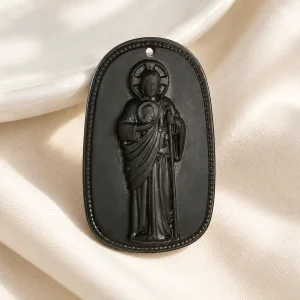
Black Jade Necklace, a Carved Saint Jude Medal
34,90 € Choose a size -
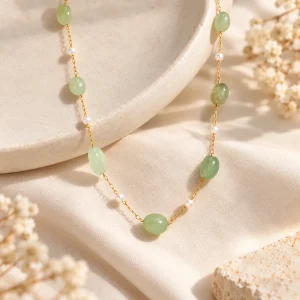
Fine Jade Necklace, Beads Spaced on a Chain
50,90 € Choose a size -
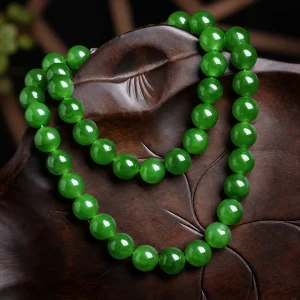
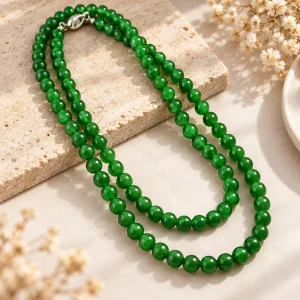
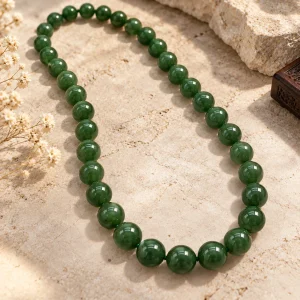
Green Jade Necklace, a Strand of Nephrite Beads
72,90 € Choose a size -
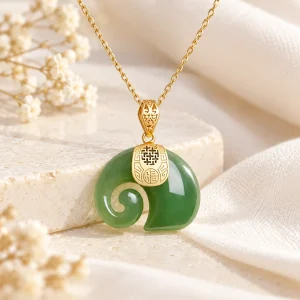
Green Jade Ruyi Necklace on a Gold Tone Chain
40,90 € Choose a size -
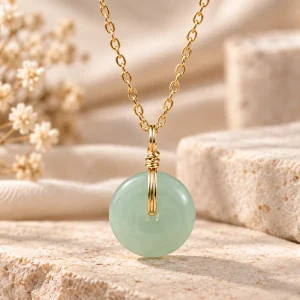
Jade and Gold Necklace, a Water Green Disc on a Golden Chain
44,90 € Choose a size -
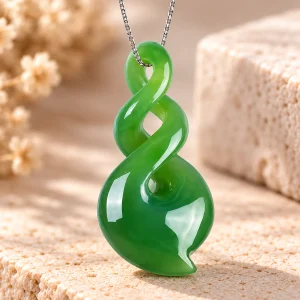
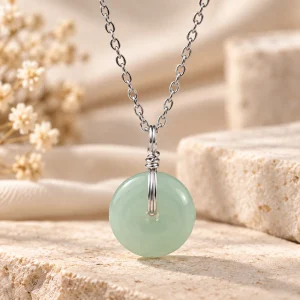
Jade and Silver Necklace, a Twist of Green Jade
37,90 € Choose a size -
Jade Bead Necklace, a Strung Strand
32,90 € Choose a size -
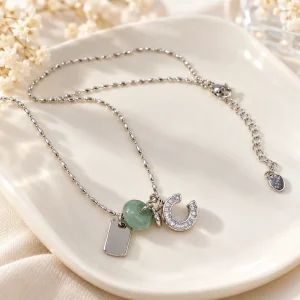
Lucky Jade Necklace with a Horseshoe Charm
42,90 € Choose a size -
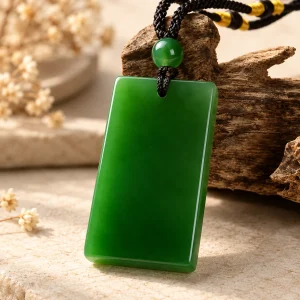
Men’s Jade Necklace, a Flat Pendant on a Cord
44,90 € Choose a size -
Real Jade Necklace, Jadeite or Nephrite
57,90 € Choose a size -
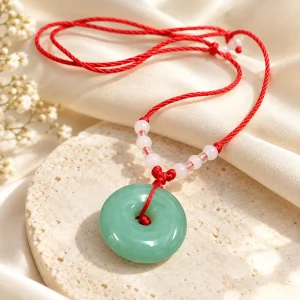
Red Cord Jade Necklace with a Green Disc
40,90 € Choose a size -
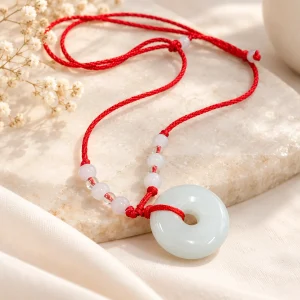
White Jade Disc Necklace on a Red Cord
40,90 € Choose a size -
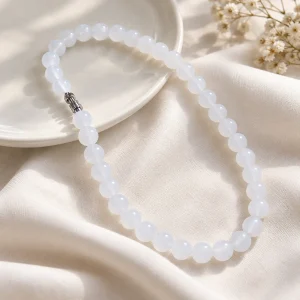
White Jade Necklace, a Strand of Nephrite Beads
67,90 € Choose a size -
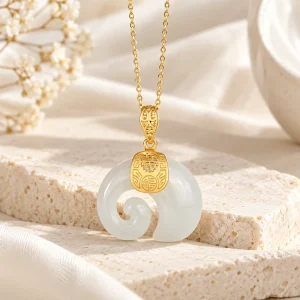
White Jade Ruyi Necklace on a Gold Tone Chain
40,90 € Choose a size -
Women’s Jade Necklace on a Sterling Silver Chain
37,90 € Choose a size -
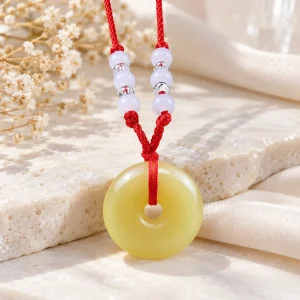
Yellow Jade Necklace, a Disc on a Red Cord
40,90 € Choose a size
Strand of beads, or single stone
The sixteen necklaces fall into three families, and that choice comes before the choice of color.
- The strung strand
- Jade beads on doubled thread, with no metal or closed by a silver clasp. The green shifts from bead to bead, from linden to fir: that is the opposite of a flaw, it is the material speaking. The strand clicks softly and keeps the coolness of the stone for a long time.
- The single stone
- A bezel set cabochon or a drilled pendant, on a fine chain or on a cord. All the attention goes to one stone, so to its green and its translucency. It is the mounting that forgives mediocre material the least.
- The spaced beads
- Small stones mounted one by one between two links of a chain, several centimeters apart. Ten times less material than a full strand, so almost no weight, and a chain that follows the skin instead of forming a rigid circle.
A word on what you will not find here: no long rope necklaces. These sixteen pieces are worn at the hollow of the neck, under the collarbone or at the breastbone, and I would rather write it than let the grid contradict it.
The length, and where the stone falls
The simplest way is to take a lace, lay it around the neck at the height you want, then measure it flat.
| Length | Where it falls |
|---|---|
| 40 cm | At the base of the neck, against the skin. Shows off a single short stone. |
| 45 cm | Just under the collarbone. The most versatile length. |
| 50 cm | At the hollow of the breastbone. Suits a good sized pendant well. |
The exact length of each piece is written on its product page, measured clasp included, and it is written there after the example has arrived. A chain is easily shortened by any jeweler; a strand of beads has to be restrung, which takes longer and is not a service I offer. The size guide.
The green, from linden to bottle green
The green does not come from the same element in each species. In jadeite, the clean vivid green comes from chromium; in nephrite, from iron, which gives the dark, closed greens. On a strand of beads that difference shows all the better because you have several stones side by side.
There is also an ivory white here, barely veined, and a nephrite black that lets a bottle green escape at its edges the moment you set it against something pale. Every color of jade, and where each one comes from.
On a necklace, light counts more than elsewhere, because the stone sits near the face and moves with every step. A green that looks flat under a ceiling light opens up against the window: translucency is what makes the difference, and translucency is what you pay for. The green of jade, in detail.
Genuine, and how I check it
What is sold under the name jade is very often serpentine or dyed quartzite, under labels that sound serious: “new jade”, “Malaysia jade”, “Korean jade”. None of them means jade.
On a strand of beads I put one bare bead on the scale before the strand is strung, when the supplier sends it to me that way: the thread and the clasp would skew the measurement. On a cabochon, I weigh the stone before setting. When the piece reaches me already mounted, I publish no figure at all.
| Material | Density |
|---|---|
| Jadeite | 3.25 to 3.36 |
| Nephrite | 2.90 to 3.03 |
| Serpentine | about 2.6 |
| Quartzite, dyed or not | about 2.65 |
What that figure does not say: the treatment. A jadeite bleached and then impregnated with resin is still a jadeite, and the resin does not change the mass enough to show. My supplier does not know the status of their stock.
So you will never read “grade A jadeite”, “type A” or “untreated” here: the status is not determined. The information sheet explains it in full.
The method and its three limits, and how to check a necklace you already own.
Silver, gold, cord
Sterling silver holds the green without warming it, and a fine link leaves all the room to the stone. Gold plating softens the green and pulls it toward the warm side: it suits deep greens better than water greens. Plated is written plated, on the product page as here. What gold changes.
The braided cord, for its part, puts no metal against the skin and adjusts with a sliding knot. It is the mounting of the flat pieces, the ones that lie on the breastbone and disappear under an open collar. Dark green and metal free mountings are in fact the safest track for a man.
Wearing it, and not damaging it
The hardness of jade is ordinary, 6 to 6.5 for nephrite and 6.5 to 7 for jadeite, and the quartz in household dust sits at 7. A strand of beads therefore scratches bead against bead if it travels loose in a bag.
- Lukewarm water, a mild soap, a soft cloth. Never ultrasound, never steam, never solvent, since the treatment status is unknown. The detail.
- On a strung strand, the thread wears out before the stone. It gets replaced, and there is nothing abnormal about that. When to have it restrung.
- Put the necklace on after perfume and cream, never before. And store it flat, in its pouch.
What follows changes register, and I flag it rather than blending it into the rest. Nothing here is demonstrated: it is what traditions have attributed to this stone.
Jade worn close to the throat, the necklace handed down from one generation to the next, the meaning given to a stone received as a gift: these usages are old and documented. What tradition puts into jade.
Frequently asked questions
Which necklace length should I choose?
40 cm at the base of the neck, 45 cm under the collarbone, 50 cm at the hollow of the breastbone. Take a lace, lay it at the height you want, measure it flat. Remember that a pendant hangs lower by its own height, bail included. The full guide.
How can I tell whether a jade necklace is genuine?
By density, measured on a bare bead or on the stone before setting: jadeite at 3.25 or above, nephrite around 2.95, serpentine at 2.6, quartzite at 2.65. On a strand already strung, the thread and the clasp skew the measurement. The steps to follow.
Should every bead be the same green?
No, and perfect evenness is in fact a signal worth examining: jade is a natural material, and a genuine strand slides from one shade to the next. An absolutely uniform, fluorescent green is almost always dyed material. Recognizing added color.
Can the thread break?
Yes, and that is the normal wear of a strand worn often: the thread wears out before the stone. It gets restrung by a jeweler, which costs little. That is why the legal warranties do not cover a thread breaking after prolonged use. The warranties in detail.
Can a jade necklace be worn in the shower?
Better not. Soap and bath products do not attack jade, but they clog the thread of a strung strand and dull the silver. And if the stone has been impregnated with resin, which I cannot know, repeated heat does it no good. Why I cannot know.
Jadeite or nephrite for a necklace?
Jadeite is more translucent, which suits a cabochon worn near the face. Nephrite is tougher and gives the dark greens and milky whites of the bead strands. They are two unrelated minerals, separated in 1863. What tells them apart.