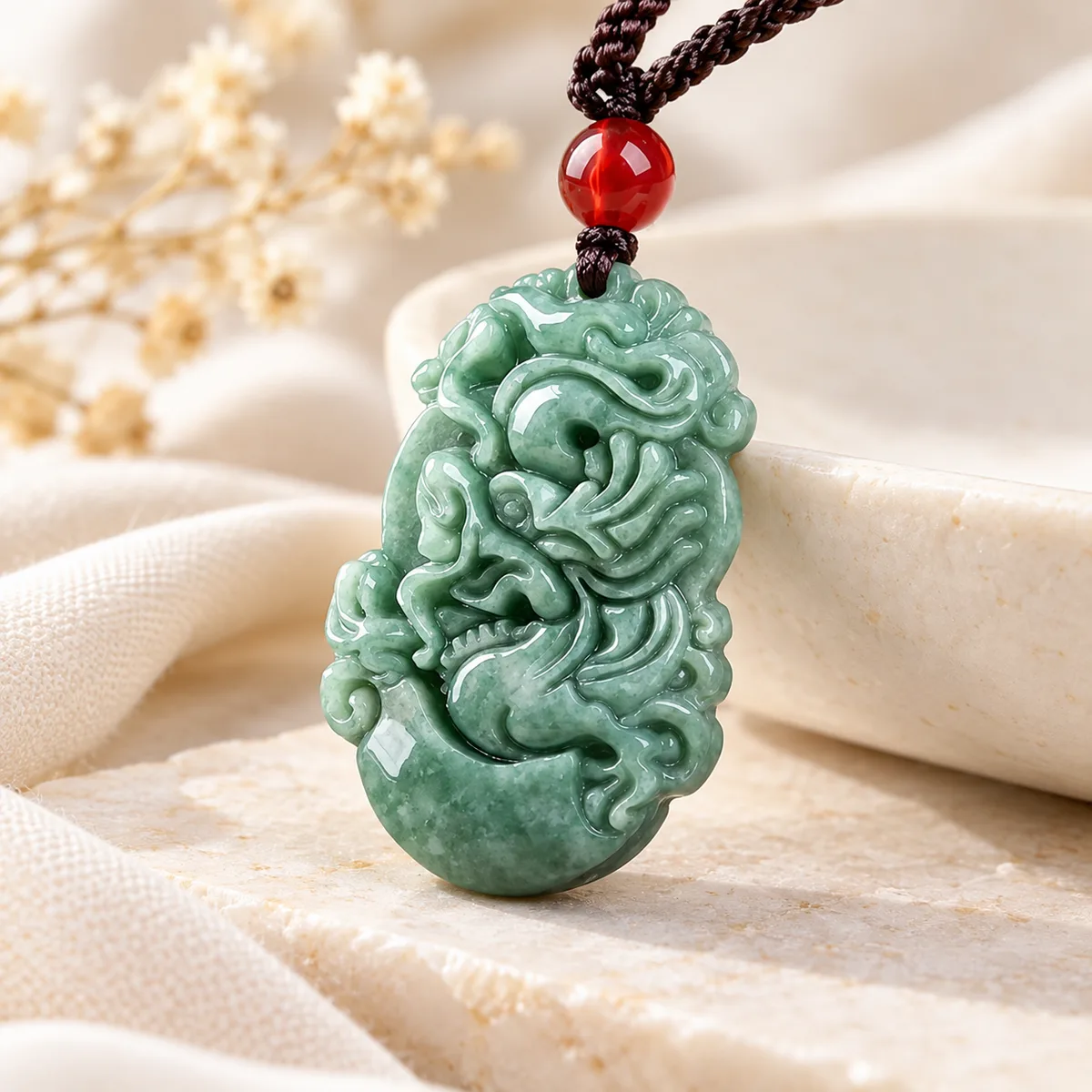
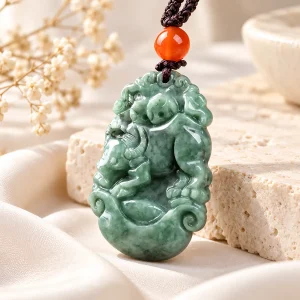
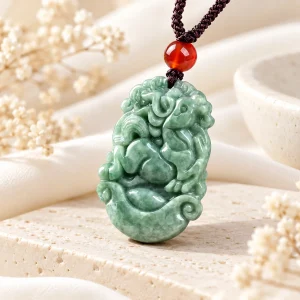
Jade dragon pendant: a plaque of soft green speckled stone, carved in relief over its whole height, hung from a braided brown cord with a red agate bead.
Those born in 1964, 1976, 1988, 2000, 2012 and 2024 belong to this sign. Check the exact date before giving it: the Chinese year starts between 21 January and 20 February, so a January birth belongs to the previous sign.
The length is set by a sliding knot, nothing to measure. The red bead is agate, not jade. Why I write it down.
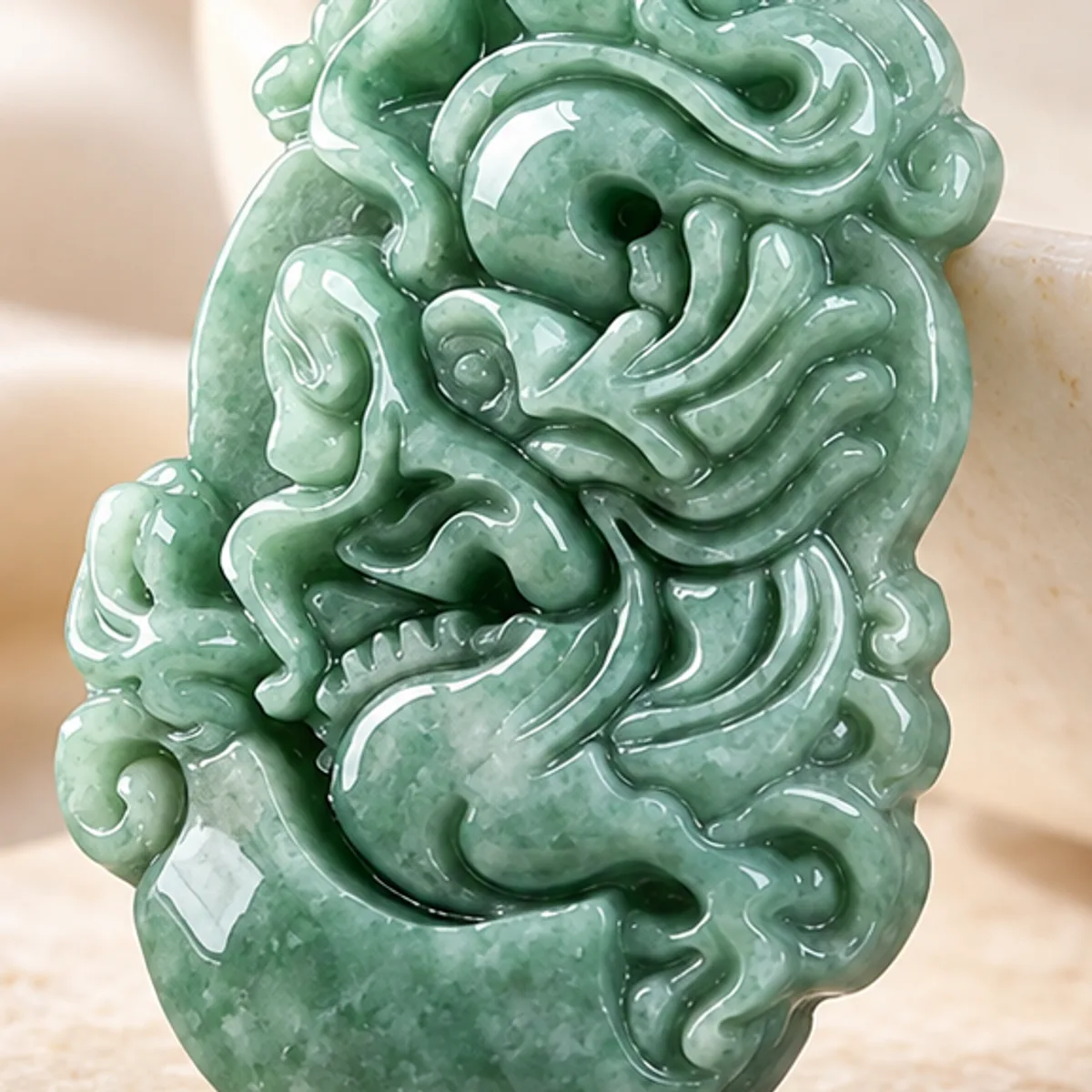
A jade dragon pendant: a plaque of soft green speckled stone, carved in relief over its whole height, hung from a braided brown cord with a red agate bead. The dragon is carved coiled on himself, mane spread and claws out, among clouds.
In four lines
The Dragon of the Chinese zodiac, carved in relief in the mass.
Speckled soft green plaque, braided brown cord, red agate bead.
Adjustable length by sliding knot: nothing to measure.
The red bead is agate, not jade, and the page says so.
The Dragon in the Chinese zodiac
Those born in 1964, 1976, 1988, 2000, 2012 and 2024 belong to this sign.
Those years are approximate, and that matters. The Chinese year does not begin on 1 January but between 21 January and 20 February, following the lunisolar calendar. Someone born in January or early February usually belongs to the previous sign, so check the exact date before giving this.
The Dragon comes fifth, although he could fly. He stopped on the way, says the legend, to bring rain to a village in need of it.
Tradition lends him drive and good fortune, with a taste for the grand gesture. He is the only one of the twelve that does not exist, and the most sought after of them all.
A carved plaque, and what the stone allows
The subject is not engraved on the surface, it is released in relief within the thickness of the plaque: the ground is cut away, the scrolls stand clear, and some parts are almost pierced through. That is work you cannot do on a brittle stone.
Jade takes it thanks to its toughness, the interlocked crystal structure that resists a crack spreading. This is not hardness: it is the property that made jade into axes before it made it into jewels. Hardness and toughness, two different things.
The stone is a speckled soft green, lighter in places and deeper in others. That irregularity is the opposite of a warning sign: a perfectly even colour is what dyeing produces, not formation.
The mounting, and what can be checked
The brown cord is braided and sets by a sliding knot: pull to shorten, spread to lengthen. No length to choose when ordering, and it wears as well short at the throat as long on the chest.
The red bead above the plaque is agate, a chalcedony. It is not jade, and its deep red most often comes from heating, an old process considered stable. I note it in the record rather than letting it pass as jade.
Outside Burma, country of extraction not confirmed
What tradition attributes to the sign and to jade
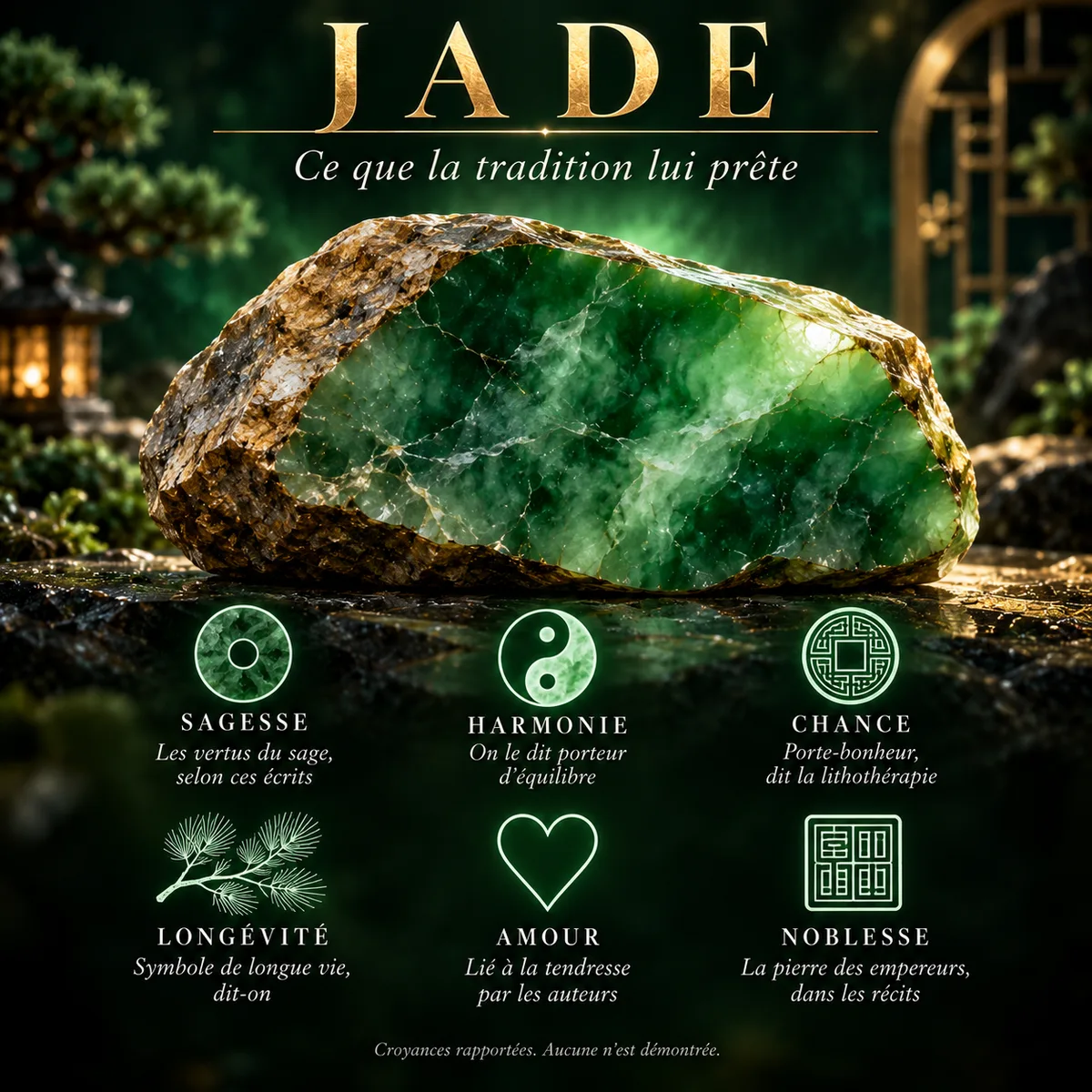
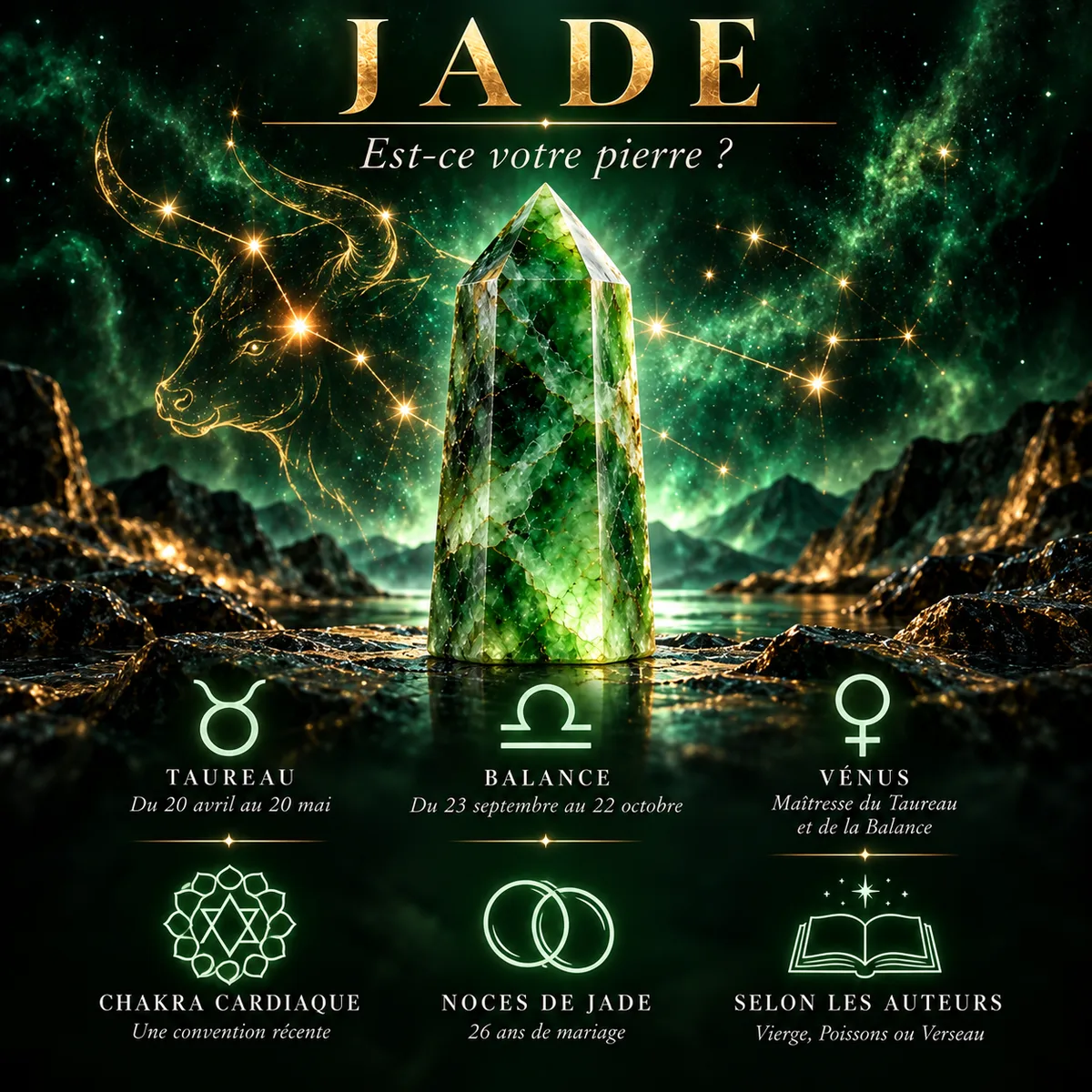
What follows changes register, and I flag it rather than blending it into the rest of the page. Nothing here is demonstrated. These are customs and beliefs, which I report because they are part of the history of this stone. No piece in this shop is sold as a remedy, and I claim no effect for this one.
The race of the twelveThe Dragon comes fifth, although he could fly. He stopped on the way, says the legend, to bring rain to a village in need of it.
What is attributed to the DragonTradition lends him drive and good fortune, with a taste for the grand gesture. He is the only one of the twelve that does not exist, and the most sought after of them all.
The year of your own signContrary to what you might expect, the year of your own sign is held to be unlucky, and many wear red that year to guard against it. It is one of the liveliest superstitions of the Chinese calendar, and it holds for all twelve.
A stone of moral virtueIn Confucian thought, jade is associated with qualities of character rather than effects on the body: uprightness, constancy, restraint. It is the best documented meaning of them all.
Dispatch within 48 hours of your order being confirmed, for delivery within 14 days from dispatch. I keep no stock in reserve, and I will not promise a date I could not meet.
Shipping Costs
€6.99 whatever the destination, free on orders over €47 to France, Belgium, Switzerland and Luxembourg. The exact amount is shown in your basket before you pay.
The Packaging, and Why It Matters
Every piece travels in its own pouch, kept apart from the others. This is not a question of presentation: the hardness of jade is unremarkable, between 6 and 6.5 for nephrite and 6.5 to 7 for jadeite, and the quartz in ordinary household dust sits at 7. Two pieces of jewellery that travel together arrive marked.
Fourteen Days to Change Your Mind
No need to give a reason. An email is enough to open a return; there is no form to fill in. Return postage is at your expense, unless the piece does not match its listing or arrives damaged.
Lukewarm water, mild soap, a soft cloth. A very soft brush for the hollows of a carving. That is all, and it is enough.
What You Must Never Do, and Why
No ultrasonic cleaners, no steam, no solvents, no heat source. This is not a precaution for show: the treatment status of my pieces is undetermined. My supplier does not know it, and weighing identifies the mineral without telling me anything about a possible resin impregnation. Resin withstands neither heat nor solvents, so every piece is handled as though it might contain some. The information sheet on treatments.
Scratches, and Where They Come From
Jade is tough, meaning very difficult to break: its structure of interlocking crystals resists cracking, and that is what made it usable for axe heads in the Neolithic. Its hardness, by contrast, is unremarkable, 6 to 6.5 for nephrite and 6.5 to 7 for jadeite. The quartz in ordinary household dust sits at 7: that is what dulls a jade, not knocks. The difference between the two.
Day to Day
Put the piece on after perfume and cream, never before. Take it off for housework, gardening and sport, where knocks against hard edges are common. Store each piece on its own, in its pouch. On a strand of beads, the thread wears out before the stone: it gets restrung, and there is nothing abnormal about that.
My name is Jade. French, from Morbihan, living in Tallinn. I choose the pieces and have them mounted: I mine nothing, I cut nothing, and the metalwork is not done by my hand. What I bring is the selection, and with this material that is what decides everything.
I am not a gemmologist, not a lapidary, not a therapist, and I do not claim to be.
I Weigh, I Do Not Certify
Before a listing goes online, I order one example of it for myself. When it reaches me unmounted, I weigh it in air, then suspended from a thread in a glass of water: the ratio of the two masses gives the density, and that figure separates jadeite, nephrite, serpentine and dyed quartzite without ambiguity.
One example per listing, and not every piece. I do not handle the piece that is sent to you, and I would rather write that down than let you believe otherwise. The method, with its three limits.
What I Cannot Know
The treatment status of my pieces. My supplier does not know it, and the scales do not tell me: they identify the mineral, not the resin impregnation. Only infrared spectroscopy in a laboratory would settle it, and I do not have that done. So you will never read “Grade A jadeite”, “Type A” or “untreated” on this site. The information sheet.
Where My Jade Comes From
No Burmese jadeite, and the first reason is legal. Not the one you read everywhere: the JADE Act of 2008 did ban these stones in the United States, but that ban was lifted on 7 October 2016. What applies today dates from 8 April 2021: the US Treasury sanctioned Myanma Gems Enterprise, the state company that controls the Burmese gem trade. So there is no blanket ban, but a US person is not allowed to trade with that entity, and a stone never tells you where it has been. A single supply chain serves ten markets, so it has to hold up in the most demanding of them. When an origin is not confirmed to me in writing, the listing does not state it. My origin charter.