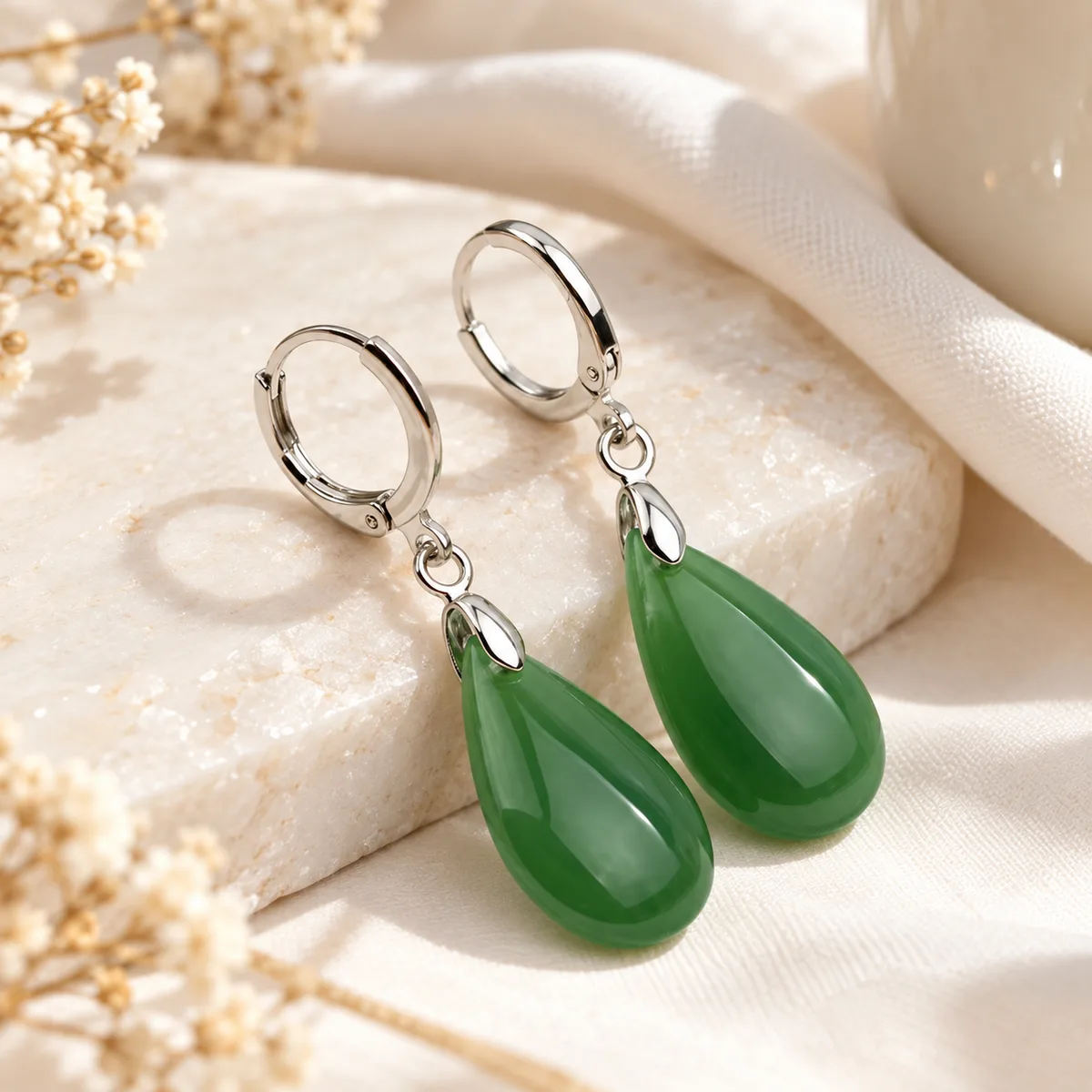
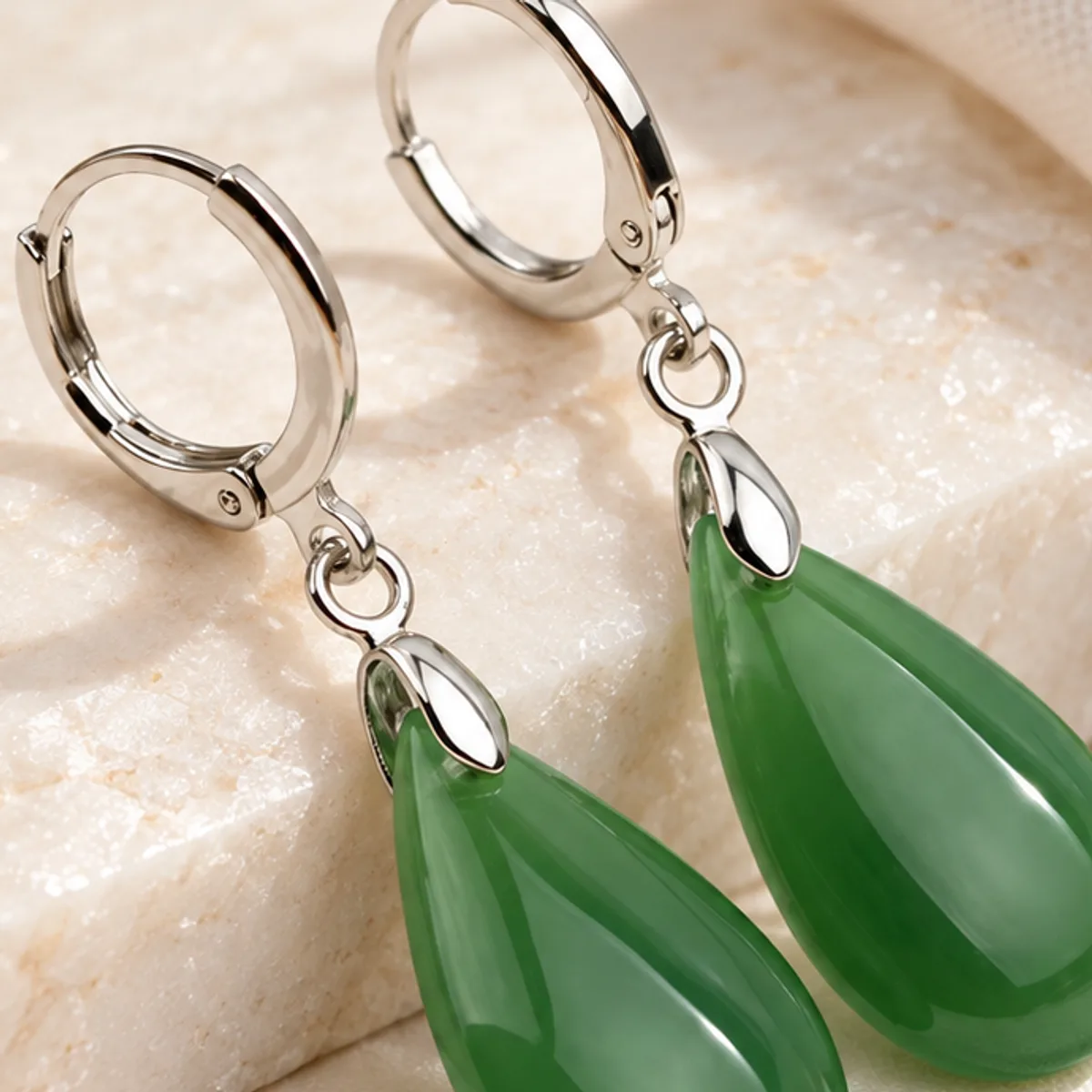
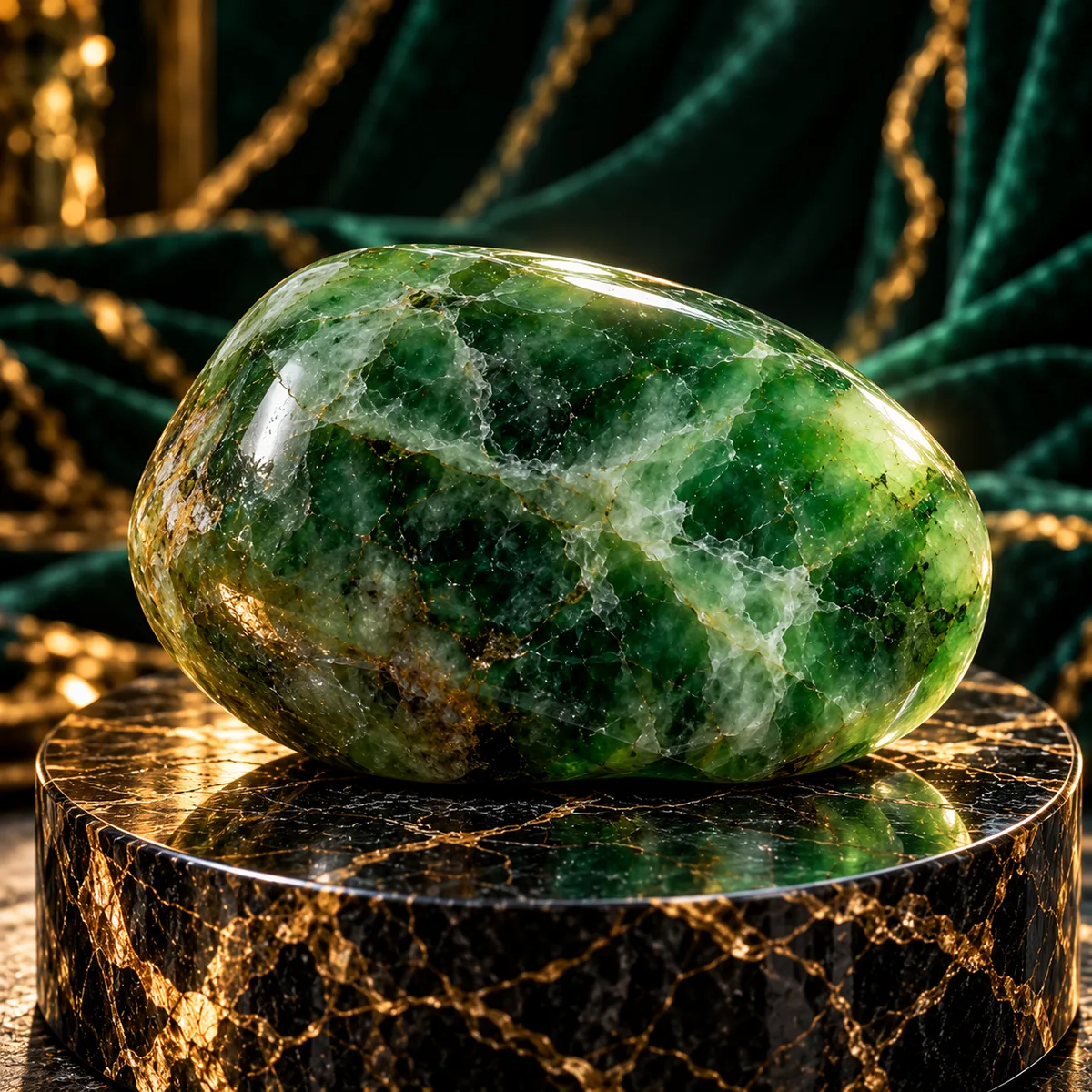
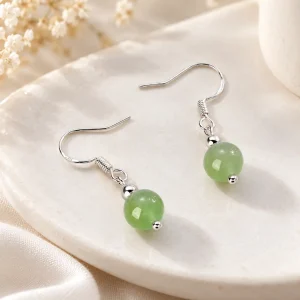
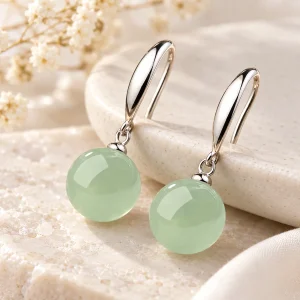
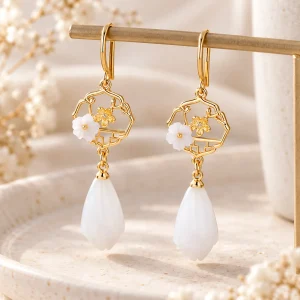
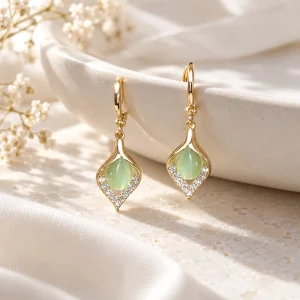
Dark green jade earrings: an elongated drop in a deep bottle green, polished without a facet, capped with a silver tone cup and hung from a small clip hoop.
Sold under reserve on the stone. The green does not weaken at the point, where the stone is thin: that is the behaviour of a dyed chalcedony, not of a colour of formation.
The weighing may settle the mineral if the cup comes off, but it will never say anything about dyeing. Why I write it down.
Dark green jade earrings: an elongated drop in a deep bottle green, polished without a facet and tapered towards the bottom, capped with a silver tone cup and hung from a small clip hoop. It is the darkest green in the catalogue.
In four lines
An elongated drop in a deep bottle green, polished without a facet.
A silver tone cup at the top, a small clip hoop.
Sold under reserve: the type colour of dyed chalcedony.
The record will depend on the cup: it must come off without forcing.
A green that does not weaken, and that is the problem
Look at the point of the drop, where the stone becomes thin. The green is as dense there as in the middle. On a stone coloured through its mass the tint lightens as the thickness falls, because there is less material to cross. Here it does not.
That behaviour belongs to a colour lodged in a material of fine, even grain, which takes it homogeneously right through: it is exactly what a dyed chalcedony gives. Nephrite, made of fibres of varying density, never colours as evenly.
I am not saying it is certain. I am saying that is what my supplier’s photograph shows, not only my own rendering, and that a shop selling one stone only has no right to pass over it. The names that do not denote jade.
The same model exists in white
This drop is sold in two colours, and that is the only difference between the two references: the white version carries exactly the same cut under the same hoop.
The difference is not only one of taste, however. The white version does not carry this reservation about colour, because a white has nothing to hide on that ground. It carries another, about weighing, which its own page explains.
In other words, neither of the two is above all suspicion, and both say so. It is the best thing I can offer someone who is hesitating: two pages that each name their limit.
What the weighing will be able to do, and what it will not
The silver tone cup is set on the upper point of the drop and held by a spot of glue. On the example I order I will try to take it off without forcing. If it comes, I weigh the stone bare; chalcedony runs around 2.60, nephrite starts at 2.90, and the figure will settle the mineral.
If it resists, I will not insist: I am not going to tear off a cup for a measurement, and the record will stay empty and say so. The method, with its three limits.
And in every case, the weighing will say nothing about dyeing. It establishes the mineral, not what has been put into it: a dyed chalcedony and a bare chalcedony weigh the same. Only a laboratory analysis would separate the two, and I do not have that done. The treatment information sheet.
Additional information
Stone
Jadeite or nephrite, not resolved
Color
Dark green
Stone shape
Drop
Motif
No motif
Mounting
Metal band
Metal
Silver tone, alloy not stated
Setting
Bead cap
Worn by
Women
Mineral family
Calcic amphibole, Sodium aluminum pyroxene
Hardness (Mohs)
6 to 7
Reference density
2.90 to 3.36 g/cm³
Toughness
Exceptional, interlocking crystals
Treatment
Not determined
Origin
Outside Burma, country of extraction not confirmed
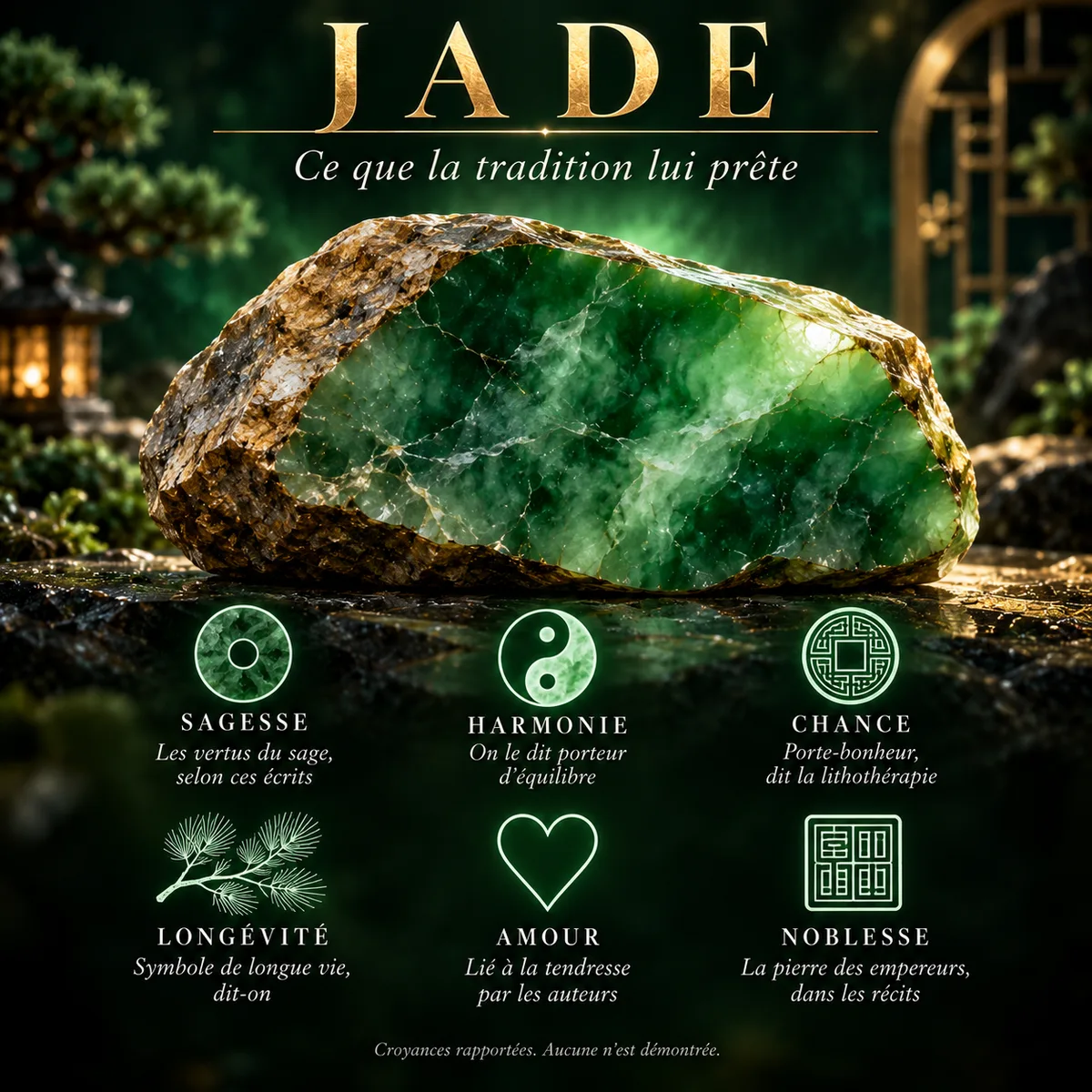
What tradition attributes to jade
What follows changes register, and I flag it rather than blending it into the rest of the page. Nothing here is demonstrated. These are customs and beliefs, which I report because they are part of the history of this stone. No piece in this shop is sold as a remedy, and I claim no effect for this one.
Deep green, a recent fashionThe taste for very saturated greens comes from the trade in Burmese jadeite, which only reaches China in the eighteenth century. Old scholarly taste far preferred pale and muted stones.
Dyeing a stone is nothing newThe dyeing of translucent stones is attested since antiquity, from Roman agate to the chalcedonies of Idar Oberstein. It is not a modern fraud, it is an old trade, which becomes a problem only when the process is kept quiet.
Jade at the earsThe jueshi, slit jade rings worn at the ear, are among the oldest known Chinese ornaments: examples are found in Neolithic burials, long before the discs and the belt pendants.
A stone of moral virtueIn Confucian thought, jade is associated with qualities of character rather than effects on the body: uprightness, constancy, restraint. It is the best documented meaning of them all.
Shipped within 48 hours of your order being confirmed, for delivery within 14 days from the day it ships. I keep no buffer stock, and I will not promise a date I cannot meet.
Shipping Costs
€6.99 no matter the destination, and free on orders of €47 or more to France, Belgium, Switzerland, and Luxembourg. The exact amount shows in your cart before you pay.
The Packaging, and Why It Matters
Every piece leaves in its own pouch, kept apart from the others. This is not about presentation: jade’s hardness is ordinary, 6 to 6.5 for nephrite and 6.5 to 7 for jadeite, and the quartz in everyday dust rates 7. Two pieces of jewelry that travel together arrive scratched.
Fourteen Days to Change Your Mind
No reason needed. One email opens a return, and there is no form to fill out. Return shipping is at your expense, unless the piece does not match its listing or arrives damaged.
Lukewarm water, mild soap, a soft cloth. A very soft brush for the hollows of a carving. That is all, and it is enough.
What You Must Never Do, and Why
No ultrasonic cleaner, no steam, no solvent, no heat source. The reason is not caution for its own sake: the treatment status of my pieces is undetermined. My supplier cannot tell me, and the weighing establishes the mineral without saying anything about a possible resin impregnation. Resin withstands neither heat nor solvents, so every piece is handled as though it might contain some. The treatment information page.
The Scratch, and Where It Comes From
Jade is tough, meaning very hard to break: its structure of interlocking crystals resists cracking, and that is what made it possible to turn it into axes in the Neolithic. Its hardness, on the other hand, is ordinary, 6 to 6.5 for nephrite and 6.5 to 7 for jadeite. The quartz in everyday dust rates 7, and that is what dulls a jade, not impacts. The difference between the two.
Day to Day
Put the piece on after perfume and lotion, never before. Take it off for housework, gardening, and sports, where the hard knocks happen. Store each piece on its own, in its pouch. On a strand of beads, the thread wears out before the stone does: it gets restrung, and there is nothing abnormal about that.
My name is Jade. I am French, from Morbihan in Brittany, and I live in Tallinn. I choose the pieces and have them set: I mine nothing, I carve nothing, and I do not do the metalwork myself. What I bring is the sorting, and with this material the sorting decides everything.
I am not a gemologist, a lapidary, or a therapist, and I do not claim to be.
I Weigh, I Do Not Certify
Before putting a reference online, I order one example of it for myself. When it reaches me unset, I weigh it in air, then suspended from a thread in a glass of water: the ratio of the two masses gives the density, and that figure separates jadeite, nephrite, serpentine, and dyed quartzite without ambiguity.
One example per reference, and not every piece. I never handle the piece that ships to you, and I would rather say so plainly than let anyone believe otherwise. The method, with its three limitations.
What I Cannot Know
The treatment status of my pieces. My supplier cannot tell me, and neither can the scale: it establishes the mineral, not the resin impregnation. Only laboratory infrared spectroscopy would settle the question, and I do not have that testing done. So you will never read “jadeite A”, “type A” or “untreated” on this site. The information page.
Where My Jade Comes From
No Burmese jadeite, and the first reason is legal. Not the one you read everywhere: the JADE Act of 2008 did ban these stones in the United States, but that ban was lifted on October 7, 2016. What applies today dates from April 8, 2021: the US Treasury sanctioned Myanma Gems Enterprise, the state-owned company that controls the Burmese gem trade. So there is no blanket ban, but an American is not allowed to do business with that entity, and a stone never tells you where it has been. I run one supply chain for ten markets, and it has to stand up to the strictest one. When an origin is not confirmed to me in writing, the listing does not state it. My origin policy.