The workshop, and who runs it
About Jade
French, from the Morbihan, based in Tallinn: I choose my stones and have them set. This name comes from a promise of healing. I do not.
- I choose and I have things set. I do not mine, I do not cut
- I weigh one example per listing, and I publish the figure
- A jade jewelry workshop, and nothing else
The word I carry comes from a promise of healing
Around 1565, during the conquest, the Spanish saw the peoples of Central America wearing a green stone against pain in the side. They called it piedra de la ijada, the stone of the flank, because it was pressed where renal colic hurts. Scholarly Latin translated it as lapis nephriticus, the stone of the kidneys, from nephros in Greek. That is where the word nephrite comes from.
French borrowed the Spanish and made éjade of it. Then a false division, l’éjade heard as le jade, gave the word we use every day. You can read it under the entry jade in the Dictionnaire de l’Académie française, ninth edition.
The word I carry comes from a 16th century promise of healing. That is exactly what I will not sell you.
This site attributes to jade no effect on health, fertility or pain. The full disclaimer is here, and it is shorter than this page.
I kept the word ijada in the domain name because a brand should say where it comes from, including when what it finds leaves it awkwardly placed. And because that kind of story, a stone named through a misunderstanding between two worlds, is precisely what led me here.
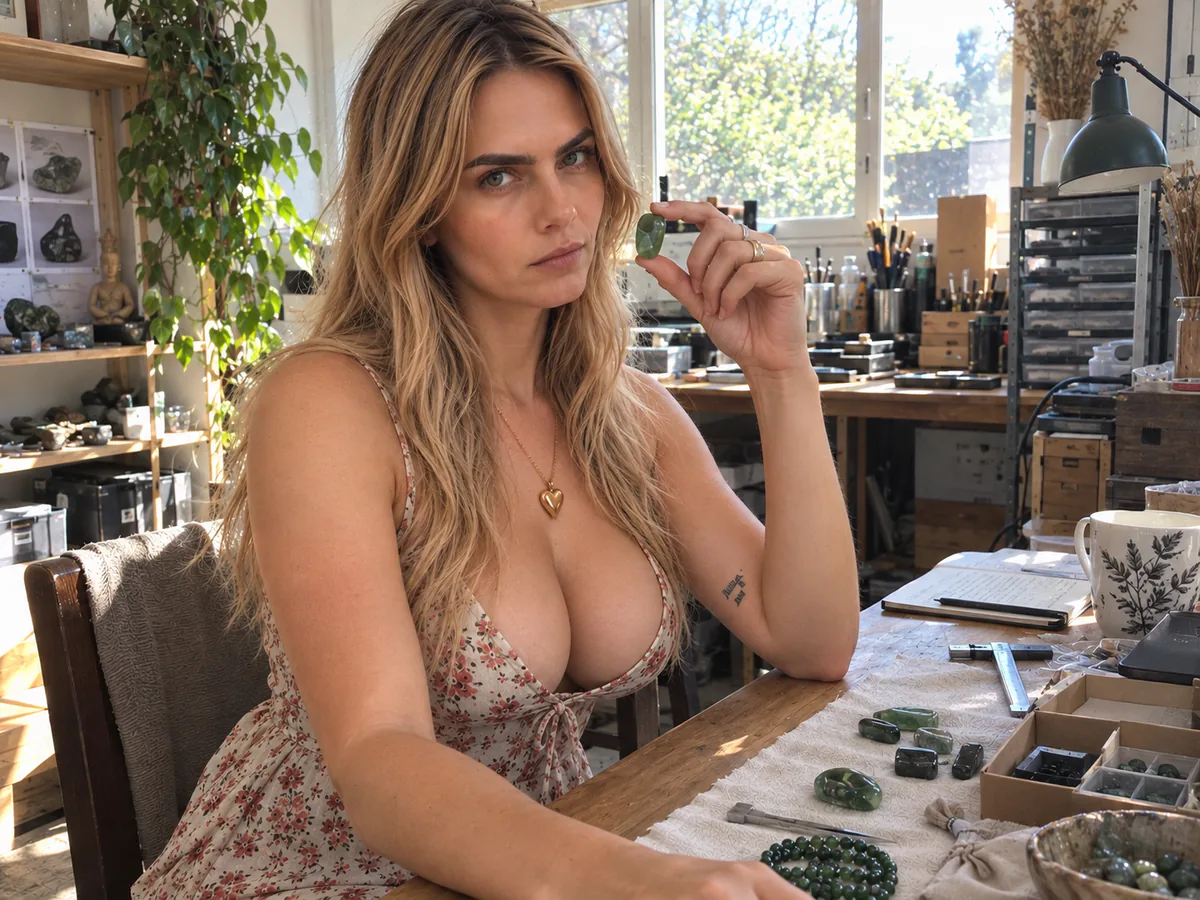
What I do, and what I do not do
I would rather write it straight away, because this market is quite happy to keep things vague.
- I do
- Choose the pieces one by one at my suppliers, order one example for myself, weigh it when it arrives bare, publish the figure, and have set what needs setting.
- I do not
- Mine, cut, polish, set. The metalwork is not from my hand.
- I am not
- A gemologist, a lapidary, or a therapist. I hold no gemology qualification and I do not claim to.
- The trade, in a word
- A jade jewelry workshop. Not a practice, not a treatment center, not a crystal healing studio.
My jade jewelry is set or chosen one piece at a time. I never write “I make” or “handmade”, because it would be false. The model is a mixed one, and it owns up to that: what I bring is the sorting, and with this material the sorting decides everything.
Why jade, and not another stone
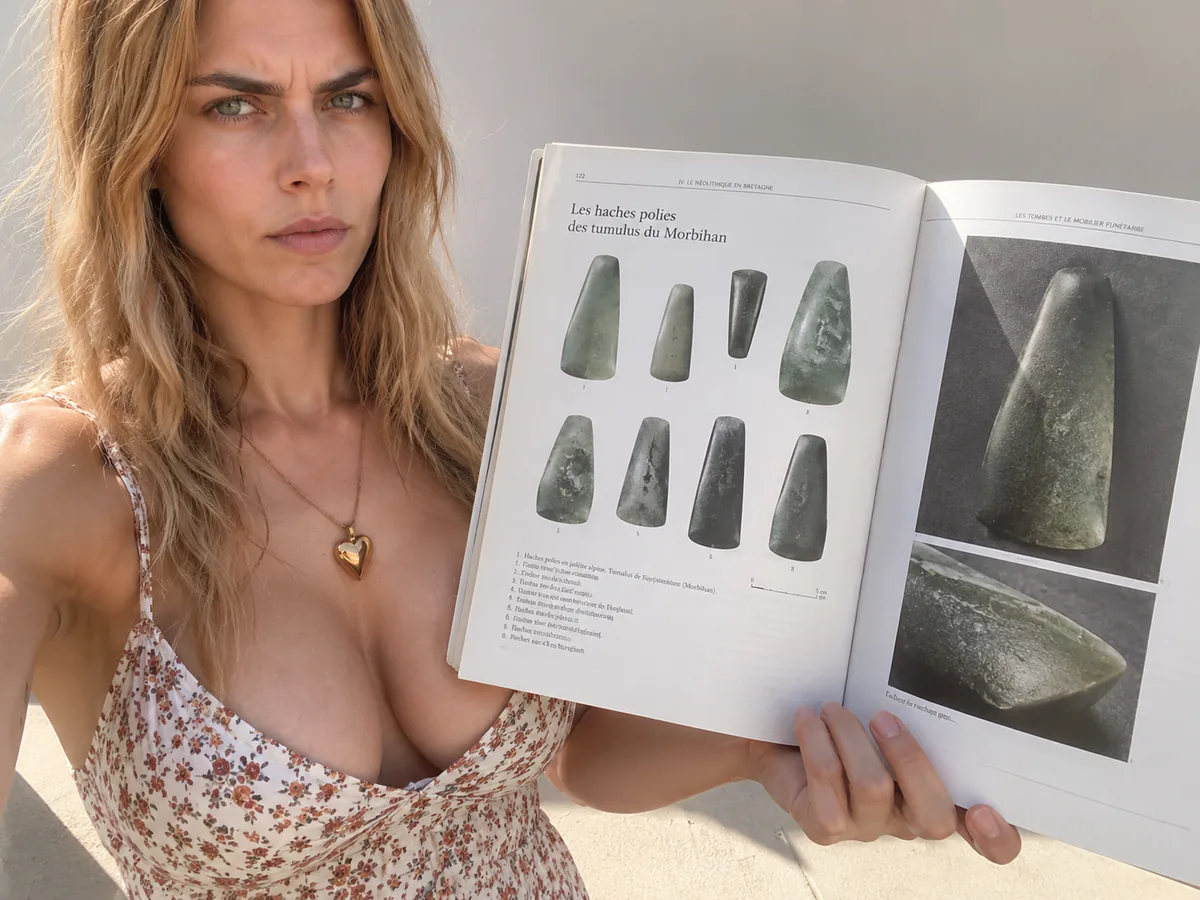
I grew up in the Morbihan, next to the display cases of the Prehistory museum in Carnac. They hold large axes of polished stone, deep green, laid down more than six thousand years ago in the barrows of Mané er Hroëk, the Tumulus Saint-Michel and Tumiac. They were not there to cut wood. They were already objects of prestige.
As a child I was told it was jade and I believed it without thinking. It was in looking into it, much later, that I understood the question had occupied researchers for a century and a half, and that it had an answer.
In June 2003, Pierre and Anne-Marie Pétrequin identified the Neolithic Alpine jadeite quarries of the Mont Viso massif, in Piedmont, between 1,500 and 2,400 meters of altitude, along with those of the Beigua massif. In the 5th and 4th millennia BCE, those quarries fed a spread of large polished axes across 3,300 kilometers from west to east, from Ireland to Bulgaria. The Morbihan deposits are among the richest in Europe.
In other words: jade was in Brittany millennia before it arrived from China, and almost nobody tells that story in France. It is the article I most wanted to write first.
A Frenchman cut jade in two, and that changes everything
In 1863 the mineralogist Alexis Damour established that what was called jade covers two unrelated mineral species: jadeite, a sodium aluminum pyroxene whose name he coined, and nephrite, an amphibole of the tremolite actinolite series. He was working on jades brought back from the sacking of the Summer Palace in Beijing three years earlier. Notice et analyse sur le jade vert, Comptes rendus hebdomadaires de l’Académie des sciences, volume 56, 1863.
Two years later he analyzed the polished axes of the Celtic monuments and recognized jadeite in them. Both halves of my story come down to the same man, which was not planned when I started reading.
What that changes for a shop: a word that covers two minerals is a word you can hide anything inside. And that is what happens. Serpentine and dyed quartzite circulate under the name jade with labels that sound serious, “new jade”, “Malaysia jade”, “Korean jade”. None of these labels means jade.
So I weigh
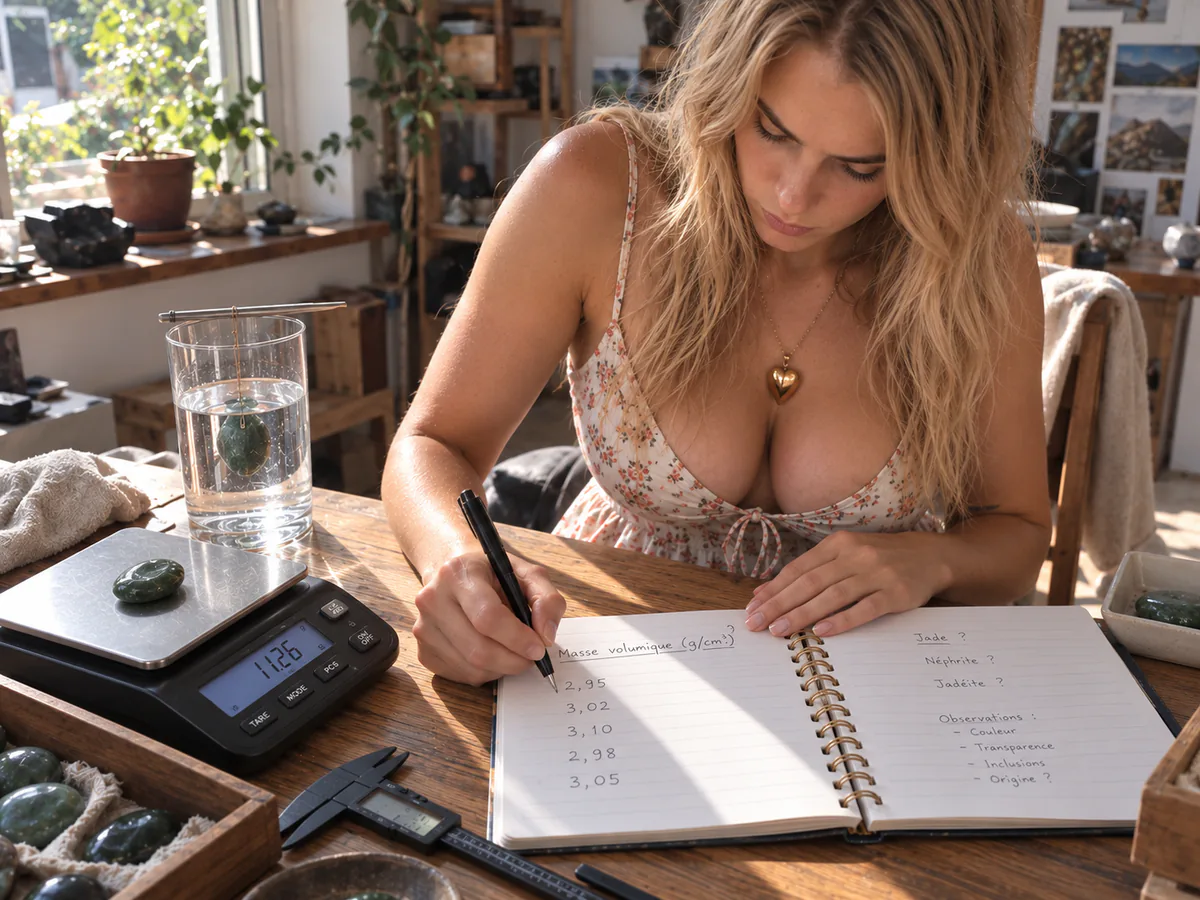
Since the difference is physical, it can be measured. A scale, a thread, a glass of water: the stone weighed in air, then hanging immersed, gives its density, and density separates jadeite, nephrite, serpentine and quartzite beyond argument.
Before I put a listing online, I order one example for myself. When it arrives without a setting, I weigh it and publish the three numbers with their date. The method in full, with its three limits, because a method without its limits is only an argument.
The most serious of those limits fits in one sentence: the scale names the mineral, it says nothing about the treatment. My supplier does not know the status of their stock, and I do not invent it. So you will never read “grade A jadeite” or “untreated” on my product pages. Why, and what it means for you.
I weigh, I do not certify. On a disputed case, my answer is that I cannot settle it. That sells less well than a laboratory logo, and it is the only thing I can hold to.
Tallinn, and what Estonia does not have
I live in Tallinn, where my business is registered. Estonia has no jade deposit, no lapidary tradition and no cutting workshop, and I will not let a well framed photograph suggest otherwise. What happens here is the choosing of pieces, the weighing, the packing and the answering of messages.
I am the one who answers, and I am the only one. That means replies that are sometimes slow, and never a “we” standing in for a department. Write to me.
Jade Ijada is a trading name. The legal notice names the actual publisher: it tells no story, it states the facts.
What you will not find here
- No serpentine, no dyed quartzite, no aventurine sold under the name jade. If a piece is neither jadeite nor nephrite, it carries its true mineral name.
- No “grade A jade”, no “type A”, no “untreated”: I do not know, and my scale does not say.
- No Burmese jadeite. The reason is legal first.
- No “semi precious” or “semi fine”: French decree no. 2002-65 forbids them across its whole scope.
- No A, AA, AAA scale. It borrows its letter from the real classification to designate a seller’s opinion.
- No promise of health, fertility or healing.
- No invented price, delay or dimension. When I do not know, the line stays empty.
These refusals are not a stylistic clause. Several pages of this site exist only because nobody else writes them.
This page is the foundation of the site: if what is written here becomes false, this is where the correction happens first.
Published on 9 September 2026.