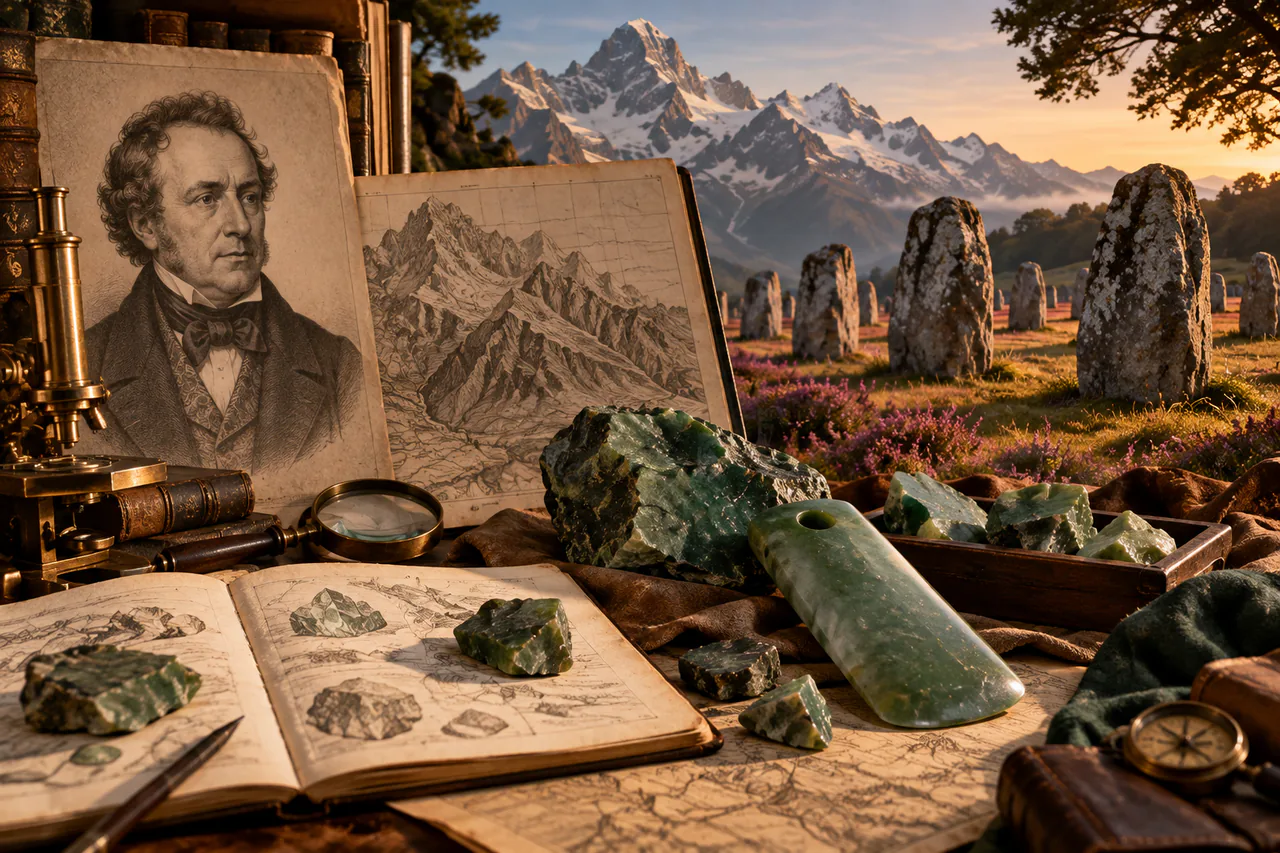
Jade in Europe: Damour, Monte Viso, Carnac
This page tells the story of European jade: the 1865 note in which a French mineralogist recognized jadeite in Neolithic axes, the Alpine quarries rediscovered in 2003, the 3,300 kilometers over which those axes traveled, and the museum cases in Morbihan, in Brittany, where you can still see them.
Jade did not reach Europe with China: Alpine jadeite was quarried at Monte Viso and Beigua, shaped into large polished axes in the 5th and 4th millennia BCE, then spread over 3,300 kilometers from Ireland to Bulgaria, and some of the richest deposits in Europe lie in Morbihan.
| Landmark | What it establishes |
|---|---|
| 5th and 4th millennia BCE | Quarrying of Alpine jadeite, polished axes spread over 3,300 kilometers |
| 1863 | Alexis Damour separates jadeite from nephrite and coins the word jadeite |
| 1865 | Damour identifies jadeite in the axes from Celtic monuments |
| June 2003 | Pierre and Anne-Marie Pétrequin identify the quarries of Monte Viso and Beigua |
My name is Jade and I run a jade jewelry workshop: I choose the pieces, have them set, and weigh one example of each reference before it goes on sale. I am neither an archaeologist nor a gemologist, and I have excavated no burial mound: what you read here comes from my reading, which I name at the end, but I grew up in Morbihan, near the museum cases this page talks about.
Two notes by Damour, two years apart
In 1863, the French mineralogist Alexis Damour (1808-1902) analyzed green jades brought back from the looting of the Summer Palace in Beijing and showed that the word jade covers two unrelated mineral species. He coined the name jadeite. That is the note everyone cites, and it is the starting point of everything I write about this stone.
The second note, from 1865, is cited far less often. Damour applied the same analysis to polished stone axes taken from Celtic monuments, and recognized jadeite in them. In other words, two years after inventing the word, he found that the material was already in Europe, in objects far older than any exchange with Asia.
I have not read the 1863 note in the original: its page numbers come to me from a bibliography, not from the page itself, so I do not copy them. What I take from it is the result, which has not changed: two minerals, one word, and the details of their difference are in jadeite or nephrite.
Monte Viso, quarries identified in June 2003
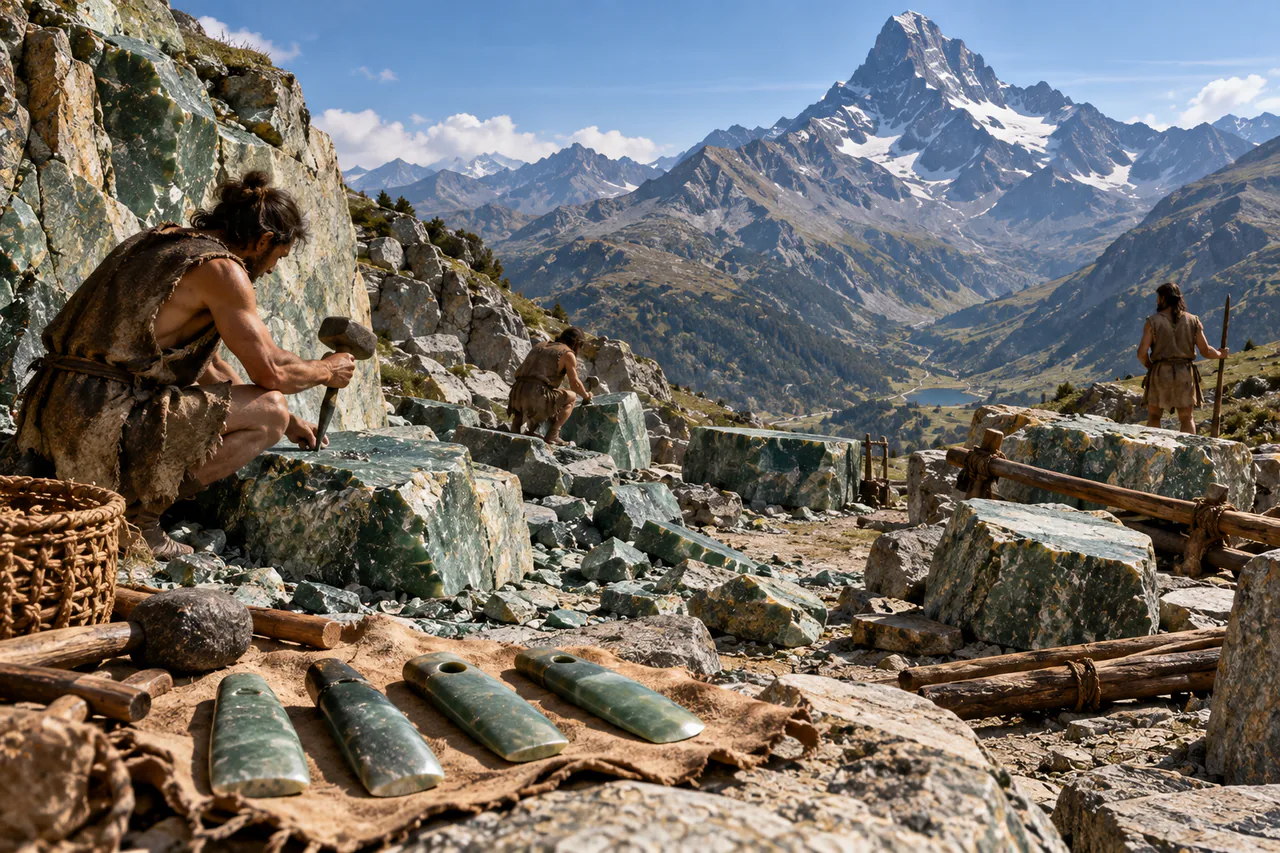
Damour had the material, not the deposit. It was not until June 2003 that Pierre and Anne-Marie Pétrequin identified the Neolithic Alpine jadeite quarries of the Monte Viso massif, in Piedmont, at an altitude of between 1,500 and 2,400 meters, and those of the Beigua massif. The work was published as the JADE project, at the French CNRS.
Geology explains why these quarries are there and not elsewhere. Jadeite forms under very high pressures at moderate temperature, which confines it to ancient subduction zones; the western Alps are one. The full mechanism is described in how jade stone forms, and the map of the deposits mined today in where jade comes from.
Jade bracelets available now
Polished axes over 3,300 kilometers
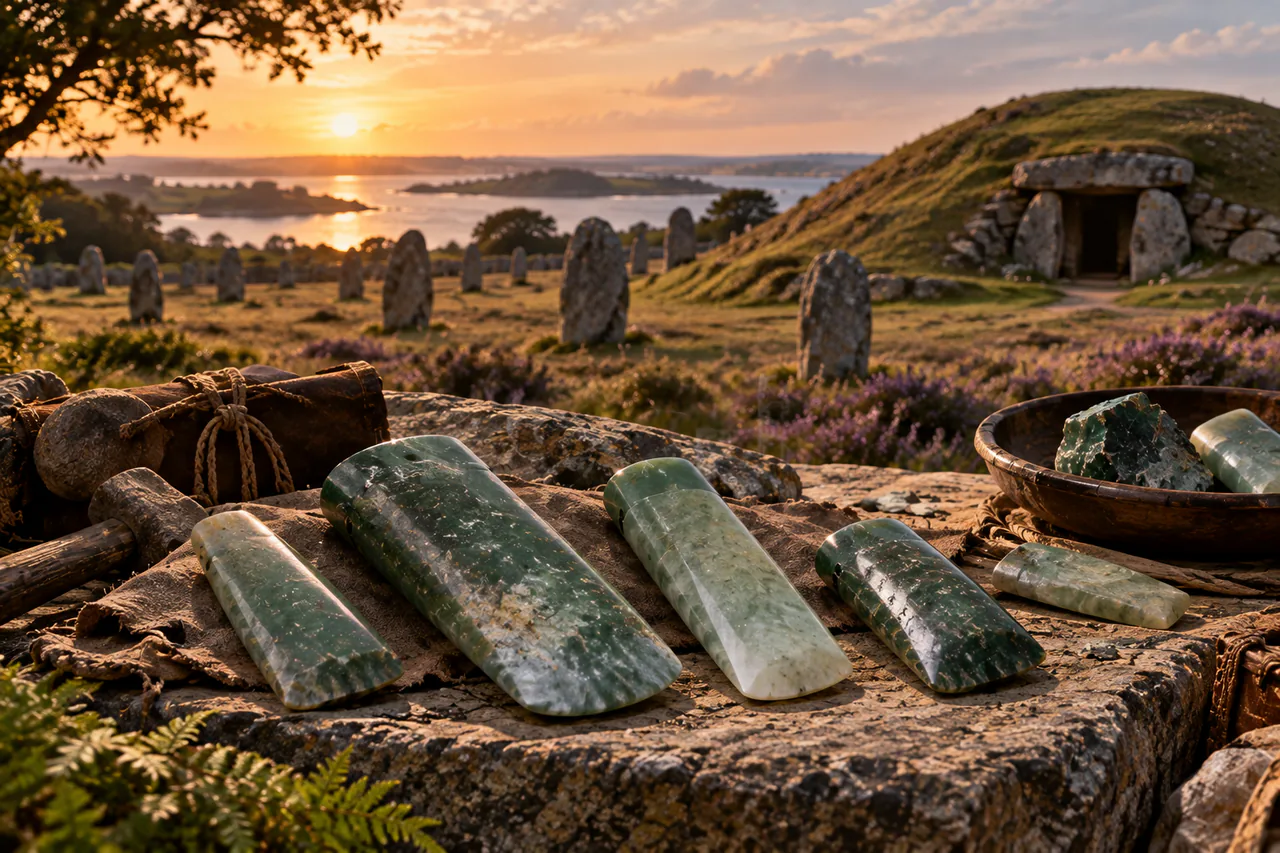
In the 5th and 4th millennia BCE, these quarries supplied large polished axes that spread over 3,300 kilometers from west to east, from Ireland to Bulgaria. That is the JADE project’s figure, and it is the one that made me write this page.
European jade is therefore neither a local curiosity nor an isolated piece found by chance: it is a network, coming out of a massif you can point to on a map today.
Alpine jadeite, not nephrite
This is the point on which most of the pages I opened get it wrong. They credit Neolithic axes to the fibrous, felted structure of nephrite, which is indeed remarkably tough. That is true for China, where the material worked since the Neolithic is indeed nephrite. It is not true here: the Alpine axes are jadeite.
Both minerals withstand impacts very well, each for its own reason, and hardness is not the same as toughness: that is the whole subject of why jade almost never breaks, so I will not repeat the demonstration here.
What separates them beyond dispute is density: 3.25 to 3.36 for jadeite, 2.90 to 3.03 for nephrite. It is the same gap I use to decide in my workshop, and the protocol is published on the weighing page. With a museum axe, nobody suspends the object in a glass of water: identification goes through laboratory methods, which is what Damour was already doing in his own way in 1865.
Carnac and the Morbihan deposits
The Carnac Museum of Prehistory, in Morbihan, displays axes from this family. The deposits of Mané er Hroëk, the Tumulus Saint-Michel and Tumiac are among the richest in Europe for this type of object.
This is the personal part of this page, and I keep it separate: I grew up a few kilometers from those cases, I saw them before I knew what a pyroxene was, and it is that story that led me to the stone, not the other way around. The path is told on the about page.
Other French collections hold jade, European or not, and I have listed them separately: jade in French museums.
What such a distance suggests
What follows is my own reasoning, and I say so rather than slip it in among the facts. A useful axe is cut from the nearest hard stone. This one was taken in the mountains, at 1,500 meters at least, and turns up thousands of kilometers away.
A material that travels that far does not do so because it cuts better: it circulates because it holds value in the eyes of those who receive it, and the very long polishing of large pieces points the same way. I stop there. What these objects meant to those who deposited them, the excavations say better than I can.
What this changes in the usual story
The usual story fits in one sentence: jade is a Chinese stone that reached Europe through trade. The second half is true for Chinese nephrite objects, which are a subject in themselves and which I cover in jade jewelry from China. The first half does not hold up against the dates.
Jade was circulating in western Europe millennia before any Chinese jade object got there, and it was not even the same mineral. These are two parallel histories, separated by a continent, brought together after the fact by a 16th century Spanish word that ended up covering both.
Why I have no European jade to sell
The question comes up quickly, and the answer is short: I know of no commercial extraction of Alpine jadeite today. What remains of this material is archaeological, it belongs to public collections, and it has no place in a shop.
So my pieces come from the ordinary jade market, and what I say about them rests on what I measure: the mineral, by weighing one example of each reference. The treatment is not determined, my supplier does not know it and my scale does not show it: the origin of my jade, the treatment information sheet.
And if you come across a label promising jade of flattering provenance, the list of compound names that do not designate jade is here: stones sold as jade.
Pendants whose density I publish
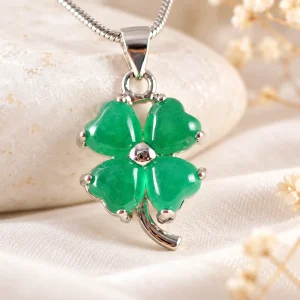
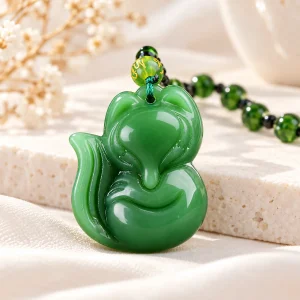
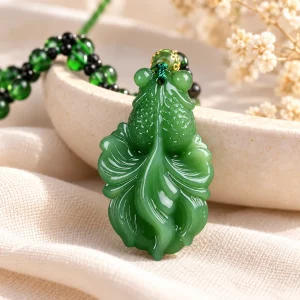
What is attributed to these stones, and what I do not say about them
What follows changes register, and I flag it rather than blending it into the rest. Nothing in it is proven: it is what traditions have attributed to this stone.
Contemporary crystal healing authors are said to associate jade with balance and luck, and classical Chinese thought is said to have seen moral qualities in it rather than a power. These attributions are reported, never established, and I have gathered them in what tradition attributes to jade stone and in the moral virtues of jade.
None of them concerns the Alpine axes. About those objects, I have only archaeology: a massif, quarries, a distance, deposits. Nothing that speaks of an effect on anyone.
The questions I get asked
Is there jade in France?
Jade objects, yes, and plenty of them: the Morbihan deposits are among the richest in Europe. Deposits of the stone itself, I know of none in France. The Neolithic quarries identified are Alpine, at Monte Viso in Piedmont and at Beigua. The material traveled here; it was not mined here.
Are European Neolithic axes made of jadeite or nephrite?
The large Alpine axes are jadeite, from Monte Viso and Beigua; nephrite is the material of Chinese Neolithic objects. Both are jades in the trade sense, they are two different minerals, and confusing them moves a history from one continent to another.
Where can you see polished jade axes in France?
The Carnac Museum of Prehistory, in Morbihan, displays some. The deposits of Mané er Hroëk, the Tumulus Saint-Michel and Tumiac come from the same area. I have gathered the other collections in jade in French museums.
Can you buy jewelry cut from European jade?
Not from me, and I know of no commercial extraction of Alpine jadeite today. What survives of this material belongs to archaeology. A piece sold as jade from the Alps would therefore deserve a question about its origin, and a weighing.
How do we know an axe is jadeite and not serpentine?
Through laboratory analysis, and Damour already worked that way in 1865. At home, on a bare stone, density separates the families: jadeite sits between 3.25 and 3.36, serpentine around 2.6. The protocol is on the weighing page.
Why is jade always described as a Chinese stone?
Because the Chinese tradition is continuous, vast and well documented, whereas European jade stops at the Neolithic and its quarries were only identified in 2003. The word itself comes from elsewhere: it is Spanish, coined in the 16th century in the Americas, and it ended up covering everything.
Where I checked
What comes from a named source. The separation of the two minerals and the word jadeite come from Alexis Damour’s note in the Comptes rendus hebdomadaires de l’Académie des sciences, volume 56, 1863; I do not give the page numbers, as I have not read it. The identification of jadeite in the axes from Celtic monuments is Damour’s, in 1865. Monte Viso, Beigua, the altitude of 1,500 to 2,400 meters, the 3,300 kilometers and the dating to the 5th and 4th millennia come from the work of Pierre and Anne-Marie Pétrequin, the CNRS JADE project, June 2003. The deposits of Mané er Hroëk, the Tumulus Saint-Michel and Tumiac are kept and displayed in Morbihan, at the Carnac Museum of Prehistory. The density ranges are those of the mineralogical literature: I repeat them, I did not measure them, and I attribute them to no particular body because I did not take them from a single one.
What is an observation, dated. On September 8, 2026, reading French pages about jade and the Neolithic, I saw the toughness of the axes credited to the felted structure of nephrite on most of the ones I opened, even when the same page went on to mention the Alps. None of these pages named Monte Viso.
What is my own reasoning. The idea that a material carried over 3,300 kilometers circulates for its value and not for its cutting edge is a deduction, not an excavation result. The fact that I have no European jade to sell rests on my not knowing of any current commercial extraction, which reflects the state of my reading, not a certainty. If you find a mistake here, write to me: I will correct it and note that I did.
In one sentence
Jade circulated in Europe millennia before it arrived from China, in the form of Alpine jadeite axes that came out of Monte Viso and were deposited as far away as Brittany. The method that separates these two minerals is on the weighing page, and the pieces are in the shop.