The Jade Mala: What a String of Beads Really Counts
This page treats the jade mala as an object: what a strand of beads is for, how to judge one, what the stone physically changes, and what I have not been able to verify. It does not cover the carved figure on pendants or the meaning of a motif: those two subjects have their own pages.
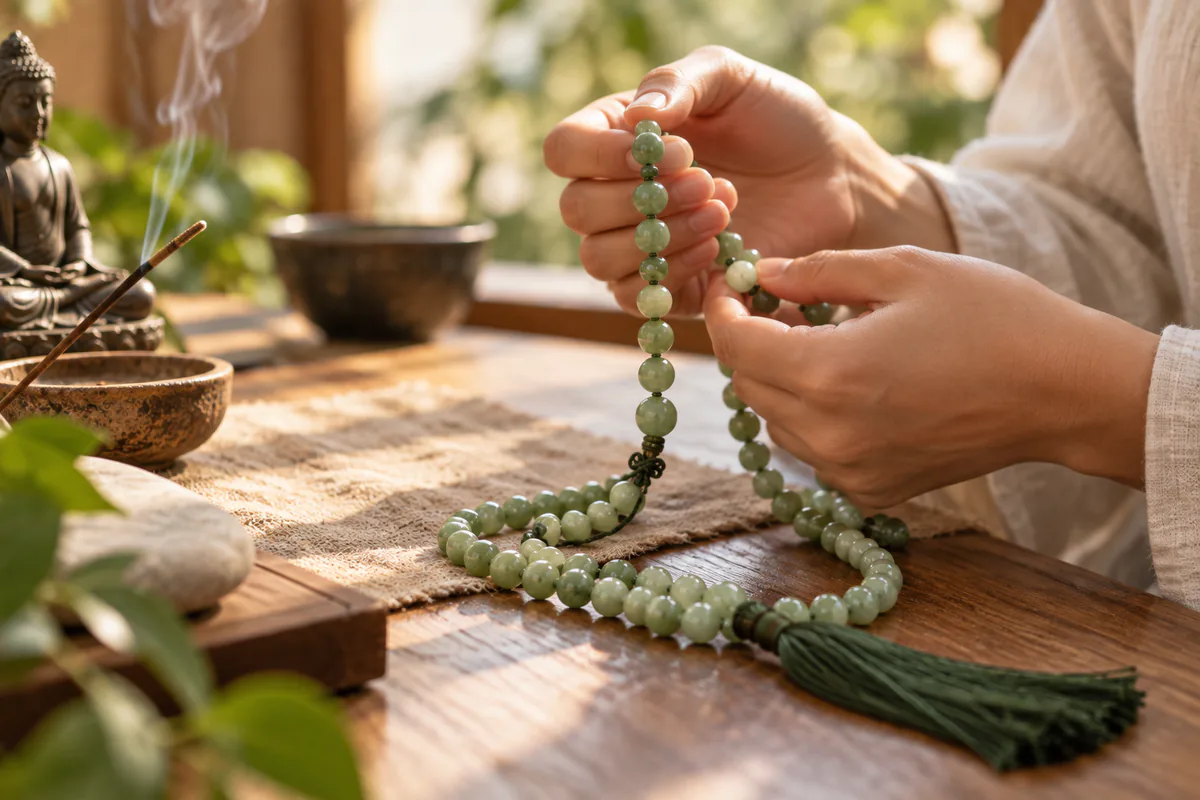
A mala is not a bracelet with a theme: it is a counter, a closed strand of identical beads that you move along to keep count of recitations, and jade adds no function to it, only a material and the constraints that come with it.
Everything else follows from that. A counter has a number of beads, a marker you can find without looking, and a thread that takes repeated friction: three physical questions, and I can deal with all three. What the stone would add to recitation, I cannot.
My name is Jade, and I run a jade jewelry workshop: my pieces are set or chosen one by one, and I weigh one example of each reference before it goes on sale. I am not a gemologist or a therapist, and I do not practice the recitation discussed here: the mineralogy is stated as fact, the practice is reported.
What a strand of beads counts
The word comes from the Sanskrit mālā, garland or wreath, and the object has the shape of its name: a supple ring held in one hand, where you push one bead along with each recitation.
The whole form follows from that use. The beads are calibrated because a counter is read with the fingertips, and an irregular diameter makes you lose count. They are round and smooth because they pass thousands of times between thumb and index finger. The strand is closed because a counter comes back to where it started.
So a mala is judged first as a tool. A thread that catches, a knot that jams between two beads, a bead smaller than the rest: these are functional defects before they are cosmetic ones, and you can see them with the strand laid flat.
The head bead, and the direction you turn
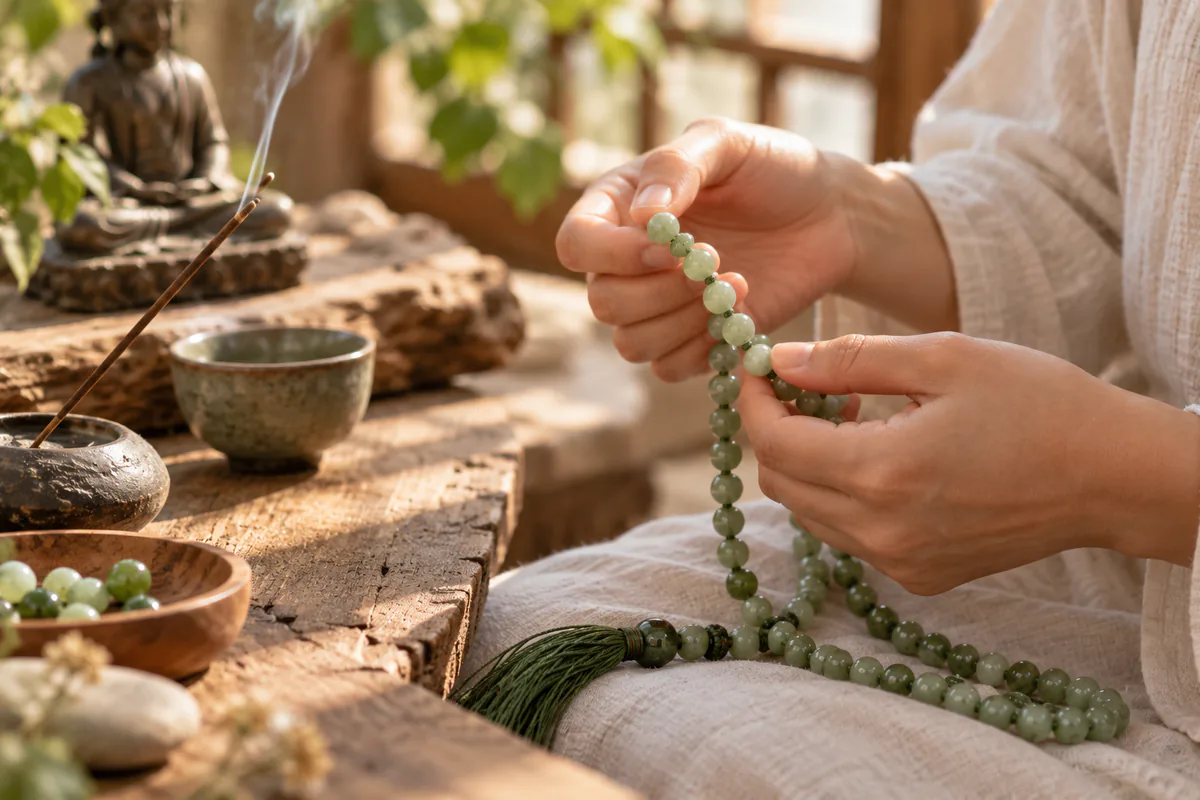
The largest bead is called the head bead, or the guru bead or mother bead depending on the translation, and a tassel often hangs from it. Its function is mechanical before it is symbolic: it tells you a round is finished, and your finger recognizes it without your having to look down. The descriptions agree on one point of practice, which I report conditionally because it is a rule of practice and not a fact a scale can check: you would not cross this bead, you would reverse direction.
The number of beads, and the question I could not close
One hundred and eight. That is the number that comes up on almost every page I opened while preparing this one, and on this point they do not contradict each other.
Its origin, on the other hand, I have not pinned down. The most widespread explanation links the number to a count of passions to overcome; another traces it to a short text in the Buddhist canon, in which a king is said to be advised to string one hundred and eight seeds and recite as he moves them along. I have not read either in an edition I could cite. So I give no title, no reference and no date: I would rather write down this gap than a scholarly-sounding sentence copied from a retailer.
What I can give you is the method: count yours, bead by bead, starting from the big one and stopping when you get back to it. The short wrist strands on sale carry counts that vary from one shop to the next, and I will not publish any count until I have counted it myself.
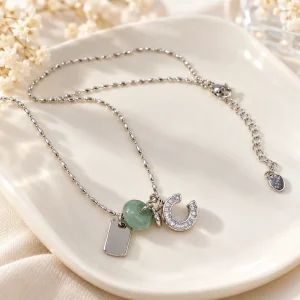
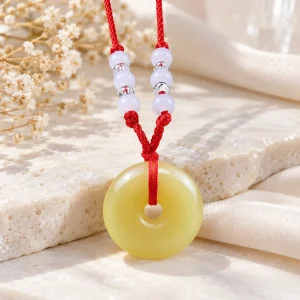
Jade necklaces, chosen one by one
What the stone would add to recitation
What follows changes register, and I flag it rather than blending it into the rest. Nothing in it is proven: it is what traditions have attributed to this stone.
The question comes back in several forms: would jade make practice more effective, deeper, faster. I do not answer it, and this is not commercial caution. A counter sold as a practice accelerator would combine the two promises I refuse to make, the promise of health and the promise of spiritual progress.
What traditions and contemporary authors have attributed to jade is gathered elsewhere, in the conditional and with attribution: what tradition attributes to jade stone. Nothing more here: the subject of this page is the object, not the stone.
A strand of beads is not a mala
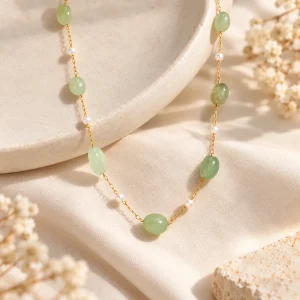
The word has become a shelf label. Many bracelets sold under the name mala are short strands, with no head bead and no fixed count, sometimes strung with beads of two diameters for the look. They are beaded bracelets, and there is nothing wrong with them: they simply do not count anything.
I say this all the more calmly because I sell them. My strand of nephrite beads closed with a flat knot is presented as a bracelet, with the density of the weighed bead and a note that treatment has not been determined. If you are looking for a counter, count the beads before you buy, in my shop as anywhere else.
The same caution applies to the material: many strands advertised as jade are serpentine or dyed quartzite, two materials that have their own names and that the trade disguises under a compound name.
A devotional object sold in a shop is still a sold object
This is the sentence I want to write, because I did not read it from any of the sellers I looked at. A mala bought in a shop arrives the way it left: strung, packed, shipped. It is not consecrated, blessed or charged, nothing I sell is, and I offer no service that would make it so.
That says nothing against the practice: it says the practice is not in the parcel. If a strand of beads becomes an instrument, it is because of what the person holding it does with it, not because of what I wrote on the product page or what it cost. I sell a material and a setting, and charging for the rest would be selling something I do not have.
Jade in a strand of beads: what it changes
Two unrelated minerals carry the name jade, jadeite and nephrite, and most commercial bead strands are nephrite: more common, and tough enough to be drilled in batches. How the two species are told apart is on the jade stone page, with the detail in jadeite or nephrite.
On a counter, what matters is not hardness but toughness, and jade is the textbook case of that difference: moderately hard, exceptionally hard to break. Nephrite sits at about 6 to 6.5 on the Mohs scale, jadeite at 6.5 to 7, and quartz rates 7 while making up a good share of ordinary dust. On a strand that is handled, then, it is the polish that goes first, and faster on nephrite: why jade almost never breaks.
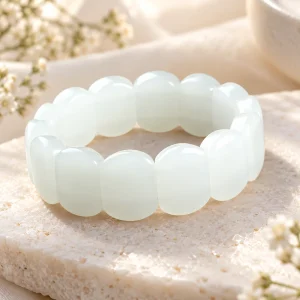
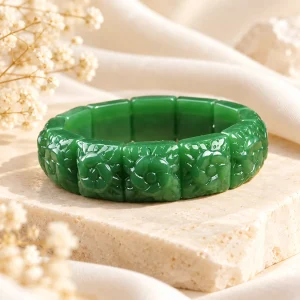
My jade bead strands, density published
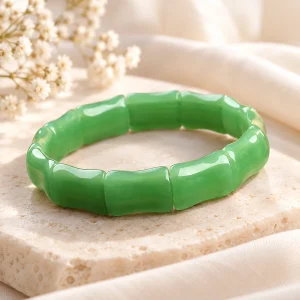
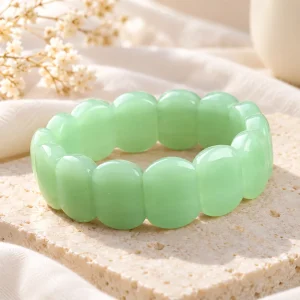
What my scale cannot tell you about a strung strand
I weigh one example of each reference before putting it on sale: the stone in air, then suspended in a glass of water, and the ratio of the two masses gives the density. Jadeite falls between 3.25 and 3.36, nephrite between 2.90 and 3.03, serpentine around 2.6 and dyed quartzite around 2.65. The protocol is on the weighing page.
On a strung strand, this measurement is worthless: the thread, the knot and the tassel go onto the scale and distort the ratio. It is one of the three limits I declare, so what I weigh for a beaded reference is one bare bead from the example, before stringing. The published figure tells you the mineral of that particular bead.
It says nothing about treatment. A bleached, resin-impregnated jadeite weighs about the same as any other, only infrared spectroscopy would settle the question, and my supplier does not know the status of their goods. I write this on every product page rather than keeping quiet: type A, B and C jade, and the treatment information sheet.
The thread, which is what gives way
On an object you move through your fingers, the wear part is not the stone: it is the thread. It stretches, it turns gray, it eventually snaps between two beads, and it almost always gives warning. A strand that gapes, beads that spread apart when you hold it horizontally, a knot that has loosened: that is the moment to act, not the moment it gives way over a sink. The detail is in when to replace the thread or cord on a jade piece.
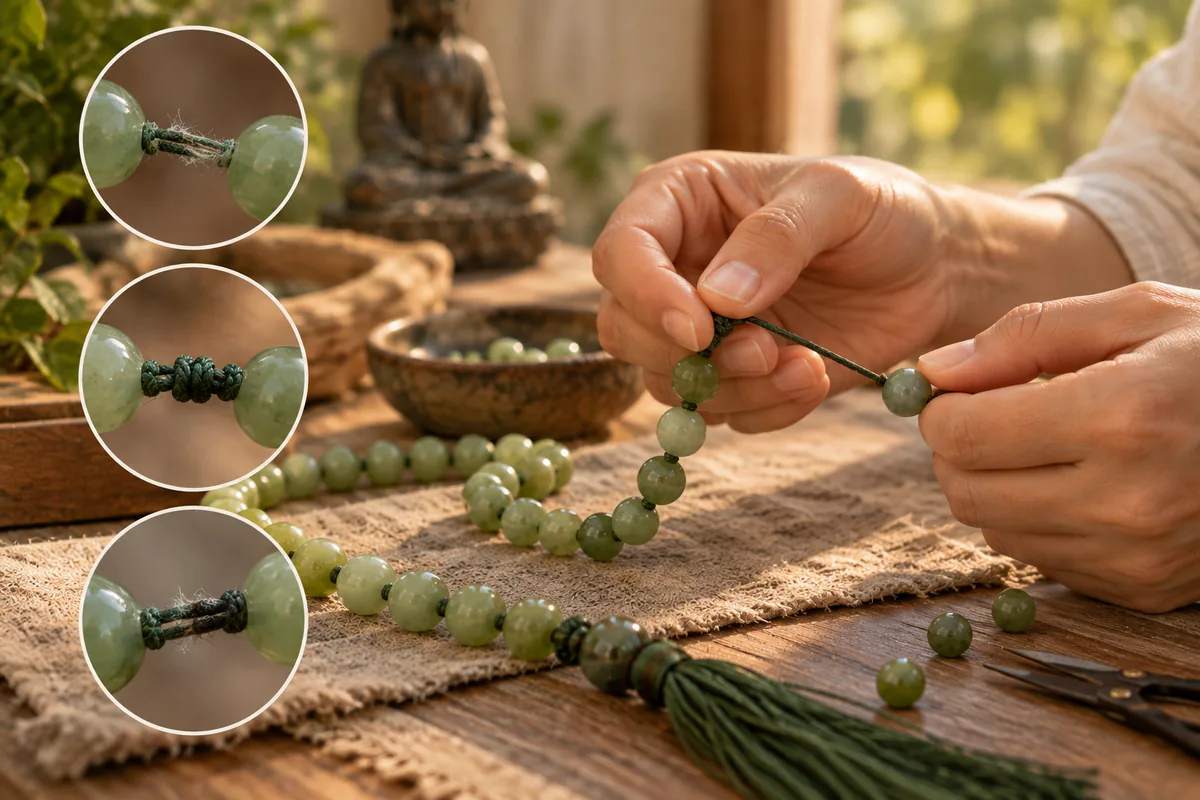
The cleaning rule matters more here than anywhere else: never ultrasonic cleaners or steam. As long as treatment has not been determined, you have to assume resin, and the thread handles the tank no better than the resin does. The rest is in how to clean jade stone.
The figures added to the strand
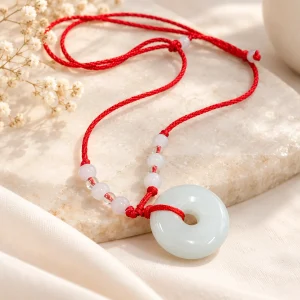
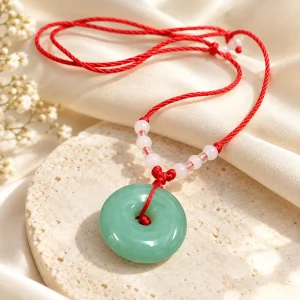
Many strands also carry a carved figure or a pierced disc, which are not part of the counter and are read separately: what tradition attaches to the dragon, the turtle, the elephant and the bi disc is gathered in jade motifs. And the round-bellied, laughing figure sold everywhere as a Buddha is not the historical Buddha: who he really is.
Questions I get asked
How many beads does a mala have?
One hundred and eight on a full strand, according to every page I opened. I have not checked the origin of this number in a text I have read, so I do not present it as fact. The count I stand behind is the one you make yourself, on your own strand.
Is a jade bead bracelet a mala?
Not automatically. A mala is defined by a fixed count and a head bead that marks the starting point. Without those two markers, it is a beaded bracelet, which is nothing to be ashamed of, but it is not a counter.
Should a mala bought in a shop be blessed or consecrated?
I am not the person who can answer that, and I would rather say so. What I can tell you is logistics: an object bought online arrives strung, packed and shipped, and I sell neither consecrated objects nor any service that would make them so.
Does a jade mala break easily?
The stone, no: jade is moderately hard and exceptionally tough. What gives way is the thread, and before that, the polish dulls.
Can you clean a bead strand in an ultrasonic cleaner?
No, and on a strung strand it is doubly no: the tank would attack any resin, which I cannot rule out, and it would wear out the thread and the knots. Lukewarm water, mild soap, a soft cloth, dry it flat.
Is the stone in a mala sold as jade the real thing?
That can be measured, but not on the strung strand, where the thread and knot distort the weighing. So I weigh one bare bead from the example ordered, before stringing, and I publish the figure.
Where I checked
What comes from a named source. The meaning of the Sanskrit word mālā, garland or wreath, is a dictionary fact. The density and hardness ranges are those of the mineralogical literature: I cite them, I did not measure them, and their limits vary by a few hundredths from one database to another, which prevents me from attributing them to a single organization. What I have no source for is written as such in the body of the page: the origin of the number one hundred and eight, and the rule that you do not cross the head bead.
What is a dated market observation. On September 10, 2026, I opened the first pages of French search results for the word mala: one hundred and eight appears almost everywhere, its origin is never tied to an identified text, and several shops sell short strands with no head bead and no fixed count under that name. On September 8, 2026, my supplier confirmed that they cannot say whether their goods are treated.
What is my own reasoning. Weighing a bare bead rather than the strung strand is a decision drawn from the limit my method declares, not a standard; treating the thread as the wear part of a counter follows from it, as does the link between hardness and the wear of the polish; refusing to say what the stone would add to recitation is a position, and I prefer it to be visible. If you find an error here, write to me: I will correct it and note the change.
In one sentence
A mala is a counter before it is a piece of jewelry, it is judged on a count, a marker and a thread, and jade brings to it a tough material whose density I publish without promising anything more. The pieces are in the shop, the method on the weighing page.