Jade Gua Sha, a Polished Nephrite Plate

34,90 €

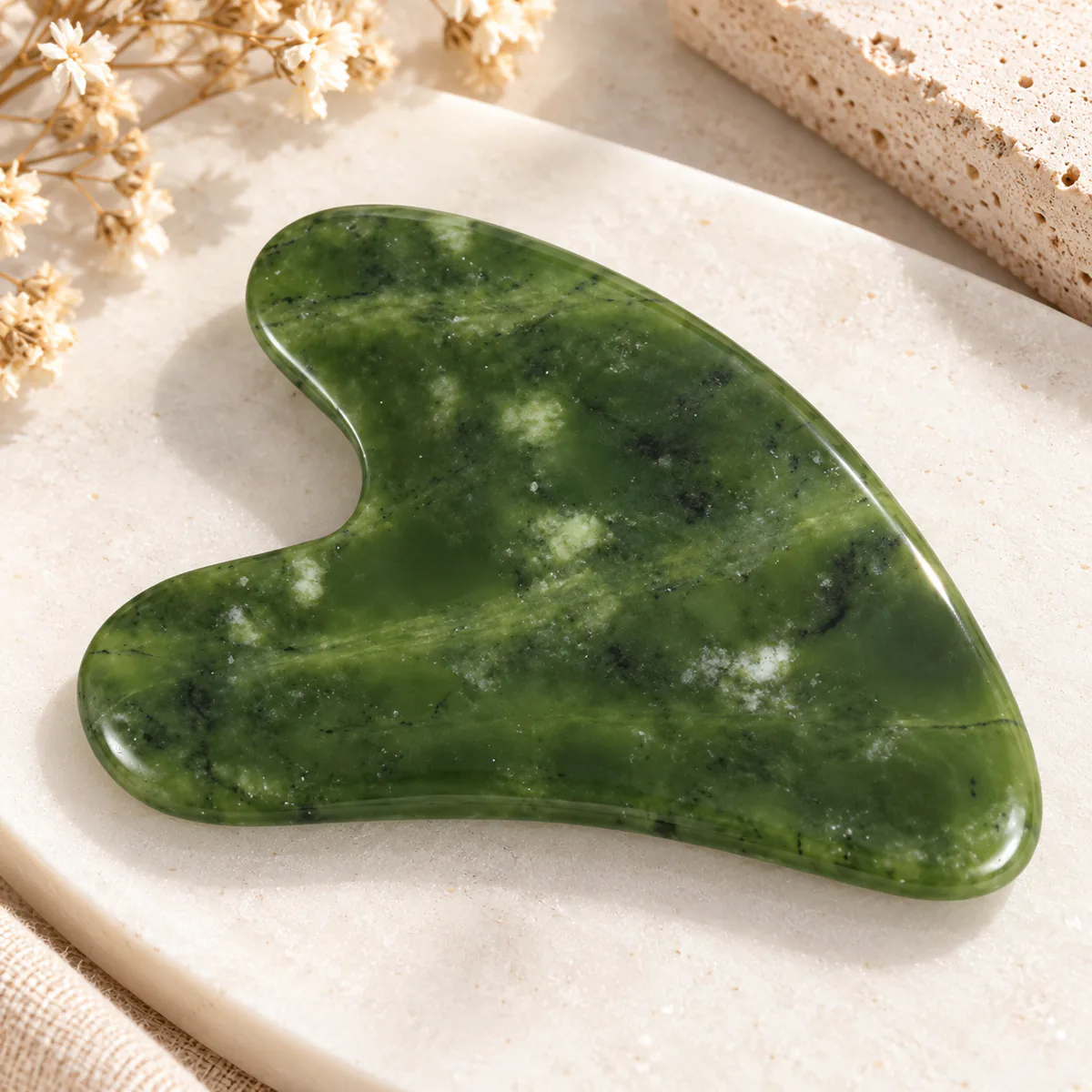
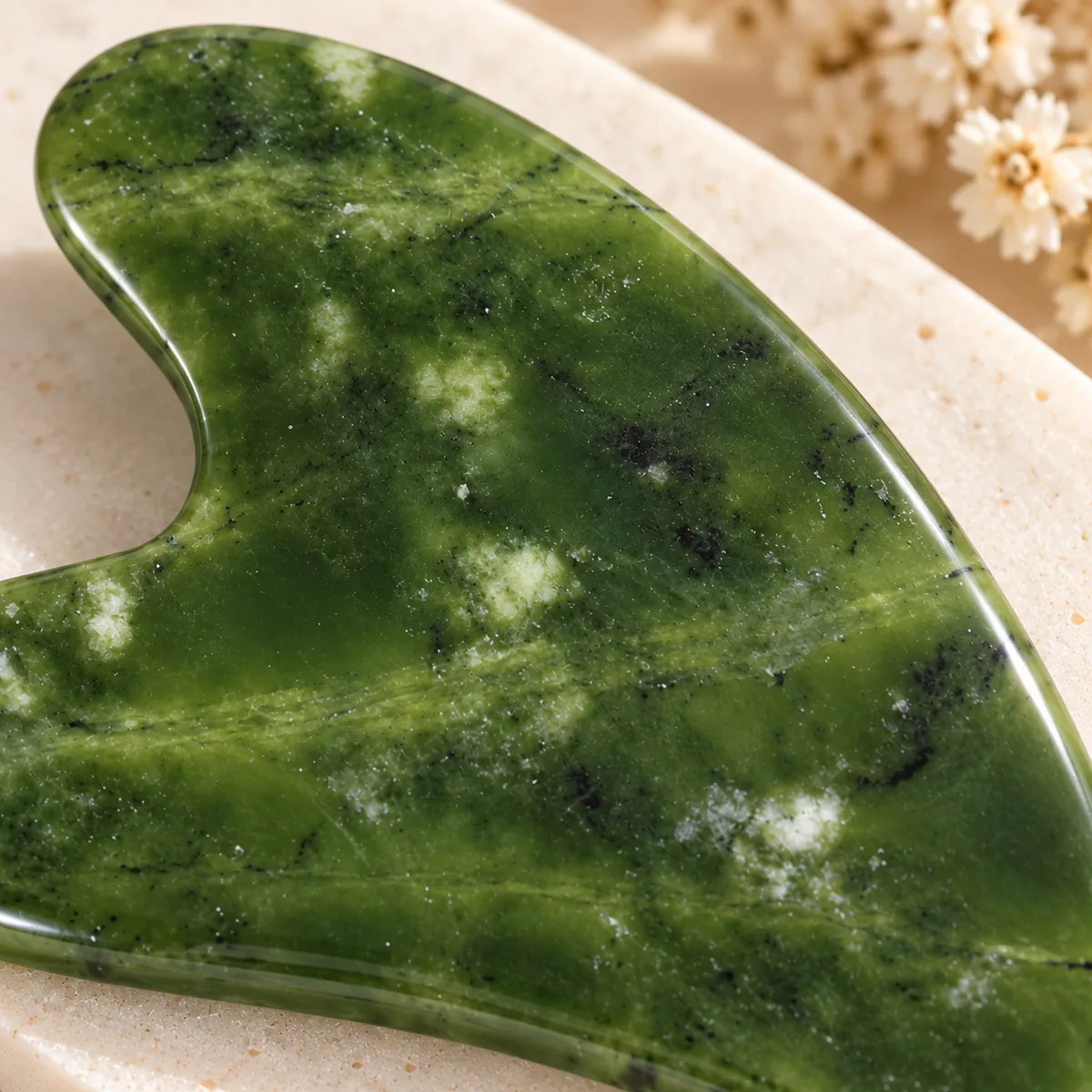
Jade gua sha, a single plate of nephrite polished on both faces, notched on one side, with rounded edges all the way around. Black veins and white patches.

No metal, no glue: it is a bare stone, so it can be weighed. The figure will be published here with its date, which this shop’s roller will never allow.

No cosmetic promise on this page: I sell a plate of polished stone, not a result on a face. The full disclaimer is here.

Category:

A jade gua sha cut from a single plate of nephrite, polished on both faces, with a notch on one side and an edge that thins toward the tip. The green is crossed by black veins and white patches. No metal, no mounting: it is a bare stone.

In four lines

  • A single plate of stone, polished on both faces. No metal, no glue.
  • A bare stone, so it can be weighed: the figure will be published here, with its date.
  • Black veins and white patches: the material has not been made uniform.
  • No cosmetic promise on this page, and that is a brand rule.

The only skincare object in the shop that can be weighed

Massage tools are the aisle where the word jade is most often false: serpentine, labeled new jade or Korean jade, and green aventurine circulate there in bulk, carried by low prices and mass production. None of these names means jade.

My method exists to settle exactly that, and it fails on the roller, whose heads are riveted into metal. Here, it applies. Nothing to take apart, nothing to cut: the plate goes into the glass of water as it is, and serpentine, at 2.6, cannot pass for nephrite at 2.90. That is a gap of thirty hundredths, huge for a kitchen scale. The three limits of weighing.

What I will not say on this page

No cosmetic promise. You will not read here that this gua sha firms, drains, refreshes, decongests, smooths or reduces anything at all. It is not a legal precaution, it is a position: I sell a plate of polished stone, not a result on a face.

You will not see a photo of it being used on a face either, or a before-and-after comparison. These are rules this shop set for itself and keeps on every page. The virtues attributed to jade, told honestly, and the medical disclaimer.

The shape, and what it is really worth

The plate has a notch on one side, a long, slightly convex edge and a softened tip. It is the most common shape, and its logic is simple: several curves on one object, to fit several surfaces.

What really matters lies elsewhere: the edge must be polished, never sharp, and the thickness must taper evenly. A gua sha with a sharp edge is unforgiving on skin. This one has rounded edges all the way around, including inside the notch, which is the spot most often done carelessly.

The black veins, and what they indicate

The plate is crossed by fine black veins and irregular white patches. Nephrite often carries dark inclusions of this kind, and its color is spread in bands because the iron was not deposited evenly.

It is not proof, and the treatment status of this piece remains not determined. It is the opposite of a warning sign: what should raise an eyebrow is a perfectly uniform color, or one that follows a network of cracks rather than the body of the stone. The checks that need no equipment.

Care, and the real risk

Lukewarm water, a mild soap, a soft cloth and thorough drying. Never ultrasonic cleaners, never steam, never solvents: the treatment status is unknown, and any resin would not withstand them.

The real risk is dropping it. Jade is very tough, its structure of interlocking fibers stops a crack from spreading, but its hardness is ordinary, 6 to 6.5 for nephrite. A thin plate dropped on a washbasin chips at the tip, which is its thinnest part. Lay it flat, never on its edge. The difference between hardness and toughness, and care in detail.
Additional information

StoneNéphrite
ColorTwo tone
Stone shapeGua sha
MotifNo motif
MountingNone
MetalNone
SettingNo setting
Worn byUnisex
Paired stonesNone, jade only
Mineral familyCalcic amphibole
Hardness (Mohs)6 to 6.5
Reference density2.90 to 3.03 g/cm³
ToughnessExceptional, interlocking crystals
TreatmentNot determined
OriginOutside Burma, country of extraction not confirmed

Lead Times

Shipped within 48 hours of your order being confirmed, for delivery within 14 days from the day it ships. I keep no buffer stock, and I will not promise a date I cannot meet.

Shipping Costs

€6.99 no matter the destination, and free on orders of €47 or more to France, Belgium, Switzerland, and Luxembourg. The exact amount shows in your cart before you pay.

The Packaging, and Why It Matters

Every piece leaves in its own pouch, kept apart from the others. This is not about presentation: jade’s hardness is ordinary, 6 to 6.5 for nephrite and 6.5 to 7 for jadeite, and the quartz in everyday dust rates 7. Two pieces of jewelry that travel together arrive scratched.

Fourteen Days to Change Your Mind

No reason needed. One email opens a return, and there is no form to fill out. Return shipping is at your expense, unless the piece does not match its listing or arrives damaged.

It is all spelled out here, with no fine print.

The Simple Routine

Lukewarm water, mild soap, a soft cloth. A very soft brush for the hollows of a carving. That is all, and it is enough.

What You Must Never Do, and Why

No ultrasonic cleaner, no steam, no solvent, no heat source. The reason is not caution for its own sake: the treatment status of my pieces is undetermined. My supplier cannot tell me, and the weighing establishes the mineral without saying anything about a possible resin impregnation. Resin withstands neither heat nor solvents, so every piece is handled as though it might contain some. The treatment information page.

The Scratch, and Where It Comes From

Jade is tough, meaning very hard to break: its structure of interlocking crystals resists cracking, and that is what made it possible to turn it into axes in the Neolithic. Its hardness, on the other hand, is ordinary, 6 to 6.5 for nephrite and 6.5 to 7 for jadeite. The quartz in everyday dust rates 7, and that is what dulls a jade, not impacts. The difference between the two.

Day to Day

Put the piece on after perfume and lotion, never before. Take it off for housework, gardening, and sports, where the hard knocks happen. Store each piece on its own, in its pouch. On a strand of beads, the thread wears out before the stone does: it gets restrung, and there is nothing abnormal about that.

Cleaning a jade piece and storing it.

What I Do, and What I Don’t

My name is Jade. I am French, from Morbihan in Brittany, and I live in Tallinn. I choose the pieces and have them set: I mine nothing, I carve nothing, and I do not do the metalwork myself. What I bring is the sorting, and with this material the sorting decides everything.

I am not a gemologist, a lapidary, or a therapist, and I do not claim to be.

I Weigh, I Do Not Certify

Before putting a reference online, I order one example of it for myself. When it reaches me unset, I weigh it in air, then suspended from a thread in a glass of water: the ratio of the two masses gives the density, and that figure separates jadeite, nephrite, serpentine, and dyed quartzite without ambiguity.

One example per reference, and not every piece. I never handle the piece that ships to you, and I would rather say so plainly than let anyone believe otherwise. The method, with its three limitations.

What I Cannot Know

The treatment status of my pieces. My supplier cannot tell me, and neither can the scale: it establishes the mineral, not the resin impregnation. Only laboratory infrared spectroscopy would settle the question, and I do not have that testing done. So you will never read “jadeite A”, “type A” or “untreated” on this site. The information page.

Where My Jade Comes From

No Burmese jadeite, and the first reason is legal. Not the one you read everywhere: the JADE Act of 2008 did ban these stones in the United States, but that ban was lifted on October 7, 2016. What applies today dates from April 8, 2021: the US Treasury sanctioned Myanma Gems Enterprise, the state-owned company that controls the Burmese gem trade. So there is no blanket ban, but an American is not allowed to do business with that entity, and a stone never tells you where it has been. I run one supply chain for ten markets, and it has to stand up to the strictest one. When an origin is not confirmed to me in writing, the listing does not state it. My origin policy.

The whole story.