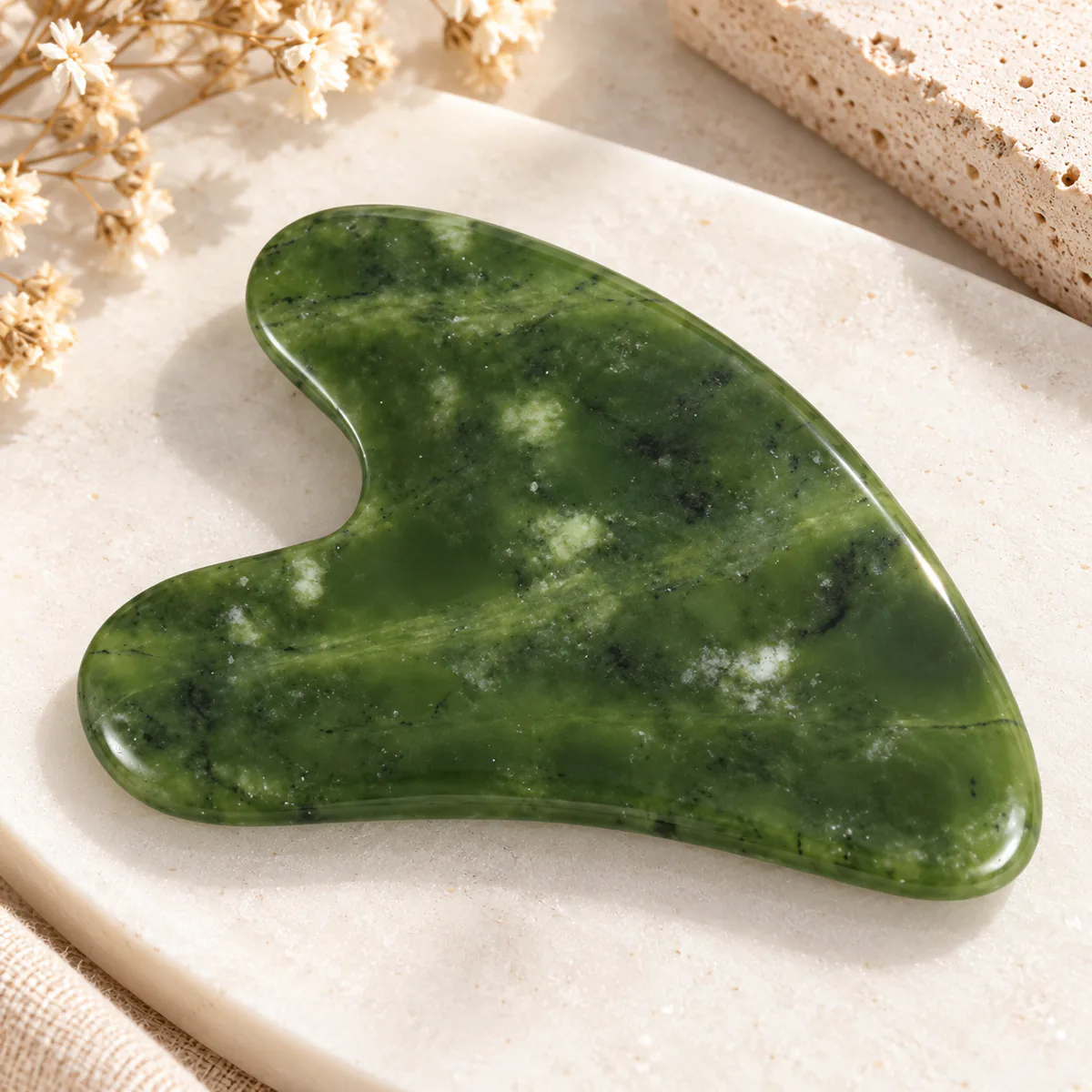
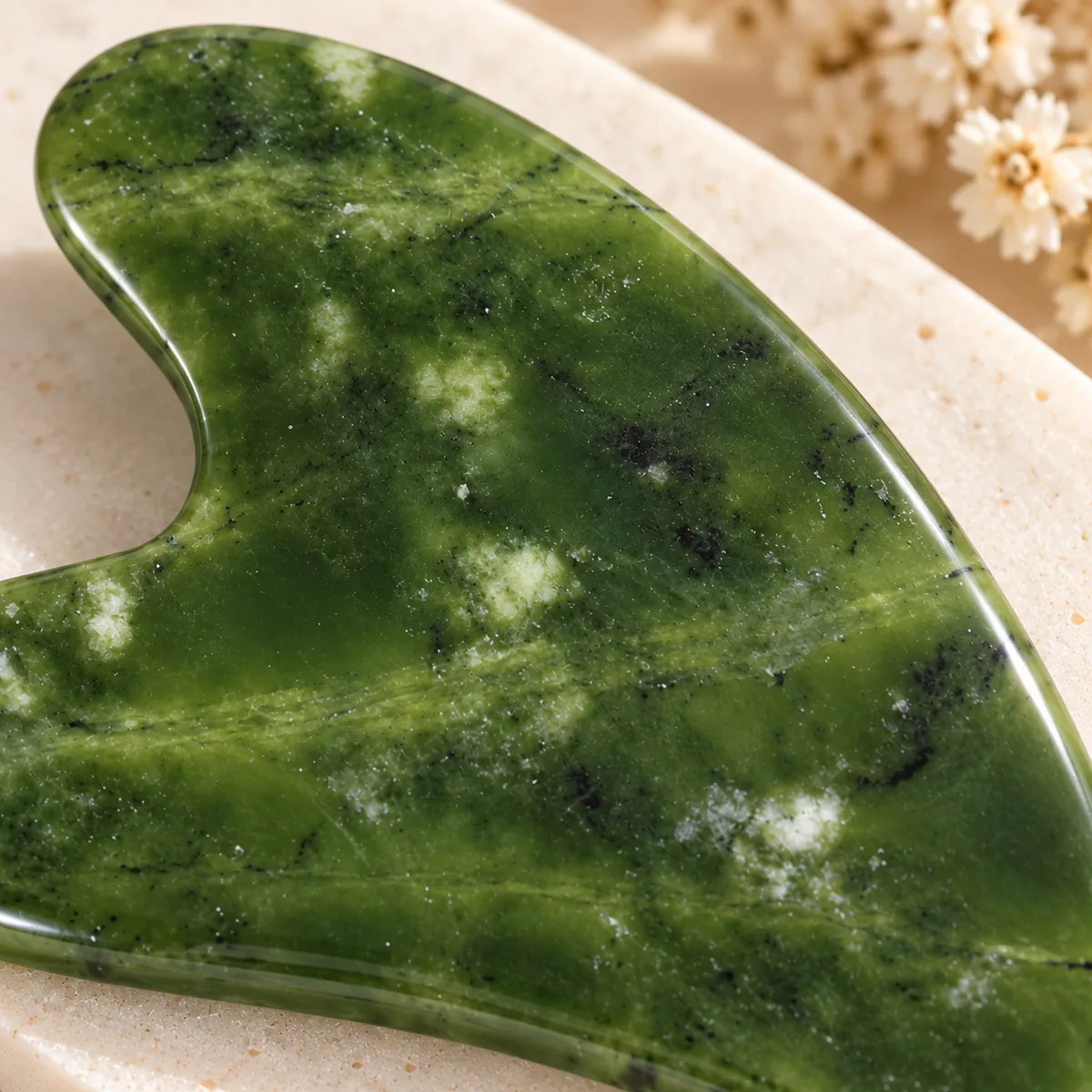
A jade gua sha cut from a single plate of nephrite, polished on both faces, with a notch on one side and an edge that thins toward the tip. The green is crossed by black veins and white patches. No metal, no mounting: it is a bare stone.
In four lines
- A single plate of stone, polished on both faces. No metal, no glue.
- A bare stone, so it can be weighed: the figure will be published here, with its date.
- Black veins and white patches: the material has not been made uniform.
- No cosmetic promise on this page, and that is a brand rule.
The only skincare object in the shop that can be weighed
Massage tools are the aisle where the word jade is most often false: serpentine, labelled new jade or Korean jade, and green aventurine circulate there in bulk, carried by low prices and mass production. None of these names means jade.
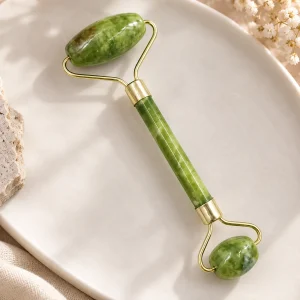
My method exists to settle exactly that, and it fails on the roller, whose heads are riveted into metal. Here, it applies. Nothing to take apart, nothing to cut: the plate goes into the glass of water as it is, and serpentine, at 2.6, cannot pass for nephrite at 2.90. That is a gap of thirty hundredths, huge for a kitchen scale. The three limits of weighing.
What I will not say on this page
No cosmetic promise. You will not read here that this gua sha firms, drains, refreshes, decongests, smooths or reduces anything at all. It is not a legal precaution, it is a position: I sell a plate of polished stone, not a result on a face.
You will not see a photo of it being used on a face either, or a before-and-after comparison. These are rules this shop set for itself and keeps on every page. The virtues attributed to jade, told honestly, and the medical disclaimer.
The shape, and what it is really worth
The plate has a notch on one side, a long, slightly convex edge and a softened tip. It is the most common shape, and its logic is simple: several curves on one object, to fit several surfaces.
What really matters lies elsewhere: the edge must be polished, never sharp, and the thickness must taper evenly. A gua sha with a sharp edge is unforgiving on skin. This one has rounded edges all the way around, including inside the notch, which is the spot most often done carelessly.
The black veins, and what they indicate
The plate is crossed by fine black veins and irregular white patches. Nephrite often carries dark inclusions of this kind, and its colour is spread in bands because the iron was not deposited evenly.
It is not proof, and the treatment status of this piece remains not determined. It is the opposite of a warning sign: what should raise an eyebrow is a perfectly uniform colour, or one that follows a network of cracks rather than the body of the stone. The checks that need no equipment.
Care, and the real risk
Lukewarm water, a mild soap, a soft cloth and thorough drying. Never ultrasonic cleaners, never steam, never solvents: the treatment status is unknown, and any resin would not withstand them.
The real risk is dropping it. Jade is very tough, its structure of interlocking fibers stops a crack from spreading, but its hardness is ordinary, 6 to 6.5 for nephrite. A thin plate dropped on a washbasin chips at the tip, which is its thinnest part. Lay it flat, never on its edge. The difference between hardness and toughness, and care in detail.