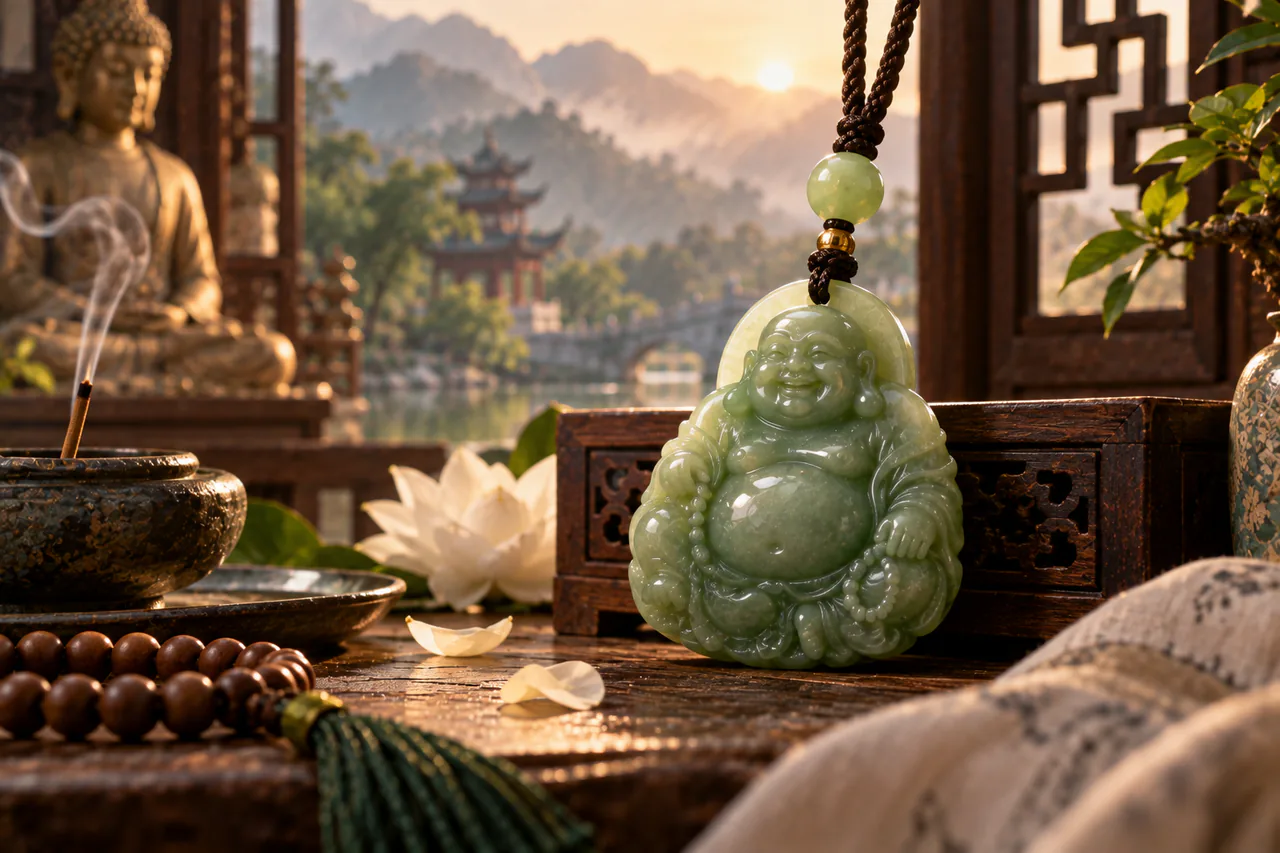
Jade Buddha Pendant Meaning: Who the Figure Really Is
A search for “jade buddha pendant meaning” is looking for a proper name. This page gives it, explains where the round-bellied figure carved in jade comes from, what Chinese and then Japanese tradition attached to it, and what I can say about the stone itself before attributing anything to it.
The round, laughing figure on jade pendants is not the historical Buddha: it is Budai, a 10th-century Chinese monk whom tradition recognized after his death as a manifestation of Maitreya, the Buddha to come.
Two figures, two continents, nearly fifteen centuries apart: Buddhist art shows Siddhartha Gautama slender, eyes lowered, never roaring with laughter. What the trade sells under the labels “laughing Buddha” or fat Buddha is the other one.
My name is Jade, and I run a jade jewelry workshop: I choose the pieces, have them set, and weigh one example of every piece before it goes on sale. I am neither a gemologist, nor a historian of religion, nor a therapist: what follows separates what is dated from what is told.
Budai, the monk with the cloth sack
His Chinese name, Budai, means cloth sack: it is the object he carries in almost all his depictions, and tradition also gives him a religious name, Qici, which usage has not kept.
The accounts describe him as a wandering monk from the Fenghua area, in present-day Zhejiang, under the Later Liang, one of the short-lived dynasties between the Tang and the Song. He sleeps wherever he drops, begs, predicts the weather, and hands out to children whatever he has been given. His death is traditionally placed in 916, at Yuelin monastery.
This biography should be read for what it is. The oldest known accounts of him date from three quarters of a century after his death, and they already describe a saint rather than a man: Budai is a figure of tradition, not a monk whose civil records anyone holds.

How a monk becomes the Buddha to come
The shift rests on a verse attributed to Budai just before his death: Maitreya, the true Maitreya, divides himself into countless bodies, he constantly shows himself to the people of his time, and the people of his time do not recognize him. I give the meaning attributed to it in the accounts available to me, not a reference translation.
Maitreya, Mílè in Chinese, is the Buddha of the next age, the one who is to appear when the teaching of Shakyamuni has run its course. Recognizing Budai as his manifestation therefore meant saying he had already come, and that no one had seen him.
The consequence can still be seen in Chinese monasteries: the statue facing the entrance is Maitreya in the form of Budai. From what I have read, this form took hold in the Song period and replaced an older iconography in which Maitreya was slender and often seated with his legs hanging down.
Hence a nuance I have not read on any jewelry page I opened while preparing this one: calling this figure a Buddha is not a mistake in Chinese Buddhism, he is one, the Buddha of the future. The mistake is to take him for the Buddha, the one who taught.
Jade pendants available now
What sets him apart from the historical Buddha
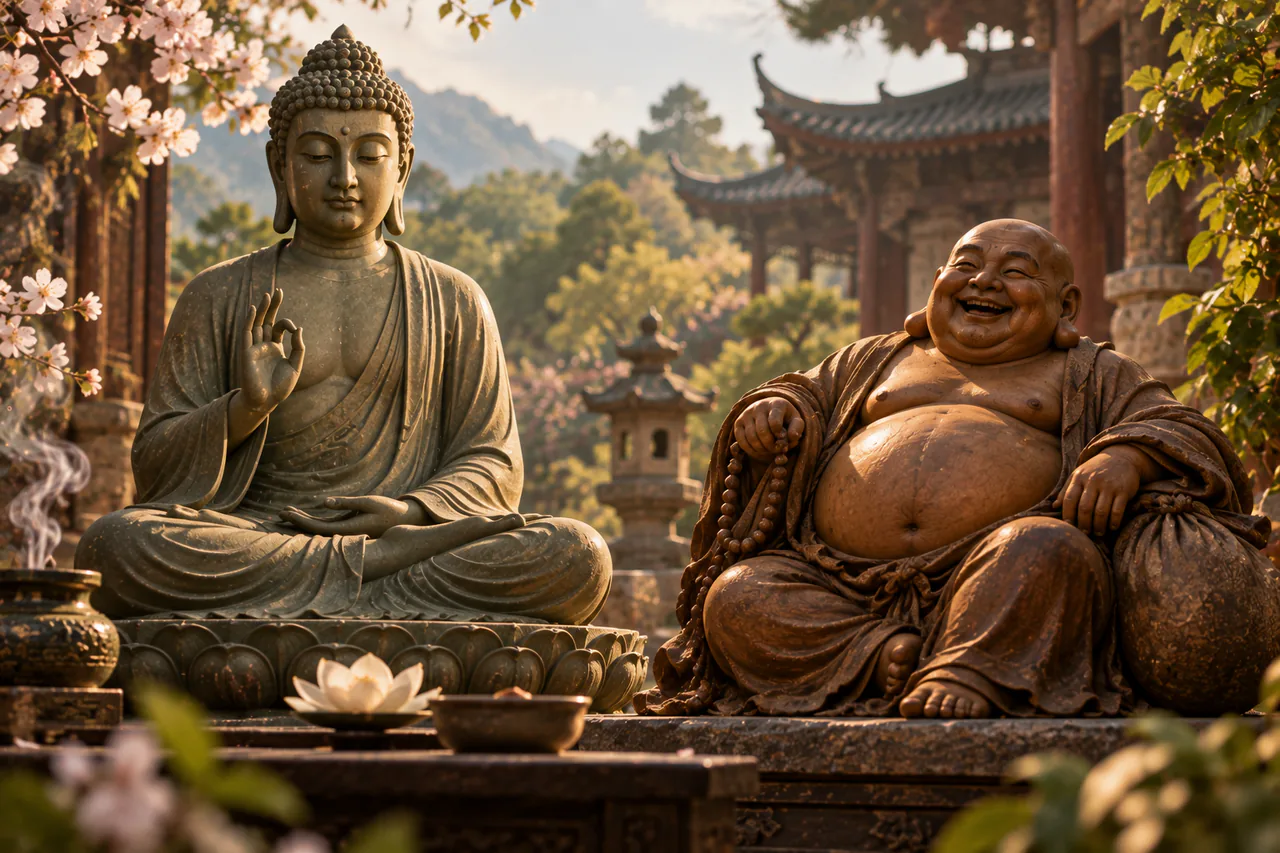
On a pendant, the distinction can be made by eye, and it comes down to a few signs.
| Siddhartha Gautama | Budai | |
|---|---|---|
| Period | 5th century BCE, dating debated | 10th century CE |
| Place | Northeastern India | China, Fenghua area |
| Status | The one whose teaching founded Buddhism | Monk, later recognized as Maitreya |
| Body | Slender, still, eyes lowered | Bare belly, open laugh, relaxed posture |
| Signs | Cranial protuberance, elongated earlobes, covering robe | Bald head, cloth sack, sometimes prayer beads |
That is why a search for jade buddha pendant meaning brings up the word Buddha on every page I opened, and almost never the name Budai: the trade name has covered over the real one. A third form also circulates, rarer, a seated cross-legged figure, slender, hands resting one on the other: that one really does represent Shakyamuni.
What tradition attributes to the figure
What follows changes register, and I flag it rather than blend it into the rest. Nothing in it is proven: it is what traditions have attributed to this figure and to this stone.
A stone does not heal anything, and the full disclaimer is here.
Budai is said to be the figure of contentment rather than wealth: a man who owns only a sack and laughs. The ingot, the gourd and the holed coin that turn him into an image of abundance are not in the story, and I take them to be later additions; contemporary authors are said to associate him with good humor, generosity and the protection of children, who often surround him in figurines.
Rubbing the figure’s belly for luck is a popular gesture I cannot tie to any text: I mention it because people ask me. The belief in jade as a lucky charm, for its part, is older than this motif and has its own history, told in where the lucky charm idea comes from.
Hotei, the same figure under another name
In Japan, Budai becomes Hotei, and he joins the group of seven gods of good fortune, the Shichifukujin, alongside figures drawn from Shinto, Buddhism and Taoism. Same silhouette, same sack, different culture: jade in Japan.
What I will not write, and what you can read on most pages on the subject: that a pendant attracts money, wards off misfortune or changes anything about someone’s health. The figure has a history, it has no effect.
Why this figure is carved in jade
The match is not a market accident. Jade does not cleave and cannot be faceted: it is worn away by abrasion, with a powder harder than itself. A material worked this way lends itself to full, rounded volumes, and a figure with no edges or points suits it better than an angular cut. Its toughness also allows a bail to be drilled right into the stone: why jade almost never breaks.
Then there is the cultural fact: in China, the material has carried ritual figures since the Neolithic, and the Buddhist motif slipped into a use that was already established. The other figures, dragon, tortoise, elephant, pierced disc, are covered in jade motifs, and the stone’s place in Chinese culture in Chinese jade jewelry.
The flip side of this success: the motif is mass-produced, serpentine and dyed quartzite carve faster and cost less, and many Buddhas sold as jade are not jade. The cover names are listed in stones sold as jade.
Jade bracelets, chosen one by one
What I can say about the stone, and what I cannot
The only thing I can check at home is the nature of the mineral: weighed in air, then suspended in a glass of water, the stone gives its density by a simple ratio.
- Jadeite: 3.25 to 3.36.
- Nephrite: 2.90 to 3.03.
- Serpentine: about 2.6.
- Quartzite, dyed or not: about 2.65.
The full protocol is on the weighing page, and three of its limits matter here. I weigh one example per piece, the one I order before the piece goes on sale, not every order that ships. The measurement applies to the bare stone: a metal bail skews the result. And it tells you the mineral, not the treatment: a resin-impregnated jadeite weighs about the same as any other, only infrared spectroscopy would settle it, and I do not have that.
My supplier cannot say whether its stock has been treated either, and I write that rather than stay silent, because silence reads as a guarantee: the real classification is explained in jade A, B, C and in the treatment information sheet, and what I publish on a product page in what I publish on each product page. You will never read “type A” or “untreated” over my name. The mineralogy of the two species is on the jade stone page.
Choosing, wearing, giving
Three things are worth looking at before the price, and none requires special knowledge.
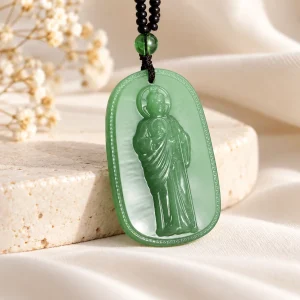
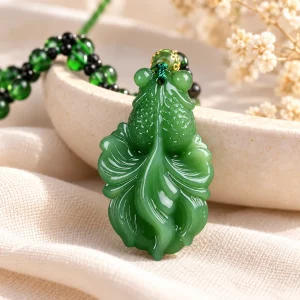
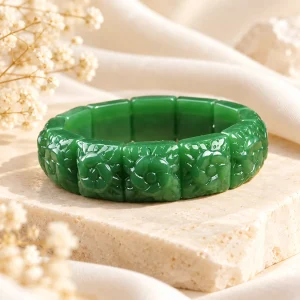
- The carving. A motif carved in the round, where the sack and the folds really exist, does not involve the same work as a flat relief engraved on a plaque. Both can be worn, they are not priced the same.
- The bail. Drilled into the stone, it leaves the piece whole and weighable; set in metal, it adds a mounting, a wear point and an obstacle to measurement. What each metal does to green is in jade and gold jewelry.
- The cord and care. The cord is chosen after the stone and gets replaced (thread and cord for jade jewelry); cleaning is done with lukewarm water, never an ultrasonic cleaner or steam as long as the treatment has not been determined (how to clean jade stone).
As for wearing it, some practitioners report customs: do not wear the figure below the waist, take it off to wash. I mention them because they exist, I do not make them a rule. A pendant with a religious figure is also best given knowing who it is for: giving jade jewelry. I give no price or size here, they are on the pendant’s product page.
The questions I get asked
Is the laughing jade Buddha the Buddha?
Not the one people think. The round-bellied figure is Budai, a 10th-century Chinese monk whom tradition holds to be a manifestation of Maitreya, the Buddha of the next age. It is not Siddhartha Gautama, who is depicted as slender.
Should you rub the pendant’s belly for luck?
It is a very widespread popular gesture with no basis I know of in the texts. I report it, I do not recommend it, and I promise neither luck, nor money, nor protection.
Can you wear this figure without being Buddhist?
Nothing forbids it, and I set no conditions on buying one. The only thing I advise is knowing who you are wearing, which is what this page is about.
How can I tell if my Buddha is real jade?
By its density, if the stone is bare: around 2.6 or 2.65, it is serpentine or quartzite. A metal bail or a cord skews the measurement, and a set pendant cannot usefully be weighed. The method is on the weighing page; the scratch and cold tests prove almost nothing.
What is the difference between the laughing Buddha and Hotei?
None, apart from the language. Hotei is the Japanese name for Budai, and in Japan he is one of the seven gods of good fortune. The same silhouette travels under two names.
Does this motif come in colors other than green?
Yes. White nephrite, honey, lavender jadeite and black carve just as well, and color says nothing about the quality of the carving. The full palette is covered in jade stone colors.
Where I checked
What comes from a named source. Budai’s account appears in two Chinese Buddhist compilations, the Song Biographies of Eminent Monks, completed in 988, and the Jingde Record of the Transmission of the Lamp, compiled in 1004. I do not read classical Chinese and have not opened them: I report what the accounts available to me say about them, including for the verse about Maitreya. The density ranges are those of the mineralogical literature: I repeat them, I did not establish them, and I attribute them to no particular organization, since I did not take them from a single one.
What is a market observation, with a date. On September 8, 2026, going through the nine French competitors on the first page of results for jade, I found none that states the mineral of its pieces, and my supplier confirmed the same day that it does not know whether its stock has been treated. The same survey shows the name Budai on none of the pages ranking for this query: that is the reason this article exists, far more than its search volume, which is tiny.
What is my own reasoning. The idea that the ingot and the gourd are later additions to the legend, the choice to treat customs of wear as reported practices and not rules, and the choice to draw no sales argument from the correction this page makes: decisions, not established facts. If you find a mistake here, write to me: I will correct it and note that I did.
In one sentence
The laughing figure on a jade pendant is Budai, a monk who became the Buddha of the future in Chinese tradition, and naming him correctly makes the piece neither more expensive nor more effective: its worth lies in the stone, which can be weighed, and in the carving, which can be looked at. The pieces are in the shop.