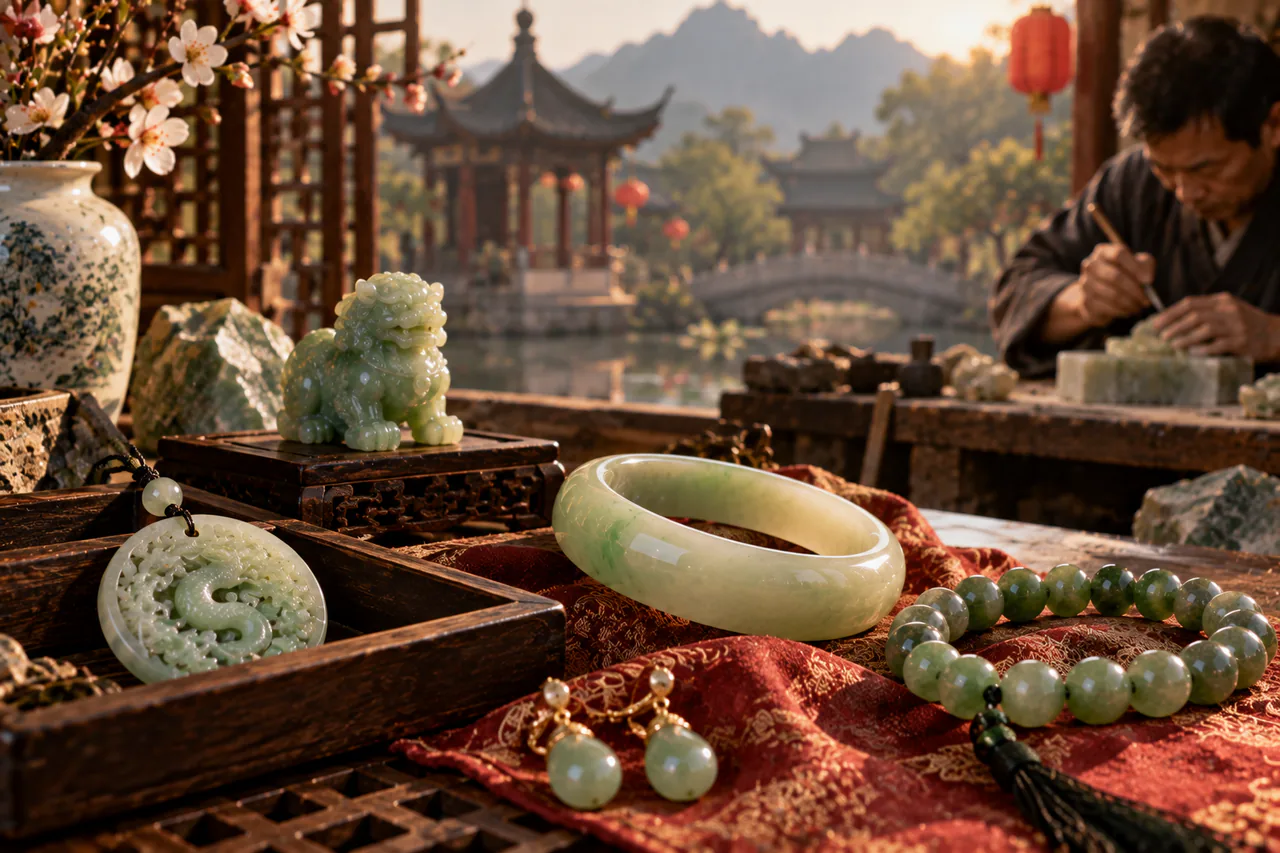
Chinese Jade Jewelry: The Subject, Not the Label
This page treats Chinese jade jewelry as a subject rather than a trade name: eight thousand years of worked stone, what China read into it, what the bracelets, pendants and necklaces people call Chinese are worth, and why the same phrase, printed on a label, no longer refers to any of it.
The jade of ancient China is nephrite, jadeite only arrives late and by way of Burma, and “Chinese jade” written on a label names neither: it is a trade name that most often covers serpentine or dyed quartzite.
My name is Jade, and I run a jade jewelry workshop: I choose the pieces, have them set, and weigh one example of every piece before it goes on sale. I am neither a gemologist nor a therapist: here the mineralogy is stated as fact, and everything else is attributed.
What “from China” means, and the three senses people mix up
Someone looking for jade jewelry with China in mind may want three things that have almost nothing in common.
- The stone and its history. What China has worked since the Neolithic, and what it read into it. That is a real subject, and it is the one most of this page covers.
- The workshop. The place where the stone was carved, drilled and set, which is almost never where it came from.
- The label. Two words on a sales tag, which tell you nothing about the material or the workshop, and which often cover a stone that is not jade.
The first two deserve an answer, the third a refusal.
Eight thousand years, and a single stone for almost all of it
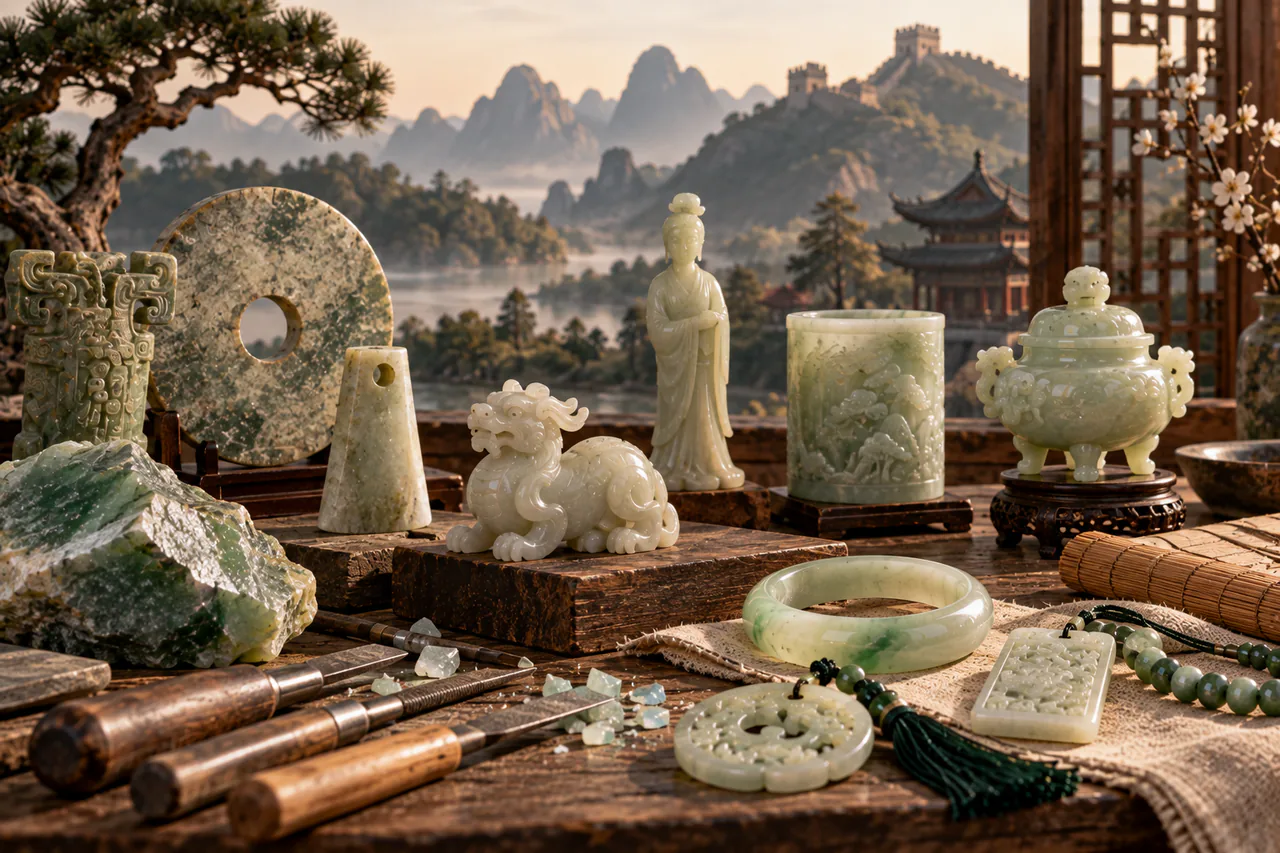
The oldest worked jades in China are dated back about eight thousand years, and for most of that time only one mineral is involved: nephrite. Bi discs, cong tubes, the ornaments of the Liangzhu culture, the ritual carvings that made Chinese jade famous: nephrite.
This nephrite is an amphibole made of microscopic fibers tangled together like felt. That felted structure makes it hard to break, which is why it was used for tools before it was used for prestige objects. Its hardness, on the other hand, remains modest, 6 to 6.5 on the Mohs scale: the difference between the two minerals is in jadeite vs nephrite, and the full guide to the material in jade stone.
At the same time, Neolithic Europe was also polishing jade axes, but of Alpine jadeite from Monte Viso: jade did not wait for China to reach Europe (jade in Europe).
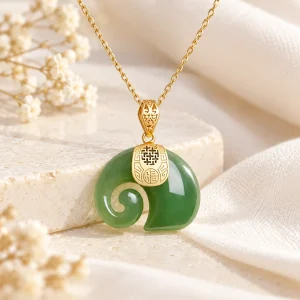
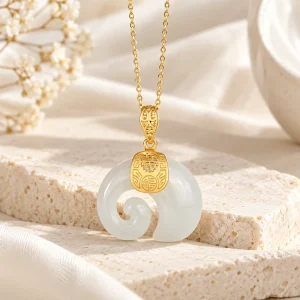
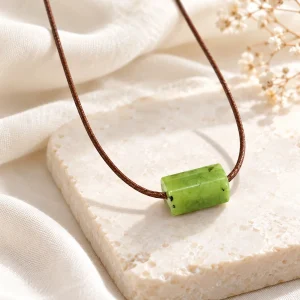
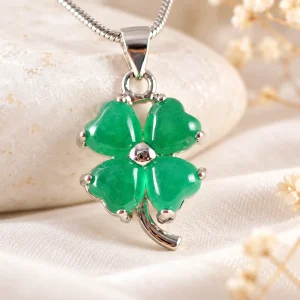
Pendants, one named mineral per piece
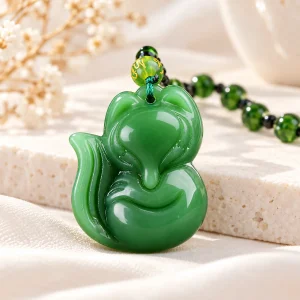
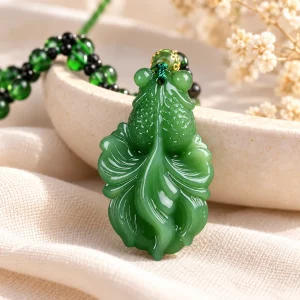
Jadeite arrives late, and not from China
Jadeite, the other stone the word jade covers, enters China much later. It is imported from Burma, and its imperial vogue dates from the 18th century. The bright, translucent green people instinctively associate with Chinese jade is therefore, on the scale of this history, a newcomer.
The confusion is costly both ways: it gives jadeite millennia that belong to nephrite, and it suggests that “imperial jade”, which refers to a quality of jadeite and not an origin, is an ancient Chinese specialty (what the term means).
China has real nephrite deposits, as do Russia, Canada and Taiwan (where jade comes from). Gem-quality jadeite, on the other hand, comes mostly from Burma, and I do not sell it: the state-owned company that controls it has been sanctioned by the United States since April 8, 2021 and by the European Union since June 21, 2021 (Burmese jade bracelet).
What China put into this stone
What follows changes register, and I flag it rather than blend it into the rest. Nothing in it is proven: it is what traditions have attributed to this stone.
A stone does not heal anything, and the full disclaimer is here.
Classical Chinese thought is said to have associated jade with moral qualities rather than a power: the material would have served to describe the accomplished person, their uprightness, their constancy. That is philosophy and not crystal healing, and I hold to the distinction: the moral virtues of jade.
The rest comes down to links, because each one is a full article: the stone in burials (jade in Chinese tombs), the carved figures (jade motifs), the story that comes up whenever its value is discussed (the He disc), what contemporary authors have added, which is neither Chinese nor ancient (what tradition attributes to the stone), and where to see it in France (jade in French museums).
What I will never write, here or anywhere else: that a piece of jewelry heals, protects or promotes fertility.
Bracelet, pendant, necklace: the forms called Chinese
Three forms come up in searches, and each one owes more to a property of the stone than to folklore.
The bangle, carved from a single block
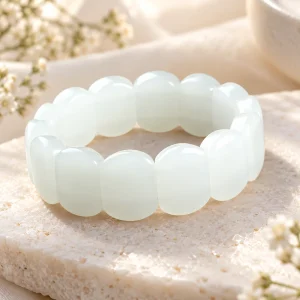
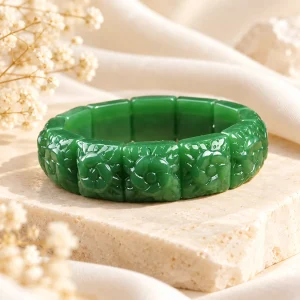
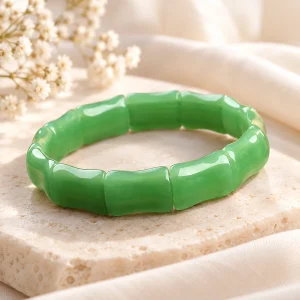
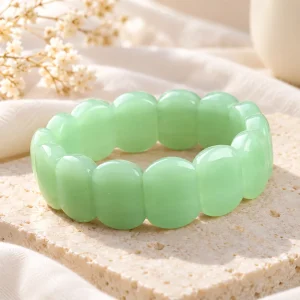
The bracelet associated with China is a ring with no clasp, cut from a single piece: jade’s toughness allows it where almost no other stone could take it (why jade almost never breaks). The difficulty lies in sizing, since a bangle slides over the hand, not the wrist (measuring your wrist). What tradition puts into the gesture is reported in the conditional in the meaning of a jade bracelet, and breakage in a jade bracelet that breaks.
The pendant
The form that wears the stone least: a drilled plaque rubs against little but clothing. The laughing figure commonly called Buddha, by the way, is not who people think: who he really is.
The necklace and the bead strand
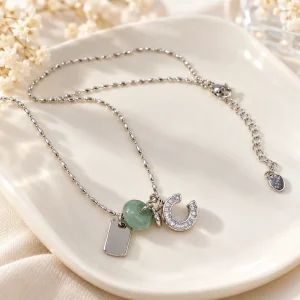
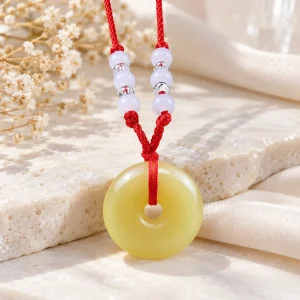
A strung strand raises a question the other forms do not: the cord goes onto the scale. My weighing therefore applies to the bare stone of the example, never to the assembled strand (weighing). The counted bead strand has its own history, and it is not Chinese in origin (the jade mala). The cord, for its part, wears out before the stone (when to replace it).
Bracelets whose density I publish
Carved in China: a different question
Carving, drilling and setting are done in China for a share I cannot put a number on, including on stones that do not come from there: a Russian or Canadian nephrite makes a perfectly good bangle in a Chinese workshop. “From China” can therefore describe the workshop without saying anything about the stone, and the reverse is also true.
That is neither a flaw nor a selling point: work is done well or badly, it is not good because it comes from one place rather than another. What is missing, when a seller only writes “from China”, is knowing which of the two they mean. Both can be stated, on two lines: what I publish on each product page, where my jade comes from.
“Chinese jade” on a label
Here the phrase changes nature. On a sales tag or in a product title, it is no longer an origin but a trade name, and it belongs to the same family as “new jade”, “olive jade”, “Malaysia jade” or “Korean jade”. These names most often refer to serpentine or dyed quartzite, not jade.
The difference is not a matter of taste. It can be weighed.
| Material | Density |
|---|---|
| Jadeite | 3.25 to 3.36 |
| Nephrite | 2.90 to 3.03 |
| Quartzite, dyed or not | about 2.65 |
| Serpentine | about 2.6 |
A quartzite around 2.65 and a serpentine around 2.6 cannot be confused with a nephrite at 2.95 or a jadeite at 3.3: the ratio between the mass in air and the mass in water separates them, and that is all weighing does. The catalog of these names is in stones sold as jade, added color in dyed jade, and the case of white in white jade stone.
French law does not name jade and still settles the matter: in its Article 9, French Decree No. 2002-65 of January 14, 2002 forbids selling a stone under any name other than its own, on the label as on any commercial document. A geographic name placed on a mineral that has nothing to do with it does exactly that: jade and the 2002 decree, jade nomenclature.
That is why the URL of this page does not use the trade name.
What I do instead
A scale, a thread, a glass of water: the stone is weighed in air, then suspended underwater, and the ratio of the two masses gives the density to compare with the table above. I weigh one example per piece, on the bare stone, not the item that ships to you, which my supplier sends directly. I publish both masses, the result, the date and the mineral I conclude from them.
What the measurement does not tell you is written in the same block, otherwise it reads as a guarantee. It establishes the mineral, jadeite or nephrite rather than serpentine or quartzite. It says nothing about the resin impregnation that separates grades A, B and C: only infrared spectroscopy would settle that, I do not have it, and my supplier does not know the status of its stock (jade A, B, C, the treatment information sheet).
The questions I get asked
Is Chinese jade jadeite or nephrite?
Historically nephrite, and for almost all of that history nephrite alone. Jadeite came in late, imported from Burma. A Chinese piece of jewelry today can be either: it is the density that tells you, not the country.
Is “Chinese jade” the name of a stone?
No. It is a trade name, from the same family as “new jade” or “Malaysia jade”, and it most often covers serpentine or dyed quartzite. The names of the stones are jadeite and nephrite. French Decree No. 2002-65 does not cite them and publishes no list of gems, but its Article 9 forbids selling a stone under any name other than its own.
What does a Chinese jade bracelet mean?
Tradition is said to attach the idea of protection and continuity to it, and the bracelet is said to be given more often than bought for oneself. That is reported, never established: the meaning of a jade bracelet. No piece of jewelry heals.
Why does jade matter so much in Chinese culture?
Because it was a tool material before it was a ritual one: its toughness made it the medium for objects meant to last, at a time when metal was scarce. Classical thought is then said to have read moral qualities into it, which is not the same thing as contemporary crystal healing.
Is jade jewelry carved in China lower quality?
That is the wrong question: the place of carving says nothing about the material, and a Russian nephrite set in a Chinese workshop is still a Russian nephrite. What should be judged is the mineral, the evenness of the polish and the cleanness of the drilling (buying jade jewelry).
How can I check that jewelry sold as Chinese jade really is jade?
Ask for the density of the bare stone and the date of the measurement. Between 2.90 and 3.03, it is nephrite; between 3.25 and 3.36, jadeite; around 2.6 or 2.65, serpentine or quartzite. The sound, cold and scratch tests prove almost nothing (what you can check at home).
Where I checked
What comes from a named source. The separation of the two minerals and the word jadeite come from Alexis Damour’s note in the Comptes rendus hebdomadaires of the French Academy of Sciences, volume 56, 1863; I do not give page numbers, as I have not read it. Monte Viso comes from the work of Pierre and Anne-Marie Pétrequin, the CNRS JADE project, June 2003. The legal texts are named in the body. The density and hardness ranges come from the mineralogical literature: I repeat them without having measured them, their limits vary from one database to another, and I therefore attribute them to no particular organization. The eight thousand years, Liangzhu and the late arrival of jadeite are the standard chronology of Chinese archaeology, as it appears in museum labels: I have not read any excavation report, so I give no date more precise than the century.
What is a market observation, with a date. On September 8, 2026, I looked at the nine French competitors on the first page of results. One was offline, three sell almost no jade, and among the rest none states the mineral of its pieces; one shows two contradictory origins on the same product page, another boasts of sourcing its jade in Burma. The same day, my supplier confirmed that it cannot say whether its stock has been treated.
What is my own reasoning. Splitting the phrase into three senses, the choice not to use the trade name in this page’s URL, and the refusal of Burmese jadeite on grounds of US law before the ethical argument: decisions, not established facts. If you find a mistake here, write to me: I will correct it and note that I did.
In one sentence
Chinese jade jewelry has eight thousand years behind it that deserve telling and a label in front of it that tells nothing: I keep the subject, I refuse the trade name, and in its place I write the name of the mineral with the number it rests on (weighing, the shop).