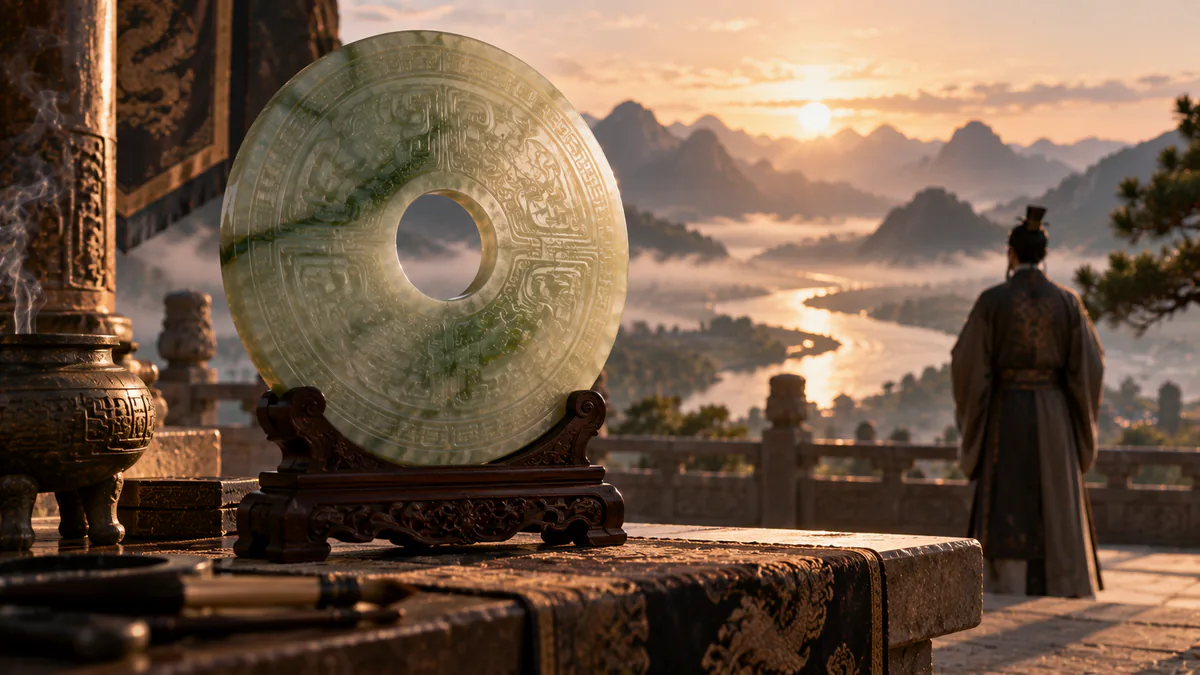
The He Disc: The Most Famous Jade Story
This page tells the story of the He disc, the most famous piece of jade in Chinese literature: where the tale comes from, what the text that carries it says, which mineral it really points to, and why a story about an imperial seal sets the price of no stone.
The He disc is a handed-down story, not an archaeological piece: no identified object matches it in the collections where I looked, and the oldest text telling its origin is a chapter of the Han Feizi, written in the 3rd century BCE by an author who used it to talk about people, not stones.
My name is Jade, and I run a jade jewelry workshop: I choose the pieces, have them set, and weigh one example of each reference before it goes on sale. I am not a gemologist, a sinologist or a therapist: what is established is stated here as fact, and what is only told is attributed to whoever tells it.
A handed-down story, and I start there
Calling it a story is not a caveat I add out of caution; it is what makes it interesting. A dated object would be described and the matter closed. This one did something other than last: it spread, and it is the reason jade and imperial power stay knotted together in the imagination long after the empires ended.
It also circulates in several versions, the ordinary fate of ancient texts. The one I follow is the oldest I have identified: a chapter of the Han Feizi, a collection attributed to the Legalist Han Fei, who died in 233 BCE, a chapter named after the story’s hero.
The story, as the Han Feizi tells it
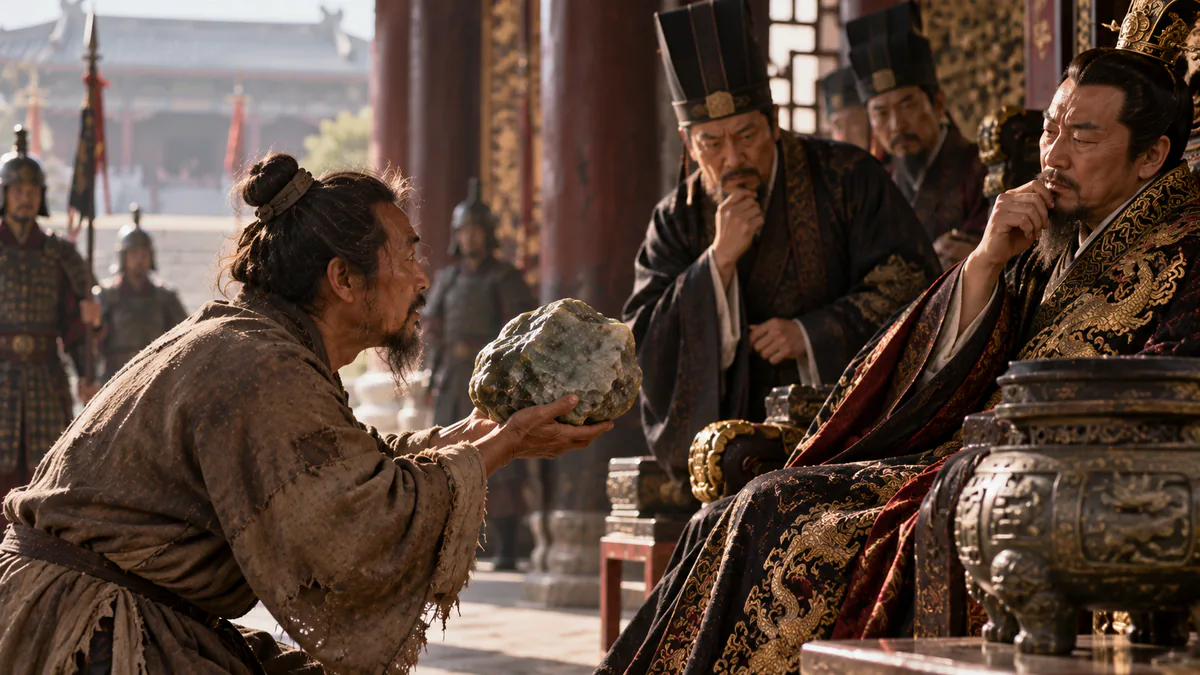
A man from the state of Chu named He finds a rough stone in the mountains. He brings it to the king, who hands it to his lapidaries. Their verdict: it is an ordinary rock. The king takes the man for a liar and has him mutilated, one foot cut off.
The king dies, his successor takes the throne, and He tries again. The lapidaries say the same thing, and he loses his other foot.
A third king reigns. This time He does not come forward: he stays at the foot of the mountain, clutching his stone, and weeps for three days and three nights, until he has no tears left and weeps blood. The king sends someone to ask why. The answer is the line the story carried across the centuries: he is not weeping for his feet, he is weeping because a treasure is called a rock and an honest man is treated as a liar. The king has the stone cut open. There is jade inside, and it is named after the man who brought it.
The text names three successive kings of Chu and gives no date. I add none: an invented date would weigh more here than its absence.
The jade pendants available now
The crux of the matter is the rind
The part of the story people most readily take for invention is the part that holds up technically, and it can be stated as fact. A nephrite pebble picked up from a riverbed looks nothing like a green stone. Its outside is a weathering rind, opaque and dull, often reddish or brown, which shows neither the color, nor the translucency, nor the grain of what it wraps. The Chinese word in the story means exactly that: a stone still in its rind, whose contents are unknown.
So the lapidaries in the story are neither foolish nor dishonest. They say what can be said from the outside, which is almost nothing. The trade in rough jade still works this way: you buy a closed mass, sometimes with a small polished window, and the price rides on what you cannot see.
It is also the limit of my own method. My scale gives a density, which assumes a bare stone: on rough still in its rind, it mixes the rind in with the rest. The protocol and its gaps are on the weighing page, and the kitchen tests that prove almost nothing are in how to recognize real jade stone.
Which jade, and why it is not a detail
The word jade covers two unrelated minerals, told apart in 1863 by the French mineralogist Alexis Damour: jadeite, a pyroxene, and nephrite, a fibrous amphibole. Their density separates them without ambiguity, 3.25 to 3.36 for the first, 2.90 to 3.03 for the second. That is the subject of this site’s main guide, and the detail is in jadeite or nephrite.
The material worked in China since the Neolithic is nephrite. Jadeite arrived late, imported from Burma, and its fashion dates from the 18th century. A disc from the time of the story is therefore nephrite, and pages that illustrate the tale with a vivid jadeite green move the whole affair by nearly two thousand years: jade jewelry in China.
The second thing the story does not say is the color. Nothing I have read of this text describes a green disc. Classical Chinese nephrite is as likely to be white, the so-called mutton fat, as green, brown or gray (jade stone colors).
What a bi is, and what it is not
The word translated as disc names a precise shape: a flat circular plaque, pierced with a central hole, polished on both faces. It is attested in China long before the time of the story, in the Neolithic burials of Liangzhu (jade motifs, jade in Chinese tombs).
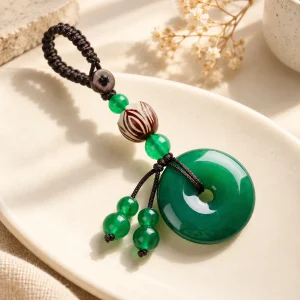
It is a shape, not a grade: the word says nothing about quality, mineral or treatment, and a pierced disc can be fine nephrite as easily as dyed quartzite. The shape itself can still be worn without borrowing anything from the story: that is what a round pierced disc pendant is.
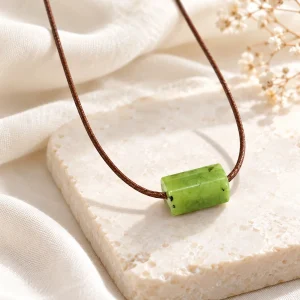
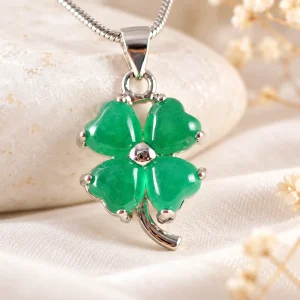
Pendants whose mineral I publish
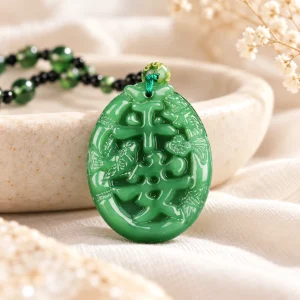
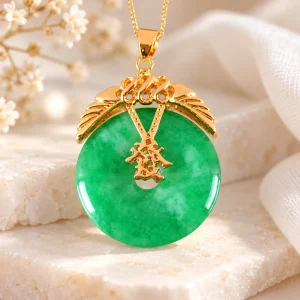
Fifteen cities for one disc
What follows does not come from the same book, and that matters: it is told by Sima Qian in the Shiji, the Records of the Grand Historian, in the 1st century BCE, in the joint biography of Lian Po and Lin Xiangru.
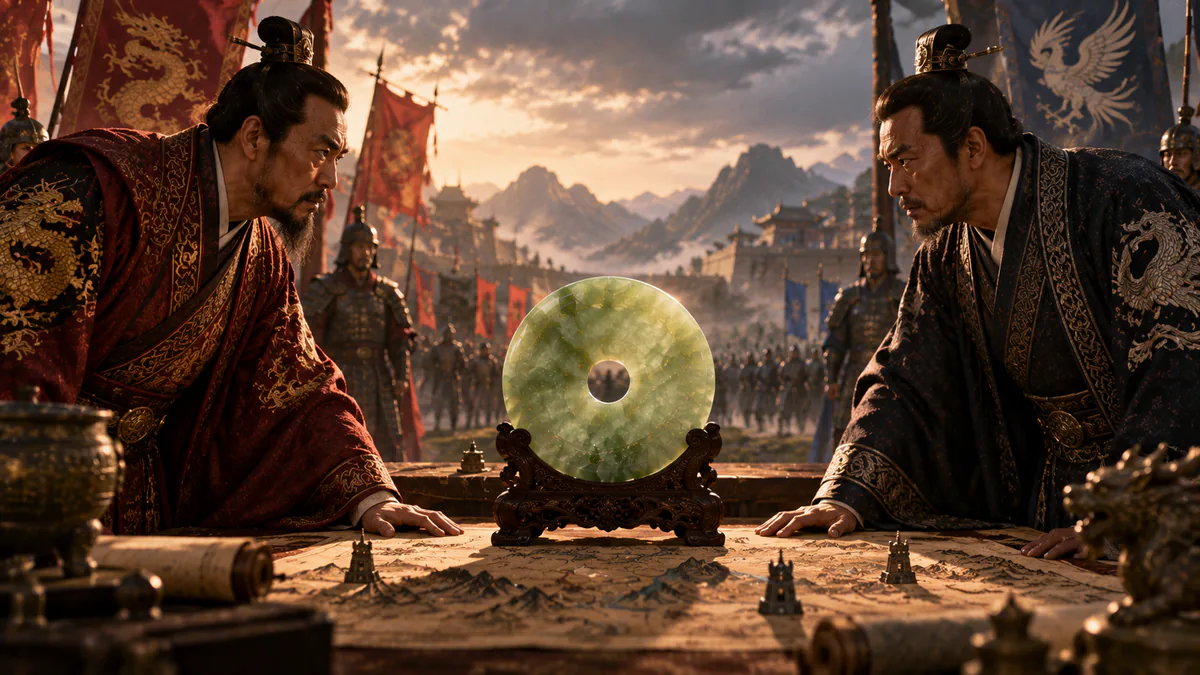
In the 3rd century BCE, the disc is in the state of Zhao. The king of Qin, the stronger power, offers to trade fifteen cities for it: refusing gives him a pretext for war, accepting means handing over the object and getting nothing back. Zhao sends Lin Xiangru to deliver it; once there, he realizes no city will ever come, takes the object back by a ruse and brings it home intact.
Two common Chinese expressions came out of it, and they are how the story has best survived: returning the disc intact to Zhao, said of something given back undamaged, and worth whole cities, said of something priceless.
The figure of fifteen cities belongs to the story and measures nothing: it is not an appraisal, it is the price one king names to test another. What really sets the price of a jade lies elsewhere: judging jade quality, jade stone prices.
From disc to seal, where tradition takes over
After Qin Shi Huang unified China in 221 BCE, tradition holds that the disc was carved into a seal, the one handed down from each dynasty to the next, with an inscription attributed to the minister Li Si. A later tradition adds a chipped corner repaired with gold. The seal eventually vanished, and its loss is usually placed in the turmoil of the 10th century.
I stop there, and I leave this sequel attributed to tradition: the two texts I name above do not tell it, and I have not identified the first one that does. Stating it as fact would give a tradition the standing of a document.
Yet it is from this sequel that the link between jade and imperial power comes. It rests on a story, not on a property of the material: no mineralogical feature sets a seal stone apart from any other. That is what makes trade vocabulary misleading when it borrows the word imperial, and I take that usage apart in what the term imperial jade really means.
What the story was made to say
A note on register, which I flag rather than blend into the rest. What follows is first a literary fact, an ancient text wrote this, then what Chinese thought drew from it. Nothing in it is proven about the stone, and nothing in it concerns the body.
The chapter containing the story is not about stones: it reads as a political text, and the stone serves as a comparison. Sound advice offered to a ruler who cannot recognize it would suffer He’s fate, and cost dearly the one who brings it. Jade stands for unseen merit, and the two severed feet are the price of bringing it too soon.
Classical Chinese thought is said to have continued in the same direction, lending the material moral qualities rather than a power: the stone would serve to describe the accomplished person. This is not crystal healing, and I hold to the distinction: the moral virtues of jade, the meaning of jade stone.
Why I draw no sales argument from it
A story about an imperial seal is the kind of tale a shop happily puts at the top of a product page, and that is exactly what I refuse to do.
No piece in this catalog is imperial, none compares to a museum piece, and the word imperial appears in the title of none of my product pages nor in any of their URLs. A prestigious provenance is not told, it is proven, and I have nothing of the kind to prove: what I sell is contemporary.
What I publish instead comes down to three numbers and a date, and above all to what they do not say: they name the mineral, never the treatment, which my supplier does not know and my scale cannot see (what I publish on every product page, type A, B, C jade, and the treatment information sheet).
Questions I get asked
Did the He disc really exist?
Nothing allows us to say so. The story is handed down by literary and historical texts, not by an excavation: I found no object identified as the disc in any collection, and no analysis ever carried out on it. It is a story, which takes nothing away from its cultural importance.
What kind of jade was the He disc made of?
Nephrite, going by the time of the story. Jadeite only reached China much later, imported from Burma, and its fashion dates from the 18th century. The two minerals are told apart by density, 2.90 to 3.03 versus 3.25 to 3.36: jadeite or nephrite.
Why were the lapidaries wrong twice?
Because they could see nothing. A nephrite pebble carries an opaque weathering rind that hides the color, the translucency and the grain. That is still how the rough trade works today: you buy a closed mass, and the price rides on what you cannot see.
What does the word bi mean?
It names a shape, a flat circular plaque pierced with a central hole, attested in China since the Neolithic. It is not a quality, a grade or a mineral: a pierced disc can be fine nephrite as easily as dyed quartzite (jade motifs).
What became of the disc and the seal supposedly carved from it?
Tradition holds that the disc was carved into a seal after the unification of 221 BCE, and that this seal vanished much later, in the 10th century. I give this as tradition only: the two ancient texts I cite here do not tell this episode.
Can you buy a jade like that one?
No, and nobody can: the object in the story does not exist as an identifiable piece. What I offer is contemporary, set or chosen one by one, and I publish its density rather than a story (the shop).
Where I checked
What comes from a named source. The version of the story I summarize is the one in the Han Feizi, a collection attributed to Han Fei, who died in 233 BCE, in the chapter named after He. The episode of the fifteen cities and Lin Xiangru comes from Sima Qian’s Shiji, the joint biography of Lian Po and Lin Xiangru. I have read neither in a critical edition: I name them because they are the texts that carry the story, not because I have combed through them. The unification under Qin Shi Huang in 221 BCE and the separation of jadeite and nephrite by Alexis Damour in 1863 are established facts. The density ranges are those of the mineralogical literature: I repeat them, and I have measured them on no ancient object.
What is a dated observation. On September 10, 2026, I opened the French and English pages that tell this story. Two things come up almost everywhere: the disc is illustrated or described as a vivid jadeite green, although nothing I have read of the text describes its color and jadeite is not the material of that period in China; and the imperial seal episode is told as fact, with no source given.
What is my own reasoning. Linking the disc to nephrite is a deduction from dating, not an analysis: nobody has examined the object, and I reason from the period to the mineral. Reading the weathering rind as the explanation for the lapidaries’ verdict is my interpretation of a mineralogical fact, not what the text says. And keeping the whole seal episode attributed to tradition comes from not having identified the ancient source that carries it, not from any doubt about its age. If you find a mistake here, write to me: I will correct it and note the change.
In one sentence
The He disc is the story of a stone nobody recognizes until it is opened, and that is the only thing it proves: not a mineral, not a value, not a power, only that you do not judge a jade by its surface. What the word covers is on jade stone, and what I measure is on the weighing page.