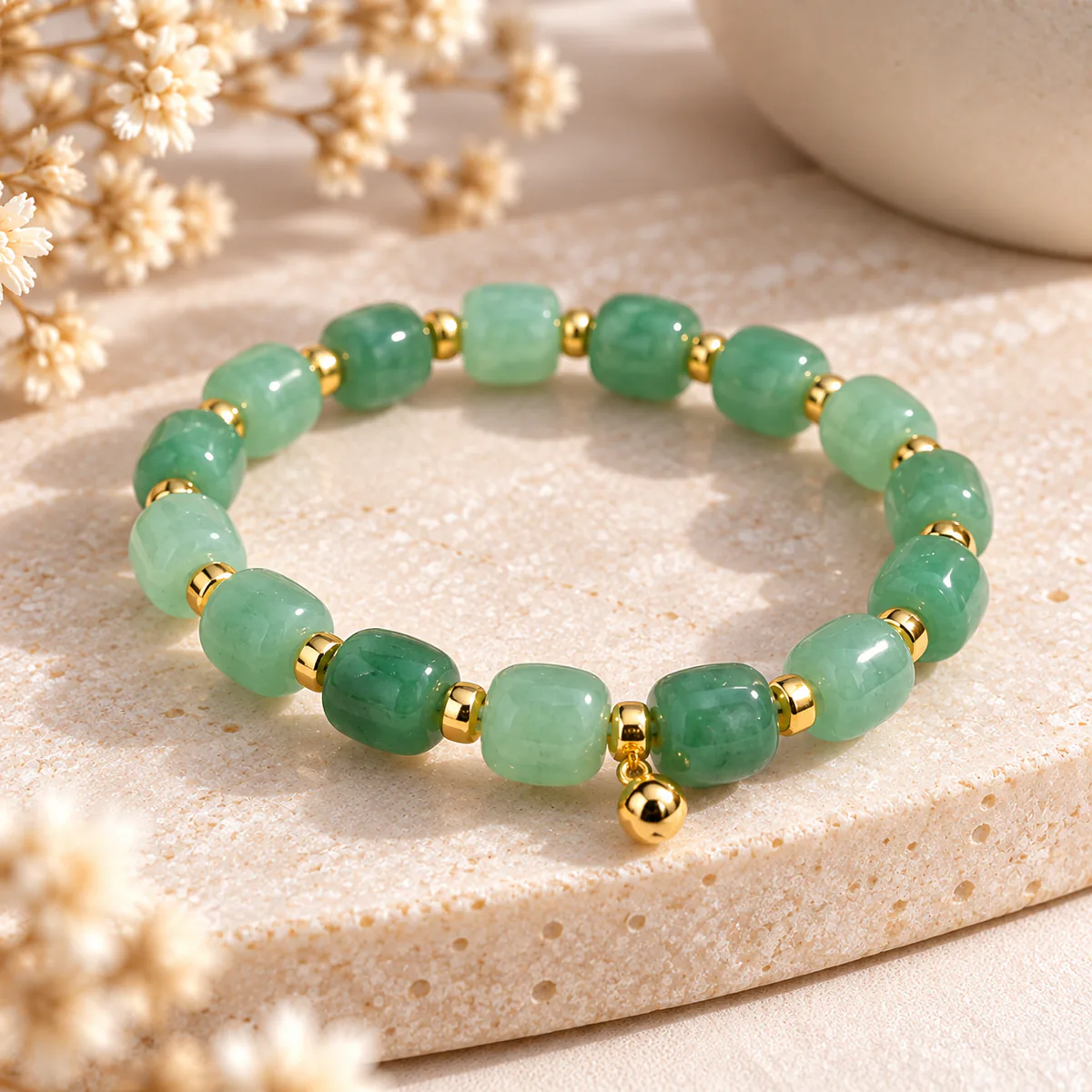
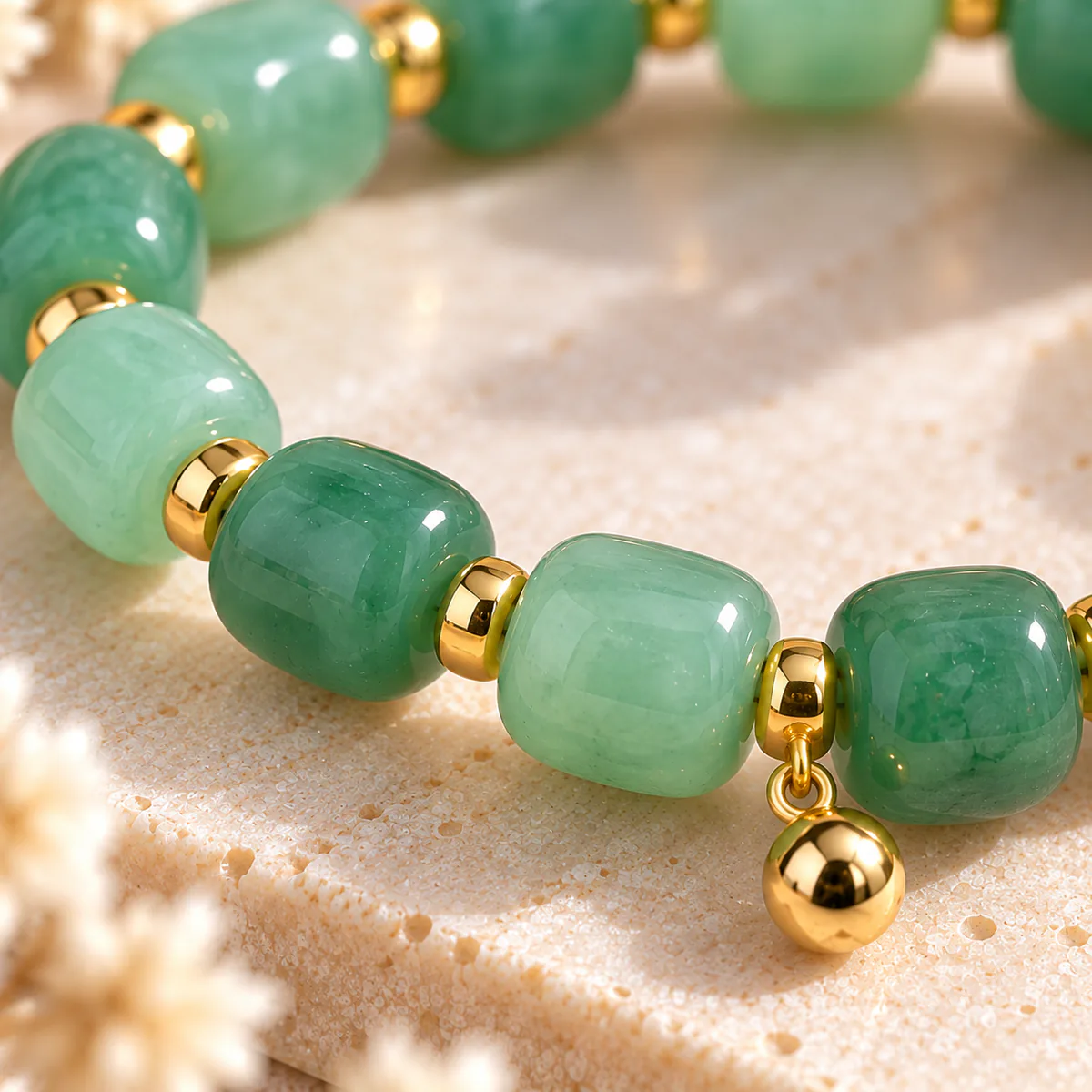
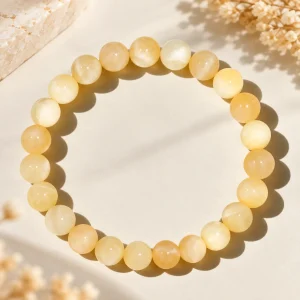
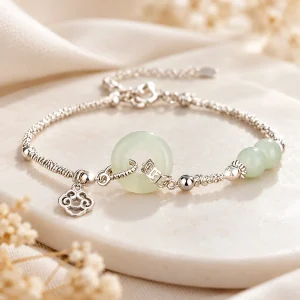
Jade barrel bead bracelet: a light mint green and a deep green alternating, set off by gold-tone spacers and a small gold-tone ball that moves on the wrist.
Barrel beads sit flat and show more stone than a round bead. With no clasp, it goes on in one movement: simply choose your wrist measurement.
A jade barrel bead bracelet that plays on two greens: a bright, light mint, and a deep green marbled with darker patches. Between each bead, a gold-tone spacer sets the rhythm of the strand, and a small gold-tone ball follows every movement of the wrist.
In four lines
Two greens alternating, light mint and deep green.
Barrel beads: they sit flat instead of rolling.
Gold-tone spacers and a small ball, to warm the green.
No clasp: it goes on in one movement.
Two Greens Answering Each Other
This jade barrel bead bracelet is not after uniformity. The pale beads, an almost translucent mint green, take the light; the dark beads hold it, with marbling that runs from fir green to sea green. Alternating, they give the strand a rhythm that a single-tone bracelet does not have.
No bead is a copy of its neighbor. The veins and clouds change from one to the next: that is the signature of a material cut from rock, and it is what makes you still look at your bracelet a year later.
The Gold Tone, to Warm the Green
Jade green is a cool colour. Set against a gold-tone metal it warms up, and that pairing has long been considered the noblest in China: gold and jade. Here, fine gold-tone spacers separate each bead and underline its shape, and a small gold-tone ball charm moves at the slightest gesture.
The gold tone goes with a gold watch, with fine rings, or is worn alone on a bare wrist. It suits a white shirt as readily as a knit jumper.
The Barrel Shape: Comfortable and Generous
A barrel bead is a small cylinder with rounded edges. It has two qualities a round bead does not: it sits flat on the wrist instead of rolling, and it shows more stone for the same size. The strand looks denser and more present without being heavier.
Nephrite, the Everyday Jade
Nephrite is one of the two minerals the word jade covers, along with jadeite. It is the tougher of the two: it is made of interlocking fibers that stop a crack instead of letting it run. That is why it has been carved in China for millennia, and why it stands up to the life of a bracelet worn every day. Jadeite or nephrite, what sets them apart, and the difference between hardness and toughness.
Wearing It, and Keeping It Beautiful
It has no clasp: it is strung on an elastic cord and goes on by rolling it over your hand. Choose your wrist measurement above the buy button; barrel beads packed between spacers make a strand slightly less supple than one of round beads, so do not take it too tight. Measuring your wrist in two minutes.
Take it off for the shower, sports and the pool: the elastic lasts longer, and the gold tone keeps its shine. A soft dry cloth is enough to care for it. Never an ultrasonic cleaner, steam or solvents, neither for the stone nor for the metal. Care in detail.
Additional information
Stone
Néphrite
Colour
Clear green, Light green
Stone shape
Barrel beads
Motif
No motif
Mounting
Elastic
Metal
Gold tone, alloy not stated
Setting
Drilled stone
Worn by
Women
Paired stones
None, jade only
Mineral family
Calcic amphibole
Hardness (Mohs)
6 to 6.5
Reference density
2.90 to 3.03 g/cm³
Toughness
Exceptional, interlocking crystals
Treatment
Not determined
Origin
Outside Burma, country of extraction not confirmed
What Tradition Attaches to This Bracelet
What follows changes register, and I flag it rather than blend it into the rest of the listing. None of it is proven. These are customs and beliefs, old or recent, that I report because they are part of this stone's history. No piece in this shop is sold as a remedy, and I claim no effect for this one.
A stone of moral virtueIn Confucian thought, jade is associated with qualities of character rather than effects on the body: uprightness, constancy, restraint. It is the best documented meaning of them all.
Gold set with jadeThe Chinese expression jin xiang yu describes the pairing of gold and jade, held to be the noblest of all. It gave its name to the design of the 2008 Beijing Games medals, which carried a jade ring.
The little luck beadThe gold ball hanging from a bead bracelet is very widespread in China today, where it is called the bead that turns your luck. The custom is commercial and recent: I flag it as such.
The left wristThe custom of wearing jade on the left is often reported, and tied to the idea of a side that receives. It is a habit, not a rule, and nothing forbids the right.
Dispatch within 48 hours of your order being confirmed, for delivery within 14 days from dispatch. I keep no stock in reserve, and I will not promise a date I could not meet.
Shipping Costs
€6.99 whatever the destination, free on orders over €47 to France, Belgium, Switzerland and Luxembourg. The exact amount is shown in your basket before you pay.
The Packaging, and Why It Matters
Every piece travels in its own pouch, kept apart from the others. This is not a question of presentation: the hardness of jade is unremarkable, between 6 and 6.5 for nephrite and 6.5 to 7 for jadeite, and the quartz in ordinary household dust sits at 7. Two pieces of jewellery that travel together arrive marked.
Fourteen Days to Change Your Mind
No need to give a reason. An email is enough to open a return; there is no form to fill in. Return postage is at your expense, unless the piece does not match its listing or arrives damaged.
Getting the size wrong is the most common reason for a return in this category, and jade cannot be resized the way a solid metal band can. Two minutes spent measuring almost always avoids it. The size guide.
Lukewarm water, mild soap, a soft cloth. A very soft brush for the hollows of a carving. That is all, and it is enough.
What You Must Never Do, and Why
No ultrasonic cleaners, no steam, no solvents, no heat source. This is not a precaution for show: the treatment status of my pieces is undetermined. My supplier does not know it, and weighing identifies the mineral without telling me anything about a possible resin impregnation. Resin withstands neither heat nor solvents, so every piece is handled as though it might contain some. The information sheet on treatments.
Scratches, and Where They Come From
Jade is tough, meaning very difficult to break: its structure of interlocking crystals resists cracking, and that is what made it usable for axe heads in the Neolithic. Its hardness, by contrast, is unremarkable, 6 to 6.5 for nephrite and 6.5 to 7 for jadeite. The quartz in ordinary household dust sits at 7: that is what dulls a jade, not knocks. The difference between the two.
Day to Day
Put the piece on after perfume and cream, never before. Take it off for housework, gardening and sport, where knocks against hard edges are common. Store each piece on its own, in its pouch. On a strand of beads, the thread wears out before the stone: it gets restrung, and there is nothing abnormal about that.
My name is Jade. French, from Morbihan, living in Tallinn. I choose the pieces and have them mounted: I mine nothing, I cut nothing, and the metalwork is not done by my hand. What I bring is the selection, and with this material that is what decides everything.
I am not a gemmologist, not a lapidary, not a therapist, and I do not claim to be.
I Weigh, I Do Not Certify
Before a listing goes online, I order one example of it for myself. When it reaches me unmounted, I weigh it in air, then suspended from a thread in a glass of water: the ratio of the two masses gives the density, and that figure separates jadeite, nephrite, serpentine and dyed quartzite without ambiguity.
One example per listing, and not every piece. I do not handle the piece that is sent to you, and I would rather write that down than let you believe otherwise. The method, with its three limits.
What I Cannot Know
The treatment status of my pieces. My supplier does not know it, and the scales do not tell me: they identify the mineral, not the resin impregnation. Only infrared spectroscopy in a laboratory would settle it, and I do not have that done. So you will never read “Grade A jadeite”, “Type A” or “untreated” on this site. The information sheet.
Where My Jade Comes From
No Burmese jadeite, and the first reason is legal. Not the one you read everywhere: the JADE Act of 2008 did ban these stones in the United States, but that ban was lifted on 7 October 2016. What applies today dates from 8 April 2021: the US Treasury sanctioned Myanma Gems Enterprise, the state company that controls the Burmese gem trade. So there is no blanket ban, but a US person is not allowed to trade with that entity, and a stone never tells you where it has been. A single supply chain serves ten markets, so it has to hold up in the most demanding of them. When an origin is not confirmed to me in writing, the listing does not state it. My origin charter.