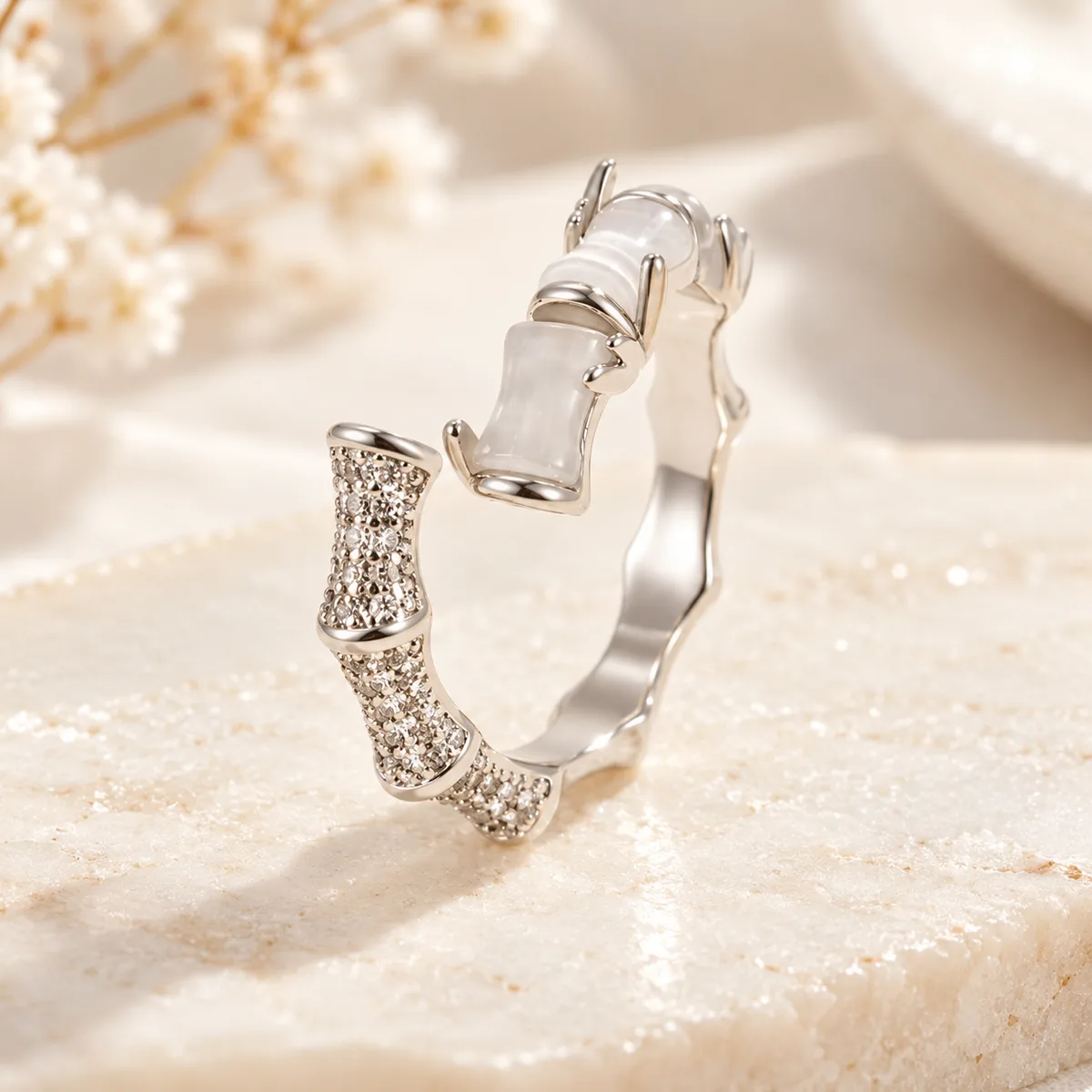
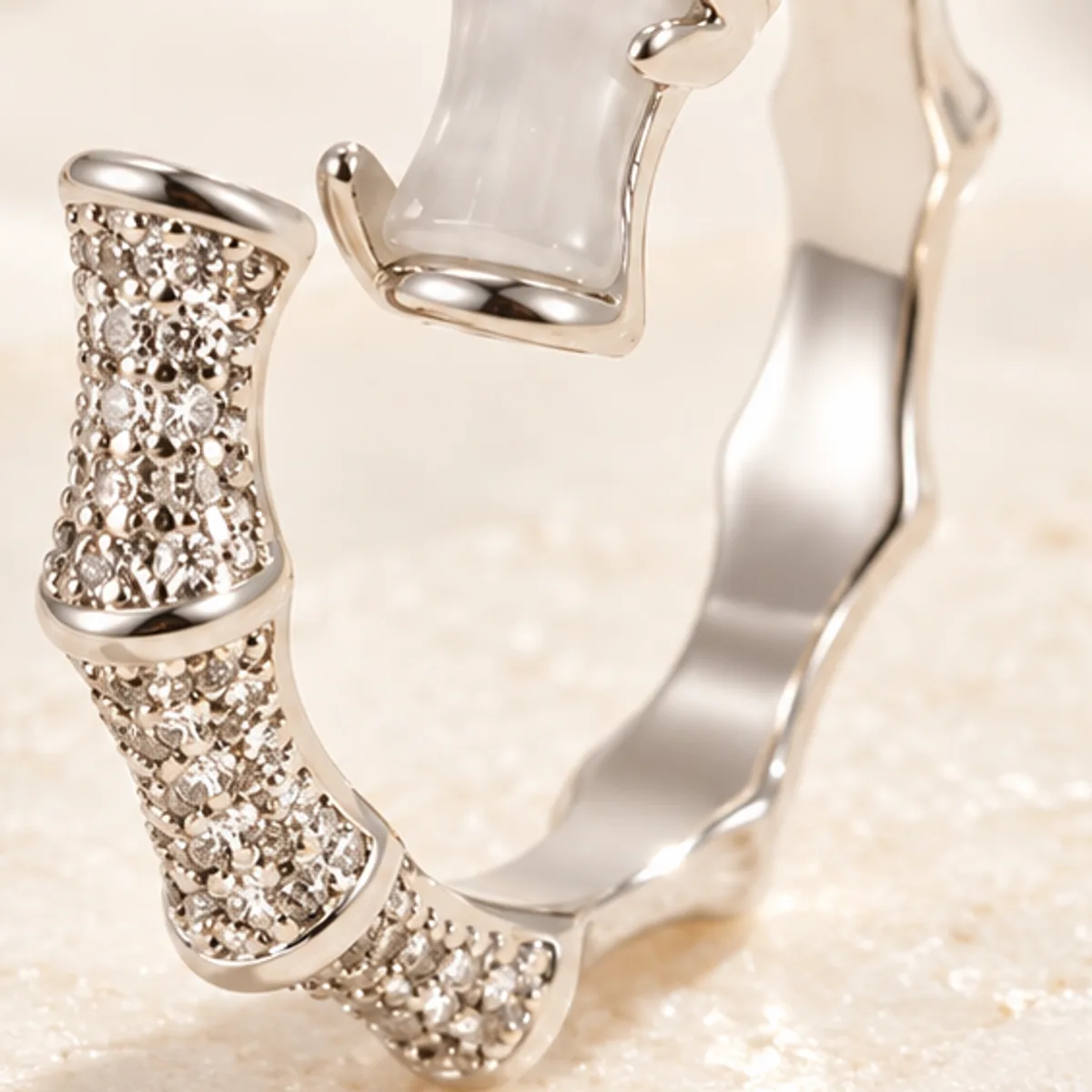
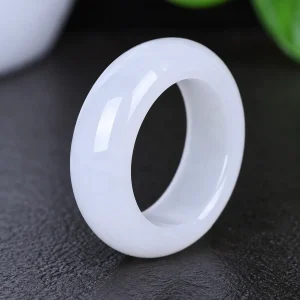
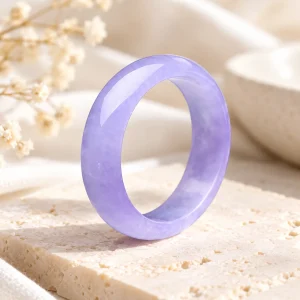
Bamboo jade ring in white stone and silver tone: the band imitates a bamboo stalk, alternating segments of pale stone with segments paved with zircons.
Bamboo is one of the three friends of winter: it bends under snow and straightens again, and its nodes mark the stages of a progression. That is what the design takes up.
Open at the back, it adjusts to the finger. The zircons are not jade, and the silver is not hallmarked: I write silver tone, not 925.
A bamboo jade ring in white stone and silver tone: the band imitates a bamboo stalk, alternating segments of pale stone with segments of silver tone paved with zircons. It is open at the back, so this one adjusts to the finger.
In four lines
The band imitates a bamboo stalk, segment by segment.
Pale stone alternating with silver tone paved with zircons.
Open at the back: this one adjusts to the finger.
The record will stay empty: a closed setting forbids weighing.
Bamboo, and why this motif
Bamboo is one of the three friends of winter, with pine and plum: three plants that hold when the others give way, and that have served for centuries as images of constancy in Chinese painting and poetry.
It bends under snow and straightens again, it is hollow so it also figures humility, and its nodes mark the stages of a progression. That last point explains the design: a ring made of successive segments takes up that reading, and bamboo is readily given at a passage, studies, a new post, a departure.
I report it because the question comes up, and a page that does not answer leaves the customer to look elsewhere. As everywhere on this site, I claim no effect for this piece.
A ring that adjusts, and what that changes
Almost every jade ring in the catalogue is a solid band cut from the stone: they cannot be resized and have to be right first time. This one is in segmented metal and open at the back: you widen it or close it gently by hand.
It is the handiest answer when you do not know the size, and it is what makes it, together with the jade flower ring, one of only two in the section that can be given without risk.
Two precautions: do not reshape it too often, because metal tires, and do not force it in one sharp movement, because the stone segments do not bend. The size guide helps you start from an approximate size.
Three materials, and only one is jade
The pale segments are announced as jade. The zircons paving the silver tone segments are not: they are synthetic stones or colourless natural zircons, brilliant cut, and I flag them in the record rather than let a pave of diamonds be imagined.
The silver is not hallmarked by my supplier. So I write it as silver tone, and not 925: a hallmark is information, and I do not invent it.
Outside Burma, country of extraction not confirmed
What tradition attributes to bamboo and to jade
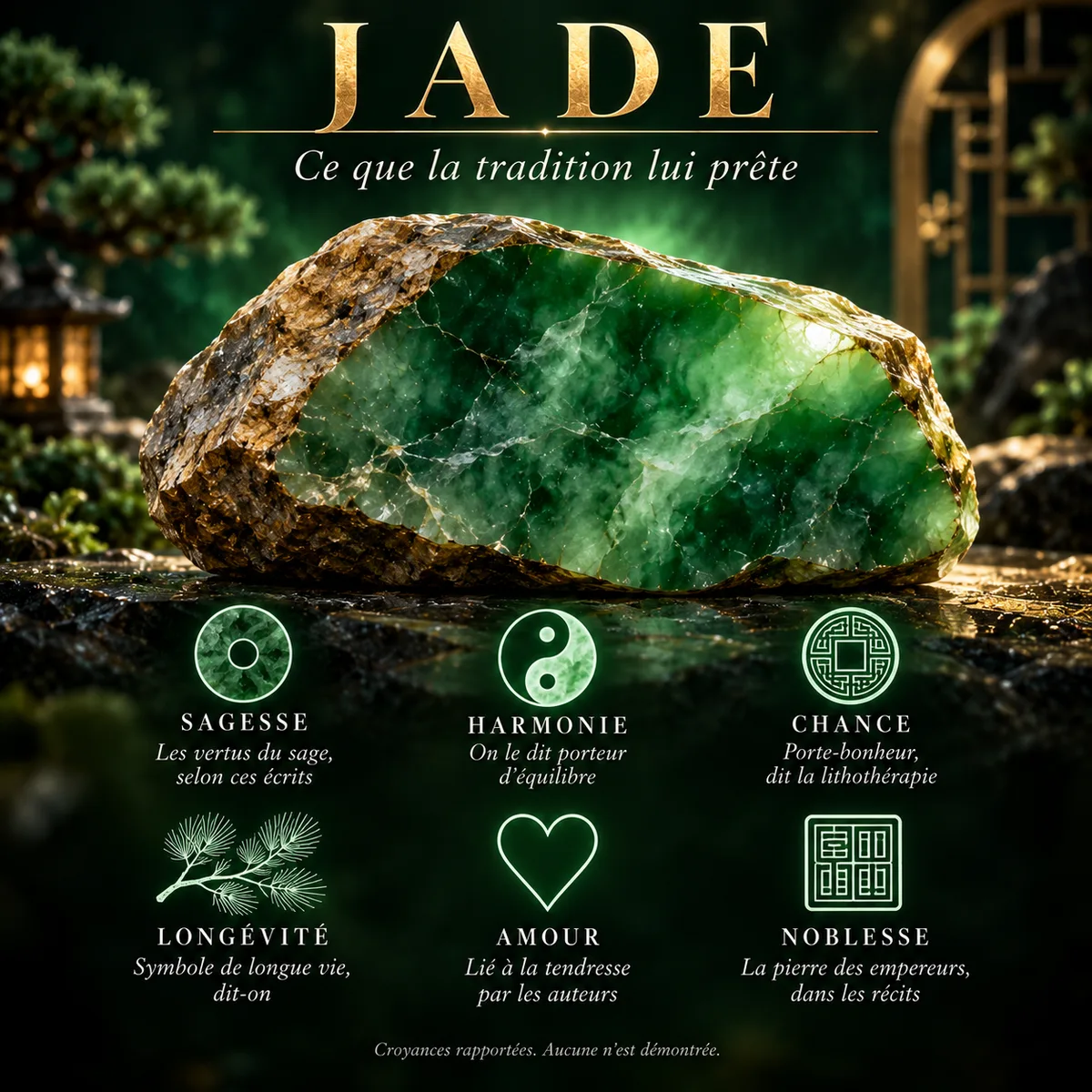
What follows changes register, and I flag it rather than blending it into the rest of the page. Nothing here is demonstrated. These are customs and beliefs, which I report because they are part of the history of this stone. No piece in this shop is sold as a remedy, and I claim no effect for this one.
The three friends of winterBamboo, pine and plum form a trio found together on screens, porcelain and jewellery. Three plants that cross the bad season, read as three ways of not giving in. What tradition puts into a jade bracelet.
Hollow, therefore humbleThe bamboo stalk is empty inside, and scholars saw in it an image of modesty: full of nothing, so ready to receive. The comparison is classical in Tang poetry.
The jade you patinate by handChinese usage holds that a jade worn every day becomes warmer and brighter with the years. What changes is the surface, polished by friction and by the natural oils of the skin: the effect is real, the explanation is mechanical.
White before greenCultivated Chinese taste long placed white nephrite at the top, well above green. The present hierarchy comes from the trade in Burmese jadeite, and it is a matter of fashion rather than of quality.
Shipped within 48 hours of your order being confirmed, for delivery within 14 days from the day it ships. I keep no buffer stock, and I will not promise a date I cannot meet.
Shipping Costs
€6.99 no matter the destination, and free on orders of €47 or more to France, Belgium, Switzerland, and Luxembourg. The exact amount shows in your cart before you pay.
The Packaging, and Why It Matters
Every piece leaves in its own pouch, kept apart from the others. This is not about presentation: jade’s hardness is ordinary, 6 to 6.5 for nephrite and 6.5 to 7 for jadeite, and the quartz in everyday dust rates 7. Two pieces of jewelry that travel together arrive scratched.
Fourteen Days to Change Your Mind
No reason needed. One email opens a return, and there is no form to fill out. Return shipping is at your expense, unless the piece does not match its listing or arrives damaged.
Getting the size wrong is the leading cause of returns in this category, and jade cannot be resized the way a solid metal band can. Two minutes of measuring almost always prevents it. The size guide.
Lukewarm water, mild soap, a soft cloth. A very soft brush for the hollows of a carving. That is all, and it is enough.
What You Must Never Do, and Why
No ultrasonic cleaner, no steam, no solvent, no heat source. The reason is not caution for its own sake: the treatment status of my pieces is undetermined. My supplier cannot tell me, and the weighing establishes the mineral without saying anything about a possible resin impregnation. Resin withstands neither heat nor solvents, so every piece is handled as though it might contain some. The treatment information page.
The Scratch, and Where It Comes From
Jade is tough, meaning very hard to break: its structure of interlocking crystals resists cracking, and that is what made it possible to turn it into axes in the Neolithic. Its hardness, on the other hand, is ordinary, 6 to 6.5 for nephrite and 6.5 to 7 for jadeite. The quartz in everyday dust rates 7, and that is what dulls a jade, not impacts. The difference between the two.
Day to Day
Put the piece on after perfume and lotion, never before. Take it off for housework, gardening, and sports, where the hard knocks happen. Store each piece on its own, in its pouch. On a strand of beads, the thread wears out before the stone does: it gets restrung, and there is nothing abnormal about that.
My name is Jade. I am French, from Morbihan in Brittany, and I live in Tallinn. I choose the pieces and have them set: I mine nothing, I carve nothing, and I do not do the metalwork myself. What I bring is the sorting, and with this material the sorting decides everything.
I am not a gemologist, a lapidary, or a therapist, and I do not claim to be.
I Weigh, I Do Not Certify
Before putting a reference online, I order one example of it for myself. When it reaches me unset, I weigh it in air, then suspended from a thread in a glass of water: the ratio of the two masses gives the density, and that figure separates jadeite, nephrite, serpentine, and dyed quartzite without ambiguity.
One example per reference, and not every piece. I never handle the piece that ships to you, and I would rather say so plainly than let anyone believe otherwise. The method, with its three limitations.
What I Cannot Know
The treatment status of my pieces. My supplier cannot tell me, and neither can the scale: it establishes the mineral, not the resin impregnation. Only laboratory infrared spectroscopy would settle the question, and I do not have that testing done. So you will never read “jadeite A”, “type A” or “untreated” on this site. The information page.
Where My Jade Comes From
No Burmese jadeite, and the first reason is legal. Not the one you read everywhere: the JADE Act of 2008 did ban these stones in the United States, but that ban was lifted on October 7, 2016. What applies today dates from April 8, 2021: the US Treasury sanctioned Myanma Gems Enterprise, the state-owned company that controls the Burmese gem trade. So there is no blanket ban, but an American is not allowed to do business with that entity, and a stone never tells you where it has been. I run one supply chain for ten markets, and it has to stand up to the strictest one. When an origin is not confirmed to me in writing, the listing does not state it. My origin policy.