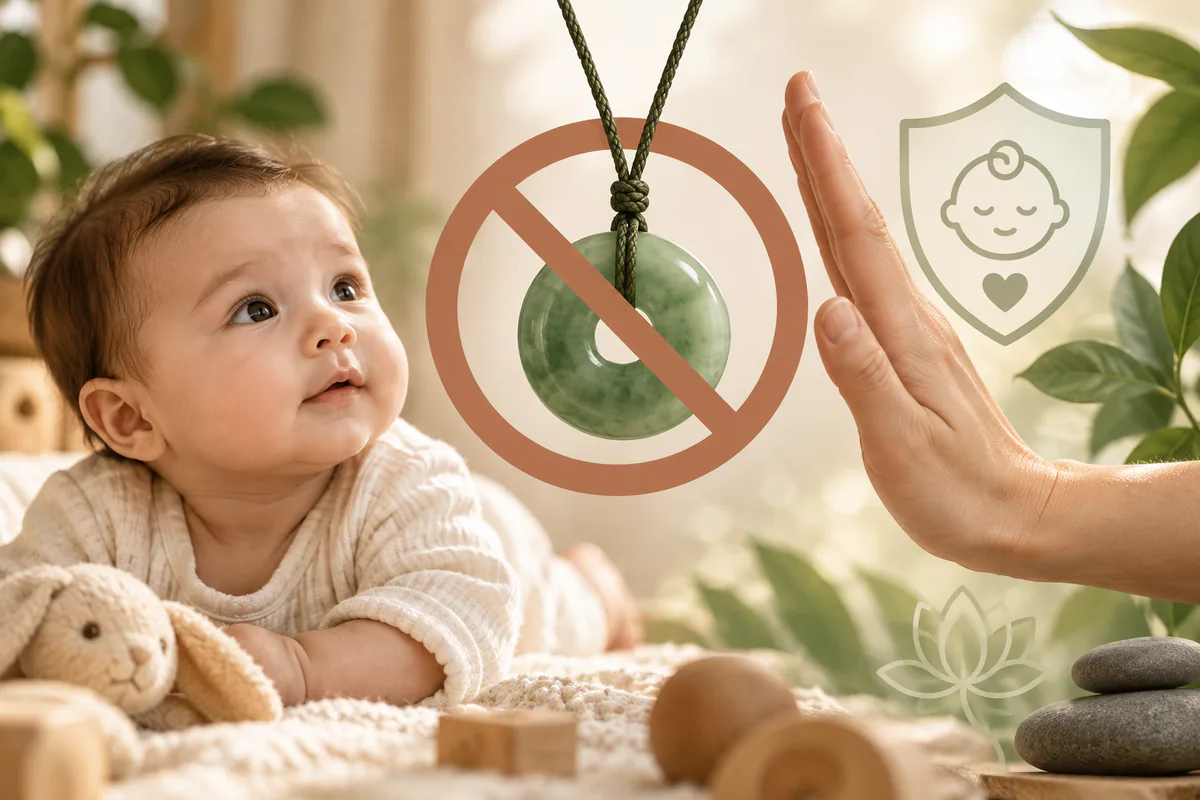
Jade Necklace for a Baby: Why I Don’t Sell One
This page answers a shopping query, “jade necklace for baby”, with a refusal. A jade necklace for a baby is not in my catalog, and rather than leave the search unanswered, I set out the two reasons: what gets tied around a very young child’s neck, what a public survey measured on this type of object, and what I promise no one.
I do not sell jade necklaces for babies, for two reasons that have nothing to do with each other: a cord tied around a very young child’s neck is a mechanical risk, and the second expectation behind this search is a health expectation, which this site never addresses.
My name is Jade, I run a jade jewelry workshop: I choose the pieces, have them set, and weigh one sample of each reference before it goes on sale. I am neither a gemologist, nor a therapist, nor a pediatrician: what I can write here comes down to two reasons, and stops there.
Two reasons, and the stone is not the issue in either
Jade has nothing special about it here, and that is the first thing to establish. What I refuse is not a material; it is a way of putting a piece together, and the person wearing it: a strand of beads or a pendant hanging from a cord, around the neck of someone who cannot take it off on their own. The same sentence would apply to amber, wood or glass.
What the stone is, mineralogically, can be read on the page that covers jade stone in full: two unrelated minerals under a single word. It is a fine subject, and it changes nothing about what follows.
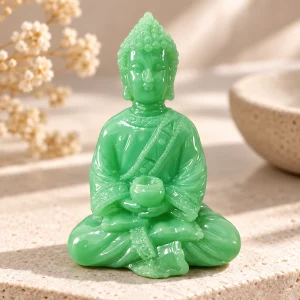
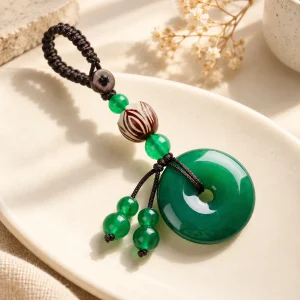
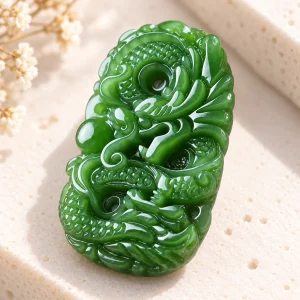
Jade objects, to give without being worn
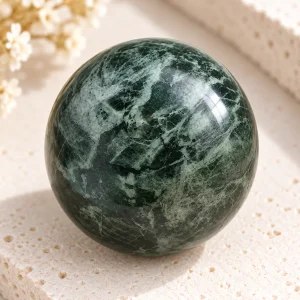
The first reason: what is tied around the neck
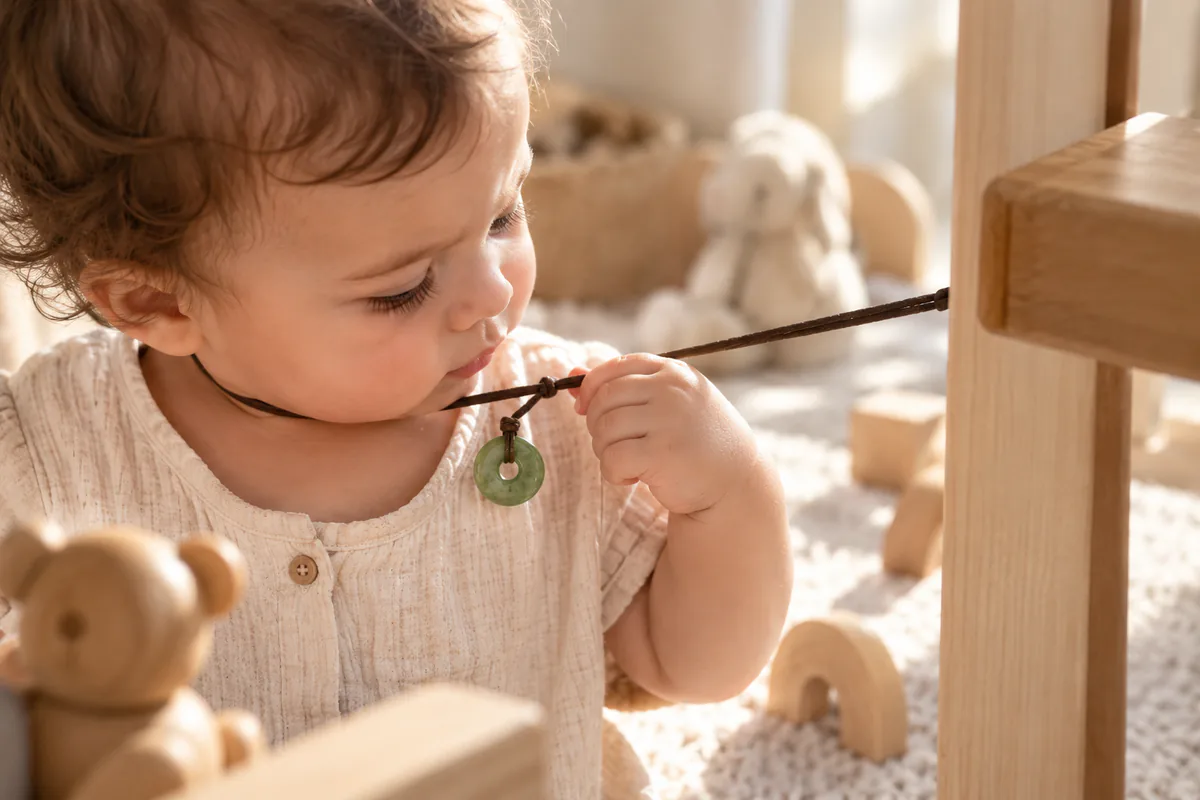
An adult’s piece of jewelry can be taken off. A very young child takes nothing off, does not always sit up, and does not signal what is bothering them. For this type of object, two opposing requirements apply to the same piece, and a necklace can meet one while failing the other.
- The cord must give way when pulled, instead of holding firm around the neck.
- The components must stay on the thread, instead of coming off one by one.
This is not an opinion about jade; it is a property of the object, and it is measured on a test bench rather than by eye. It has been measured.
What was measured, and by whom
France’s consumer fraud authority, the DGCCRF, published a survey titled Sécurité des colliers et bracelets pour jeunes enfants (Safety of necklaces and bracelets for young children). Of 32 necklaces and bracelets sampled, 28 were judged dangerous because of the risk of strangulation or choking, and 16 warnings were issued to the businesses concerned.
The criterion used is mechanical, which is what makes it understandable to anyone: the clasp must give way at 2.5 kilograms of pull, so that the loop opens instead of resisting, and the thread, for its part, must hold, so that the components do not scatter. The two requirements pull in opposite directions on the same object, which goes a long way toward explaining the sampling result.
These figures can be read on economie.gouv.fr, on the survey’s page. They cannot be read at a retailer that summarizes them, because a commercial summary generally keeps the part that suits it.
What that survey does not say
It says nothing about jade, and I am not going to make it say anything other than what it contains. The pieces sampled were amber and hazel necklaces and bracelets: that is the market that was sampled, not mine. So I cite this survey for one thing only, the mechanical standard it applies, and never as a finding about jade jewelry.
Nor do I take up the framing under which these objects were sold, which belongs to health and has no place here. And extending a requirement measured on other materials to anything tied around a very young child’s neck is my own reasoning: I flag it as such rather than passing it off as a survey result.
The second reason: an expectation I do not address
The first reason would be enough to close the question. The second is of a different kind, and I would rather name it than skirt around it: some of the people searching for this product are not expecting a piece of jewelry; they are expecting an effect on a child’s health.
This site promises no such effect, on any page, at any age. I cannot sell an object while leaving that expectation intact, and I cannot settle it either: I have no competence to say what does or does not act on a child, and a jewelry shop is not the place to ask that question anyway. The full disclaimer has its own page, and it applies to the whole site.
Where the idea of jade worn as a precaution comes from
What follows changes register, and I flag it rather than blending it into the rest. Nothing in it is proven: it is what traditions have attributed to this stone.
The word jade comes from the Spanish piedra de la ijada, the stone of the flank, coined around 1565 by Spaniards who had seen conquered peoples wearing it on their bodies. The name of this shop was therefore born of a promise of healing, and that is exactly what I will not sell.
Tradition, and later contemporary authors, attribute protection and luck to jade. These are reported attributions, never established, and I gather them on the page on the virtues attributed to jade stone and on the lucky charm page, in the conditional, rather than slipping them into a product page. None of them creates a reason to tie a cord around a baby’s neck.

What I do not offer instead
People sometimes ask me for a smaller format: a bracelet instead of a necklace, a single bead, a thinner cord. I do not offer that either, and the survey cited above in fact covers both formats together.
The reason is simple, and it comes down to what I know how to do. I weigh a stone to find out what mineral it is; I do not test the pull strength of a clasp, so I have no safe version to offer in its place. Offering a substitute worn by the child would amount to pretending to have solved the problem by changing its size.
Giving jade for a birth, another way
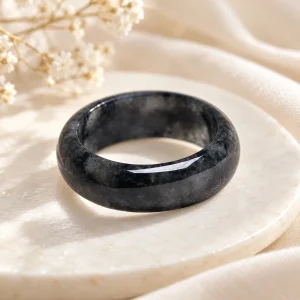
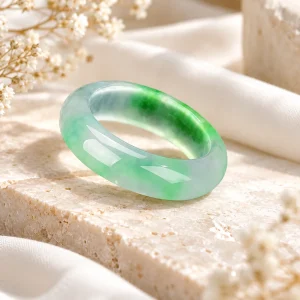
The gift itself remains intact, on one condition: that the piece is not worn by the child. A piece of jewelry put away and passed on later, or a piece worn by an adult, raises neither of the two questions on this page.
That is what I answer when someone asks me for a birth gift, and the rest becomes a matter of taste rather than caution: choosing a piece to give is covered in giving jade jewelry as a gift.
A birth gift worn by an adult
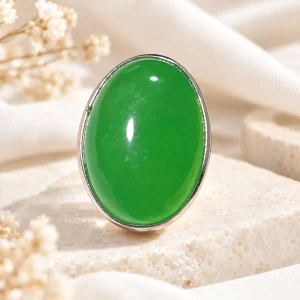
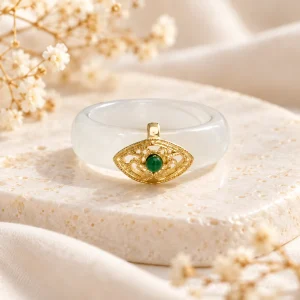
If you already have one
I would take it off, without making a drama of it and without replacing it with another piece that gets worn. The object does not become bad and does not need to be thrown away: it becomes a piece of jewelry again, one that will wait for its moment.
If the remaining question is about the thread and clasp on an adult’s piece, it has its own page: thread and cord for jade jewelry. And if a strand has already broken, what to do is in a broken jade bracelet.
The questions I get asked
Do you sell jade necklaces for babies?
No, and I will not. The two reasons are independent of each other: a cord around a very young child’s neck is a mechanical risk, and the second expectation that often comes with this search is a health expectation, which I do not address on any page of this site.
Is jade dangerous for a baby?
The question targets the wrong thing. What I take issue with is not the material but the way the piece is put together: a closed loop around the neck of someone who cannot open it, and components that can come off the thread. The same caveat would apply to another stone, to wood or to glass.
Would a bracelet be better than a necklace?
I do not offer that either. The public survey I cite covered 32 necklaces and bracelets, both formats together, and 28 pieces were judged dangerous. Changing an object’s size does not change what is at issue in how it is put together.
At what age can a child wear jade jewelry?
I do not set an age, and I am not qualified to set one. That is a gap in this page, and I would rather write it down than put forward a number that would look serious while resting on nothing.
Someone gave my baby a jade necklace; what should I do?
What I would do: take it off, put it away, and not replace it with another piece that gets worn. The piece loses nothing by waiting. For care of the thread and clasp on an adult’s piece, everything is on its page.
Why write a whole page about a product you do not sell?
Because the search exists, it lands on shops, and the honest answer is a reasoned refusal rather than a missing page. This is not the first page on this site written against its own catalog, and it will not be the last.
Where I checked
What comes from a named source. The survey is the DGCCRF’s Sécurité des colliers et bracelets pour jeunes enfants, published on economie.gouv.fr: 32 necklaces and bracelets sampled, 28 judged dangerous because of the risk of strangulation or choking, 16 warnings issued to businesses, a clasp that must give way at 2.5 kilograms of pull and a thread that must hold. The pieces sampled were amber and hazel, and I do not make them say a word about jade. The etymology of piedra de la ijada follows the entry for jade in the Dictionnaire de l’Académie française, ninth edition.
What is a dated observation. As of September 8, 2026, the French phrasings of this search add up to a volume of 10 in the keyword tool I use: demand is tiny, and it is the only measurement I have on the subject. The refusal, for its part, was written into the shop’s plan before this page existed, and it appeared there twice rather than once.
What is my own reasoning. Extending a requirement measured on other materials to any cord tied around a very young child’s neck, refusing a substitute worn by the child whatever its format, and leaving the second expectation out of the text instead of trying to refute it: these are decisions, not established facts, and someone better placed than I am might make them differently. If you find a mistake here, write to me: I will correct it and note the correction.
In one sentence
A jade necklace for a baby is not a product I can sell honestly: what is at issue is the cord and the expectation, never the stone, and the stone has its own page.