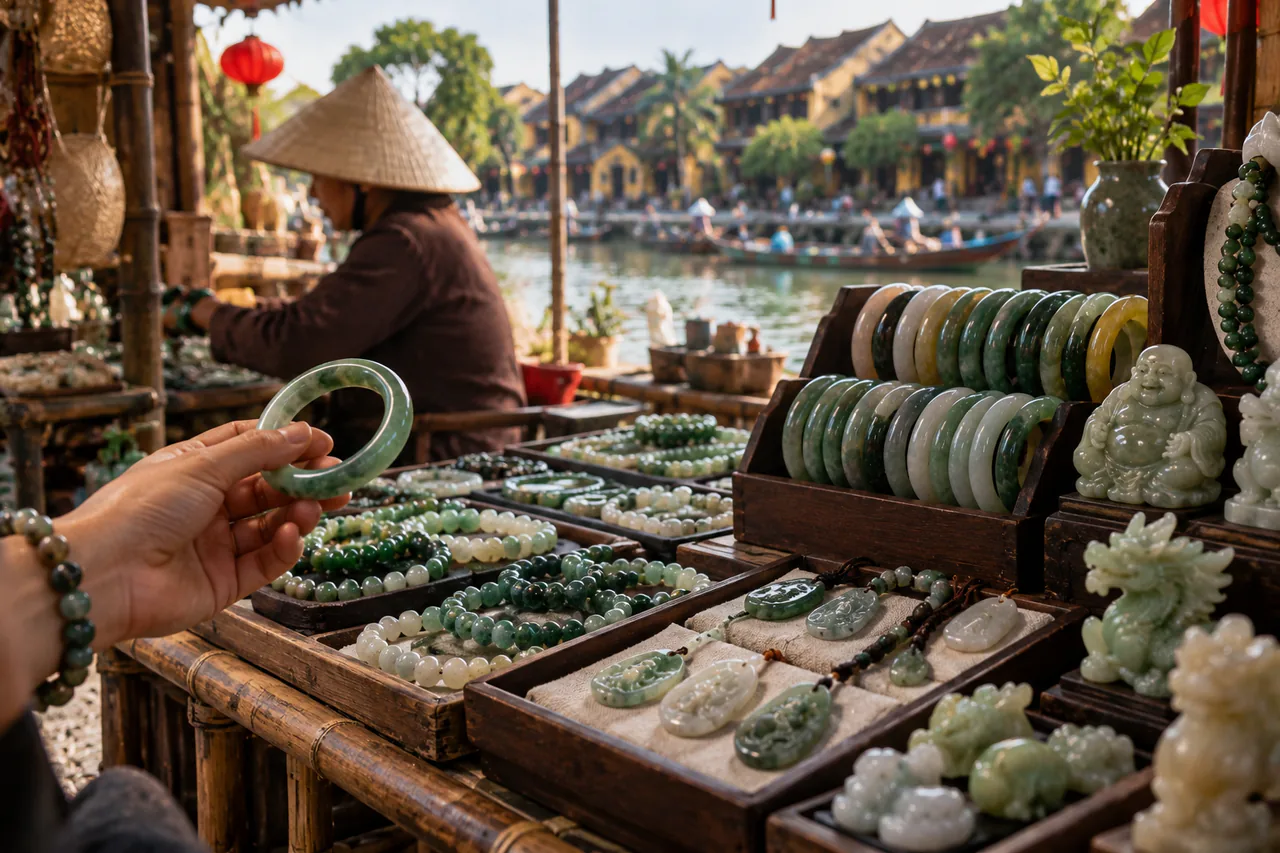
Vietnamese Jade Jewelry: What the Market Sells Under the Name
This page looks at what the label “Vietnamese jade jewelry” covers: the materials sold under that name, what a bracelet, ring or pendant brought back from there needs to be checked for, and why none of my pieces carries the word.
“Vietnamese jade” is not the name of a mineral but a label of origin: it most often covers nephrite of very variable quality or serpentine, and it is the density of the stone, not the country, that tells the two apart, provided you can weigh it bare.
The word jade does not refer to a single species: it covers two unrelated minerals, jadeite and nephrite, told apart in 1863 by the French mineralogist Alexis Damour. Serpentine is neither, and yet it is one of the materials the trade most often sells under that word. The distinction is laid out on the jade stone page.
My name is Jade, and I run a jade jewelry workshop: I choose the pieces, have them set, and weigh one example of every piece before it goes on sale. I am neither a gemologist nor a therapist: here, the mineralogy is stated as fact, and everything else is attributed.
What the Vietnamese label refers to, and what it leaves out
When you search for Vietnamese jade jewelry, you are looking for a material and you get a geography. The word Vietnam says, at best, where the piece was bought, set or resold. It says nothing about the mineral species, the treatment or the quality, and those three are what separate two green bracelets laid side by side.
The deposit lists I have read cite Vietnam neither for gem-quality jadeite nor among the major nephrite producers: the map is in where jade comes from. That silence does not prove an absence, and I do not present it as one. It is enough not to read the label as a mineral origin.
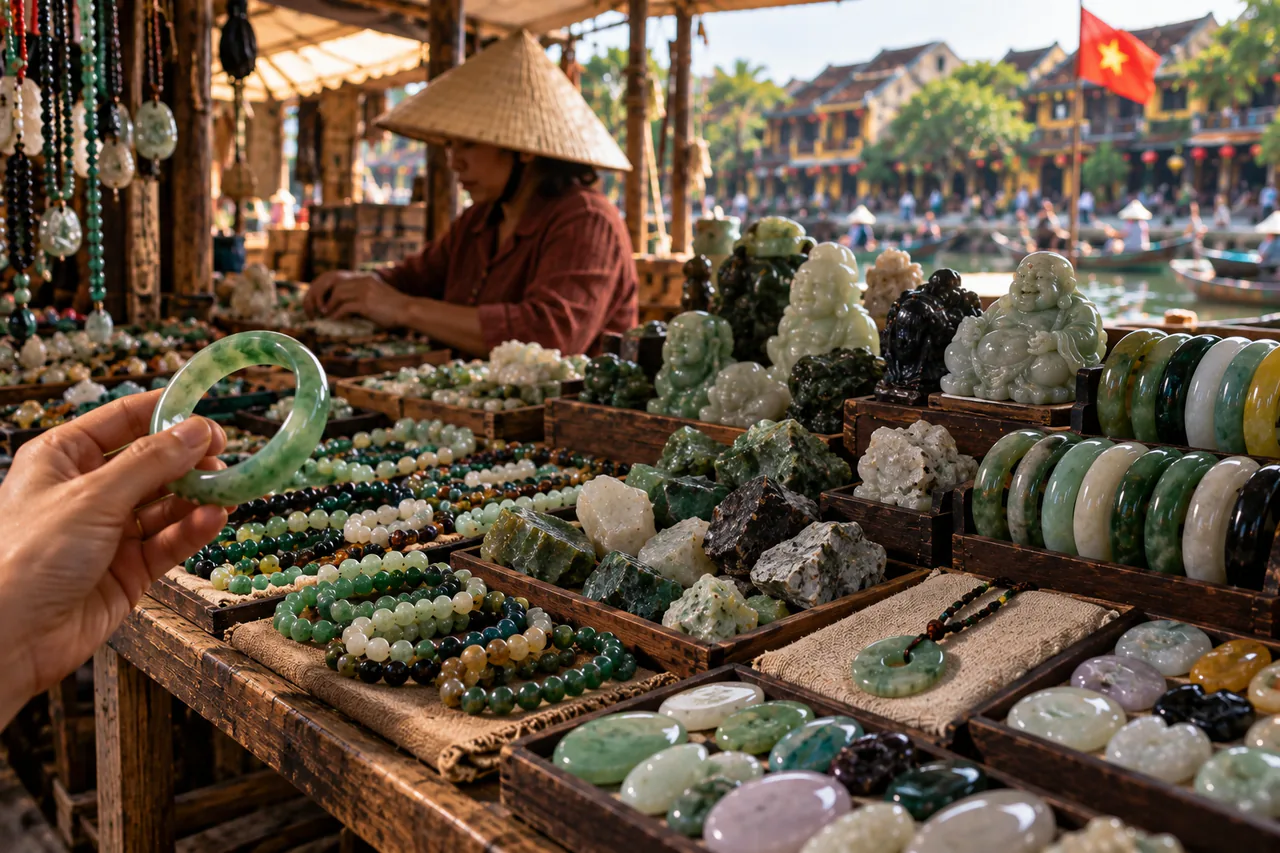
Variable-quality nephrite, serpentine: the two expected answers
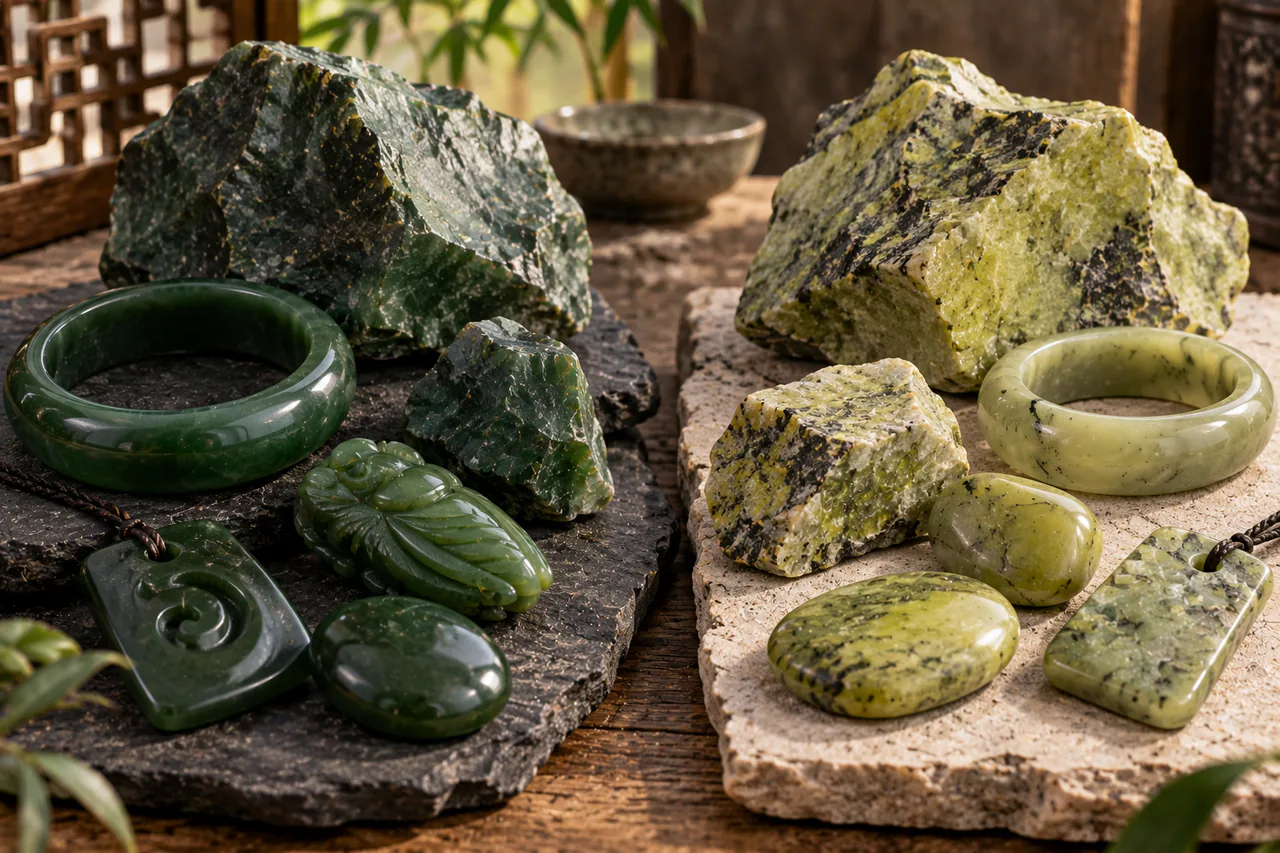
The two materials I expect to find behind this name are nephrite, in a range that runs from even and translucent to opaque, gray and stained, and serpentine. The first is jade in the mineralogical sense. The second is not, and has another name.
| Material | Density |
|---|---|
| Jadeite | 3.25 to 3.36 |
| Nephrite | 2.90 to 3.03 |
| Serpentine | about 2.6 |
| Quartzite, dyed or not | about 2.65 |
These ranges come from the mineralogical literature. Between serpentine and nephrite, the ranges do not overlap, and that is what makes the question answerable at home. Between serpentine and dyed quartzite, my scale hesitates, and I say so rather than force a verdict.
The real name behind each compound label is in stones sold as jade. None of these stones is bad. Each simply has a name, and that name is not jade.
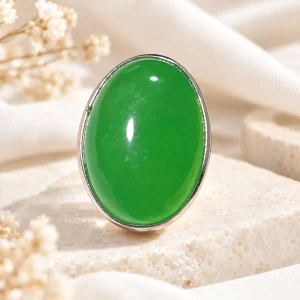
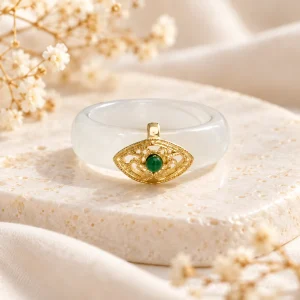
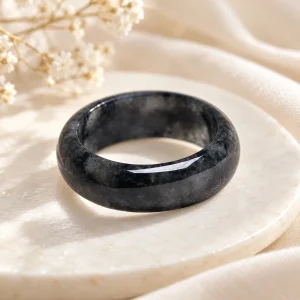
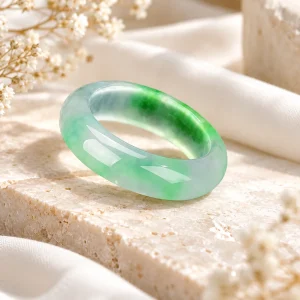
Jade rings available now
What a scale can settle at home
A stone weighed in air, then hung from a thread in a glass of water, gives its density by a simple ratio, which you then compare with the table. That is what I do on the example I order before putting a piece online, and never on the item that ships to you, which comes from the supplier without passing through my hands: the protocol is published.
Three limits, which matter especially for a piece brought back from a trip. The measurement applies to the bare stone: a strung necklace or a setting puts the cord and the metal on the scale. It loses its value on very small pieces, where the uncertainty swallows the gap between 2.65 and 2.95. And it tells you the mineral, never the treatment: a stone bleached and then impregnated with resin weighs about the same as any other, and only infrared spectroscopy, which I do not have, would settle it (the A, B and C classification, my information sheet).
Counter checks, the scratch, the sound, the feeling of cold, prove almost nothing: how to tell if jade is real.
Bracelet, ring, pendant: what each form lets you check
The bangle and the bead strand
Among the searches this topic brings together, the bracelet is the most requested form, ahead of the ring and the pendant. Two very different objects hide behind the word. A bangle carved from a single block lends itself well to weighing, since the stone is bare. A bead strand cannot be measured properly while it is strung, and that is reason enough to conclude nothing about a strand you have just brought home.
A word on wear, which often surprises people: nephrite, at around 6 to 6.5 on the Mohs scale, sits below the quartz in ordinary dust, which rates 7, and so loses its polish faster than jadeite, at 6.5 to 7. Its toughness, however, remains remarkable, and that is what makes a bangle carved from a single block possible (why jade almost never breaks, measuring your wrist).
Ring and pendant, where the method stops
A ring or a pendant holds far less material than a bangle, and the first two limits of weighing add up here: the stone is small, and almost always set or mounted on a bail. On these forms, I only reach a conclusion if the stone can be measured bare; otherwise, I write that I do not know.
The carved motifs people bring back, pierced disc, leaf, seated figure, circulate throughout East Asia and say nothing about the material (jade motifs). A lovely carving in serpentine is still a lovely carving: it changes its name, not its quality.
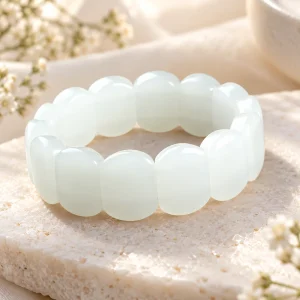
Bracelets whose density I publish
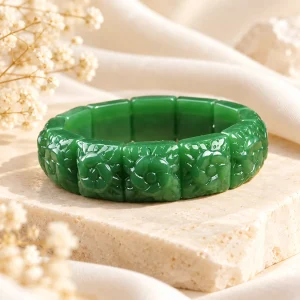
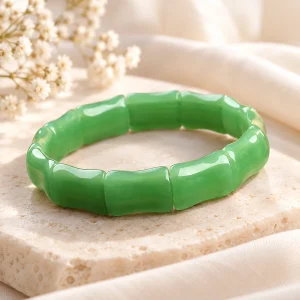
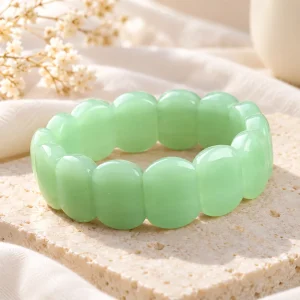
What tradition attributes to these bracelets
What follows changes register, and I flag it rather than blend it into the rest. Nothing in it is proven: it is what traditions have attributed to this stone.
A stone does not heal anything, and the full disclaimer is here.
Tradition is said to give these bracelets a protective role and a value of family continuity, the piece being handed down rather than replaced, and contemporary crystal healing authors are said to associate them with balance. These are reported attributions, never established, and they do not depend on the country of purchase: the meaning of the jade bracelet.
One belief comes up more often than the others, that of the bangle that breaks by taking a blow meant for its wearer; it has its own page, a jade bracelet that breaks. What I will never write in my own name, whatever the origin: that a piece of jewelry heals, protects or promotes fertility.
What French law says about a label of origin
French Decree No. 2002-65 of January 14, 2002, which governs the trade in gemstones, mentions neither jade, jadeite nor nephrite, and contains no positive list of names. Stating a real origin is therefore not in itself a false description: Vietnam is a country, not a misappropriated mineral name.
What the text prohibits lies elsewhere, and it is more useful to the buyer. Its Article 9 forbids selling a stone under another name, on labels as on any commercial or advertising document: calling serpentine jade falls squarely under it, and the stated origin changes nothing. Its Article 5 bans “semi-precious” and “semi-fine” outright (jade and the 2002 decree).
The decree itself provides no penalty: enforcement goes through the French Consumer Code, Article L.441-1 for deception about the nature, species or origin, punished under Article L.454-1 by three years’ imprisonment and a fine of 300,000 euros.
Why none of my pieces carries this word
None of my product pages and none of my categories carries the word Vietnam, neither in its title nor in its URL: I treat a URL as one commercial document among others, and I do not want a label of origin where the reader is looking for a mineral. What I know about the upstream supply of my pieces is written on where my jade comes from, gaps included.
This page nonetheless exists, and that is a decision. A keyword research tool suggested turning it into a category: I declined, because serving this demand with a category would mean selling an origin in place of a material.
For every piece, I publish the mineral, the mass in air, the mass in water, the resulting density, the date of the measurement, and the fact that the treatment has not been determined (what I publish on each product page). What makes a piece valuable lies elsewhere: judging jade quality.
The questions I get asked
Is Vietnamese jade real jade?
It depends on the piece, and the name of the country cannot answer that. If the stone is nephrite, it is jade in the mineralogical sense; if it is serpentine, it is not, whatever its color.
How can I find out what the bracelet I brought back is worth?
Establish the material before the value. Hydrostatic weighing on a bare bangle gives a number to compare with the table on this page; on a strand of beads, the cord skews the measurement and it proves nothing.
Does the price paid there tell you anything about the material?
No, and it is a misleading marker. I give no figures here, because I have not recorded any series of Vietnamese prices I could publish, and I have never been to those shops.
What does a Vietnamese jade bracelet mean?
Tradition is said to give it a value of protection and inheritance, and contemporary authors are said to associate it with balance. These are reported attributions, stated conditionally, and none depends on the country of purchase.
Does a very intense green prove the stone is jade?
No. A bright, uniform green can also be obtained by dyeing, notably on quartzite, and color alone separates none of the materials on this page: dyed jade.
Do you sell Vietnamese jade jewelry?
No, and no more under that label than under the name of any other country. My pieces are named by their mineral, with the number it rests on: the shop.
Where I checked
What comes from a named source. The legal texts are named in the body: French Decree No. 2002-65 of January 14, 2002, Articles 5 and 9, and the French Consumer Code, Articles L.441-1 and L.454-1. The separation of jadeite and nephrite comes from Alexis Damour’s note to the French Academy of Sciences in 1863; I do not give page numbers, as I have not read it. The density and hardness ranges are those of the mineralogical literature: I repeat them, I did not measure them, and their limits vary by a few hundredths from one database to another. I therefore attribute them to no particular organization, because I did not take them from any one of them.
What is a market observation, with a date. On September 8, 2026, I looked at the nine French competitors on the first page of results for jade queries, and none states the mineral of its pieces. The same survey showed me a French site ranking fifth for “bijoux jade” with a page entirely devoted to Vietnamese jade, which is why this topic is covered here rather than ignored. The same day, my supplier confirmed that it cannot say whether its stock has been treated.
What is my own reasoning. I found no source telling me exactly where the material sold under this name comes from, and I write that rather than fill the gap: what I put forward is that the label refers to a place of purchase, not a species. The link between nephrite’s hardness and wear from dust, the refusal to open a category for an origin and the refusal to reach a conclusion on a set stone are decisions, not established facts. If you find a mistake here, write to me: I will correct it and note that I did.
In one sentence
Vietnamese jade jewelry is first of all jewelry bought in Vietnam, and the word that really tells you something is the name of the mineral, which a scale gives in a few minutes on a bare stone. The method is on the weighing page, and the pieces are in the shop.