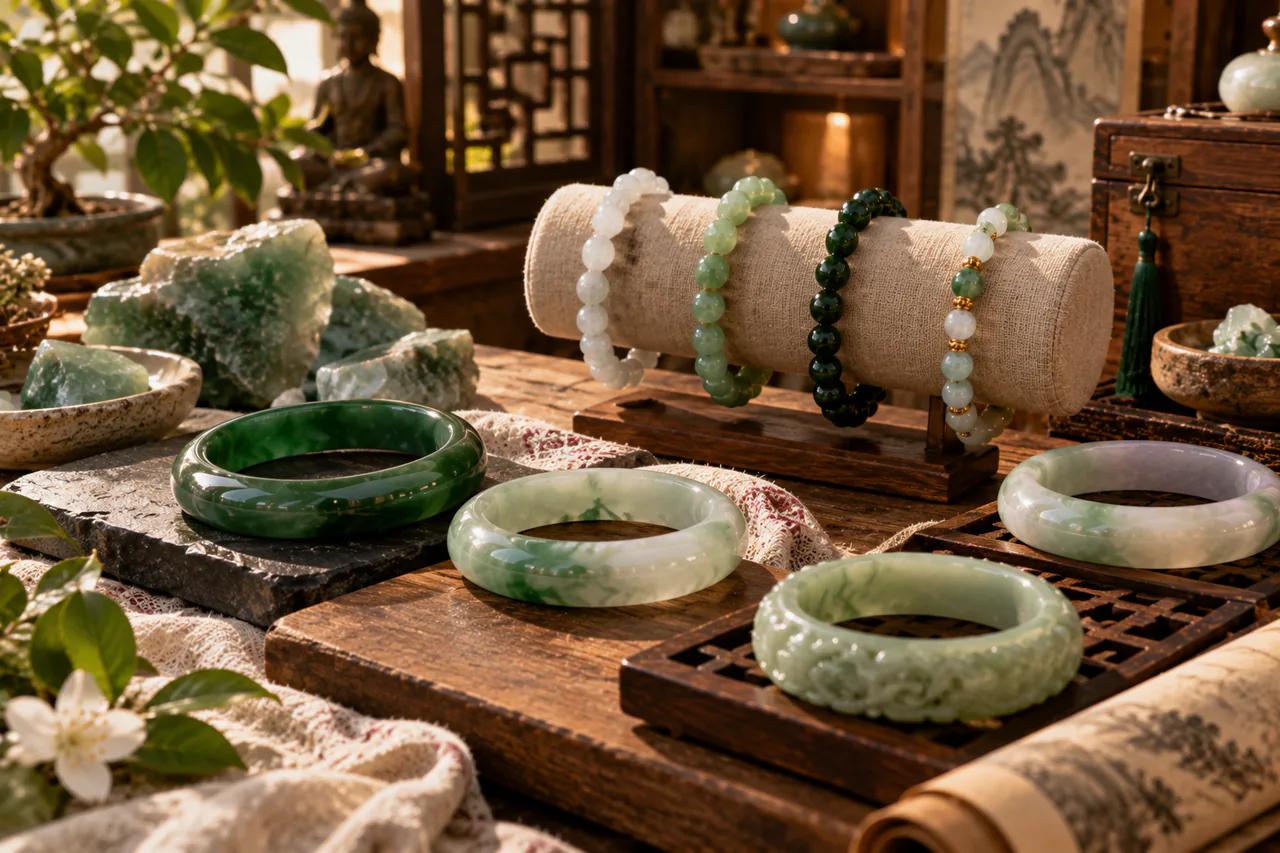
Real Jade Bracelet Price: What a Jade Piece Costs
What a set piece of jade jewelry costs, bracelet, necklace, ring or pendant, and the four things that make the bill vary. Someone who types “real jade bracelet price” is looking for an amount: this page says what that amount is made of, and why I write none.
The price of a piece of jade jewelry does not come down to the stone alone: four variables make it up, the material actually present, the quantity of stone and the cutting it has undergone, the metal and the setting, and then the channel through which the piece reaches you.
They do not carry the same weight in every format. On a bangle carved from a single block, the stone makes up almost the whole bill; on a slender ring, the metal sometimes costs more than the cabochon it holds.
My name is Jade and I run a jade jewelry workshop: I choose the pieces, have them set, and weigh one example of each reference before it goes on sale. I am neither a gemologist nor a therapist, and I do not appraise other people’s jewelry.
What “real” adds to the price, and what it does not
The word is not a product page ornament, it is regulated in France. Article 4 of French Decree No. 2002-65 of January 14, 2002 prohibits the words “élevé, cultivé, de culture, vrai, précieux, fin, véritable, naturel” (raised, cultivated, cultured, true, precious, fine, real, natural) for reconstructed, composite, synthetic, artificial and imitation products. Used correctly, the French word véritable, rendered here as real, therefore says one thing and one thing only: the stone is not an imitation.
It does not say which jade is involved: the word covers two unrelated minerals, jadeite and nephrite, which are traded neither in the same volumes nor at the same price level (two stones and a single word).
Nor does it say whether the stone has been treated. “Real” and “untreated” are two different claims, and the second cannot be inferred from the first. My scale establishes the material and cannot see resin; my supplier does not know the treatment status of the goods, and only infrared spectroscopy in a laboratory would settle it. I do not have it, and I say so rather than stay silent (jade A, B, C, my information sheet).
The material, and the gap it opens on its own
Before comparing two bracelets, you need to know whether both contain jade. Jadeite sits between 3.25 and 3.36 in density, nephrite between 2.90 and 3.03, while serpentine hovers around 2.6 and dyed quartzite around 2.65 (the weighing). Two bracelets that look alike can therefore be two different materials, and that gap comes before any question of quality (stones sold as jade).
On a piece that is already set, checking becomes difficult for a mechanical reason: hydrostatic weighing applies to the bare stone, and the metal of a setting, like the thread of a strung strand, enters the measurement and skews it. So I weigh one example of each reference before setting, not the order that ships to you (what each product page carries).
With the material equal, what then separates two stones comes down to six criteria, gathered separately rather than summarized here: judging the quality of a jade. The price gap on the stone alone, without a setting, has its own page: what makes the gap from one to a hundred.
Jade bracelets available now
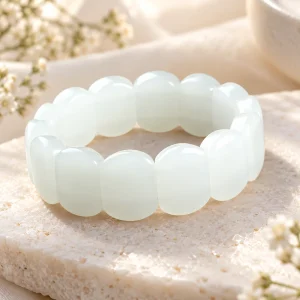
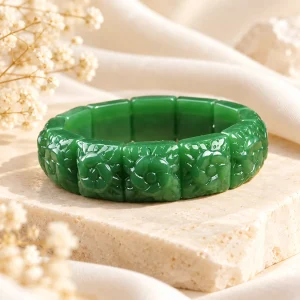
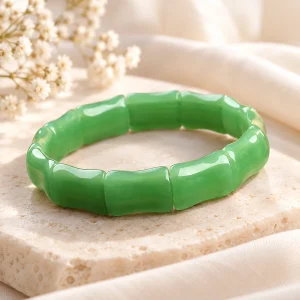
The quantity of stone, and what the cutting takes away
Two pieces that contain the same weight of jade have not used up the same amount of rough block, and that is the amount the sales pages I opened detail least.
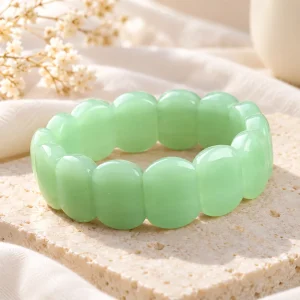
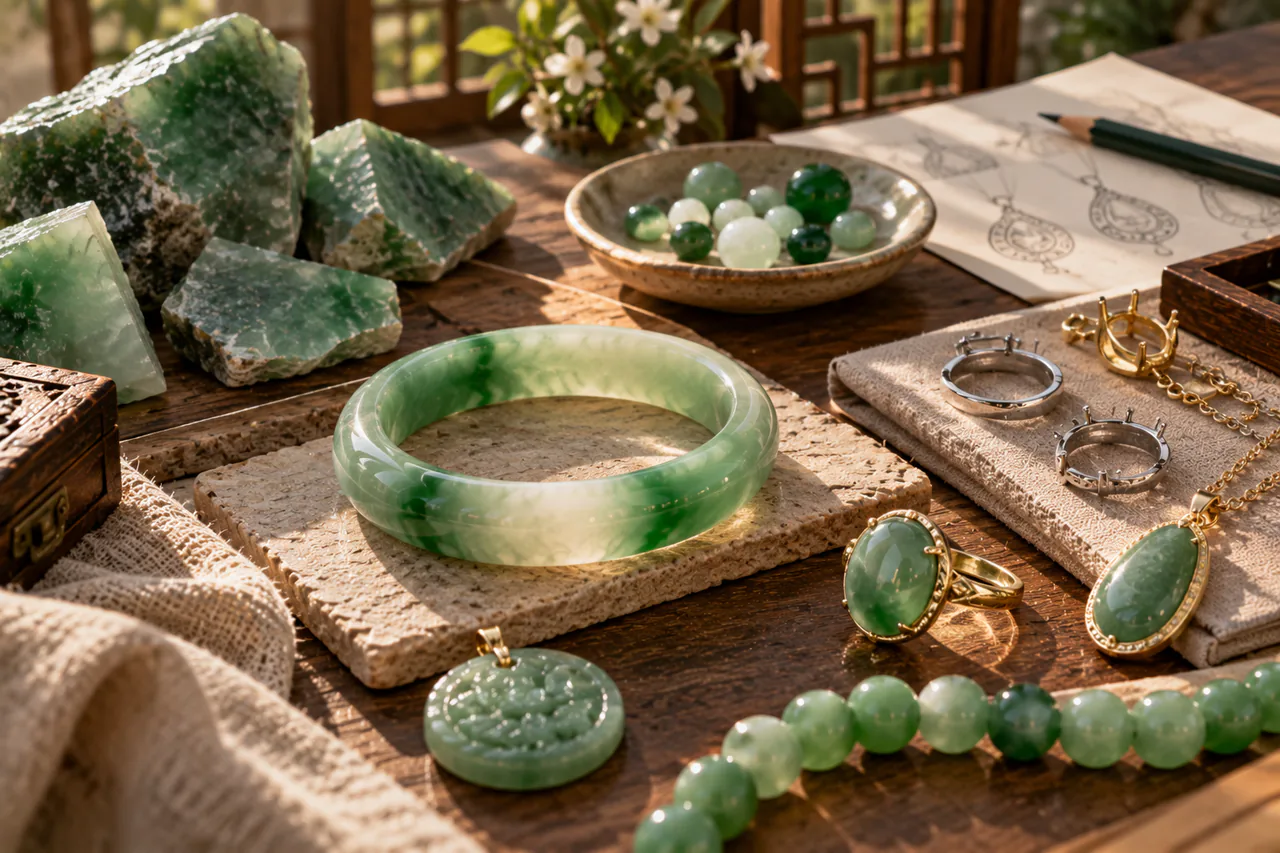
- A bangle carved from a single block means hollowing out the center, and so losing that material, and requires a stone that is sound all the way around: a flaw in the wrong place condemns the whole piece.
- A strand of beads is cut around the flaws and loses almost nothing. The cost moves into sorting: matching thirty beads of similar color and translucency means setting many aside.
- A cabochon or a plaque is taken from a chosen zone, and its thinness lets more light through than the same jade carved in volume.
These three objects cannot cost the same with the material equal, and none is better than the others: they are different lapidary gestures.
The metal, the thread and the clasp
The metal is the part of the bill that moves without the stone having anything to do with it: gold and silver have a daily market price, jade does not. Between a gold setting, a 925 silver setting and a plated metal, the gap widens before jade even comes up, and it says nothing about the stone set in it (choosing the metal).
The rest of the setting is small and still counts. A strung strand holds by a thread and a clasp, which are wear parts: they get replaced, and that replacement is part of the real cost of a piece worn every day (when to change the thread and cord).
What you pay for that is not in the jewelry
The fourth variable is nowhere in the object: a store, a team, returns handled, shipping and a margin all end up in the displayed price. It is neither an abuse nor a secret, but it is the part that explains why the same amount does not mean the same thing depending on where you read it.
What follows changes register, and I flag it rather than blending it into the rest. Nothing in it is proven: it is what traditions have attributed to this stone.
Some sales pages present the benefits tradition supposedly attributes to jade as a feature of the jewelry, just like its size or its polish. These attributions are reported, never established (what tradition attributes to the stone), and I do not see how they could go into a price.
Bracelets whose density I publish
Bracelet, necklace, ring or pendant
The format shifts the relative weight of the four variables.
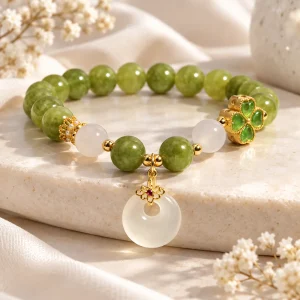
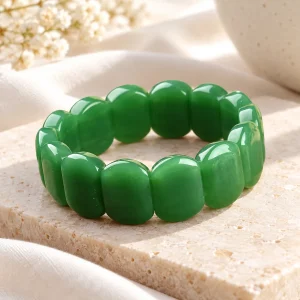
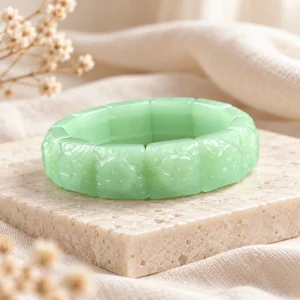
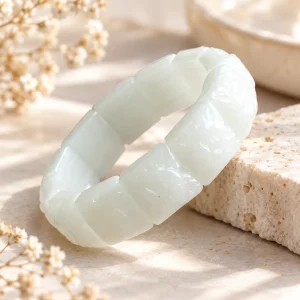
- The bracelet covers two objects that have almost nothing in common. The bangle is a single hollowed stone, with no metal and no clasp: everything comes down to material and cutting, and since it does not come off easily, the size is decided before buying (measuring your wrist, the size guide). The strand of beads, for its part, adds sorting, thread and clasp.
- The necklace takes more stone, and above all more stones matched to one another: it is the format where sorting costs the most.
- The ring is the format where metal weighs heaviest, because the stone is small and the setting indispensable.
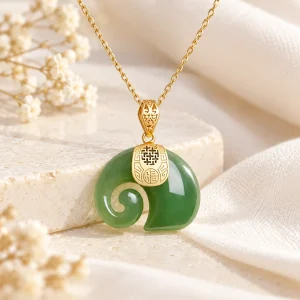
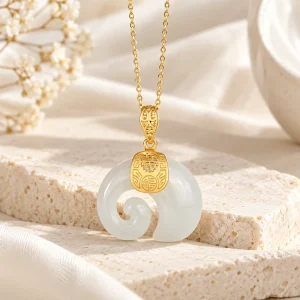
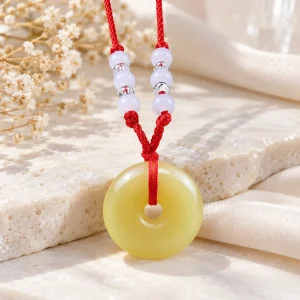
- The pendant rests on a single stone and a bail: one piece, one measurement, one price.
A low price, a high price, and what neither proves
A low price is not proof of a fake stone: an opaque, uncarved nephrite costs little and is still jade. A high price is no more proof of jade: nothing prevents charging for a dyed quartzite at a nephrite’s rate, and the sales page will not contradict itself.
What should raise a flag is a mismatch between the amount and the vocabulary: a small price paired with high-end words, vivid green, translucent, imperial. Two markers are worthless and often turn up together: the A, AA, AAA scale, which borrows its letters from the only classification that exists without its definition, and the two words that article 5 of the same decree prohibits across its entire scope, which I discuss elsewhere (is jade a precious stone). The rest of what to look at before paying is here: what to watch out for before buying.
Why you will not read any amount here
You came looking for a number, and I write none: I invent no price, no lead time and no dimension, and I state the gap rather than a plausible value.
Three reasons, the first of which is specific to set jewelry. A jewelry price depends on a metal price that changes every day and on setting work that is never the same from one workshop to the next: a range written into an article ages faster here than for rough stone, and it stays online for years. Next, I have no dated market survey to publish, and copying ranges read elsewhere would spread amounts whose material and treatment I do not know. Finally, the prices of my pieces are on their product pages, up to date, with the measurement that goes with them (the shop).
Finding out what a piece you already own is worth
The query “real jade bracelet price” covers two intentions that nothing in the words separates: buying, and finding out what an inherited bracelet is worth. I do not do appraisals and have no qualification to do them. What I can describe are the two answers without which an amount rests on nothing.
The material first. On a bangle or a pendant in bare stone, hydrostatic weighing settles the question at home, as long as the piece is not too small for the scale. On a strung strand or a set piece, it settles nothing until the stone is separated from the thread and metal, which is no small matter on an old piece (what you can check yourself).
The treatment next, which requires a laboratory, for the very reason that prevents me from determining it on my own pieces. Without these two answers, a stated value is only an opinion about an unknown material.
The questions I get asked
How much does a real jade bracelet cost?
There is not one price but a scale, driven by four things: the mineral actually present, the quantity of stone and its cutting, the metal and the setting, and then the sales channel. As long as the first answer is missing, an amount means nothing.
Why don’t two jade bracelets that look alike cost the same?
Because they may not contain the same material, and because a bangle hollowed from a single block does not use the same quantity of stone as a strand of beads cut around the flaws. Add the metal and the clasp.
Is a cheap jade bracelet necessarily fake?
No. An opaque nephrite, uncarved and strung on a simple thread, costs little and is still jade. What should raise a flag is a low price paired with high-end vocabulary.
Should you pay more for a gold setting than for 925 silver?
That is a question of metal, not stone: the gap exists and it says nothing about the jade set in it. The choice comes down to how you wear it and to your skin.
Does the price depend on the color of the jade?
Yes, but after the mineral and the treatment, and less through the hue itself than through its evenness and the translucency. The details are on the page about the price of the stone alone, because they concern the material before the jewelry.
How can I find out what the jade bracelet I inherited is worth?
By getting two answers. The material, which hydrostatic weighing gives you if the stone is bare and not too small, which is the case for a bangle but not for a strung strand. The treatment, which requires a laboratory. I do not do appraisals.
Where I checked
What comes from a named source. French Decree No. 2002-65 of January 14, 2002 is cited in the body of the text, articles 4 and 5, and the list of eight words prohibited for imitations is taken from the text itself. The density ranges for jadeite, nephrite, serpentine and quartzite come from the mineralogical literature: I repeat them, I did not measure them, their bounds vary by a few hundredths from one database to another, and so I do not attribute them to any particular body.
What is a market observation, dated. On September 8, 2026, I looked at the first page of French results for “bracelet jade véritable prix”: eight of the nine results were product pages, and none published the density of the stone being sold. For the broader price intent, appraisal services also came up, which is not the trade I practice. The same day, my supplier confirmed to me that they cannot say whether their goods are treated.
What is my own reasoning. The breakdown into four variables, the idea that a set jewelry price ages faster than a rough stone price because a metal price moves every day, ranking the necklace as the format where sorting costs the most, and the decision to publish no amount without a dated survey: these are positions, not established facts. If you find a mistake here, write to me: I will correct it and note that I did.
In one sentence
The price of a piece of jade jewelry is made of four things, only one of which is the stone, and “real” means the absence of imitation, never the absence of treatment. The method is on the weighing page, and the pieces are in the shop.