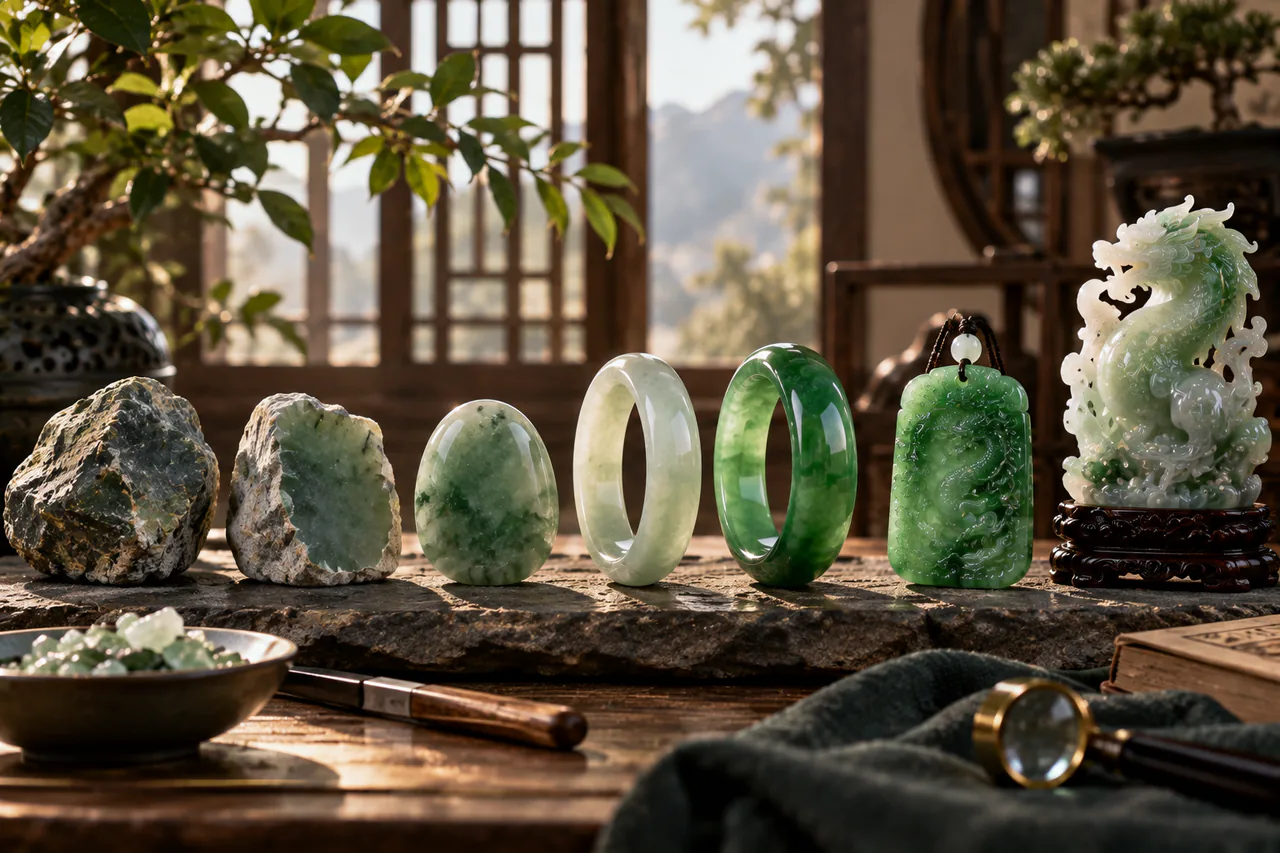
Jade Stone Price: What Makes a Hundredfold Gap
Someone searching for “jade stone price” expects a figure, and this page first explains why I do not write one. It covers what widens the gap between two stones sold under the same word, the price per kilo, what cutting and setting add, and what you can do with an inherited piece.
There is no single jade stone price, and the biggest gap is not a gap in grade but in material: three things come before everything else, the mineral actually in the piece, the treatment it has received, then colour and translucency.
The hundredfold gap in the title is a ratio, not a survey: between a dyed quartzite sold under a jade name and a translucent jadeite, you change material, not grade.
My name is Jade, and I run a jade jewellery workshop: I choose the pieces, have them set, and weigh one example of every piece before it goes on sale. I am neither a gemmologist nor a rough-stone dealer: I measure, I do not certify.
The first gap is not a question of quality
Before comparing two jades, you need to know whether both are jade. The word covers two unrelated minerals, jadeite and nephrite, and the trade sells others under that name: serpentine sits around 2.6 and dyed quartzite around 2.65, while jadeite falls between 3.25 and 3.36 and nephrite between 2.90 and 3.03 (weighing). This divide governs everything that follows about price, and it has its own page: jade stone, two minerals under one name.
This shift in material is the first level of the price gap, and nothing in a price list shows it. A seller can charge for dyed quartzite at the price of nephrite without the product page contradicting it: that is mostly the case with the pink and fuchsia bracelets sold under jade names (stones sold as jade). Hence the conclusion that governs the rest of this page: a price does not tell you the material. You have to ask the seller for it, and then check it on a scale.
Jadeite and nephrite, two markets
The two legitimate jades are not traded in the same places or in the same volumes. Gem-quality jadeite comes mainly from Burma and carries the top of the world market; nephrite, mined notably in Russia, Canada and China, arrives in far larger quantities and supplies most of the jewellery on the market (where jade comes from).
This is not a piece-by-piece ranking: an even, crack-free nephrite does not compare with a dull, fractured jadeite, and I know of no rule that ranks the two species one above the other. The top of the market, however, is held by jadeites (what separates the two minerals).
Jade rings of the moment
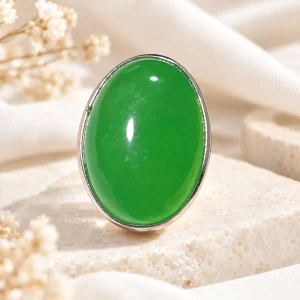
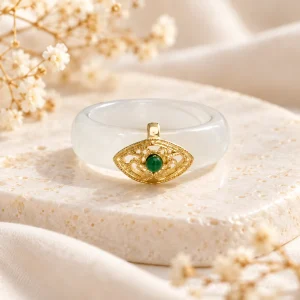
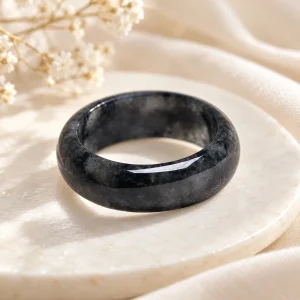
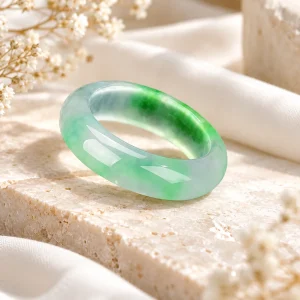
Treatment, a gap nothing shows to the eye
Two jadeites of the same colour can be separated by a factor invisible to the eye. The A, B, C classification does not describe quality but treatment: A, neither bleached nor impregnated; B, bleached with acid then filled with resin; C, colour added. A B stone has lost material and gained polymer, it sells for less and ages differently (dyed jade).
French law does not name jade and applies all the same. Decree No. 2002-65 of 14 January 2002 requires, in its Article 2, that the name be completed by the treatment undergone, dye and filling explicitly included, and its Article 3 exempts three traditional lapidary practices: impregnation with a colorless fluid substance, heat treatment, and bleaching without dye or varnish (what a seller must disclose). Whether the resin in a B jadeite counts as a colorless fluid substance under Article 3 is not settled by the text, and I do not settle it here. Hence the sheet required by Article 10: my information sheet.
For my own pieces, the line is short and unpleasant: I do not determine treatment. My supplier does not know it, my scale cannot see it, and only infrared spectroscopy would settle it. This part of the price escapes me just as it escapes the buyer.
Colour and translucency
Once mineral and treatment are settled, two criteria come before the others at the only competitor I have seen publish quality criteria: colour, then translucency. And colour is judged less by its hue than by its evenness. In jadeite, bright, vivid green comes from chromium and ordinary green from iron; in nephrite, from iron alone: green jade stone. A hue spread without clouds or streaks costs more than a more intense but patchy one: from an even stone, a lapidary cuts matching pieces.
Translucency comes next, meaning how far light travels into the stone: that is where two pieces of the same green stop looking alike.
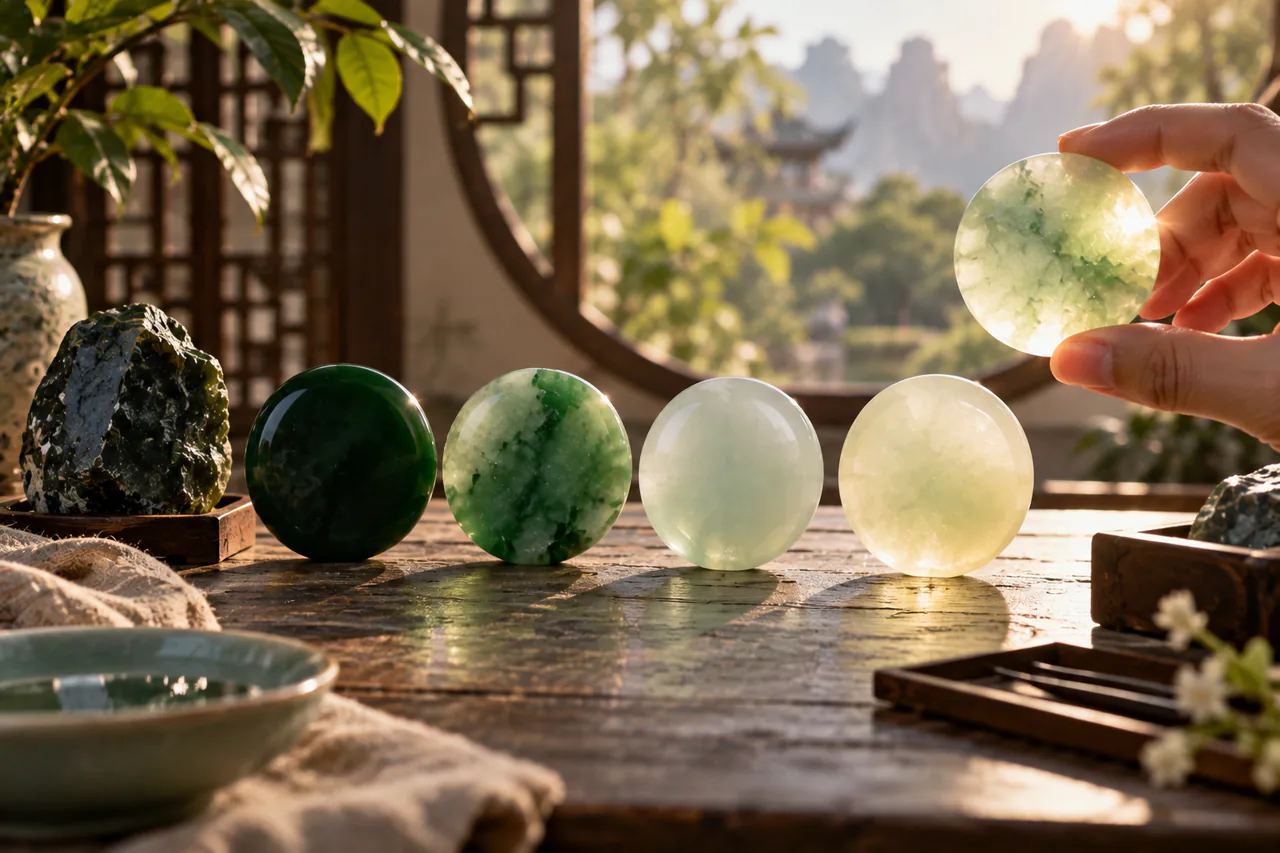
“Imperial jade” refers to the top of this scale in jadeite, a deep, translucent green, and not to a place of origin: what the term covers. Green is not the only colour of jade (the colours of jade), and the other criteria come after these two: judging the quality of jade.
The price of jade stone per kilo
The price per kilo is a dealer’s question more than a jewellery buyer’s. It assumes an even material, which nothing guarantees in a rough block: the same weight can hide a core of beautiful colour or a dull, cracked mass, and the outside does not reveal the inside. It is not a price, it is a lot average.
Nor have I found a public price list to copy. Burmese jadeite, which forms the top of this market, is sold upstream by the state-owned company added to the European Union sanctions list on 21 June 2021. I do not sell that origin, whose official supply chain has also been under United States sanctions since 8 April 2021 (Burmese jade).
Rough nephrite is another market, and a more open one: I offer an uncut block, whose mass and density I publish (the nephrite block).
Stone by weight and set jewellery
When the stone becomes jewellery, other costs come in, and they are covered separately: what a piece of jade jewellery costs. Comparing a bracelet price with a price per kilo makes no sense.
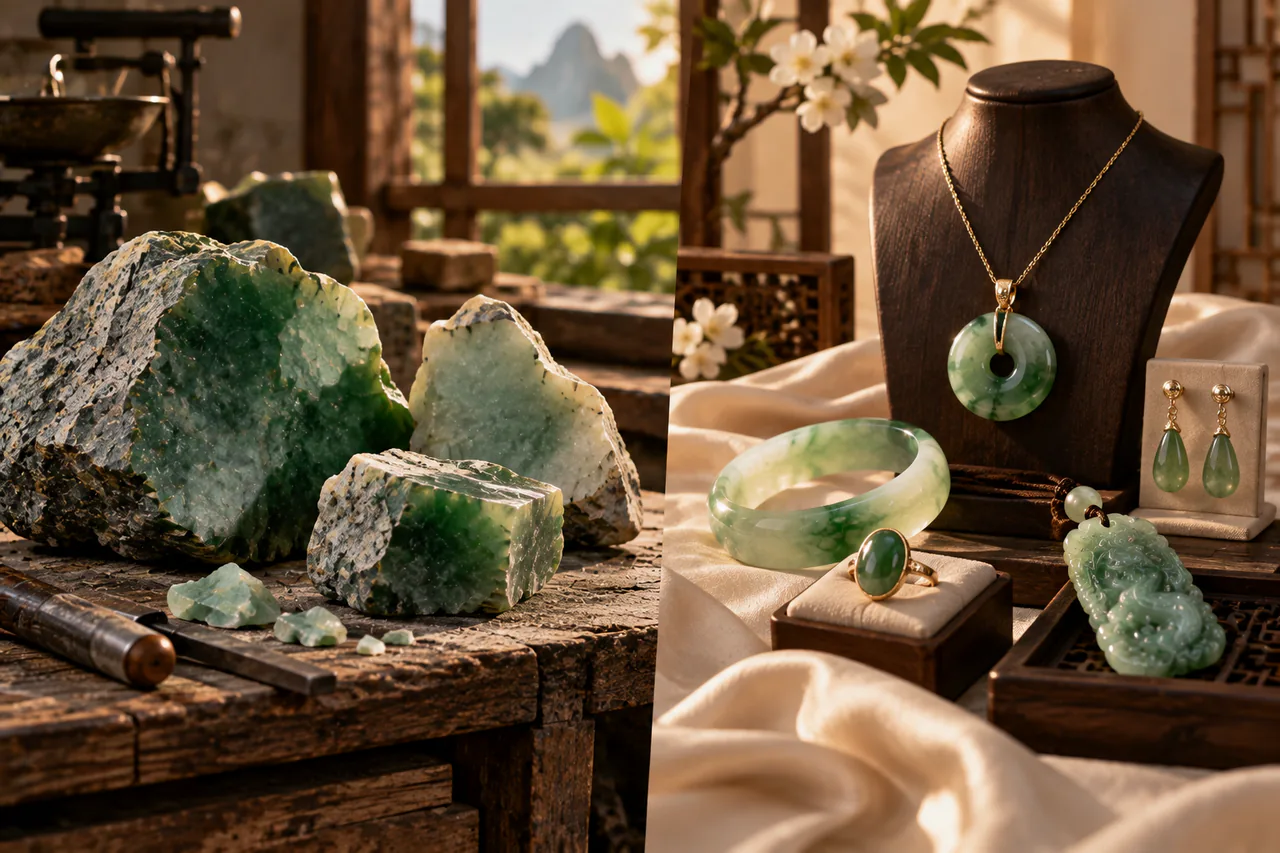
Cutting adds a factor few pages explain. A bangle carved from a single block requires a stone that is sound all the way around: one flaw in the wrong place condemns the whole piece. A strand of beads, by contrast, is cut around the flaws, and a flaw costs only one bead. For the same material, these two objects do not require the same stone.
Metal counts too, and on small pieces it sometimes weighs more than the stone: jade and gold, or sterling silver.
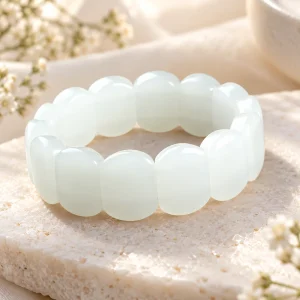
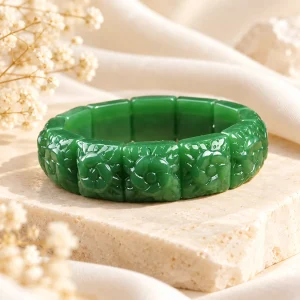
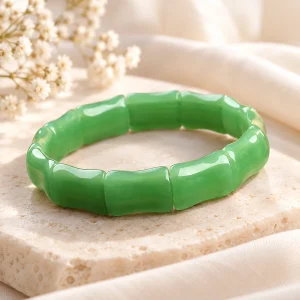
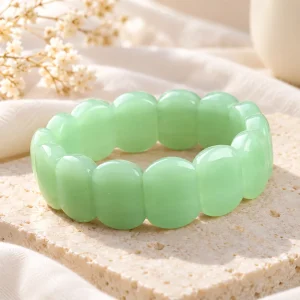
Bracelets whose mineral I give before the price
Price benchmarks that are worth nothing
Five benchmarks circulate on product listings, and none of them holds up.
- The A, AA, AAA scale refers to no standard I have been able to find. It borrows its alphabet from the real classification, the one for treatments: jade A, B, C.
- “Certified”, used on its own, says neither who certified, nor what, nor how. A laboratory report carries a name, a date and a technique.
- “100% natural” says nothing about bleaching or resin: Article 2 of the decree governs here.
- “Semi-precious” and “semi-fine” are prohibited by Article 5 of French Decree No. 2002-65 across its whole scope, and they appear on most of the stone pages I have opened: is jade a precious stone.
- A high price taken as proof. This is the one this page keeps overturning: nothing prevents charging for dyed quartzite at the price of nephrite, and a sales page never contradicts it.
The listing wording that should make you close the tab is in buying jade jewellery.
Why you will not read any amount here
You came looking for a number, and I write none: I invent no price, no lead time and no dimension, and I write the gap rather than a plausible value.
Three reasons. I have no dated market survey to publish, and copying ranges read elsewhere would spread figures whose material and treatment I do not know. A range written in an article ages badly and stays online for years. And the prices of my pieces can be read on their product pages, kept up to date.
What I publish instead can be checked: the mass in air, the submerged mass, the density, the date of measurement and the mineral it concludes, on one example of every piece (what each product page shows, the shop). The day I have real ranges, they will appear here.
Getting a stone you own appraised
The words “jade stone price” cover two intentions that nothing in the query separates: buying, and finding out what an inherited piece is worth.
I do not do appraisals and I have no qualification to do them. What I can say about an inherited stone comes down to two steps: the material, which hydrostatic weighing separates at home from serpentine or quartzite as long as the stone is bare and not too small (what you can check yourself), then the treatment, which requires a laboratory. Without these two answers, any amount announced rests on nothing.
The questions I get asked
How much does a jade stone cost?
There is no single answer, and not only because qualities vary: the word covers two minerals, and the trade sells others under that name. Before any amount, you need to know what material you are talking about.
Is cheap jade necessarily fake?
No. An ordinary nephrite, opaque and uncarved, costs little and is still jade. What should raise concern is a low price with high-end vocabulary: vivid green, translucent, imperial, certified. That proves nothing on its own, and that is exactly the problem: ask for the mineral, the measured density, then the treatment status.
What is the price of jade per kilo?
I have not found a public price list, and a price per kilo says little here: the same weight can contain very uneven material. It is a lot average, not a price.
Does jadeite cost more than nephrite?
At the top end, yes: the top of the market is held by green, translucent jadeites. On everyday pieces, the two species overlap, and a beautiful nephrite outranks a mediocre jadeite.
How can I check that a price matches the material advertised?
By asking the seller for the mineral, the measured density, then the treatment status. If they answer “jade” without specifying jadeite or nephrite, they do not know, or do not want to say. On a stone you have bought, weighing separates jade from serpentine or quartzite, never one resin-filled jadeite from another.
Does jade jewellery gain value over time?
I do not talk about investments and I sell nothing as one. Mass-produced jewellery is not an asset: what resells are old, carved, documented pieces, a different trade from mine.
Where I checked
What comes from a named source. French Decree No. 2002-65 of 14 January 2002 is cited in the body of the text, Articles 2, 3, 5 and 10. The American ban on importing Burmese jadeite, introduced by the Tom Lantos Block Burmese JADE Act of 2008, was lifted by Executive Order 13742 of 7 October 2016; the American sanctions of 8 April 2021 and the European sanctions of 21 June 2021 target the state-owned company that controls Burmese jade. The density ranges come from the mineralogical literature: their limits vary by a few hundredths from one database to another, so I attribute them to no organization.
What is a market observation, with a date. Everything that follows was recorded on 8 September 2026. Of the nine French competitors in the top 10, none of those selling jade states the mineral of its pieces, and one uses the A, AA, AAA scale. For “bracelet jade véritable prix”, eight of the nine results on the first page were product pages, and two appraisal services came up on the broader price intent: that survey concerns the bracelet query, not this one. Only one of these competitors publishes quality criteria, and it places colour and translucency before the others: this is trade practise, not a standard, and I have not seen it quantified anywhere. Finally, my supplier confirmed that it cannot say whether its stock is treated.
What is my own reasoning. Price held to be silent on the material, the order I give the three factors, the B stone held to cost less and age differently, the even hue priced higher than a more intense but patchy one, the price per kilo reduced to a lot average, the flaw that condemns a bangle but not a strand of beads, the share of metal on small pieces, resale reserved for old pieces rather than mass-produced jewellery, and the decision to publish no amount without a dated survey: these are positions, not established facts. If you find a mistake here, write to me.
In one sentence
The price of a jade stone is decided first by what it is, then by what has been done to it, and only after that by its colour: as long as the first two answers are missing, an amount means nothing. What I can put next to a price is a measurement: how I weigh, and what I sell.