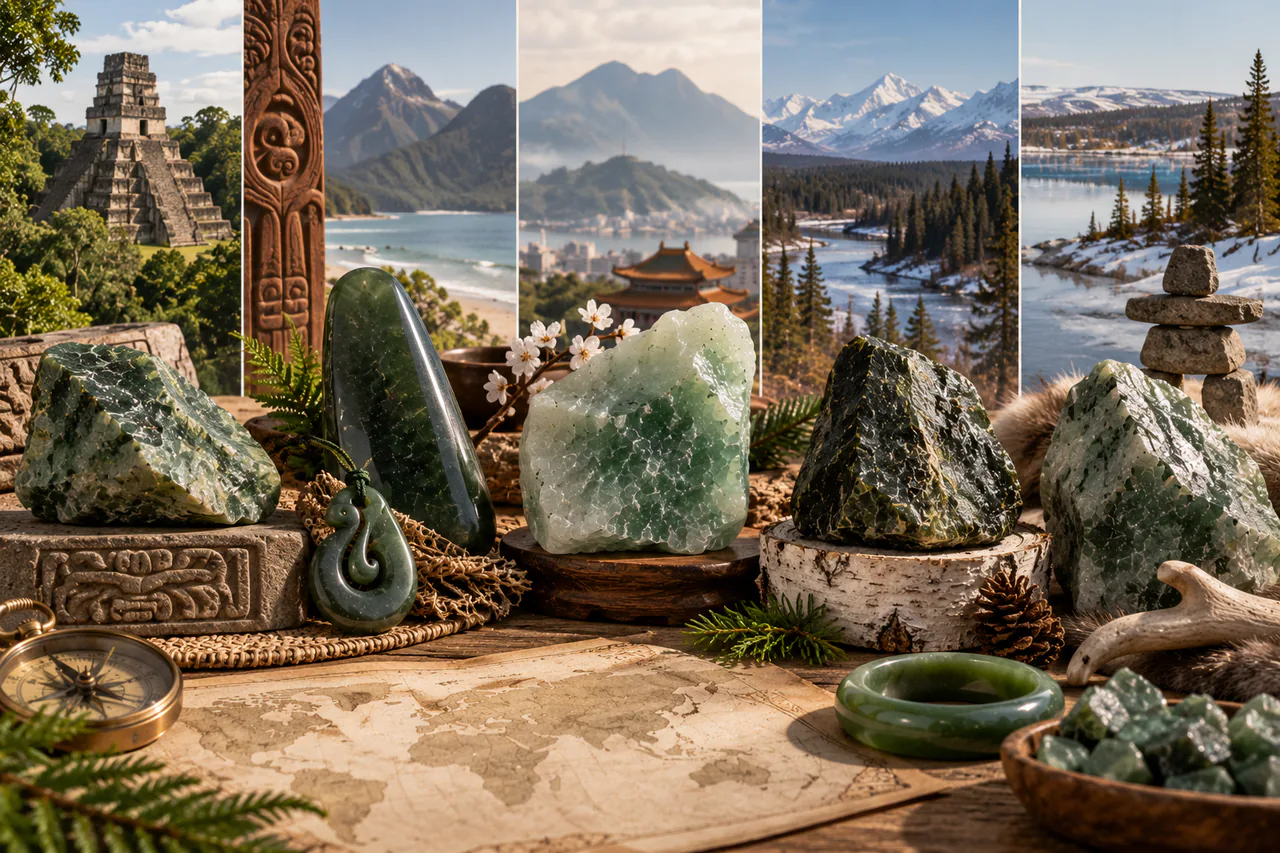
Where Jade Comes From: Guatemala, Pounamu, Taiwan, Russia, Canada
This page maps the jade deposits: where jadeite is found, where nephrite is found, what Guatemala, New Zealand, Taiwan, Russia, Canada and China produce, and why the origin of a piece of jewellery almost always remains impossible to verify.
The two minerals called jade do not share the same map: gem-quality jadeite is rare and comes mostly from Burma, with Guatemala as the only other commercial source, while nephrite, commonplace on a global scale, is mined on almost every continent.
| Country | Mineral | What it supplies |
|---|---|---|
| Burma | Jadeite | Most of the gem-quality jadeite on the world market |
| Guatemala | Jadeite | The second commercial source, far behind |
| New Zealand | Nephrite | Pounamu, whose ownership is vested by law |
| Russia, Canada | Nephrite | The large volumes of today’s trade |
| China, Taiwan | Nephrite | The historic deposits of East Asia |
My name is Jade and I run a jade jewellery workshop: I choose the pieces, have them set, and weigh one example of each reference before it goes on sale. I am neither a gemmologist nor a geologist, and I have not been to any of these mines: this page describes deposits, never my stock, and I explain further down why the two do not overlap.
Two minerals, two maps that do not line up
The word jade covers two unrelated species, separated in 1863 by the French mineralogist Alexis Damour: that is the starting point for everything else, developed on the jade stone page and in jadeite or nephrite. They do not form under the same conditions, and that is why they are not found in the same places.
- Jadeite requires very high pressures at moderate temperature. It is confined to ancient subduction zones, where one oceanic plate has slid beneath another: a handful of massifs worldwide, no more.
- Nephrite forms at the contact between serpentinized ultramafic rocks and silica-rich rocks, or in contact with dolomitic marbles. These settings are common, and deposits number in the dozens.
Hence the imbalance that explains a good part of the prices (how jade stone forms).
Burma, which supplies almost all jadeite
The gem-quality jadeite in world trade comes overwhelmingly from a single region, Hpakant, in Kachin State, in northern Burma. That is where the translucent pieces the market calls imperial jade come from, a term that describes a quality of material and not a prestigious origin: what the term really means.
I do not sell it. Neither the United States nor the European Union prohibits its import today: the American ban set by the Tom Lantos Block Burmese JADE Act of 2008 was lifted in 2016. But the state-owned company that controls Burmese jade has been sanctioned by the United States since 8 April 2021 and by the European Union since 21 June 2021. The human cost of this mining has its own page: Burmese jade bracelet.
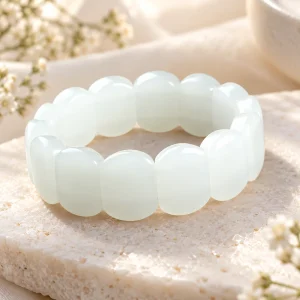
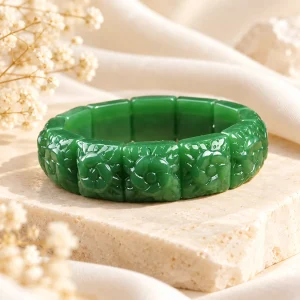
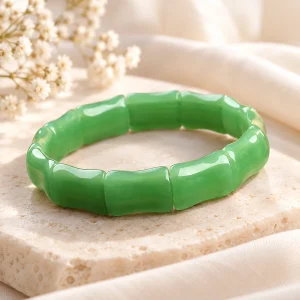
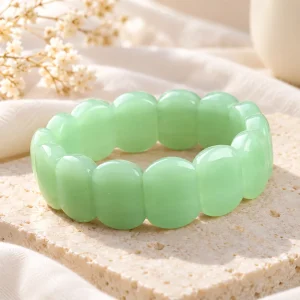
Jade bracelets available now
Guatemala and the Motagua Valley
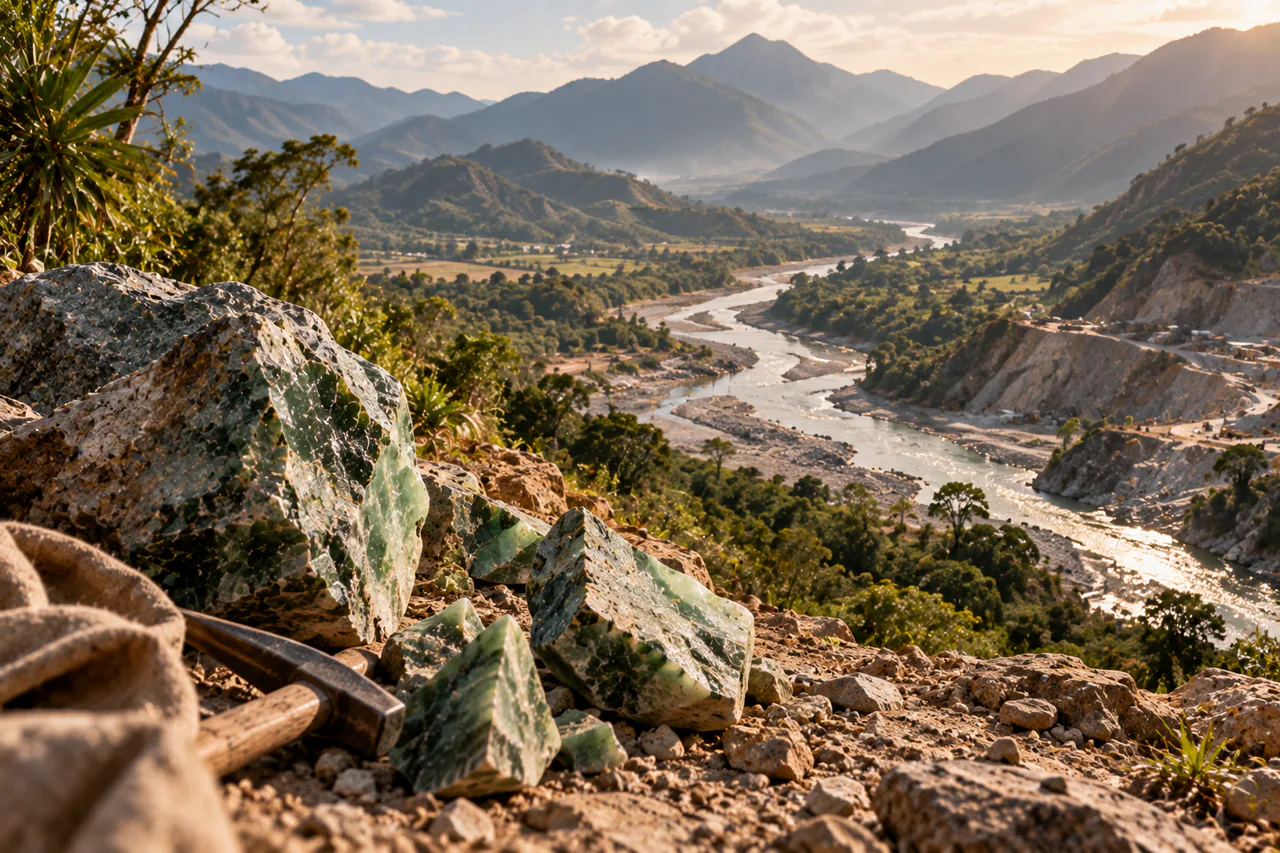
The Motagua Valley, in the east of the country, is the only gem jadeite deposit mined on a commercial scale outside Burma. It follows an ancient collision zone between two plates.
It is an old deposit: the Olmecs, then the Maya, made masks, beads and ceremonial axes from it, and ranked this material above gold. After the Spanish conquest, the source stopped being worked and its location was lost; it was rediscovered in the mid-20th century, and mining resumed.
So there is a genuine Guatemalan trade, with workshops and shops, particularly around Antigua. That does not make the label verifiable: on a piece bought remotely, “Guatemalan jade” is a claim by the seller, not a measurement.
New Zealand: pounamu, and who owns it
Pounamu refers to the nephrite of the South Island, which New Zealand English calls greenstone. The deposits are on the west coast, and much of the stone is gathered in rivers and on beaches, as pebbles.
One mineralogical point matters here: pounamu is not a mineralogical term. It covers several materials, including tangiwai, which is a bowenite, and therefore a serpentine, not a nephrite. It is a cultural category before it is a mineral species, exactly as the word jade was for centuries.
The decisive point is legal. A New Zealand law of 1997 vested ownership of all the pounamu in its territory, the takiwā, which covers most of the South Island, in the iwi Ngāi Tahu. Gathering there is managed by the iwi, and the export of raw stone from the country is regulated. So this is not a vague customary reserve: it is a property right, with a named owner (Maori pounamu).
The consequence for my workshop: I imitate neither the hei-tiki nor the koru. These forms belong to a living culture, and reproducing them would mean selling a sign that does not belong to me. The motifs I have set are elsewhere: jade motifs.
China and Taiwan, the nephrites of East Asia
China’s historic nephrite comes from Hetian, in Xinjiang, on the northern slope of the Kunlun: pebbles gathered in rivers, then mining in the mountains. It is the material of ritual carving, including the white nephrite known as mutton fat. Jadeite, for its part, only reached China in the modern era, imported from Burma: jade jewellery from China.
Taiwan has a nephrite deposit on its east coast, around Hualien, mined industrially in the second half of the 20th century to the point of making the island a major producer, then almost abandoned. It is much older than its industrial episode: Taiwanese nephrite was already circulating in Southeast Asia in prehistory, and archaeology has found it in the Philippines and Vietnam (jade from Vietnam).
Russia and Canada, today’s volumes
A green nephrite bangle bought in ordinary retail has a good chance of coming from one of these two countries.
- Russia mines nephrite in eastern Siberia, notably in Buryatia. A large share goes to China, where it is worked. The country also produces a little jadeite.
- Canada has mined British Columbia nephrite since the 1970s. Production is almost entirely exported, and a good part is carved outside the country.
Remember that last line: a piece carved in one country is not a piece mined in that country, and the two are easily blurred on a label.
Two deposits that no longer supply the trade
Europe. The Neolithic Alpine jadeite quarries of the Monte Viso massif, in Piedmont, and of the Beigua massif, identified in June 2003 by Pierre and Anne-Marie Pétrequin, supplied large polished axes in the 5th and 4th millennia BCE that spread over 3,300 kilometres, from Ireland to Bulgaria. They supply nothing anymore: it is an archaeological deposit, not a jewellery one (jade in Europe).
Japan. The jadeite of Itoigawa, on the Sea of Japan, bears witness to one of the oldest known uses of this material, well before China. The deposit is protected today and does not supply the trade: jade in Japan. Kazakhstan also produces a little jadeite, without weighing on the market.
Maori pendant, tiki, jewellery from Guatemala: what you are buying
A Maori pendant or a tiki sold cheaply online is, most of the time, neither pounamu nor even nephrite: it is most often serpentine, dyed quartzite or resin, in a copied shape (stones sold as jade). Even when the stone really is nephrite, it may have been mined in Canada and carved in New Zealand: honest as long as it is stated, misleading when it is not.
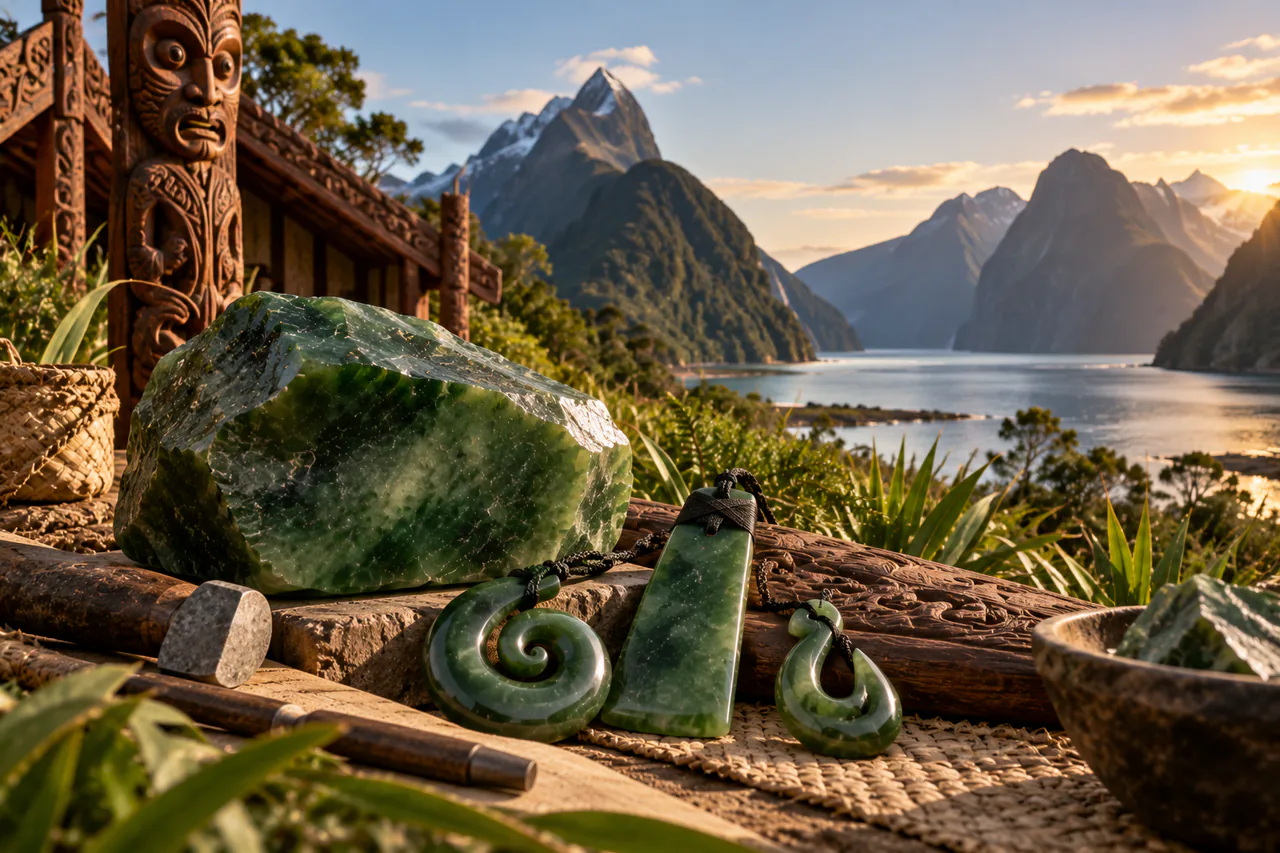
If a New Zealand origin matters to you, buy it there, from carvers who document the stone, with a traceability system linking the piece to its block. For jade jewellery from Guatemala, the same logic applies: the trade exists, and it can be verified on site or through an identified workshop.
What I offer is not that, and I will not pretend otherwise: I publish the mineral and the measurement behind it, not a country (what I publish on each product page).
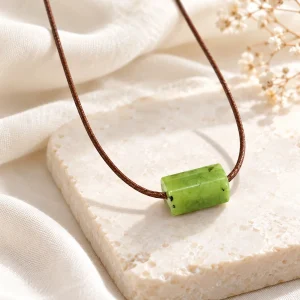
Pendants whose density I publish
Why an origin can almost never be proven
Hydrostatic weighing, my only instrument, separates jadeite (3.25 to 3.36) from nephrite (2.90 to 3.03), and both from serpentine (about 2.6) and dyed quartzite (about 2.65). It answers the question “is it jade”, and the protocol is published on the weighing page. It does not answer the question “where does it come from”: two nephrites from two continents weigh the same.
A well-equipped laboratory can sometimes point toward a region by reading inclusions and trace elements, when it has reference samples to compare against. It is neither systematic nor an address, and it is beyond the reach of a workshop like mine. Add that the trade goes through cutting workshops that buy from several sources, and origin gets lost without anyone having lied.
My rule is therefore the same as for treatment: I say what I measure, and I state the gap when there is one. Treatment is not determined either, my supplier does not know it and my scale does not show it, and only infrared spectroscopy would settle it (jade A, B, C, the treatment information sheet). What I know about the provenance of my pieces is written on the origin of my jade.
The questions I get asked
Where is jade stone found in the world?
Jadeite is found in Burma, Guatemala, Japan, and marginally in Russia and Kazakhstan. Nephrite is far more widespread: Russia, Canada, China, Taiwan, New Zealand, Australia. Only Burma and Guatemala supply gem-quality jadeite on a commercial scale.
Is there jade in France?
No French deposit supplies the trade. The jadeite of the polished axes found in the burial mounds of Morbihan comes from the Italian Alps: it is European jade, not French jade, and it is archaeological.
Is Guatemalan jade as good as Burmese jade?
On the market, highly translucent Burmese pieces command the top prices. But the comparison is made piece by piece: translucency, evenness of colour, fineness of grain and treatment weigh more than the map (judging the quality of a jade).
Can you buy pounamu and bring it home?
A finished piece can be bought without difficulty from a New Zealand carver. What is regulated is the gathering of the stone, owned by Ngāi Tahu in its territory since 1997, and the export of raw material. Ask the seller beforehand, not afterward.
Is a jade tiki pendant necessarily pounamu?
No, and it rarely is. The shape is copied everywhere, in serpentine, dyed quartzite or resin. Without documentation from the carver, a cheap tiki is a shape, not a provenance.
How can I find out where my jade comes from?
Most of the time, you cannot. You can establish the mineral at home by hydrostatic weighing (how to tell if jade is real), and that is already a lot. The country rests on the seller’s word, unless there is a documented supply chain.
Where I checked
What comes from a named source. The legal texts are named in the body: the Tom Lantos Block Burmese JADE Act of 2008 and its lifting by Executive Order 13742 of 7 October 2016, the designation of the Burmese state jade company by the US Treasury on 8 April 2021 and its addition to the European sanctions list on 21 June 2021, and the New Zealand law of 1997 vesting pounamu in Ngāi Tahu. Monte Viso, Beigua, the 3,300 kilometres and the June 2003 date come from the work of the Pétrequins, the CNRS JADE project. The separation of jadeite and nephrite comes from Alexis Damour’s note in the Comptes rendus hebdomadaires de l’Académie des sciences, volume 56, 1863; I do not give the page numbers, as I have not read it.
What I take from the literature without having measured it. The formation conditions of the two minerals, the density ranges, the location of the deposits cited, the serpentine nature of tangiwai and the varieties of pounamu, and the prehistoric circulation of Taiwanese nephrite to the Philippines. I have seen none of these deposits, and I attribute this information to no particular body because I did not read it in a single one.
What is my own reasoning. Refusing Burmese jadeite on grounds of US law before the ethical argument, refusing to imitate the hei-tiki and the koru, and the decision never to write a country of origin on a product page since I cannot measure it: these are decisions, not established facts. If you find a mistake here, write to me: I will correct it and note that I did.
In one sentence
Jade comes from very few places when it is jadeite and from many when it is nephrite, but outside the rare supply chains that document it, origin remains an unverifiable claim on a piece of jewellery, whereas the mineral can be measured. The method is on the weighing page, and the pieces are in the shop.