Jade and the 2002 French Decree: What a Seller Must Say
This page reads French Decree No. 2002-65 of 14 January 2002 article by article, from the seller’s point of view: what it requires you to write about a treated stone, the information sheet it requires you to hand over, the words it takes out of the trade, and what it costs not to comply.
The 2002 decree never defines the word jade, and does not even name it: neither jade, nor jadeite, nor nephrite appears in it. What it requires of a seller comes down to three things: including the treatment in the name, never selling a stone under the name of another, and making a treatment information sheet available before the sale.
The rest of the text works the other way round: rather than saying what to write, it removes words, eight for imitations and two for everyone.
My name is Jade, and I run a jade jewellery workshop: my pieces are set or chosen one by one, and I weigh one example of each reference before it goes on sale. I am not a gemmologist, a lawyer or a therapist: I quote the texts rather than summarize them from memory, and I say where my reading stops.
The text, its scope, and what it does not name
The text is called French Decree No. 2002-65 of 14 January 2002, on the trade in gemstones and pearls, in force since 1 February 2002. In France, it is the reference text on how these products are named when they are sold.
The first thing to know before reading it: it mentions neither jade, nor jadeite, nor nephrite, and it contains no positive list of gemstone names. No one will find the legal definition of jade in it, for the simple reason that it is not there. What it does contain is more useful to a buyer: naming and disclosure rules that apply to jade just as they do to garnet or pearl.
Six of its articles directly concern a seller, and those are the ones I take here, in the order of what they do. Jade’s commercial rank is covered separately in is jade a precious stone; the material itself is the subject of jade stone.
Articles 2 and 3: when the name must include the word treated
Article 2 concerns stones that have undergone treatment, and it is not satisfied with a footnote: it requires the name itself to be completed with the word “treated” (traité), or with an indication of the treatment applied. The methods covered are named in the text: irradiation, laser, dye, surface diffusion, filling, and more broadly any other laboratory method that alters the stone’s appearance, colour or clarity.
With jade, the method that comes up is dye. A quartzite dyed green, a jadeite whose colour has been enhanced, a bracelet in a pink nature does not produce all fall under this list, and their name must say so: that is the subject of dyed jade. The obligation rests on the seller, not on the buyer.
Article 3 sets out the exception, and it comes down to three traditional lapidary practices: impregnation with a colorless fluid substance, heat treatment, and bleaching without dye or varnish. A stone that has undergone only one of these three can be sold without the word “treated”.
This trio raises a specific question about jade, and I do not settle it here: a jadeite bleached with acid and then impregnated with resin, what the market calls type B, has undergone two operations that resemble two of the three exemptions without being identical to them. The discussion is in type A, B and C jade.
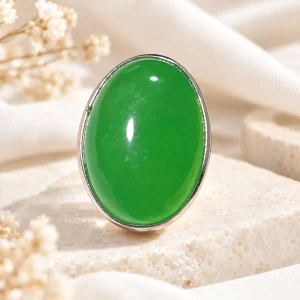
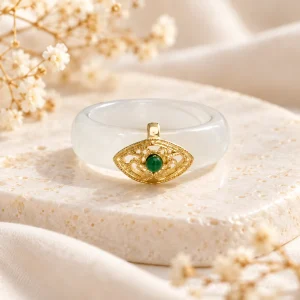
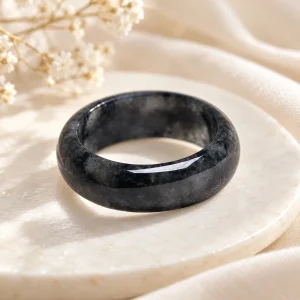
The jade rings available now
Article 10: the information sheet, and when it must exist
This is the article that interests me most, because it creates a document and that document is rarely encountered. Article 10 requires a treatment information sheet: made available to the buyer before the sale, and handed over with the invoice.
Two moments, and the first matters as much as the second: information given after payment documents a purchase already made. In an online shop, “before the sale” means a page reachable from the product page and from the checkout process, not a line in the confirmation email.

On 8 September 2026, I opened the nine French sites that search results offered me in this field, and I did not find this sheet anywhere, which means I did not find it, not that it does not exist. Mine is published, and it also states what I cannot determine: the treatment information sheet.
Article 4: the eight words banned on an imitation
Article 4 lists eight words: raised, cultivated, cultured, real, precious, fine, genuine, natural (in French: élevé, cultivé, de culture, vrai, précieux, fin, véritable, naturel). They are banned for describing reconstituted, composite, synthetic, artificial and imitation products.
The scope matters as much as the list, and that is where a quick reading goes wrong. These eight words are not removed from the language: they are removed from the label of an imitation. A glued doublet cannot be sold as a “genuine” stone, a synthetic corundum as a “natural” stone, coloured glass as a “fine” stone.
On a real stone, the word genuine therefore keeps its use, and that is the use I give it: it contrasts jade with serpentine or dyed quartzite, which the scale establishes (weighing, stones sold as jade). It never contrasts an untreated stone with a treated one: I do not write that second meaning, and I do not write “natural” on its own either, lacking the infrared spectroscopy that would back it up.
Article 5: the two words banned for everyone
Article 5 fits on one line, and it is the decree’s only outright vocabulary ban: “semi-precious” (semi-précieux) and “semi-fine” (semi-fin) are banned across its whole scope, with no exception for any species or product. Everywhere else the text regulates a word within a context; here it removes two from commercial language.
The term the profession uses instead, for everything outside the quartet of diamond, ruby, sapphire and emerald, is fine stone (pierre fine). Or simply gemstone. Jade belongs there: is jade a precious stone, and the vocabulary of a product page in the jade glossary.
What makes this article remarkable is the gap between its clarity and how it is applied. On 8 September 2026, of the nine domains on the first page for this field, four used one of the two words in their own text, including one in a section heading. I do not name them and I do not legally characterize any of their situations: I report a practise, I am not a judge.
Article 9: the label, the invoice, and a page’s address
Article 9 prohibits selling a stone under any name other than its own, and specifies where: on labels, and on any commercial or advertising document.
That last phrase extends the matter far beyond the little card placed under the stone. An invoice, a catalogue, a listing, a product description are commercial documents. In my reading, a page’s address is one too: a URL containing a stone’s name sells under that name, just as a product title does. I present this as a reading and not as a settled point: the decree predates online commerce as it works today, and I have not read any ruling that says so.
Checking it, though, takes nothing: if a page’s address announces a stone that the page’s text contradicts, one of the two names is false. Labels that cover a different material are listed in stones sold as jade, and the rules of professional organizations, which do not have the force of law, in how jade is named.
What the decree does not contain: penalties
This is the point I did not read on any of the pages I opened that day, and it changes how this text should be cited: French Decree No. 2002-65 provides for no penalty. No fine, no sentence, no procedure. A seller who writes one of the two words in Article 5 incurs nothing under the decree itself.
Enforcement happens elsewhere, through the French Consumer Code. Its Article L.441-1 covers deception about the nature, species, origin or substantial qualities of a good, and Article L.454-1 punishes it with three years’ imprisonment and a fine of €300,000. I quote these penalties as they are written.
Two consequences for a buyer. First, the decree is not a label: complying with it proves nothing about the stone, it proves the seller wrote correctly. Second, the complaint that counts before a judge is not the banned word but deception about the material, and that is exactly what a density measurement documents. The check you can do at home is described in how to recognise genuine jade.
What these articles mean on my own pages
Here is what these six articles look like once applied to a real catalogue.
| What I write | What I never write |
|---|---|
| The name of the mineral, jadeite or nephrite, and the measured density, with its date | A compound name that covers a different stone |
| That treatment status has not been determined, and why | “untreated”, “natural”, or silence, which reads as a guarantee |
| Fine stone, or gemstone | The two words in Article 5 |
| The A, B, C classification, explained | An advertised AA or AAA quality |
The details of the fields on each product page are in what I publish on every product page, and the measurement protocol and its limits on the weighing page. And because Article 10 is not satisfied by a paragraph at the bottom of a page, the information sheet lives on a page of its own, linked from every product. The same questions, put to another seller: buying jade jewellery.
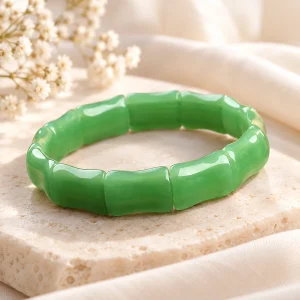
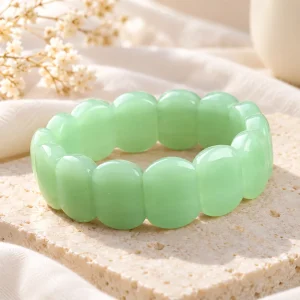
Bracelets whose mineral and density I publish
Questions I get asked
Does the 2002 decree apply to jade?
Yes, as it does to any gemstone sold in France, but without naming it. The text mentions neither jade, nor jadeite, nor nephrite and contains no positive list: its rules apply to jade because they apply to its whole scope.
Must a seller state that a stone is treated?
Yes, and in the name itself, completed with the word “treated” or an indication of the treatment: that is Article 2. Article 3 exempts three traditional practices: impregnation with a colorless fluid substance, heat treatment, and bleaching without dye or varnish.
What is the treatment information sheet?
A document required by Article 10: made available to the buyer before the sale, then handed over with the invoice. The decree sets neither its form nor its medium, only those two moments. Mine is online, on its own page.
Can jade be described as a semi-precious stone?
Not under French law. Article 5 bans “semi-precious” and “semi-fine” across the decree’s whole scope, without exception: it is its only outright vocabulary ban. The term the profession uses for everything that is not diamond, ruby, sapphire or emerald is fine stone.
What does a seller risk by not complying with the decree?
Nothing under the decree, which provides for no penalty. Enforcement goes through the French Consumer Code: Article L.441-1 covers deception about the nature, species or substantial qualities, punished under Article L.454-1.
Is the word “genuine” banned on a stone?
No: Article 4 bans it, along with seven other words, for describing an imitation. On a real stone it can still be used, and it means jade rather than serpentine or dyed quartzite. It does not mean untreated.
Where I checked
What comes from a named source. French Decree No. 2002-65 of 14 January 2002 on the trade in gemstones and pearls, in force since 1 February 2002: its Articles 2, 3, 4, 5, 9 and 10, and the absence of any penalty provision in the text. The penalties are those of the French Consumer Code, Article L.441-1 for deception and Article L.454-1 for the penalty. I read these texts myself, not in a commentary or a ruling, and I do not interpret them beyond what they say.
What is a dated market observation. On 8 September 2026, I opened the nine French sites that search results offered me in this field. Four used one of the two words in Article 5 in their own text, including one in a section heading, and the A, AA, AAA scale appeared five times in those same results. I did not find the Article 10 sheet anywhere. I name none of these domains and I do not legally characterize any of these pages: I measure, I do not certify, and that applies to the law too. The same day, my supplier confirmed that they cannot say whether their goods are treated.
What is my own reasoning. Treating a page’s address as a commercial document within the meaning of Article 9 is a reading, not a settled point. The comparison between type B jadeite and the Article 3 exemptions is a question I raise and do not close. And the idea that the useful complaint before a judge is deception about the material rather than the banned word is a deduction on my part. If you find an error here, write to me: I will correct it and note the change.
In one sentence
The 2002 decree does not say what jade is: it says what a seller must disclose about a treatment and which words they may no longer use, and it leaves punishment to the Consumer Code. What actually informs a buyer lies elsewhere, in the name of the mineral and the number behind it: weighing, and the shop.