What I Publish on Every Jade Page, and Why
This page describes what appears on every product page on this site, field by field, and also explains the boxes I leave empty.
Every product page carries five fields: the named mineral, jadeite or nephrite; the treatment status, which is undetermined, with the reason why; the mass in air, the immersed mass, the resulting density and the date of the reading; the statement that I weigh one sample per reference and not the piece that ships to you; and the reminder that I measure without certifying.
My name is Jade, I run a jade jewelry workshop: I choose the pieces, have them set, and weigh one sample of each reference before it goes on sale. I am neither a gemologist nor a therapist: what follows describes a measurement and its limits, not an expert appraisal.
The five fields, in order
A product page on this site is not a sales page with numbers added to it: the numbers are its framework. So these five fields are not scattered at random, and here is where each one sits.
- The mineral, in the product page title and in the first line of the description: it is the first thing you read.
- The treatment status, just below, with its reason. A product page does not go live without it.
- The measurement and its date, in a separate block, when I have been able to weigh the bare stone of the sample.
- The scope of that measurement, in that same block and not one link away.
- The limit, at the bottom of the page: I measure, I do not certify.
The protocol itself lives on the weighing page. This page describes what you read, not what I do.
The named mineral, and the number behind it
The word jade covers two unrelated minerals, jadeite and nephrite, separated in 1863 by the French mineralogist Alexis Damour: not the same family, not the same hardness, not the same market. The details are on the jade stone page and in jadeite or nephrite.
On a product page, then, the word jade alone is not enough. The title carries the mineral, and the first line of the description repeats it with the number behind it: jadeite sits between 3.25 and 3.36, nephrite between 2.90 and 3.03.
The rule has a flip side, and that is where it costs something: a piece that measures around 2.6 or 2.65 is serpentine or quartzite, it carries that name, and the word jade does not appear in its title. The compound labels that circulate in their place are covered in stones sold as jade.
Jade rings right now
The treatment status, and why it remains undetermined
This is the field I would gladly publish filled in, and it never is. It carries one word, undetermined, followed by its reason.
A jadeite can have been bleached with acid and then impregnated with resin without anything showing to the eye or on the scale: the resin does not displace enough mass to register. The classification that describes these states, A, B and C, is explained in jade A, B and C. Only infrared spectroscopy in a laboratory settles it, and I do not have that equipment. My supplier does not know the status of their stock either: I asked them on September 8, 2026, and they do not know.
Hence a vocabulary rule I apply everywhere: I never write jadeite A, type A, untreated or natural about my pieces, including by omission, because silence at that point reads as a guarantee. Article 2 of French Decree No. 2002-65 requires the name to be completed with an indication of treatment; it does not say what to write when you do not know, and I write that I do not know. The rest is on the treatment information sheet.
Three numbers and a date
The heart of the product page fits in four lines: the mass of the stone weighed in air, its mass suspended in a glass of water, the density that the ratio of the two gives, and the day of the reading. The date matters as much as the number: it says that someone put an object on a scale at a dated moment, rather than copying a value from a catalog.
Three limits accompany these numbers, in the same block and not one link away. A method whose limits live on another page is no longer a method; it is a sales pitch.
- It does not distinguish a bleached and impregnated jadeite from an intact one. It names the mineral; it says nothing about resin.
- Metal and thread skew it. It therefore applies to the bare stone of the sample, and when I cannot take a piece apart, I do not publish a number.
- It loses its value on very small pieces. On a bead a few millimeters across, the uncertainty of the scale becomes of the same order as the gap between 2.95 and 2.65: the number no longer decides anything.
One sample per reference, not every piece
This sentence sits right next to the number on the product page, and it is there to prevent a flattering reading. Pieces ship directly from the supplier: I do not handle the one you receive. What I handle is the sample I order for myself before putting a reference online. That is what I weigh, that is the number that gets published, and that is what the product page talks about.
For a stone, the consequence is concrete: the green of your piece will not be exactly that of the photo, and its density would differ slightly from the one I display if you measured it. Writing the opposite, that every piece is weighed, would sell well and be false, and any buyer can check by asking.
I measure, I do not certify
The last field is not a number, it is a limit. I have no gemology qualification and do not claim to have one. The words certificate, certified, guaranteed and appraisal appear on none of my product pages, and their absence is deliberate.
What I publish is a dated reading, repeatable with a kitchen scale and a glass of water. It is not an attestation, and it does not put me in a laboratory’s place. In a disputed case, my answer fits in one sentence: I cannot decide.
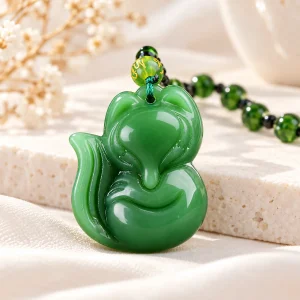
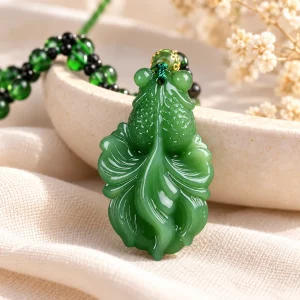
Pendants, with the five fields on every product page
Reading the number without a scale
A density of 3.31 means nothing to someone who does not work with densities. The simplest thing is to translate it into weight: at identical size and shape, the four materials that circulate under this name do not weigh the same.
| Material | Density | At equal size |
|---|---|---|
| Jadeite | 3.25 to 3.36 | the heaviest of the four |
| Nephrite | 2.90 to 3.03 | about one tenth lighter |
| Serpentine | about 2.6 | about one fifth lighter than jadeite |
| Quartzite, dyed or not | about 2.65 | similar to serpentine |
Two bangles of the same diameter and width, one in jadeite and the other in serpentine, therefore differ by about a fifth of their weight, and the hand notices that gap when it holds both at once.
This is not a test, and I do not offer it as one. A single hand has no reference, two pieces of different sizes cannot be compared, and a setting muddles everything. Weighing in the hand helps you understand the published number; it does not replace it. What you can really check at home is in how to recognize real jade stone.
The empty boxes, and why I do not fill them
A product page on this site has gaps, written as gaps rather than filled with a plausible value. There are four kinds.
- Treatment, undetermined, for the reasons above. It is the most visible empty box, and the one I care about most.
- The missing measurement on a piece that reaches me already set or strung: rather than a number skewed by metal and thread, the product page says there is no weighing, and where the mineral name then comes from.
- Geographic origin, when my supplier does not know it or cannot establish it: the origin of my jade.
- Dimensions and delivery times that I have not recorded myself. An invented value gets noticed on delivery day.
An empty box disappoints in the moment. It has the advantage of still being true six months later.
What I read on other product pages
On September 8, 2026, I opened the nine French competitors on the first page of results for jade queries. One was offline, and three sell almost no jade. Among those left to read, I found no product page stating the mineral of its piece with a measurement to back it up. One displays two contradictory origins on the same page, the text and the table contradicting each other. Another uses the A, AA, AAA scale, which has no standard behind it and borrows its letters from the real classification, the one for treatments.
One nuance, because it is more honest than the shortcut: one of these sites, which ranks well, correctly explains the A, B and C classification in its content. What is missing, then, is not the mention; it is the step from the mention to the product page.
The questions I get asked
Why doesn’t your product page say whether the jade is natural?
Because I do not know. My scale names the mineral; it does not detect a resin impregnation, and my supplier does not know the status of their stock. So I write undetermined, rather than a reassuring word that nothing backs up.
Can I repeat your measurement at home?
Yes, and that is partly the point. You need a scale accurate to 0.01 g, a fine thread, a glass of water and the bare stone. You may find a difference of a few hundredths: it is not the same piece, and the method has its own uncertainty. The protocol is on the weighing page.
Why do some product pages show no number?
Because the stone reached me already set or strung and I could not weigh it bare. The product page says so, and specifies that the mineral name then relies on what my supplier tells me. A number skewed by a setting would be worse than an empty box.
Does density tell you the quality of the stone?
No. It tells you the mineral species, nothing more. Translucency, fineness of grain, evenness of color and polish make a piece’s quality, and two jadeites with the same density can be very far apart on those points.
Do you weigh the piece I will receive?
No, and that is written on every product page next to the number. I weigh one sample per reference, the one I order before putting it on sale. The pieces ship directly from the supplier, and I do not have them in hand.
What does genuine mean on this site?
Real jade rather than serpentine or dyed quartzite, in other words what weighing establishes. The word never means untreated, which is a different question and one I cannot settle. The two are often blurred in listings, and making that gap readable is roughly what this page is trying to do.
Where I checked
What comes from a named source. The separation of jadeite and nephrite, and the word jadeite itself, come from Alexis Damour’s note in the Comptes rendus hebdomadaires de l’Académie des sciences, volume 56, 1863; I do not give its page numbers, because I have not read it. From French Decree No. 2002-65 of January 14, 2002, I cite Article 2, on indicating treatment in the name, and Article 10, on the information sheet made available before sale. The density ranges are those of the mineralogical literature: I repeat them, I did not establish them, and their limits vary by a few hundredths from one database to another. I attribute them to no organization, having taken them from none in particular.
What is a market observation, dated. On September 8, 2026, I opened the nine French competitors on the first page of results and read their product pages: the survey is above and applies to that day. The same day, my supplier confirmed that they cannot tell whether their stock is treated.
What is my own reasoning. Writing undetermined rather than staying silent, publishing no number for a piece I cannot take apart and then saying where the mineral name comes from, restating the three limits in the same block as the measurement, refusing the words certified and guaranteed: these are decisions, not established facts. If you find a mistake here, write to me: I will correct it and note the correction.
In one sentence
A product page on this site states the mineral, the number behind it, the day of the reading, what the reading applied to and what it does not prove: that is not much, and it is more than I found anywhere else. The product pages are in the shop, the method on the weighing page.