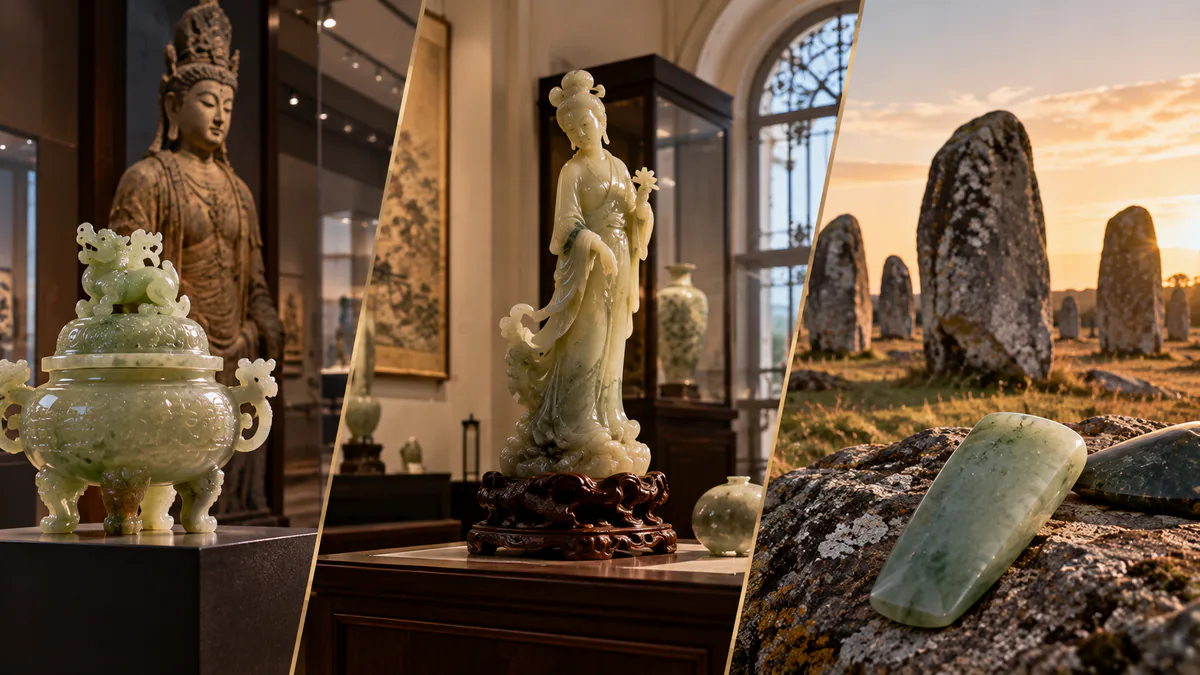
Jade in French Museums: Guimet, Cernuschi, Carnac
Where to see jade in France without buying anything: what these three public collections really display, how to read a jade museum label, what is not where you might expect it, and what I was able to verify about their opening hours on the day I am writing.
Three public collections are enough to see both jades in France: the Guimet National Museum of Asian Arts and the Cernuschi Museum, in Paris, for Chinese jades, and the Carnac Museum of Prehistory, in Brittany’s Morbihan department, for the great Alpine jade axes of the European Neolithic.
My name is Jade, and I run a jade jewellery workshop: I choose the pieces, have them set, and weigh one example of each reference before it goes on sale. I am not a gemmologist or a therapist, and this is the only page on this site that sends you somewhere other than my shop.
Why a museum, when you want to buy
On 8 September 2026, I looked at the nine French competitors on the first page of results: none of them states the mineral of its pieces. A museum label writes down what is known about the material, and lets you see what is not known, because it has nothing to gain from it.
There is a more down-to-earth reason to go: it is the simplest way to see both jades at full size on the same day. A photograph does a poor job of showing the translucency of a jadeite and the slightly greasy surface of polished nephrite, and I say this knowing that my own images do no better. What separates the two minerals is on the jade stone page and explained in detail in jadeite or nephrite.
Guimet: seven millennia, and three addresses not to mix up
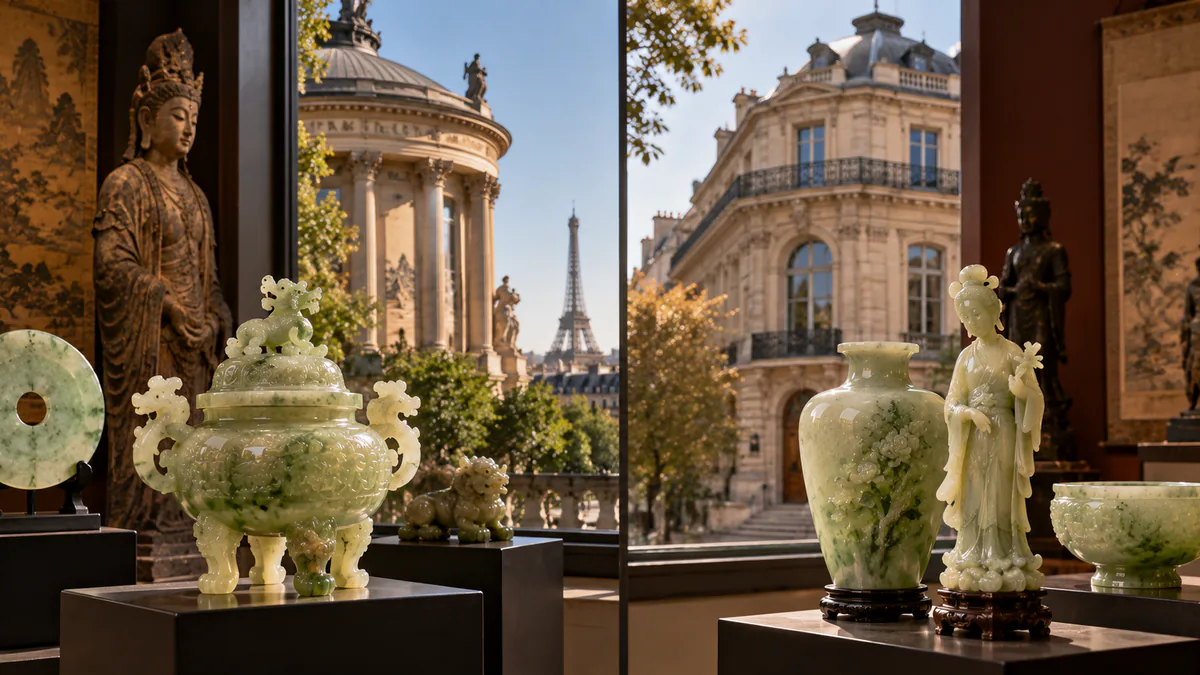
The Guimet National Museum of Asian Arts, 6 place d’Iéna, in Paris’s 16th arrondissement, lists some 20,000 objects covering seven millennia for its Chinese section alone, from the Neolithic to the end of the Qing dynasty in 1911. Jade runs through the whole route rather than occupying a single room: cong tubes and bi discs at the start, court jades at the end.
One point makes the trip worthwhile for anyone buying jade: what is Chinese and ancient is nephrite. Jadeite arrived late in China, imported from Burma, and its imperial vogue dates from the 18th century. Seeing the two materials separated by four thousand years of display cases clears up a confusion the trade keeps alive, which I come back to in jade jewellery in China.
The Guimet name covers three separate addresses, and booking for the wrong door is easy. Checked on 10 September 2026 on the museum’s website: the museum itself is on place d’Iéna; the Maison Guimet, 19 avenue d’Iéna, can only be visited on a guided tour, by reservation; the Musée d’Ennery, 59 avenue Foch, is closed for renovation until 2028.
One detail that matters here: it was by analyzing jades brought back from the looting of the Old Summer Palace in Beijing, in 1860, that Alexis Damour split the word jade in two, three years later. The objects in this museum and the vocabulary I use come from the same moment, as told in jade in Europe.
The jade objects available now
Cernuschi: a Liangzhu disc, and free admission
The Cernuschi Museum, the City of Paris museum of Asian arts, is at 7 avenue Vélasquez, in the 8th arrondissement, on the edge of Parc Monceau. It is smaller than Guimet, less crowded, and its permanent collections are free, like those of the other City of Paris museums.
Rather than an inventory, one specific piece. The museum holds a nephrite bi disc from the Liangzhu culture, from the Jiangnan region, dated between 3300 and 2000 BCE, which entered the collection as a gift from Édouard Larcade on 15 June 1927, under inventory number M.C. 7349. Six lines, and everything is there: the mineral, the culture, the date, the donor, the date of acquisition. No jade product page I have read goes that far, and mine do not either.
What follows changes register, and I flag it rather than blending it into the rest. Nothing in it is proven: it is what traditions have attributed to these objects.
Ancient Chinese ritual texts are said to link the bi disc to Heaven and the cong tube to Earth, and museum notes repeat this reading while dating it. It describes a way of thinking, not a property of the stone. The forms and what they carried are covered in jade motifs.
Carnac: the great Alpine jade axes
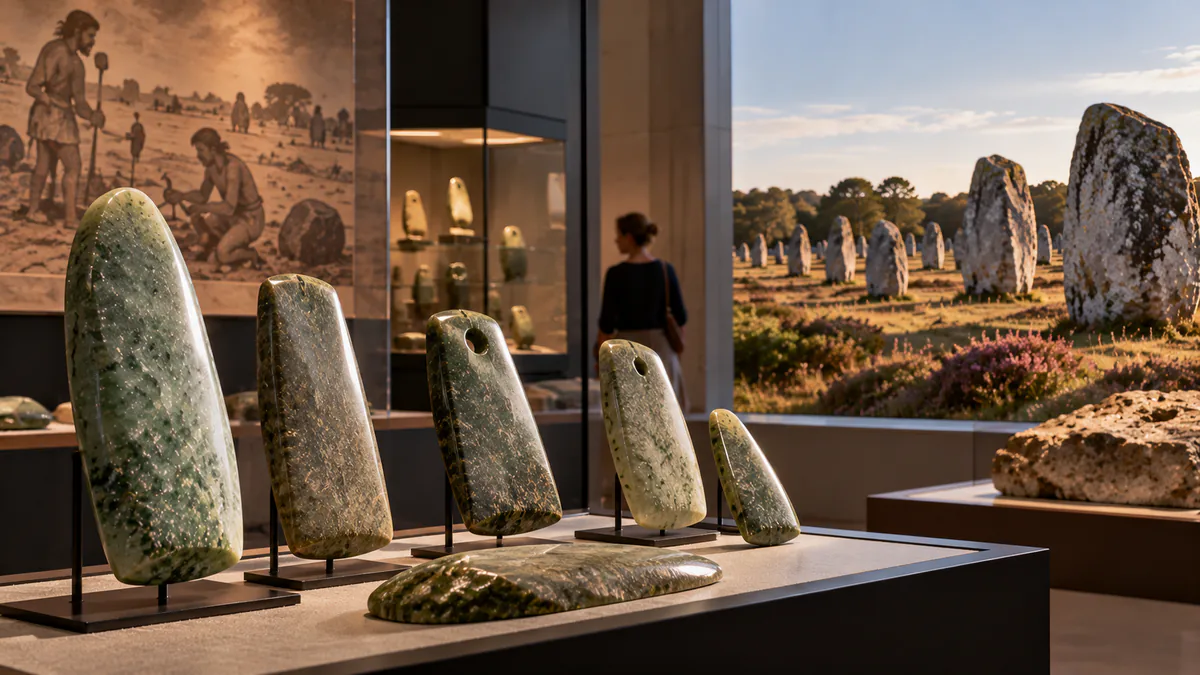
The Carnac Museum of Prehistory, place Christian Bonnet, in Carnac in the Morbihan, grew out of the excavations of James Miln and then Zacharie Le Rouzic. Its collection page highlights the great Alpine jade axes from the Saint-Michel mound, which is in Carnac itself, along with the polished ornaments from Spain that accompanied them.
What these axes change fits in one sentence: jade was in Europe before it arrived from China. In June 2003, Pierre and Anne-Marie Pétrequin identified the Neolithic Alpine jadeite quarries of the Monte Viso massif, in Piedmont, between 1,500 and 2,400 metres, and of the Beigua massif. In the 5th and 4th millennia BCE, they supplied a spread of great polished axes over 3,300 kilometres, from Ireland to Bulgaria.
These blades are long, thin and polished to a mirror finish, too fine to fell a tree: archaeologists see them as prestige objects rather than tools. Jade lends itself to this because it withstands impacts better than the rocks the other axes were made of, and that property is not hardness but toughness, two things most of the pages I opened confuse: why jade almost never breaks. I grew up near these display cases, and that is why this site exists rather than another.
What is not in Carnac, and where it is
The great Carnac mounds are named in one breath, Saint-Michel, Tumiac, Mané er Hroëk, and that suggests their grave goods are all in the same place. They are not.
- The Saint-Michel mound is in Carnac, and its grave goods are what the Museum of Prehistory’s page highlights.
- Mané er Hroëk is in Locmariaquer, about twenty kilometres away. Excavated in 1863 by René Galles, its grave goods, jade axes included, are held at the archaeological museum of Vannes.
- Tumiac is in Arzon. I was not able to establish where its grave goods are held on the day I am writing, and I would rather say so than guess.
If you only have time for one visit, Carnac brings together the axes and the megalithic landscape in which they were laid, and that context is worth the trip more than the stone alone.
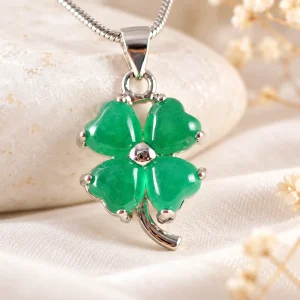
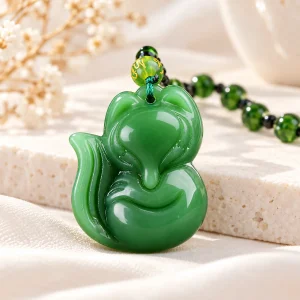
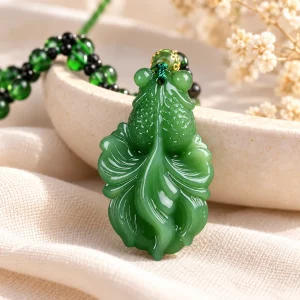
Jade pendants, chosen one by one
Reading a jade museum label
A label reads quickly when you know what you are looking for, and above all what you will not find there.
- The material. Nephrite or jadeite when it has been identified, just “jade” when the identification is old or was never redone. This is not carelessness: the separation of the two minerals dates from 1863, and many objects entered collections before that.
- The date, the culture, the mode of acquisition. Gift, bequest, purchase or excavation, with its date. That is traceability, and it is public.
- What is almost always missing: density. No one suspends an archaeological piece in a glass of water. Yet it is the number I publish on my product pages, for lack of a laboratory: the weighing protocol.
- What is always missing: treatment. No one looks for resin in a five-thousand-year-old object, and the question only arises in the modern trade: type A, B and C jade.
The vocabulary on museum labels is not that of sellers, and it is a relief. The trade terms are gathered in the jade glossary.
What a display case does not prove
An online collections database is not a gallery. The record for the bi disc I cite above gives the material, the date and the donor, and does not say whether the object is on display. That is true of most records: a museum shows a fraction of what it holds, and that fraction rotates.
Seeing a museum jade does not teach you to recognise your own. The lighting is carefully designed, the piece is selected, the glass is in the way, and you can neither weigh it in your hand nor turn it over. The checks that really work at home are elsewhere: how to recognise genuine jade.
What a museum shows is not what is for sale. A piece that entered a public collection was chosen for its quality, its history or its rarity. Comparing a store-bought bracelet to a court piece leads to misplaced disappointment: what gives a jade its value is in judging the quality of a jade.
Before you go: what I checked
Noted on 10 September 2026 from the museums’ own websites. Opening hours age faster than an article: check the day before, and do not set off on my word alone.
- Guimet, 6 place d’Iéna, 75116 Paris. Open every day except Tuesday, 10 a.m. to 6 p.m., last admission listed at 5:30 p.m. Closed 1 May, 14 July, 25 December and 1 January.
- Cernuschi, 7 avenue Vélasquez, 75008 Paris. Open Tuesday to Sunday, 10 a.m. to 6 p.m. Permanent collections free.
- Carnac Museum of Prehistory, place Christian Bonnet, 56340 Carnac. Its calendar is seasonal and I was not able to pin it down on the day I am writing: so I give no hours or prices, and refer you to the museum’s website.
The two Paris museums each close one day a week, and it is not the same day: on Tuesday, Cernuschi is open and Guimet is not. It is the easiest mistake to make if you want to visit both back to back.
Questions I get asked
Can you see jadeite and nephrite in the same museum?
Yes, at Guimet: the Chinese section covers seven millennia, from Neolithic nephrite to court jades, where Burmese jadeite appears. In Carnac, the jade on display is Alpine jadeite, with no nephrite counterpart.
Do you have to pay to see jade in Paris?
Not necessarily: the permanent collections of the Cernuschi Museum are free, like those of the City of Paris museums. Guimet is a national museum and charges admission, with the usual free-entry categories, which it publishes on its own website.
Are the Carnac axes really jade?
Some of them are, and it is jadeite from the Alps, not nephrite. The others are fibrolite, variscite or local rocks. That mix is what makes the display interesting: the jade stands out because it is surrounded by other materials.
Why does a label sometimes just say “jade”?
Because the separation between jadeite and nephrite dates from 1863, and many objects entered collections before that, with an identification that was never redone. Analyzing an archaeological piece is expensive and does not always add anything to what the gallery is trying to say.
Can a museum identify my stone?
No, that is not its role: museums do not appraise pieces belonging to private individuals, and a gemological assessment is a job for a laboratory. At home, hydrostatic weighing tells you the mineral and nothing else, within its limits: the weighing page and the treatment information sheet.
Is there jade in other French museums?
Certainly, starting with the archaeological museum of Vannes for the grave goods of Mané er Hroëk. I have only checked these collections, and I stick to what I have looked at rather than drawing up a list I have not verified.
Where I checked
What comes from a named source. The addresses, opening days, hours and free admission to the permanent collections come from the websites of the museums concerned, consulted on 10 September 2026. The record for the bi disc, material, culture, date, donor and inventory number M.C. 7349, comes from the City of Paris museums’ collections portal. The Alpine jade axes from the Saint-Michel mound are highlighted on the collection page of the Carnac Museum of Prehistory. Monte Viso, Beigua, the altitudes, the 3,300 kilometres and the date of June 2003 come from the work of Pierre and Anne-Marie Pétrequin, the CNRS JADE project. The separation of jadeite and nephrite comes from Alexis Damour’s note in the Comptes rendus de l’Académie des sciences, volume 56, 1863; I do not give the page numbers, as I have not read it.
What is a dated observation. On 8 September 2026, I looked at the nine French competitors on the first page of results: none of them states the mineral of its pieces. On 10 September 2026, I was not able to get the Carnac museum’s hours from its website, and I leave that written here rather than copying a calendar read elsewhere. The sources I opened that day, none of them the museum itself, give the grave goods of Mané er Hroëk as held at the archaeological museum of Vannes.
What is my own reasoning. The choice of these three collections over others, the idea that a label says more than a product page, and the warning about online databases that do not say what is on display: these are decisions, not established facts. If you find an error here, or if a gallery has changed since, write to me: I will correct it and note the change.
In one sentence
Guimet and Cernuschi show Chinese jade, Carnac shows European jade, and all three write on a label what the stone trade most often keeps quiet: the mineral, its date and its origin. That is the standard I try to meet with a scale instead of a laboratory, described in what I publish on every product page.