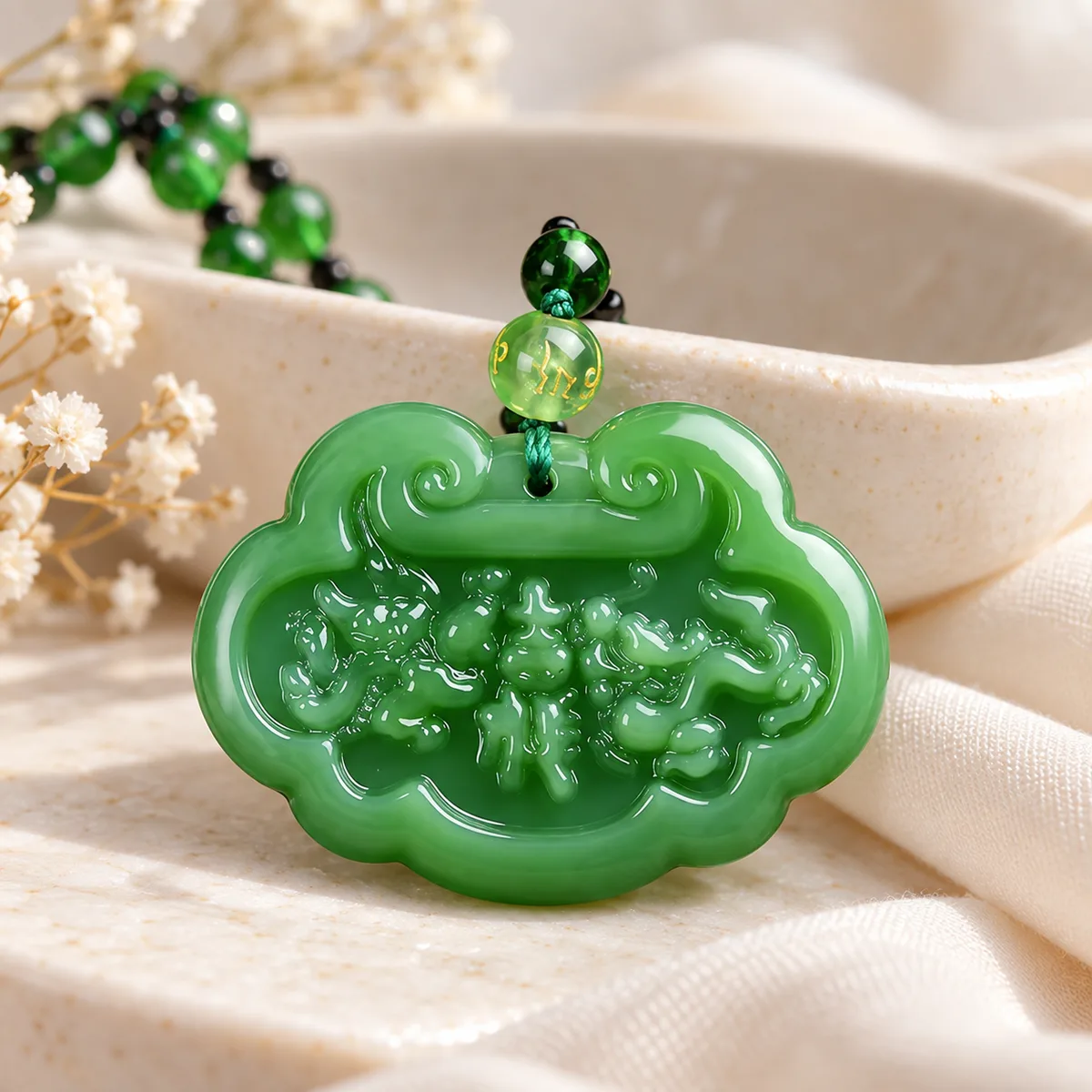
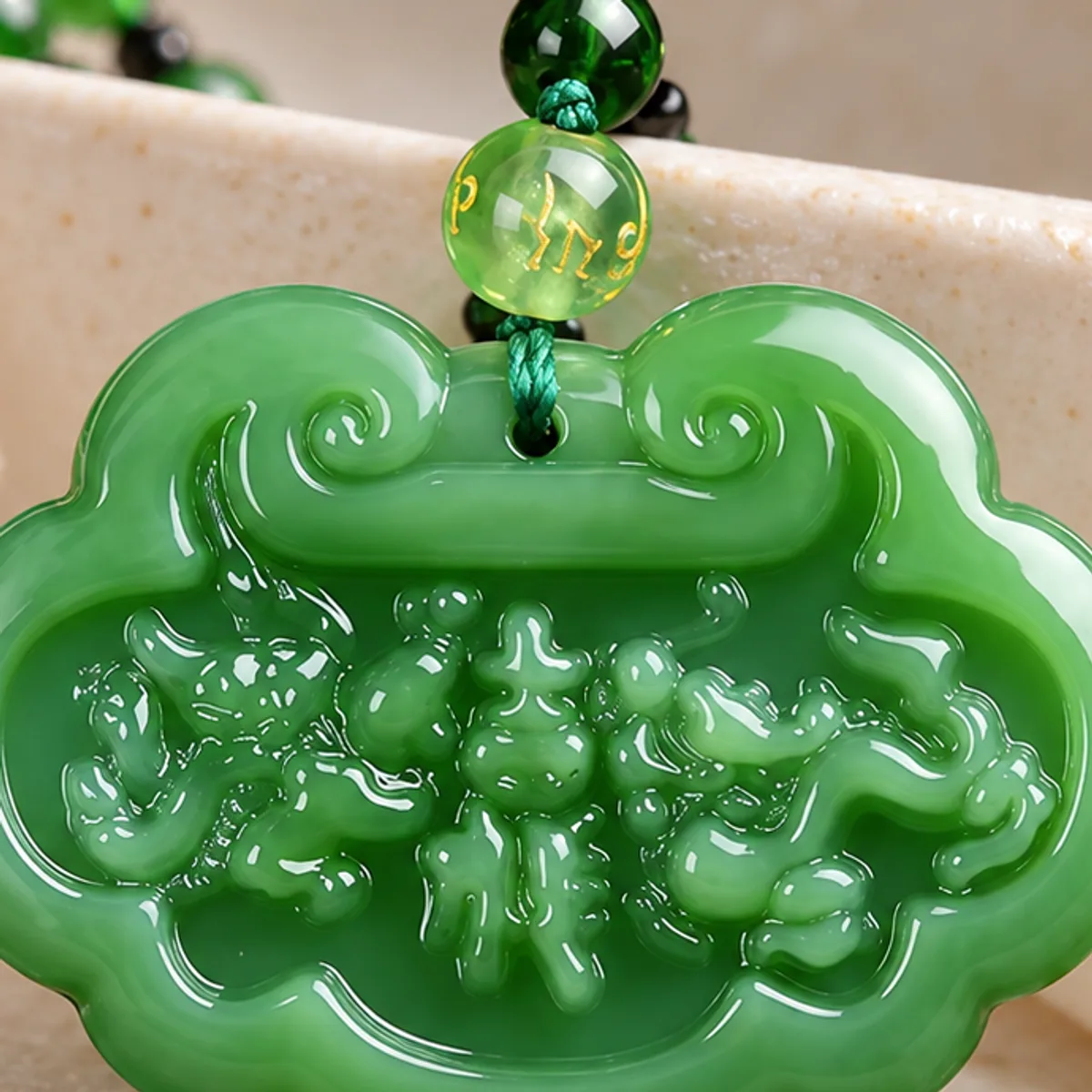
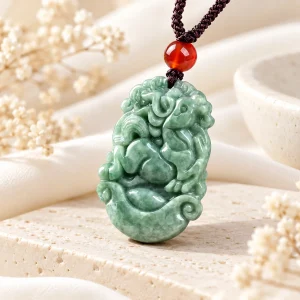
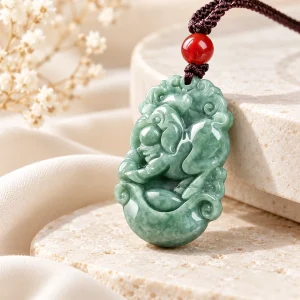
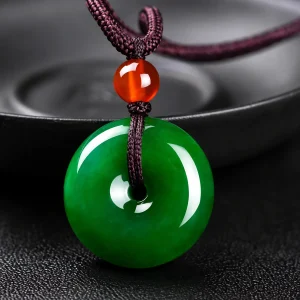
Jade lock pendant: a plaque cut in the shape of an old lock, the top scalloped into cloud scrolls and the centre carved in relief. Knotted to a strand of green and black beads.
It is the Chinese lock of long life, hung round children’s necks to tie them to the world of the living. It is worn at any age today, and often given at a birth.
The beads of the strand are not announced as jade, and the page says so. The plaque unties, so it weighs: the record will be published. Why I write it down.
A jade lock pendant: a plaque cut in the shape of an old lock, the top scalloped into cloud scrolls, the centre carved in relief with a plant motif. It is knotted to a strand of green and black beads, with a small yellow bead under the bail.
In four lines
The shape of the longevity lock, cut from a single piece.
Motif carved in relief at the centre, edges polished into scrolls.
On a strand of green and black beads, which are not jade.
The record will be published: the plaque unties, so it weighs.
A lock that closes nothing
This shape has a name in Chinese, changmingsuo, the lock of long life. It is not an abstract ornament: it copies a real object, the plate lock of old chests, with its rectangular body and its top cut into scrolls.
The custom is documented from the Ming dynasty: the lock was hung round a child’s neck, often at the first month or the first birthday, and the idea was to lock the child to life, to keep it from leaving. In families that had lost infants, it was a grave object, not a trinket.
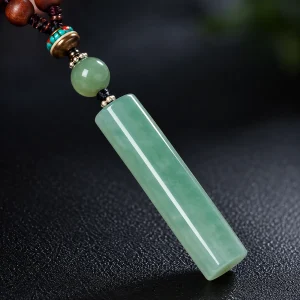
The plaque is knotted to a strand of translucent green beads alternating with black ones, with a small yellow bead just under the knot. None of those beads is announced as jade by my supplier, and I am not going to assume it on his behalf: they sit in the record, on their own line, as material not established.
The green of the beads is in fact colder and more transparent than the green of the plaque, which shows plainly in the photographs. Two greens that do not match is exactly the kind of detail an honest page points out instead of smoothing over.
The knot holding the plaque undoes without a tool. That is what makes the weighing possible, and it is also what lets you swap the strand for a plain cord if this one does not suit. The thread and the cord of a jade piece.
What the stone is, and what remains to be established
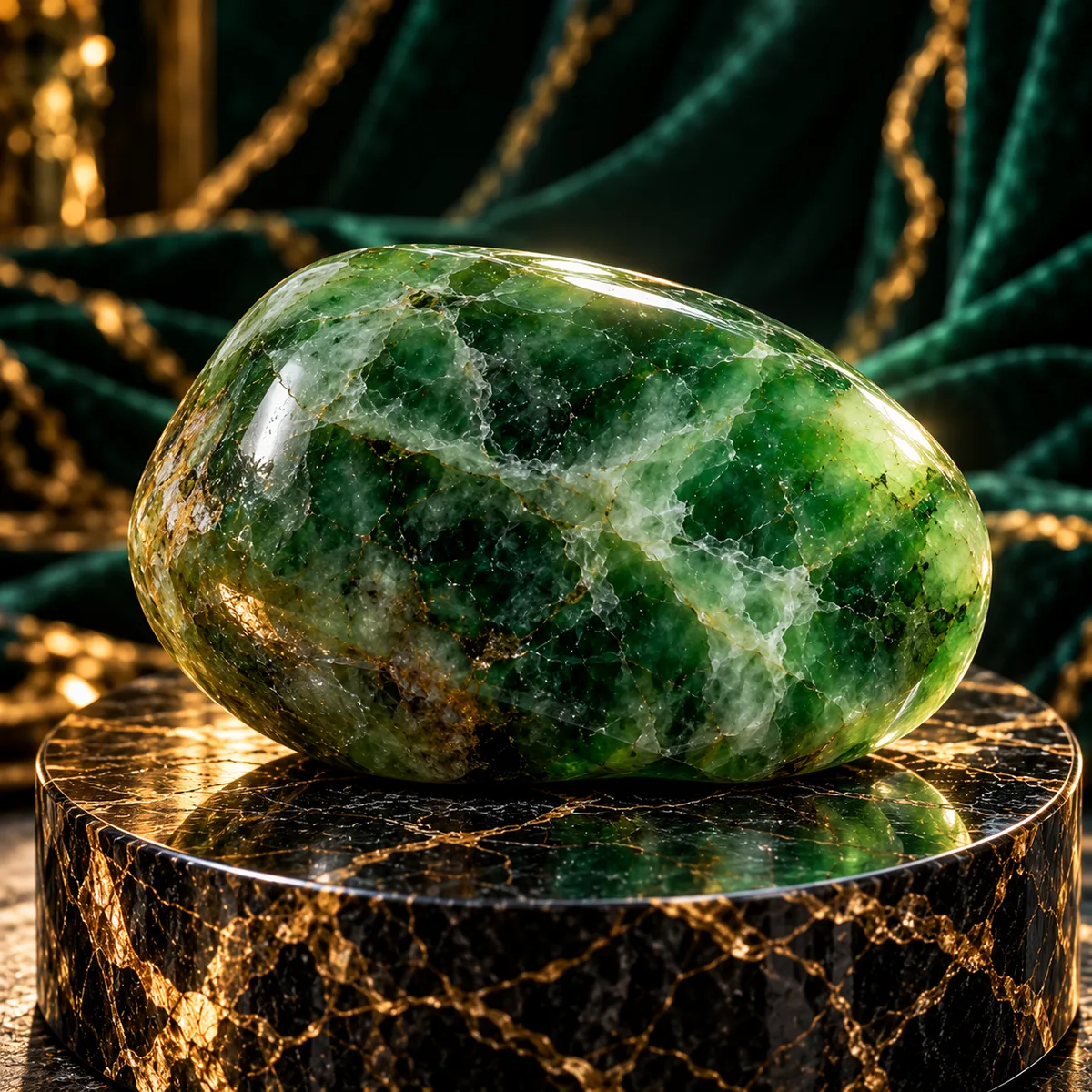
The plaque is a frank, fairly deep green, with lighter zones where the stone thins towards the edges. That grain is consistent with a nephrite, but colour proves nothing: what is sold under the name jade is very often serpentine or dyed quartzite.
The only thing that settles it without a laboratory is the density, and on this reference it is measurable since the plaque unties. The figure will be published in the record, with its date, and it will say jadeite, nephrite, or something else.
Outside Burma, country of extraction not confirmed
What tradition attributes to the lock and to jade
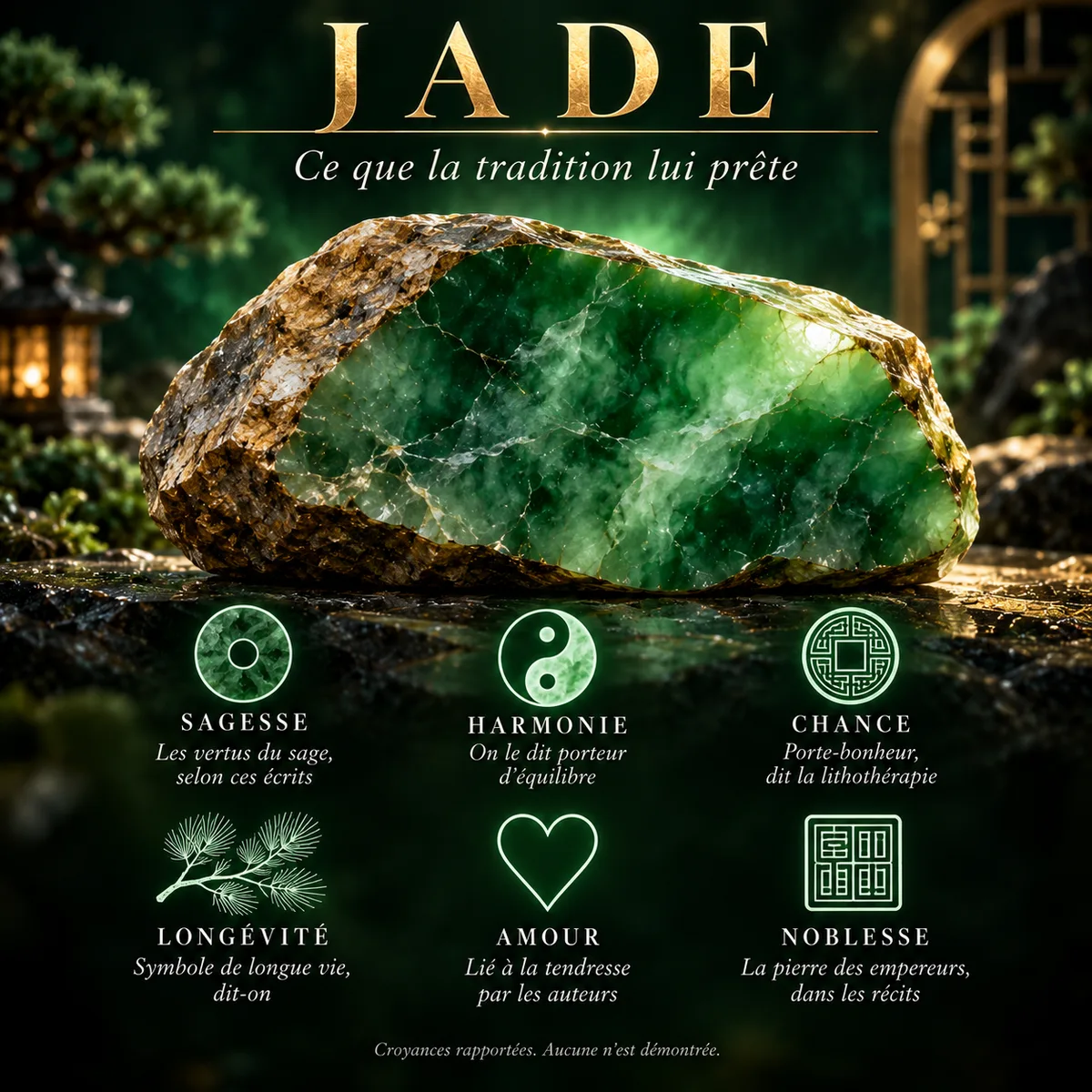
What follows changes register, and I flag it rather than blending it into the rest of the page. Nothing here is demonstrated. These are customs and beliefs, which I report because they are part of the history of this stone. No piece in this shop is sold as a remedy, and I claim no effect for this one.
Locking a child to lifeThe lock of long life was hung round a newborn's neck to tie it to the world of the living. In some regions the family gathered coins from a hundred households to have it cast: the lock then belonged to the whole village, not to the parents alone.
A lock with no keyThe object copies a lock, but it has neither bolt nor key, and that is the point of the image: what is closed is not meant to open again. It was often kept into adulthood, then passed on.
The scrolls of the topThe cloud head cut into the top is called ruyi, which means as you wish. It is one of the most widespread motifs of Chinese ornament, and it reads as a wish for fulfilment rather than as a protection.
A stone of moral virtueIn Confucian thought, jade is associated with qualities of character rather than effects on the body: uprightness, constancy, restraint. It is the best documented meaning of them all.
Dispatch within 48 hours of your order being confirmed, for delivery within 14 days from dispatch. I keep no stock in reserve, and I will not promise a date I could not meet.
Shipping Costs
€6.99 whatever the destination, free on orders over €47 to France, Belgium, Switzerland and Luxembourg. The exact amount is shown in your basket before you pay.
The Packaging, and Why It Matters
Every piece travels in its own pouch, kept apart from the others. This is not a question of presentation: the hardness of jade is unremarkable, between 6 and 6.5 for nephrite and 6.5 to 7 for jadeite, and the quartz in ordinary household dust sits at 7. Two pieces of jewellery that travel together arrive marked.
Fourteen Days to Change Your Mind
No need to give a reason. An email is enough to open a return; there is no form to fill in. Return postage is at your expense, unless the piece does not match its listing or arrives damaged.
Lukewarm water, mild soap, a soft cloth. A very soft brush for the hollows of a carving. That is all, and it is enough.
What You Must Never Do, and Why
No ultrasonic cleaners, no steam, no solvents, no heat source. This is not a precaution for show: the treatment status of my pieces is undetermined. My supplier does not know it, and weighing identifies the mineral without telling me anything about a possible resin impregnation. Resin withstands neither heat nor solvents, so every piece is handled as though it might contain some. The information sheet on treatments.
Scratches, and Where They Come From
Jade is tough, meaning very difficult to break: its structure of interlocking crystals resists cracking, and that is what made it usable for axe heads in the Neolithic. Its hardness, by contrast, is unremarkable, 6 to 6.5 for nephrite and 6.5 to 7 for jadeite. The quartz in ordinary household dust sits at 7: that is what dulls a jade, not knocks. The difference between the two.
Day to Day
Put the piece on after perfume and cream, never before. Take it off for housework, gardening and sport, where knocks against hard edges are common. Store each piece on its own, in its pouch. On a strand of beads, the thread wears out before the stone: it gets restrung, and there is nothing abnormal about that.
My name is Jade. French, from Morbihan, living in Tallinn. I choose the pieces and have them mounted: I mine nothing, I cut nothing, and the metalwork is not done by my hand. What I bring is the selection, and with this material that is what decides everything.
I am not a gemmologist, not a lapidary, not a therapist, and I do not claim to be.
I Weigh, I Do Not Certify
Before a listing goes online, I order one example of it for myself. When it reaches me unmounted, I weigh it in air, then suspended from a thread in a glass of water: the ratio of the two masses gives the density, and that figure separates jadeite, nephrite, serpentine and dyed quartzite without ambiguity.
One example per listing, and not every piece. I do not handle the piece that is sent to you, and I would rather write that down than let you believe otherwise. The method, with its three limits.
What I Cannot Know
The treatment status of my pieces. My supplier does not know it, and the scales do not tell me: they identify the mineral, not the resin impregnation. Only infrared spectroscopy in a laboratory would settle it, and I do not have that done. So you will never read “Grade A jadeite”, “Type A” or “untreated” on this site. The information sheet.
Where My Jade Comes From
No Burmese jadeite, and the first reason is legal. Not the one you read everywhere: the JADE Act of 2008 did ban these stones in the United States, but that ban was lifted on 7 October 2016. What applies today dates from 8 April 2021: the US Treasury sanctioned Myanma Gems Enterprise, the state company that controls the Burmese gem trade. So there is no blanket ban, but a US person is not allowed to trade with that entity, and a stone never tells you where it has been. A single supply chain serves ten markets, so it has to hold up in the most demanding of them. When an origin is not confirmed to me in writing, the listing does not state it. My origin charter.