Jade Symbolism: China, Mesoamerica and the Spanish Ijada
This page answers “jade symbolism” by first saying which stone it is talking about: what ancient China, Mesoamerica and Neolithic Europe put into this material, where the word jade comes from, and why it was born from a promise of healing that I refuse to make to you again.
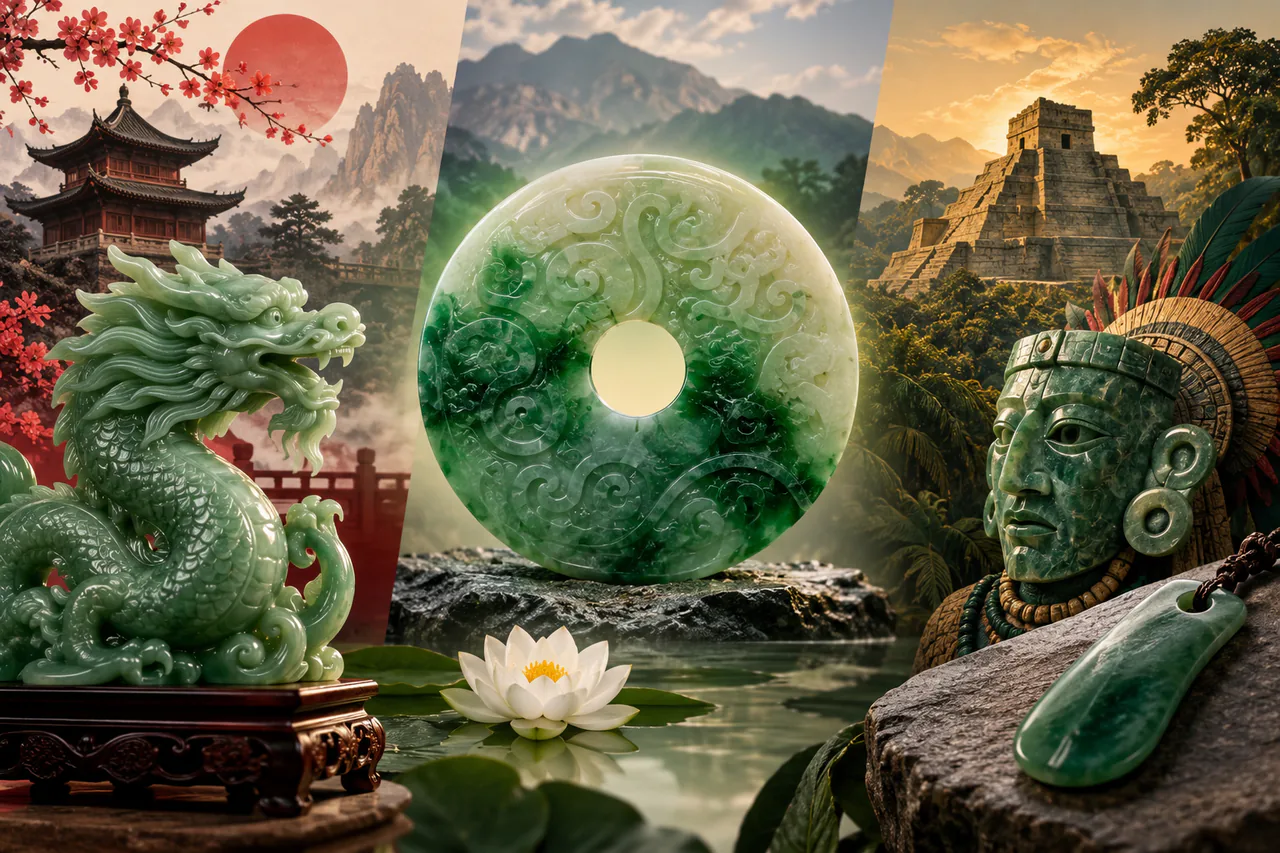
Jade does not have one meaning, it has at least three that do not speak to each other: Chinese nephrite, which classical thought is said to have made a measure of a man’s moral worth; Mesoamerican jadeite, which its tradition reportedly linked to water and breath and which accounts of the conquest describe as preferred to gold; and the Alpine jadeite of European axes, of which only the objects remain.
My name is Jade, I run a jade jewellery workshop, and I weigh one example of every piece before it goes on sale. I am neither a gemmologist, nor a historian, nor a therapist: what is established is written here as fact, and what is believed is written as attributed.
Where the word jade comes from, and what it meant
The word has nothing Chinese about it, and nothing Mesoamerican either: it is Spanish. Around 1565, during the conquest, the Spanish coined piedra de la ijada, the stone of the flank, because they saw the conquered peoples wear this material against kidney colic. The same object received the Latin name lapis nephriticus, which gives nephrite, from the Greek nephros, kidney.
French took the Spanish word and made it éjade. Then a faulty split cut the article in the wrong place, l’éjade became le jade, and the modern word was born from a misreading. The path is traced in the entry jade of the Dictionary of the Académie française, ninth edition.
What this name does not say remains. The two words I use every day, jade and nephrite, point to the same part of the body: the flank in Spanish, the kidney in Greek. Neither speaks of the stone, its colour, its hardness, or the continent it comes from. In our languages, the first meaning of jade is that of a remedy observed from a distance by soldiers.
A name born from a promise of healing
This shop is called Jade Ijada, and the second word is the one from 1565. I chose it knowingly, because it carries a contradiction I would rather write in large letters than leave dormant: my shop bears the name of a remedy, and it sells no remedy. It is the idea that opens my about page.
In fairness to the 16th-century Spanish, what they recorded were people wearing this stone on the flank. Their accounts do not allow the observed use to be separated from a supposed effectiveness, and I do not know who took that step. A stone worn against pain is not a stone that heals pain, and yet it is from this confusion that the two stone names we still use come.
Jade pendants of the moment
What ancient China put into jade
The first misunderstanding, and it governs everything else: the material worked in China since the Neolithic is nephrite, not jadeite, which arrived late from Burma and whose imperial vogue dates from the 18th century. Attributing the Chinese millennia to jadeite lends it the history of the other mineral: jadeite or nephrite.
A material that was ritual first
In ancient China, nephrite was not first used for ornament: it produced bi discs, cong tubes and the ornaments of Liangzhu, objects of rite and rank. The figures carved on them are in jade motifs. Han tombs went as far as enclosing bodies in jade plaques sewn with gold thread, a subject covered in jade in Chinese tombs.
A stone that describes a man
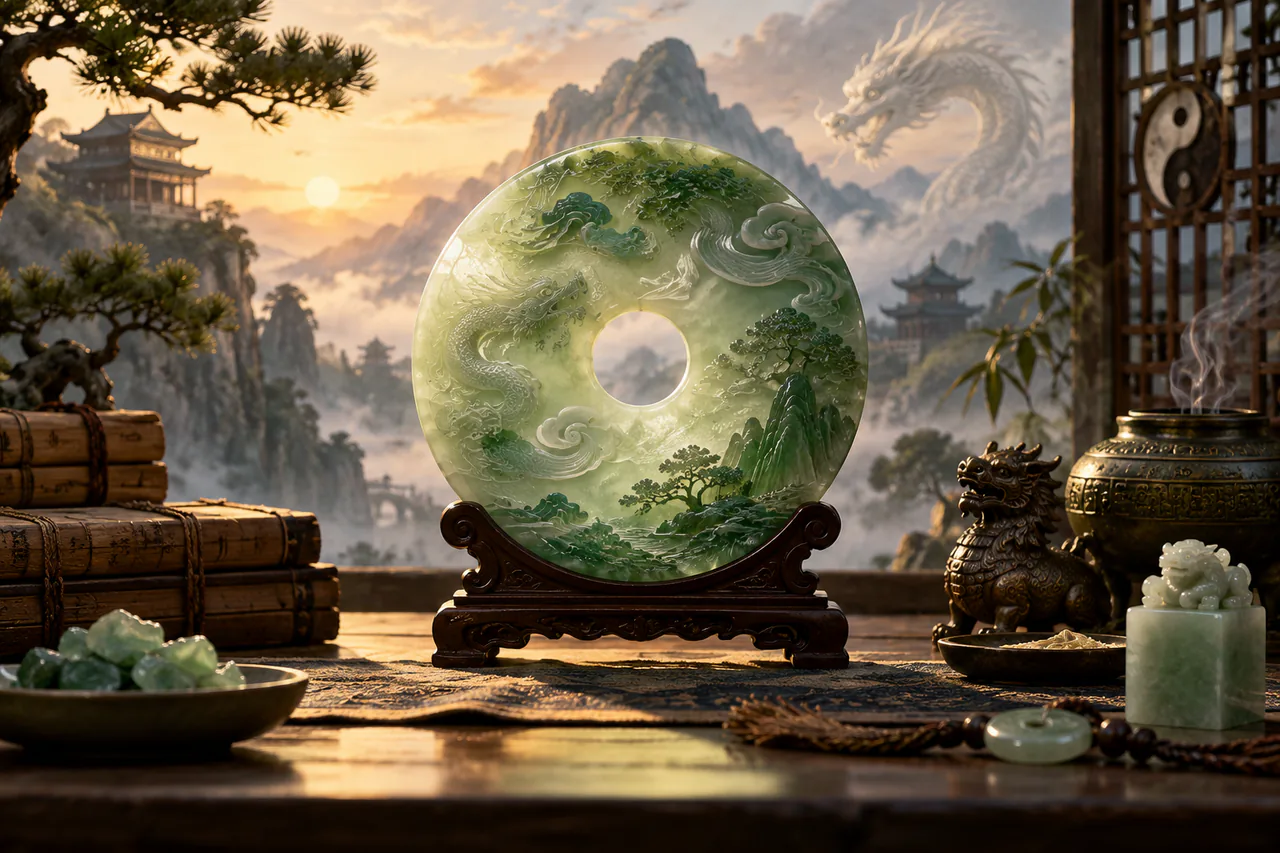
The second shift resembles nothing you read today under the word symbolism: classical Chinese thought is said not to have attributed qualities to jade, but to have used it to describe them. The stone would become a term of comparison for speaking about an accomplished man. This is not crystal healing, it is ethics: the moral virtues of jade.
One note of caution on translation, to finish: the Chinese word yu, which museum cases render as jade, does not name a mineral species but a rank, the family of stones held to be beautiful. A label announcing “Chinese jade” therefore still does not say what material it is talking about, and that is one of the reasons I refuse it: jade jewellery from China.
Mesoamerica, where the stone came before gold
On the other side of the world, with no known contact, a second story unfolds with a stone that bears the same name and is not the same mineral. The Olmecs, then the Maya, worked the jadeite of the Motagua valley, in Guatemala: the map of deposits is in where jade comes from.
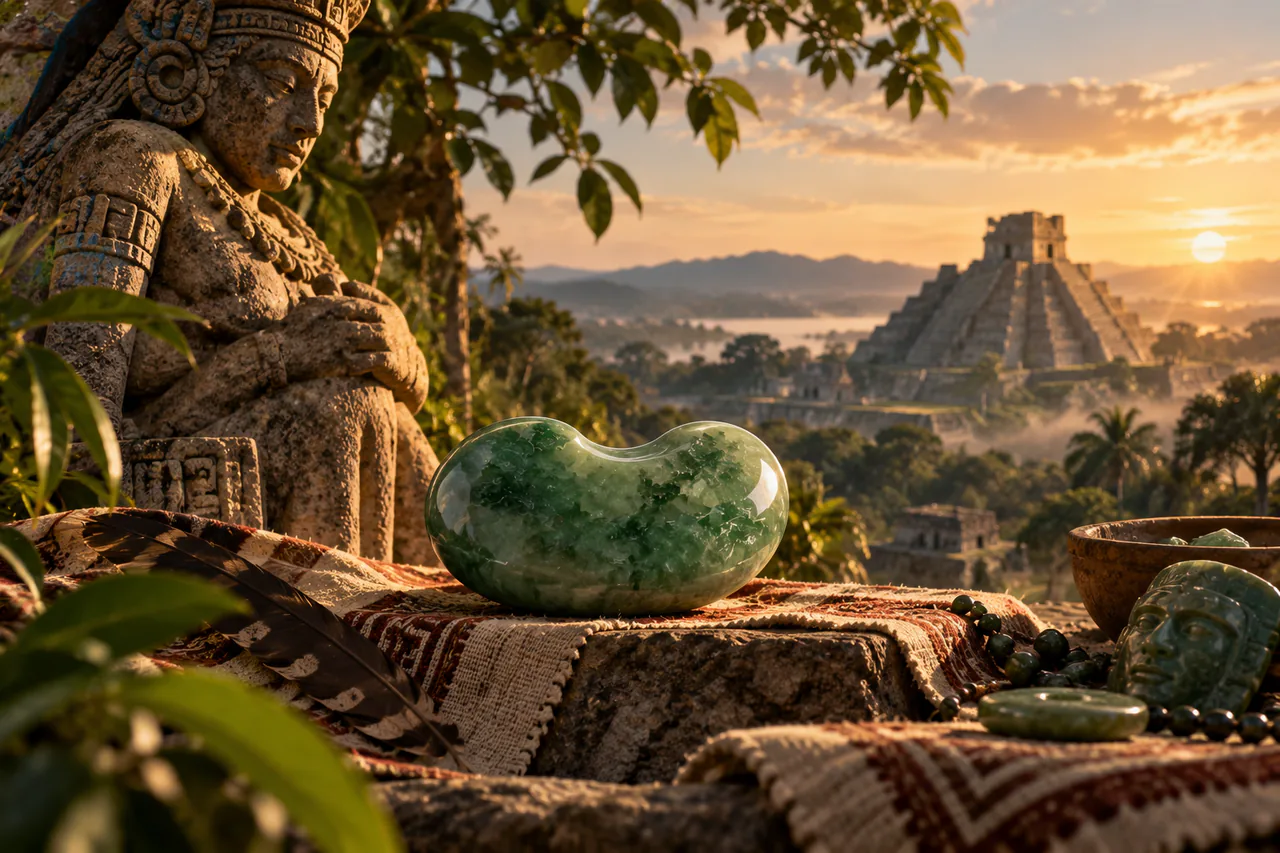
What the accounts of the conquest report is an inverted order of value: the green stone comes before gold. What is material are the jadeite beads placed in burials; Mesoamerican tradition, for its part, is said to link the stone with water, maize and breath. This reads not as a pharmacopoeia but as a cosmology, in which green would stand on the side of what gives life.
This is where the loop closes. The tradition the Spanish encountered in the 16th century, the one that led them to coin piedra de la ijada, was Mesoamerican. The word Europe then applied to green stones that had nothing to do with one another, Chinese nephrite included, was born in front of a Mesoamerican jadeite, from a Spanish shortcut between a use and a remedy.
Neolithic Europe, the meaning we have lost
The third story is European, it took place closest to here, and almost nobody writes about it in France. In June 2003, Pierre and Anne-Marie Pétrequin identified the Neolithic quarries that supplied the polished Alpine jadeite axes found in Celtic monuments, in the Monte Viso massif. The whole file, from Damour to the display cases in Carnac, is in jade in Europe, and the collections in jade in French museums.
What these objects meant, I do not know, and nobody can read it directly: there is no text, only axes and tombs. What we can see is that blades from these same Alpine quarries turn up from Ireland to Bulgaria, and that nobody carries a polished axe from one end of Europe to the other just to fell a tree.
Jade bracelets, chosen one by one
New Zealand, a meaning still alive
Three traditions do not cover all of jade. Japan has its own, around Itoigawa, whose date and status I will not write before reading them in a source I can cite: that will be jade in Japan. New Zealand raises something else. Pounamu, a nephrite, is not a catalogue colour there: a 1997 New Zealand law vested ownership of the pounamu on its territory in the Ngāi Tahu iwi. A material whose meaning is still alive and legally held by a people is not copied into a decorative pendant, and that is why I imitate neither the hei-tiki nor the koru: Māori pounamu.
Why these meanings are not about the same stone
Here is the objection I have been leading up to since the beginning. Chinese nephrite is a fibrous amphibole; Mesoamerican jadeite and Alpine jadeite are a fine-grained pyroxene. Two unrelated species, separated by Damour in 1863, about three centuries after the word jade began to cover both; what distinguishes and measures them is on the jade stone page.
The word therefore arrived before the distinction, and it never recovered. When a page announces that “jade symbolizes wisdom”, it states at best a sentence true of one mineral, in one country, at one time. Applied to a Guatemalan jadeite bracelet or a Monte Viso axe, the same sentence no longer refers to anything.
A page about jade symbolism should therefore begin by saying which stone it is talking about. That is rarely the case, for a mechanical reason: among the shops I opened on 8 September 2026, only one really separates jadeite from nephrite in its texts, and none writes the mineral on its pieces. A page that does not name it cannot say which history it is talking about.
On top of this comes a commercial layer. A good share of what is sold as jade is serpentine or dyed quartzite, two materials to which none of these traditions refers: see stones sold as jade. A bracelet whose mineral is unknown inherits none of these histories, and that is why I weigh one example of every piece before putting it on sale: the protocol is published.
This measurement has a limit, which I write in the same breath: it gives the mineral, never the treatment. My supplier does not know the status of its stock, and only infrared spectroscopy would settle it: the treatment information sheet.
What contemporary crystal healing has added
What follows shifts register, and I say so rather than blending it into the rest. None of it is proven: it is what traditions have attributed to this stone.
Contemporary crystal-healing authors link jade with balance, calm and luck. These attributions are recent compared with the three histories above, and I find no direct lineage between them. They are gathered in what tradition attributes to jade stone, and the lucky-charm idea in where that reputation comes from.
All of this changes again when the stone becomes a piece of jewellery you wear or give: it is no longer the same question, and it is covered elsewhere, in what tradition puts on the wrist.
What I will never write, whatever my shop is called: that a piece of jewellery heals, protects, soothes an organ or promotes fertility.
The questions I get asked
What does jade stone symbolize?
It depends on which stone and which people. In China, classical thought is said to have taken nephrite as a term of comparison to describe a man’s moral qualities. In Mesoamerica, tradition reportedly linked jadeite with water, maize and breath, and accounts of the conquest describe it as preferred to gold. In Neolithic Europe, it travelled thousands of kilometres, for reasons now lost.
Where exactly does the word jade come from?
From the Spanish piedra de la ijada, the stone of the flank, coined around 1565 in the Americas. The Latin lapis nephriticus gives nephrite, from the Greek nephros, kidney. French went through éjade, then a faulty split of the article gave le jade.
Does jade mean the same thing in China and in Mesoamerica?
No, and they are not even the same stones: nephrite on one side, jadeite on the other, two unrelated minerals only separated in 1863, and two traditions with no contact. The single word is a European convenience.
Is jade really a lucky charm?
It is a belief, and I report it as such: attested, dated, never proven, and I draw no promise from it. Its genealogy is in where that reputation comes from.
What does it mean to give a jade bracelet?
Giving has its own tradition, distinct from the meaning of the stone: what tradition puts on the wrist. A customary list, which has no single official authority, also places jade at the twenty-sixth wedding anniversary: jade wedding anniversary.
Does a jade colour have a meaning?
Traditions have attached meanings to colours, but colour is first a matter of chemistry: chromium or iron in jadeite, iron alone in nephrite. Before looking for meaning in a green, it is better to know where it comes from and whether the colour was added: the colours of jade, dyed jade.
Where I checked
What comes from a named source. The path of the word, from piedra de la ijada to éjade and then to jade, is the one given in the entry jade of the Dictionary of the Académie française, ninth edition. The separation of the two minerals and the word jadeite come from Alexis Damour’s note in the Comptes rendus de l’Académie des sciences, volume 56, 1863; I do not give the page numbers, because I have not read it. The Monte Viso massif, the date of June 2003 and the spread of axes from Ireland to Bulgaria come from the Pétrequin research, the CNRS JADE project. The vesting of pounamu in Ngāi Tahu is that of the 1997 New Zealand law.
What is a market observation, with a date. On 8 September 2026, I opened the nine French competitors on the first page of results. One was offline, three sell almost no jade, only one really separates jadeite and nephrite in its texts, none labels its pieces with the mineral they contain, and one uses the A, AA, AAA scale, which has no normative existence.
What is my own reasoning. That a page silent on the mineral cannot say which history it is talking about is a deduction, not a finding, and dividing this article into three separate traditions is an editorial choice. My reading of the word yu as a rank rather than a species comes from the general literature, with no specific edition to cite: it is a caution in translation, not a sourced fact. The same goes for the green stone preferred to gold, which accounts of the conquest report and whose edition I have not opened. My silence on the Japanese figures and on those of the Han burial suits is deliberate. If you find a mistake here, write to me: I will correct it and note that I did.
In one sentence
Jade stone does not have one meaning but several, each tied to a people, a period and, most often, a different mineral; what I can measure is the mineral of the example I weighed before it went on sale, and that is what I publish. The method is on the weighing page, and the pieces are in the shop.