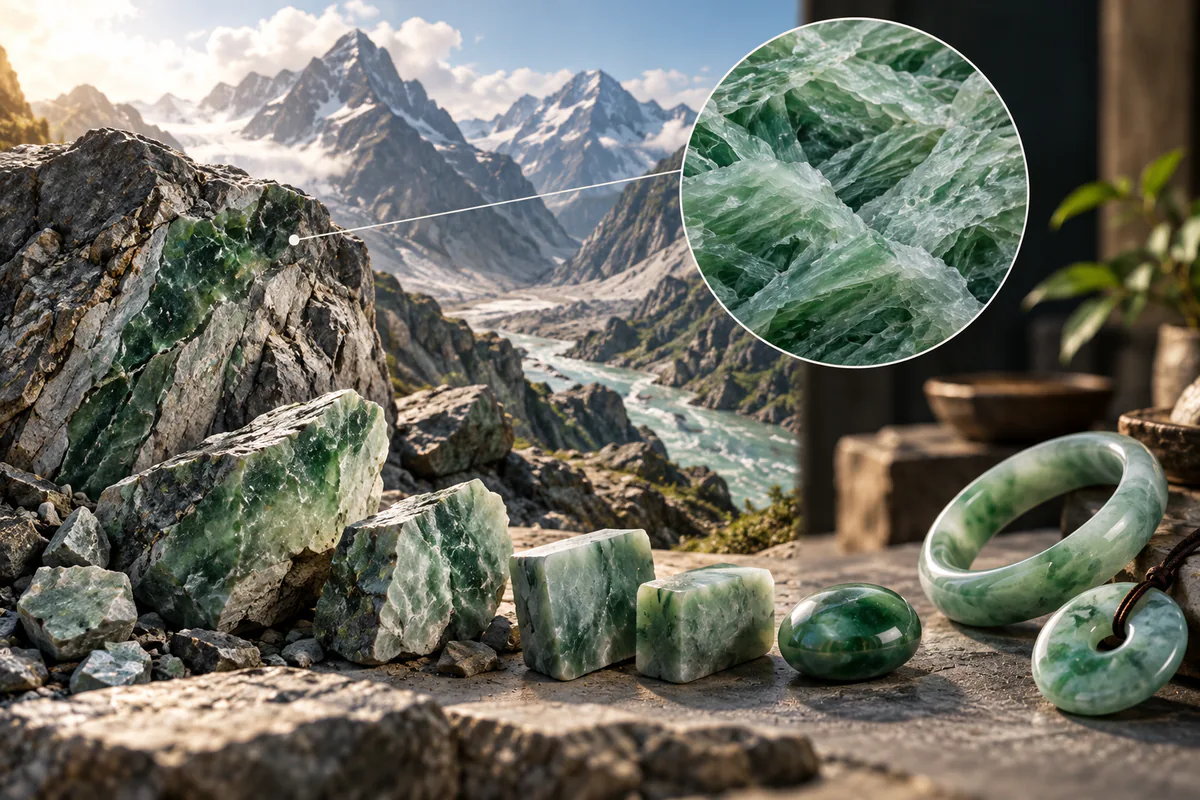
How Jade Stone Forms
How is jade formed? In reality that is two questions: jadeite and nephrite are born neither in the same place, nor under the same conditions, nor from the same rocks. This page describes both recipes, what they leave in the stone, and the numbers I do not publish.
Jadeite crystallizes in subduction zones, under very high pressure and at low temperature, while nephrite forms where ultramafic rocks meet silica-rich fluids. Two geological recipes that share neither the setting, nor the ingredients, nor the rarity.
The word jade is a trade name, not a mineral species: it covers a pyroxene and an amphibole, separated in 1863 by the French mineralogist Alexis Damour. As long as you ignore that split, the question has no answer, because it has two. The full overview is on jade stone, the comparison of the two species in jadeite or nephrite.
My name is Jade, I run a jade jewelry workshop: I choose the pieces, have them set, and weigh one sample of each reference before it goes on sale. I am neither a gemologist nor a geologist, and what follows comes from the mineralogical literature, not from my workbench.
Two minerals, two geological recipes
Jadeite is a sodium-aluminum pyroxene, with the formula NaAlSi2O6: it needs sodium, aluminum, silica and, above all, a very particular regime of pressure and temperature. Nephrite is a calcium amphibole of the tremolite-actinolite series, rich in magnesium, which takes in iron in its place: it needs calcium, magnesium, silica, and the meeting of two rocks that have no business being together.
Nothing in these two lists overlaps. They are neither two grades of the same material nor two stages of the same process, but two minerals grouped under one name because they look alike to the eye.
Jadeite is born in a subduction zone
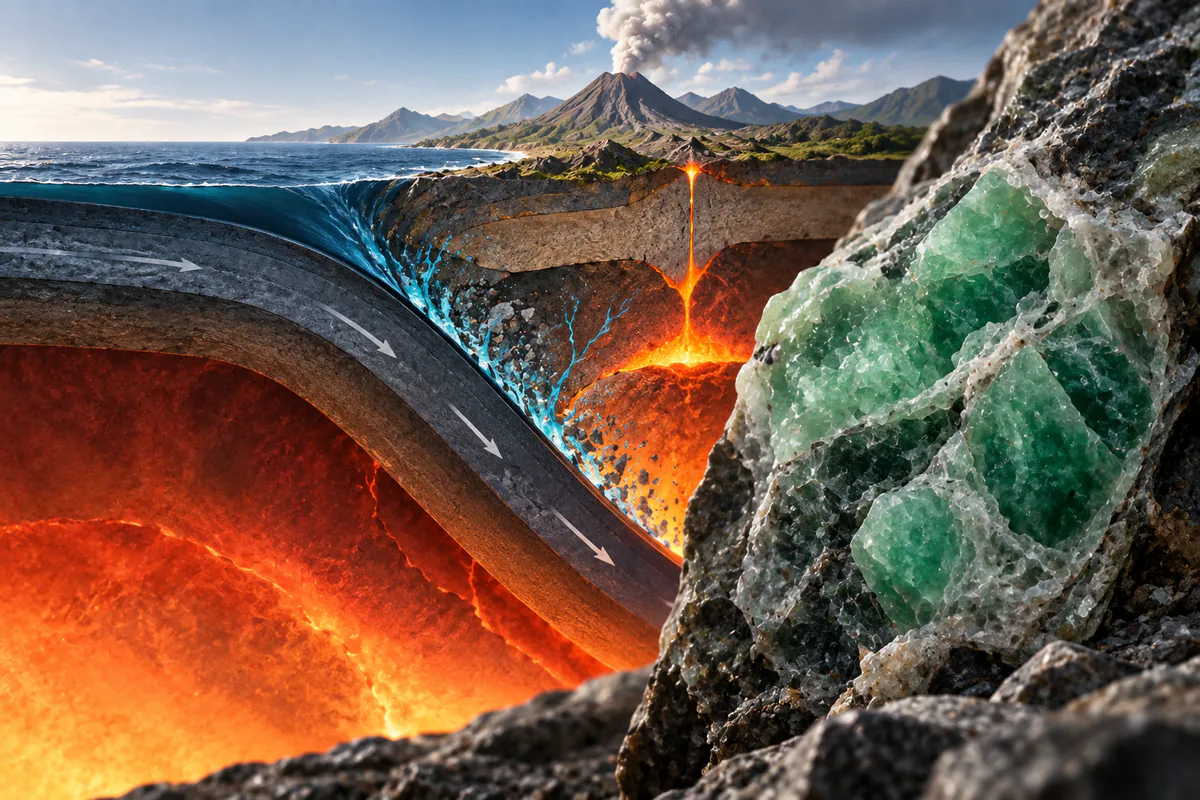
A subduction zone is a place where an oceanic plate dives beneath another. What matters here fits in one sentence: the descending plate is cold, and it sinks faster than the surrounding heat can warm it, while pressure rises immediately with depth.
The result is an imbalance that surface geology does not produce: high pressure, low temperature. That is the regime in which jadeite is stable, and it is why it is sought there rather than in the volcanic terrain or granite massifs where one might look first.
Its elements are not delivered by magma but by water. The diving plate is saturated with it, held in its sediments and minerals, and depth forces it out. This water, loaded with sodium, aluminum and silica, rises along the contact between the two plates, and it is by unloading there that it leaves jadeite behind.
Jade rings right now
Why it comes out of a serpentinite mélange
The same water has a second effect, and that is what explains the shape of the deposits. As it passes through the mantle above the diving plate, it turns peridotite into serpentinite, a hydrated rock that is lighter and mechanically soft. Being lighter than its surroundings, this serpentinite rises along the subduction channel, deforming like a paste, and carries up blocks of rock formed at depth. The result has a name: a mélange, in the geological sense, a tectonic assemblage of blocks embedded in a matrix.
Jadeite occurs there as blocks and lenses caught in serpentinite, not as a continuous vein that a prospector could follow along a rock face. The difference is practical as much as descriptive: a good share of the jade mined worldwide is extracted as isolated blocks, freed from their matrix or picked up in river gravels, and that is where the uncertainty about what a block contains before it is opened comes from.
On the crystallization itself, I will not take sides. The mineralogical literature discusses two mechanisms: direct precipitation from the fluid, in fractures in the serpentinite, and replacement of a pre-existing rock by that same fluid. They are not mutually exclusive from one deposit to another, and I have no way of saying which one made a given stone.
Nephrite forms at a contact
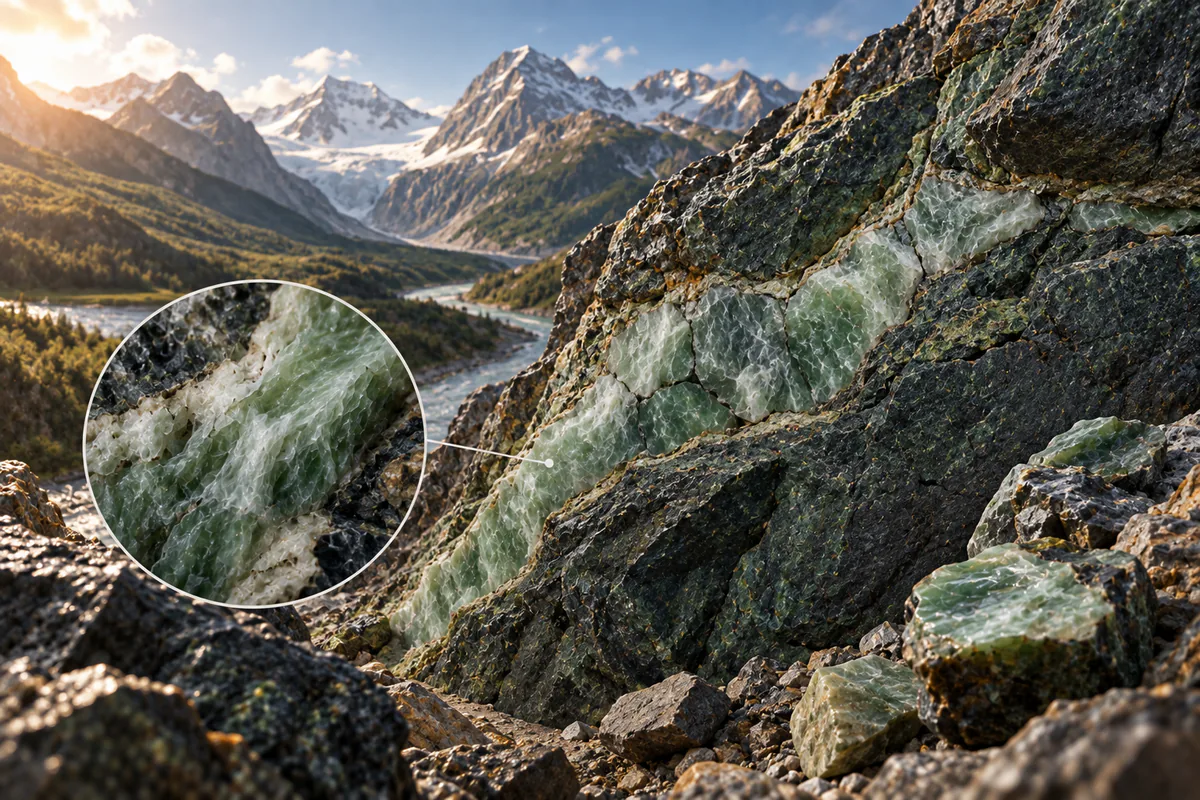
Nephrite needs neither subduction nor extreme pressure. It needs a boundary: the place where an ultramafic rock, rich in magnesium, comes into contact with a silica-rich fluid, most often from a granitic intrusion. Two rocks that are out of equilibrium exchange elements across this contact, and it is in this exchange band that the amphibole crystallizes, with magnesium and calcium coming from one side and silica from the other. The reaction zone is narrow, which explains why nephrite occurs as lenses and veins along a contact rather than as deep masses.
The literature describes a variant of the same principle, where the silicate rock’s partner is not ultramafic but a dolomitic carbonate. The mechanism does not change: a contact, fluids, time.
These ingredients are far more widespread than those of jadeite, and that is the underlying reason why nephrite is the more common of the two. Ultramafic massifs cut by intrusions are not rare; subduction zones that have returned their rocks to the surface are much rarer. Most commercial jade jewelry is nephrite, and that is not a commercial accident but a geological consequence.
What formation leaves in the stone
The two recipes do not leave the same texture in the stone, and it is that texture that makes jade resistant. The growth of nephrite in a reaction zone produces interwoven microscopic fibers, tangled like felt; the crystallization of jadeite produces fine, tightly interlocked grains. In both cases, a crack trying to cross the stone has to get around obstacle after obstacle: why jade almost never breaks.
They also explain part of the color, since trace elements come from the rocks the fluids passed through: chromium, abundant in ultramafic settings, gives jadeite its vivid green, and iron gives the more ordinary greens of both species. The rest of the palette is in jade stone colors.
What formation does not change, however, is density: it depends on the mineral’s structure, not on the deposit it comes from. Jadeite sits between 3.25 and 3.36, nephrite between 2.90 and 3.03, and these two ranges never overlap. That is exactly what my scale relies on: the weighing protocol.
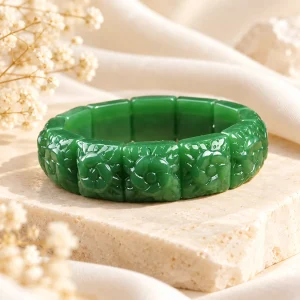
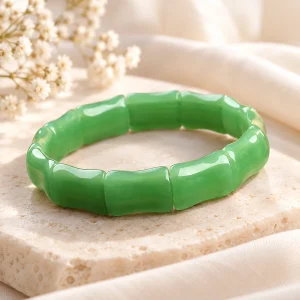
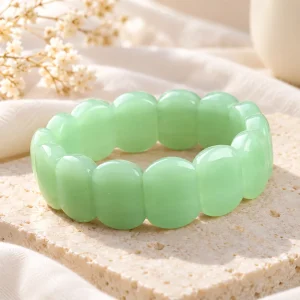
Bracelets whose density I publish
Why deposits are where they are
The map follows the recipes. Jadeite deposits are known only along ancient subduction sutures, which confines it to a handful of places: Myanmar supplies most gem-quality material, the Motagua Valley in Guatemala comes next, far behind, and Russia, Kazakhstan and Japan produce marginal amounts. Since the Western Alps are also an ancient subduction zone, the same rule explains the jadeite of European Neolithic axes (jade in Europe). Nephrite, for its part, follows ultramafic belts, in New Zealand, Russia, Canada, Taiwan and China. The details of the deposits are in where jade comes from, and what I will or will not source from them in the origin of my jade.
The numbers I do not publish
A page on how a mineral forms calls for two numbers: a pressure and a temperature. You read them almost everywhere, often without a source, and sometimes different from one page to the next. I do not write them here, because I have not read them from the GIA, on Mindat, or in the nomenclature of the International Mineralogical Association, and I do not copy a number when I do not know where it comes from.
This is not fussiness. This whole site rests on numbers I measure and publish with their date; placing a laboratory value next to them, taken on trust, would mean doing exactly what I criticize the market for. The gap is written down, and it will be filled the day I read those values somewhere they can be attributed.
Two other things formation does not tell you, and they matter more to a buyer. It says nothing about treatment: a jadeite that was bleached and then impregnated with resin formed like any other, and it is what happened to it afterward that changes its price and its care (jade A, B, C, the treatment information sheet). And it says nothing about what you are being sold: serpentine and dyed quartzite formed elsewhere and differently, and yet they circulate under the name jade (stones sold as jade, how to recognize real jade stone).
The questions I get asked
How is jade formed, in one sentence?
In two ways, because it is two minerals. Jadeite crystallizes in subduction zones, under high pressure and at low temperature, from fluids rising between two plates. Nephrite forms at the contact between an ultramafic rock and a silica-rich fluid.
How long does it take for jade to form?
Geological timescales, beyond the reach of any human scale. I do not give a number: I have not read one I can cite, and a plausible duration is not a measured one.
Is jade still forming today?
Subduction zones are active right now, and the conditions that make jadeite exist there. No one observes it directly, and whatever forms there will not return to the surface for a very long time. That is reasoning, not an observation.
Why is jadeite rarer than nephrite?
Because its formation conditions are rare, and because the rocks involved also have to return to the surface. The setting that produces nephrite, a contact between ultramafic rock and a silicate intrusion, is far more widespread.
Does formation explain the color of jade?
Partly: the trace elements that color the stone, mainly chromium and iron, come from the rocks the fluids passed through. But a color may also have been added in a workshop, and that is no longer geology (dyed jade).
Can you see how a stone formed by looking at it?
Not at home. A slightly greasy polish points toward nephrite, fine translucency toward jadeite, but these are clues, not proof. Hydrostatic weighing tells you which side of the density table you are on; it tells you neither the deposit nor the mechanism.
Where I checked
What comes from a named source. The description of the two formation settings, the formulas and the assignment of the species to pyroxene and amphibole are those of the mineralogical and gemological literature, as published by the GIA, the Mindat database and, for species names, the International Mineralogical Association. The density ranges come from there too: I repeat them without having established them, and their limits vary by a few hundredths from one database to another, which is why I do not pin them on one organization rather than another. The separation of the two minerals and the word jadeite come from Alexis Damour, Comptes rendus hebdomadaires de l’Académie des sciences, volume 56, 1863; I do not give its page numbers, because I have not read it.
What is an observation, dated. On September 8, 2026, I looked at the nine French competitors on the first page of results for this stone: none of them states the mineral of its pieces. The same day, my supplier confirmed that they cannot tell whether their stock is treated. On the specific subject of this page, I did not find a French site that separates the two formations, but that survey was not systematic, so I do not present it as a measurement.
What is my own reasoning. The link between the lightness of serpentinite and the return of blocks to the surface, the link between how common ultramafic contacts are and nephrite’s place in the trade, and the idea that the texture inherited from formation explains toughness: chains of reasoning I consider solid, not measurements I have made. If you find a mistake here, write to me: I will correct it and note the correction.
In one sentence
Jade does not form; two minerals do, one in the cold and pressure of a subduction zone, the other at the boundary of two rocks exchanging their elements, and this double origin explains both the rarity of one and the texture of both. What tells you which one you are holding is on the weighing page, the pieces in the shop.
Pendants, with the mineral named on each product page