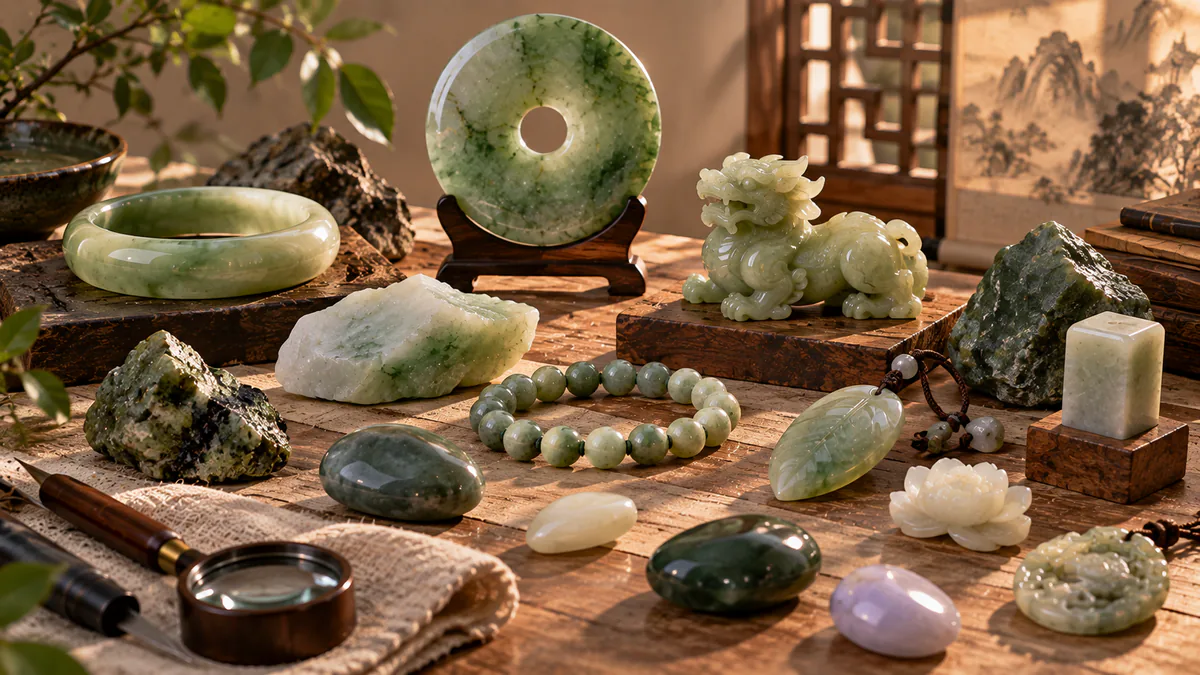
The Jade Glossary in Fifteen Words
This jade glossary brings together the fifteen words that come up on a product page, a label or a listing, with what each one refers to, what it does not tell you, and the article that goes into it further.
Fifteen words are enough to read a jade product page without being fooled: jadeite, nephrite, serpentine, quartzite, density, hardness, toughness, translucency, grain, polish, cabochon, bangle, Bi disc, A, B, C treatment, and dyed.
Four name a material, three can be measured, three are judged by eye, three name a shape, and two describe what was done to the stone. The first four refer to what a scale can settle; the other eleven cannot be weighed.
My name is Jade, and I run a jade jewelry workshop: I choose the pieces, have them set, and weigh one example of each reference before it goes on sale. I am not a gemologist or a therapist: here the mineralogy is stated as fact, and what I do not know is written down.
What a glossary can do, and what it cannot
The right word proves nothing: it lets you ask the right question, and spot the seller whose answer misses the point. Two of the fifteen carry the definition of all the others, jadeite and nephrite, and they are the ones I have seen used least: of the nine French shops I opened on September 8, 2026, not one product page stated which of the two minerals it was selling. How they are told apart is the subject of this site’s main guide, and the professional rules that try to pin down these names are the subject of how jade is named.
The two minerals, and only those two
Jade is a trade word. Mineralogy knows not one jade but two, unrelated, separated in 1863.
Jadeite
A sodium aluminum pyroxene, formula NaAlSi2O6, made of fine interlocking grains; density 3.25 to 3.36. The word was coined in 1863 by the mineralogist Alexis Damour, who had just shown that the name jade covered two species. It tells you nothing about color, origin or treatment: what separates the two minerals.
Nephrite
A calcium amphibole of the tremolite-actinolite series, made of fibers matted together like felt; density 2.90 to 3.03. Its name comes from the Latin lapis nephriticus, kidney stone, just as the word jade comes from Spanish: both were born from a promise of healing, which this site never makes. It is the material of ancient Chinese jade, long before jadeite arrived: the two minerals in detail.
The jade rings available now
Two materials the trade sells under this name
They are neither fake nor bad: they have a name, and that name is not jade. Article 9 of French Decree No. 2002-65 prohibits selling a stone under any name other than its own.
Serpentine
A group of soft green minerals, with a density close to 2.6. It is the material I most often find behind a compound name containing the word jade, such as new jade or Korean jade, which do not refer to any species. The gap with the two true jades is counted in tenths, and a scale sees it without hesitation: stones sold as jade.
Quartzite
A quartz rock, with a density close to 2.65, porous enough to take a dye: it is the material of many pink and fuchsia bracelets. The word rarely appears on the French listings I read, replaced by a fancy name. The dye is found in the cracks, where it builds up more heavily: how to recognize added color.
The three words that can be measured
The only ones that give a number, and two of them are constantly swapped for each other.
Density
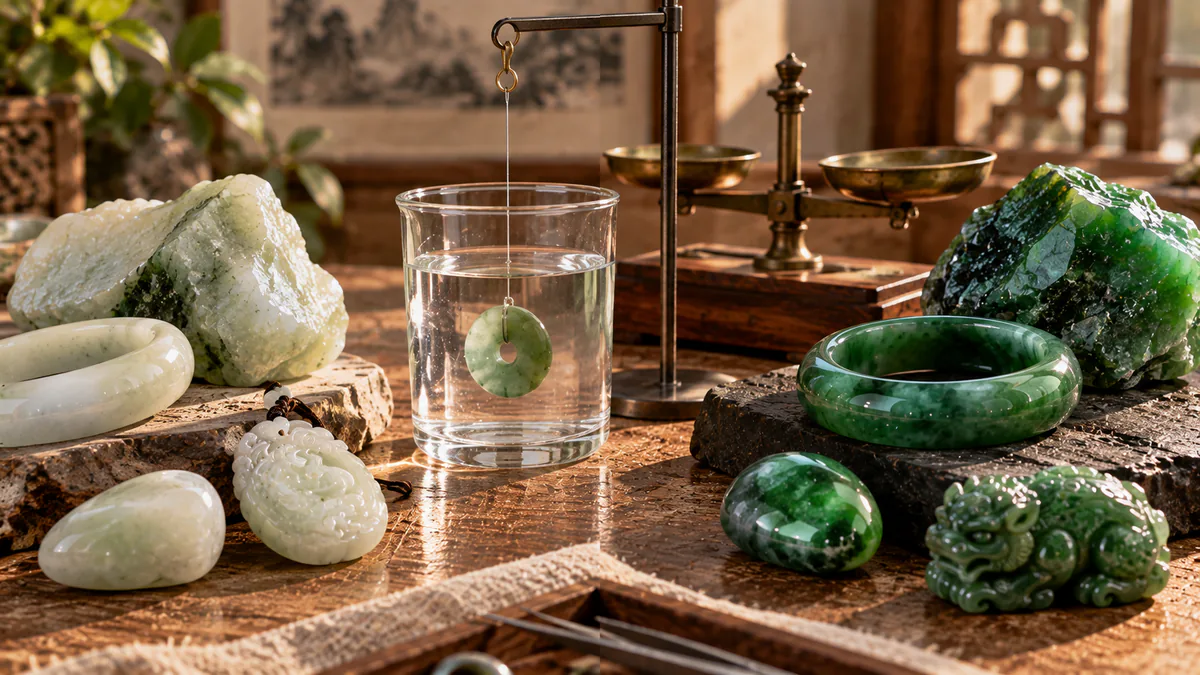
Mass divided by volume. You can get it at home by hydrostatic weighing: weigh the bare stone in air, then suspended in a glass of water, and work out the ratio. This is the number that places a piece on the side of the two jades or of their substitutes, and the protocol, with its three limits, is on the weighing page.
Hardness
Resistance to scratching, on Friedrich Mohs’s scale from 1 to 10. Nephrite sits at about 6 to 6.5, jadeite at 6.5 to 7: the first falls below quartz, which rates 7 and makes up a good share of ordinary dust. The single figure you often read for jade therefore flattens a real difference: hardness and toughness.
Toughness
Resistance to breaking, unrelated to hardness: diamond is the hardest mineral and splits under a hammer. Jade does the opposite, because its interlocking grains or matted fibers stop a crack from spreading. That is what made it the material of the polished axes of the Neolithic, nephrite in China and jadeite in the Alps: why jade almost never breaks.
The three words judged by eye
None of them gives a number: they are compared, by hand and in the light, and a photograph hides at least two of them.
Translucency
The ability to let light through without letting you see through, which is not transparency. It is judged by bringing a lamp close to an edge or a thin rim, never from a head-on photo, where a light background is enough to fake it. It is one of the six value criteria, and it does not replace the others: judging the quality of a jade.
Grain
The fineness of the texture: interlocking grains in jadeite, matted fibers in nephrite. The finer it is, the deeper a polish the surface will take. Grain shows under a loupe on an edge or inside the drill hole, rarely in a picture: the six criteria.
Polish
The surface finish achieved at the last stage of working the stone. A crisp polish reflects a window without distorting it; a rough one makes the reflection ripple, and a surface worn for years gradually loses it. What wears it down is more often storage, with other jewelry in the same box, than wear: storing a jade piece.
The three words for shapes
They refer to objects, not qualities, and a listing that uses them correctly already tells you a lot.
Cabochon
A stone cut as a smooth dome with a flat base, without any facets. It is the cut of most set jade pieces: facets add nothing to a material you cannot see through. The height of the dome changes the look, and a very flat one makes the color seem paler than it is: the pendants.
Bangle
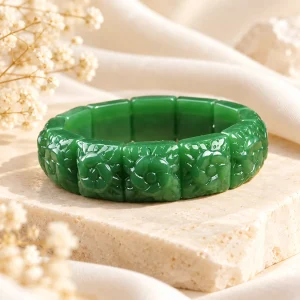
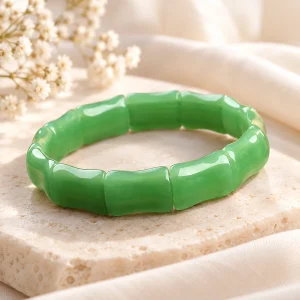
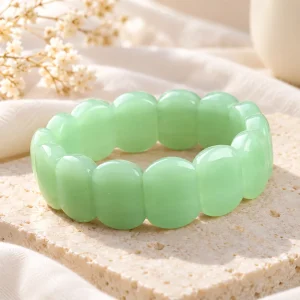
A one-piece bracelet with no clasp, cut from a single block and then hollowed out. It does not open: it slides over the thumb joint, with the hand folded into a cone, and it is the inside diameter that matters, not the wrist circumference. The measurement is taken before buying, nothing fixes a mistake afterwards: measuring your wrist, the bracelets.
Bi disc
A flat disc pierced with a central hole, a Chinese form attested from the Neolithic and carved in nephrite long before jadeite was known in China. Older books spell the name pi, following another romanization of Chinese: it is the same object. What the form meant is still debated: jade motifs.
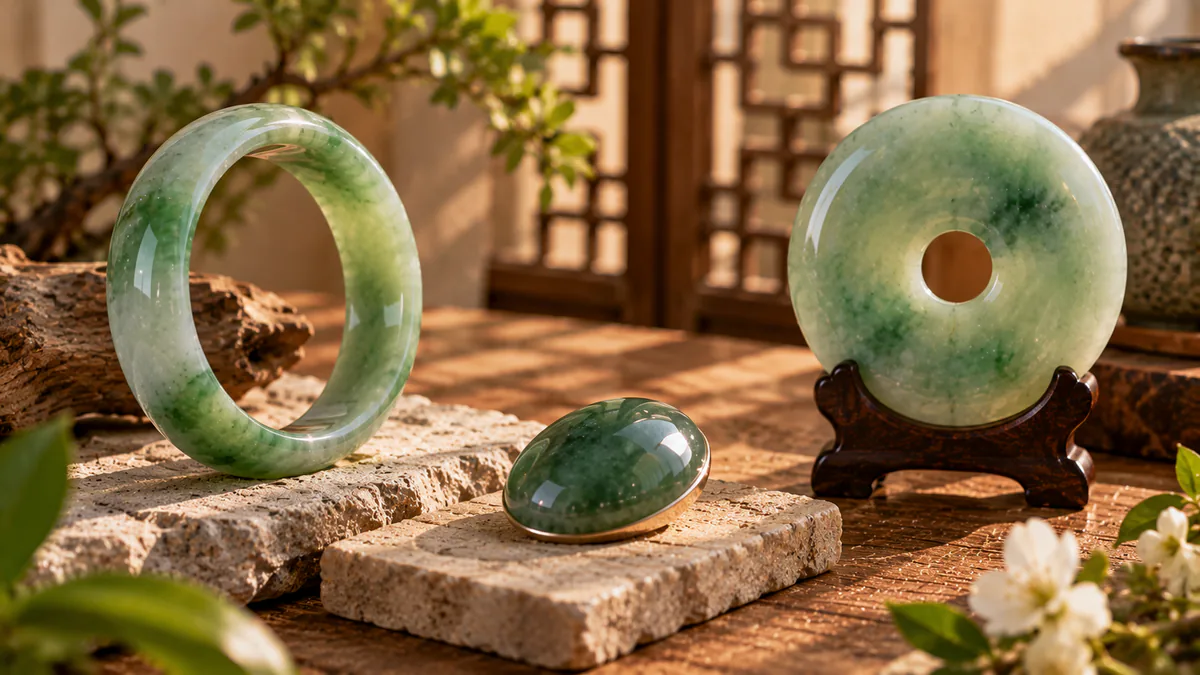
Bangles and bracelets whose density I publish
The two words for treatment
The ones that cost the most to ignore, and the only ones for which I cannot say what they mean for my own pieces.
A, B, C treatment
The classification used in the jade trade, and the only one that exists: A, nothing beyond polishing and a surface wax; B, stone bleached with acid then impregnated with resin; C, dyed stone, and the last two can be combined. Only infrared spectroscopy can settle it, I do not have access to it, and my supplier does not know the status of their goods: so I do not place any of my pieces in this grid (type A, B and C jade, the information sheet).
Dyed
Said of a stone whose color was added with a dye, which penetrates the porosity and micro-cracks. Article 2 of French Decree No. 2002-65 then requires the name to be completed with a mention of the treatment, while Article 3 exempts three long-established lapidary practices, including bleaching without dye or varnish. Dye is looked for in the cracks, where it concentrates: dyed jade.
The words this glossary does not define
Four families are missing, and none by oversight.
Semi-precious and semi-fine. Article 5 of French Decree No. 2002-65 bans the French terms semi-précieux and semi-fin across its whole scope, without exception: it is the only outright vocabulary ban in the text. That does not make jade a precious stone in the strict sense, and the correct French term is pierre fine, which English simply calls a gemstone (is jade a precious stone).
A, AA, AAA. This scale has no standing in any standard and borrows its alphabet from the real classification, the one for treatments. A seller who displays it is announcing a quality without saying who measures it: what a seller must disclose.
Compound names. Malaysian jade, Australian jade, African jade: sales names covering dyed quartzite, chrysoprase and grossular (stones sold as jade).
Certificate, certified, guaranteed, appraised. Leaving them out is the clearest choice on this page. I weigh one example of each reference, I publish the measurement, the date and the mineral it points to, and I stop there: I am not a gemologist and I issue no document. I measure, I do not certify: what I publish on every product page.
Questions I get asked
Jadeite or nephrite, which one is real jade?
Both. Since Damour’s note in 1863, the word legitimately covers these two species and only these two. Neither is superior by nature: they do not have the same grain or the same possible translucency, and a piece is judged within its own species.
How can I tell which mineral my bracelet is?
With hydrostatic weighing, which gives the density and compares it with the four reference points on this page. It is done on the bare stone: on a set piece or a strung strand, the metal and thread distort the measurement. It also loses its value on very small pieces.
What does type A jade mean?
In the A, B, C classification, a stone that has received no acid, no resin and no dye. It is a real category, unlike the A, AA, AAA scale. I do not place any of my pieces in it: my scale gives the mineral, not the treatment.
Does “semi-precious” mean anything?
Not in French law, where the word is even banned. Article 5 of French Decree No. 2002-65 of January 14, 2002 prohibits semi-précieux, along with semi-fin, for all materials within its scope. The correct French term is pierre fine; in English, gemstone does the job.
What is the difference between a bangle and a beaded bracelet?
A bangle is cut from a single block and hollowed out, with no clasp: it is chosen by inside diameter and slides over the thumb joint. A strand of beads is adjusted by length, repaired by restringing, and judged bead by bead.
Is translucent jade always better?
No. Translucency is one criterion out of six, and it does not make up for a crack, a rippled polish or uneven color. A sound, opaque nephrite is a different object from a cracked, translucent jadeite.
Where I checked
What comes from a named source. The separation of the two minerals and the word jadeite come from Alexis Damour’s note in the Comptes rendus hebdomadaires de l’Académie des sciences, volume 56, 1863; I do not give the page numbers, as I have not read it. The Articles 2, 3, 5 and 9 cited are those of French Decree No. 2002-65 of January 14, 2002, a text which, incidentally, mentions neither jade, nor jadeite, nor nephrite. The hardness scale is Friedrich Mohs’s. The density and hardness ranges are those of the mineralogical literature: I cite them, I did not establish them, and I do not attribute them to any organization because I did not take them from any one in particular.
What is a dated market observation. On September 8, 2026, I opened the nine French shops on the first page of results: not one product page stated the mineral being sold, one displayed two contradictory origins, and another used the A, AA, AAA scale. The same day, my supplier confirmed that they cannot say whether their goods are treated.
What is my own reasoning. The choice of these fifteen words over others, how they are grouped, the decision not to define certificate, certified, guaranteed or appraised, and the link between the hardness of a nephrite and the wear of its polish by dust: these are decisions, not established facts. If you find an error here, write to me: I will correct it and note the change.
In one sentence
A glossary does not replace a scale, but it makes a product page readable: as soon as a listing names the mineral, gives the number behind it and says what it does not know, there is almost nothing left to guess. The method is on the weighing page, and the pieces are in the shop.
Pendants, with the mineral named on every page