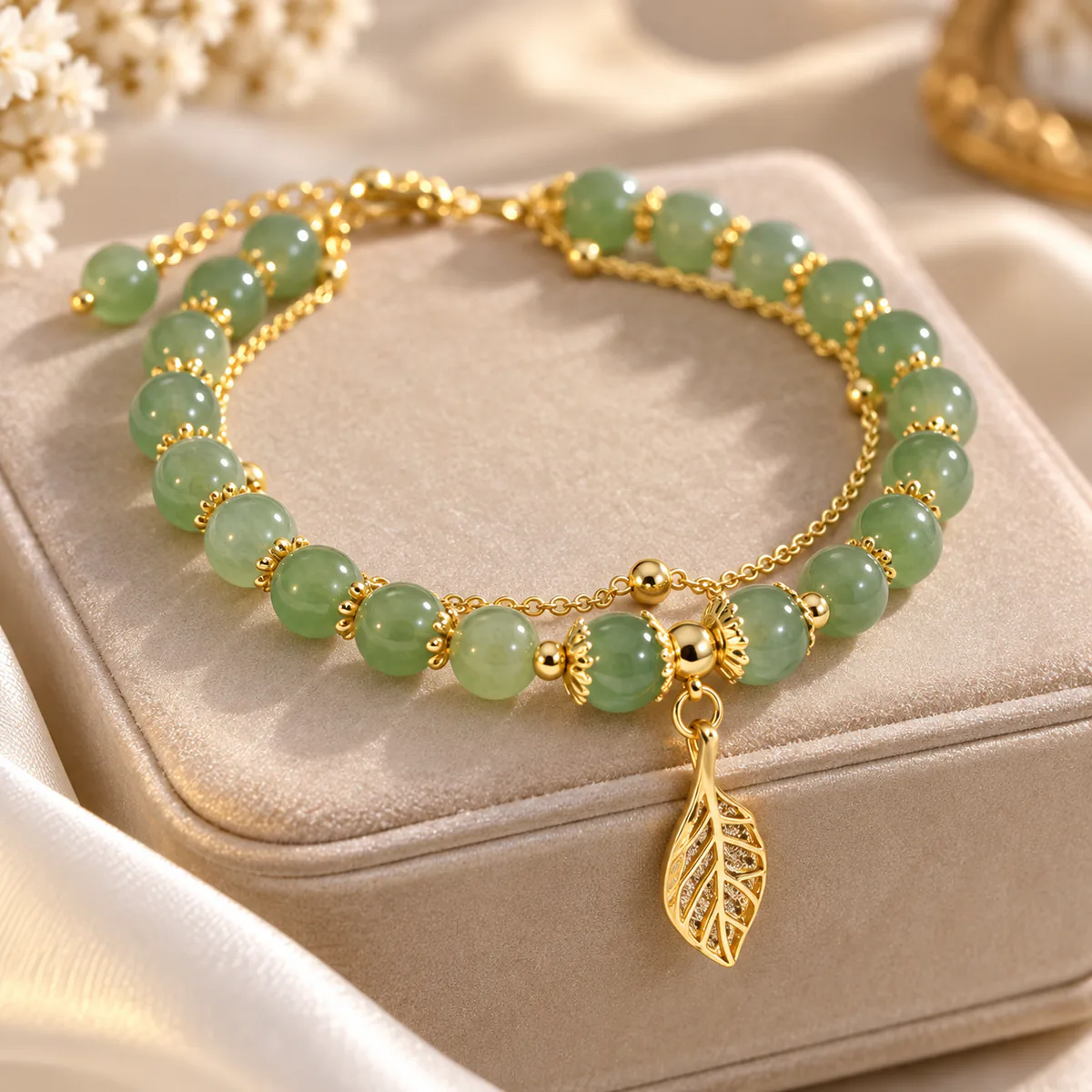
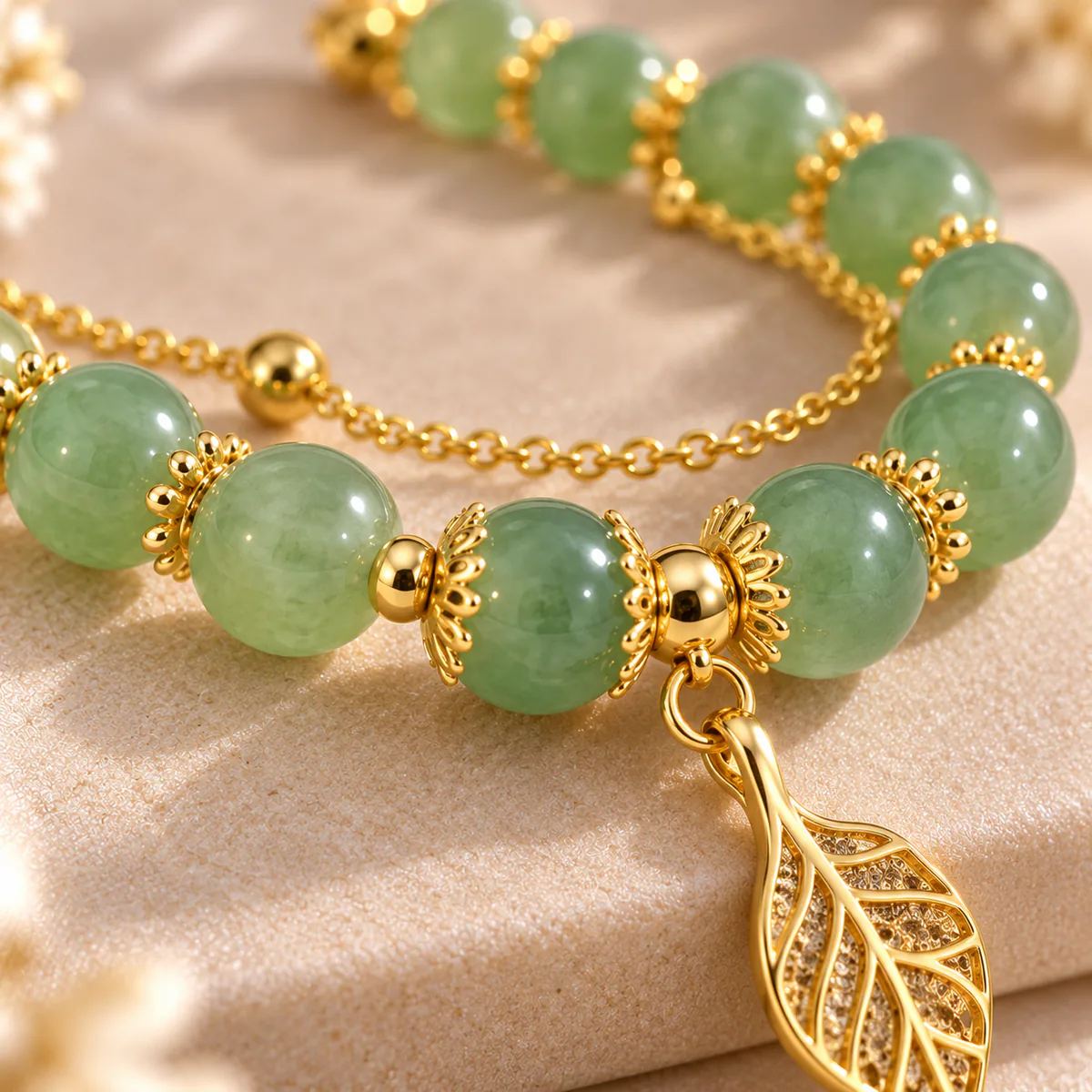
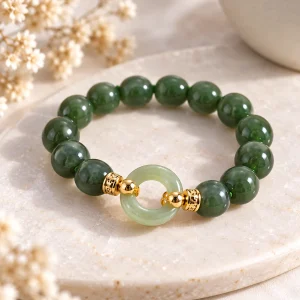
Jade and gold bracelet, a strand of round light green jadeite beads separated by gold-tone caps, doubled by a chain. Openwork leaf charm below the clasp.
Adjuster chain, so no size to choose: the length is set at the clasp. Adjust on the bead strand, the shorter one, so the chain does not hang loose.
The word gold is in the name, not in my record: the alloy is unspecified. Strung, therefore not weighable. Treatment status undetermined.
A jade and gold bracelet strung as a single strand of round light green jadeite beads, separated by small gold-tone caps, and doubled by a gold-tone chain running parallel to the strand. An openwork leaf set with white stones hangs below the clasp, and an adjuster chain extends the closure.
In four lines
Strand of light green beads, gold-tone caps, doubled by a chain.
Openwork leaf charm set with white stones, not identified.
Adjuster chain: no size to choose, the length is set at the clasp.
Strung, therefore not weighable: no figure will be published, and the listing says so.
What “Jade and Gold” Means Here
It is the name under which the market sells this kind of bracelet, and it is what people type. I keep it. But I am not going to let anyone believe it means solid gold, or even a guaranteed plating thickness.
What I know: the metal is gold-tone. What I do not know: whether it is gold plate, vermeil or gilded brass. The difference is far from small on a bracelet, which rubs against a sleeve and a desk all day long: gilded brass takes on a patina within a few months of daily wear. The day a supplier gives me an answer in writing, it will appear in the record, and not before. I weigh, I do not certify.
The white stones on the leaf are not named either. At that size, a cubic zirconia and a diamond look alike: I will not call them by either name.
An Adjuster Chain, So No Size to Choose
The clasp is extended by a short chain ending in a bead. You hook the lobster onto whichever link suits, and the bracelet covers several centimeters of wrist that way. So you will see no size dropdown above the buy button, unlike the other bracelets in the shop.
One practical detail: on a double assembly, bead strand plus chain, the two strands do not tension the same way. Adjust on the shorter strand, the beads, so the chain does not hang loose and catch.
A Light Green, and What It Is Worth
The beads are a pale green, slightly milky, with a little translucency at the edges. On jadeite, that green comes from a low content of chromium; on nephrite, from a low content of iron. The two minerals are entirely unrelated and Alexis Damour separated them in 1863. What sets them apart.
The market overvalues intense green and looks down on pale green. That is a pricing convention, not a hierarchy of material. What you can check yourself, on the other hand, is the drill hole: on a dyed stone the color concentrates there, and the rim of the hole is darker than the rest of the bead. The checks that need no equipment at all.
What Damages It, and What Saves It
Jade is tough, its structure of interlocking crystals stops a crack from spreading, but its hardness stays ordinary: the quartz in everyday dust, which rates 7, dulls beads over time. On a bracelet it is rubbing against a desk that wears it, not impacts. Hardness and toughness.
This model’s weak point is elsewhere: the chain and the clasp. A fine link bends, a lobster springs open, and an adjuster chain is the first thing to fail on a bracelet worn every day. Take it off for sports and housework. Lukewarm water, mild soap, fully dry afterward. Never an ultrasonic cleaner, never steam, never solvents.Care in detail.
Additional information
Stone
Jadéite
Color
Light green
Stone shape
Round beads
Motif
No motif
Mounting
Bead strand, Chain
Metal
Gold tone, alloy not stated
Setting
Drilled stone
Worn by
Women
Paired stones
White stones, not identified
Mineral family
Sodium aluminum pyroxene
Hardness (Mohs)
6.5 to 7
Reference density
3.25 to 3.36 g/cm³
Toughness
Exceptional, interlocking crystals
Treatment
Not determined
Origin
Outside Burma, country of extraction not confirmed
What Tradition Attaches to the Jade Bracelet
What follows changes register, and I flag it rather than blend it into the rest of the listing. None of it is proven. These are customs and beliefs, old and documented, that I report because they are part of this stone's history. No piece in this shop is sold as a remedy, and I claim no effect for this one.
The stone worn against the skinJade takes on body temperature within minutes and holds it. That is a physical property, conductivity, and several traditions have made something else entirely of it. I stay with the first.
The strand of beadsThe round bead bracelet is a late form, one that came out of modern trade, whereas the pierced disc and the polished axe are attested from the Neolithic on. The age of the stone is not the age of the object.
A stone of moral virtueIn Confucian thought, jade is associated with qualities of character rather than effects on the body: uprightness, constancy, restraint. It is the best documented meaning of them all.
The black specksThe dark inclusions in nephrite have been judged differently from one period to another, sometimes a flaw, sometimes a mark of the natural. Neither reading says anything at all about the mineralogical quality of the stone.
Shipped within 48 hours of your order being confirmed, for delivery within 14 days from the day it ships. I keep no buffer stock, and I will not promise a date I cannot meet.
Shipping Costs
€6.99 no matter the destination, and free on orders of €47 or more to France, Belgium, Switzerland, and Luxembourg. The exact amount shows in your cart before you pay.
The Packaging, and Why It Matters
Every piece leaves in its own pouch, kept apart from the others. This is not about presentation: jade’s hardness is ordinary, 6 to 6.5 for nephrite and 6.5 to 7 for jadeite, and the quartz in everyday dust rates 7. Two pieces of jewelry that travel together arrive scratched.
Fourteen Days to Change Your Mind
No reason needed. One email opens a return, and there is no form to fill out. Return shipping is at your expense, unless the piece does not match its listing or arrives damaged.
Getting the size wrong is the leading cause of returns in this category, and jade cannot be resized the way a solid metal band can. Two minutes of measuring almost always prevents it. The size guide.
Lukewarm water, mild soap, a soft cloth. A very soft brush for the hollows of a carving. That is all, and it is enough.
What You Must Never Do, and Why
No ultrasonic cleaner, no steam, no solvent, no heat source. The reason is not caution for its own sake: the treatment status of my pieces is undetermined. My supplier cannot tell me, and the weighing establishes the mineral without saying anything about a possible resin impregnation. Resin withstands neither heat nor solvents, so every piece is handled as though it might contain some. The treatment information page.
The Scratch, and Where It Comes From
Jade is tough, meaning very hard to break: its structure of interlocking crystals resists cracking, and that is what made it possible to turn it into axes in the Neolithic. Its hardness, on the other hand, is ordinary, 6 to 6.5 for nephrite and 6.5 to 7 for jadeite. The quartz in everyday dust rates 7, and that is what dulls a jade, not impacts. The difference between the two.
Day to Day
Put the piece on after perfume and lotion, never before. Take it off for housework, gardening, and sports, where the hard knocks happen. Store each piece on its own, in its pouch. On a strand of beads, the thread wears out before the stone does: it gets restrung, and there is nothing abnormal about that.
My name is Jade. I am French, from Morbihan in Brittany, and I live in Tallinn. I choose the pieces and have them set: I mine nothing, I carve nothing, and I do not do the metalwork myself. What I bring is the sorting, and with this material the sorting decides everything.
I am not a gemologist, a lapidary, or a therapist, and I do not claim to be.
I Weigh, I Do Not Certify
Before putting a reference online, I order one example of it for myself. When it reaches me unset, I weigh it in air, then suspended from a thread in a glass of water: the ratio of the two masses gives the density, and that figure separates jadeite, nephrite, serpentine, and dyed quartzite without ambiguity.
One example per reference, and not every piece. I never handle the piece that ships to you, and I would rather say so plainly than let anyone believe otherwise. The method, with its three limitations.
What I Cannot Know
The treatment status of my pieces. My supplier cannot tell me, and neither can the scale: it establishes the mineral, not the resin impregnation. Only laboratory infrared spectroscopy would settle the question, and I do not have that testing done. So you will never read “jadeite A”, “type A” or “untreated” on this site. The information page.
Where My Jade Comes From
No Burmese jadeite, and the first reason is legal. Not the one you read everywhere: the JADE Act of 2008 did ban these stones in the United States, but that ban was lifted on October 7, 2016. What applies today dates from April 8, 2021: the US Treasury sanctioned Myanma Gems Enterprise, the state-owned company that controls the Burmese gem trade. So there is no blanket ban, but an American is not allowed to do business with that entity, and a stone never tells you where it has been. I run one supply chain for ten markets, and it has to stand up to the strictest one. When an origin is not confirmed to me in writing, the listing does not state it. My origin policy.