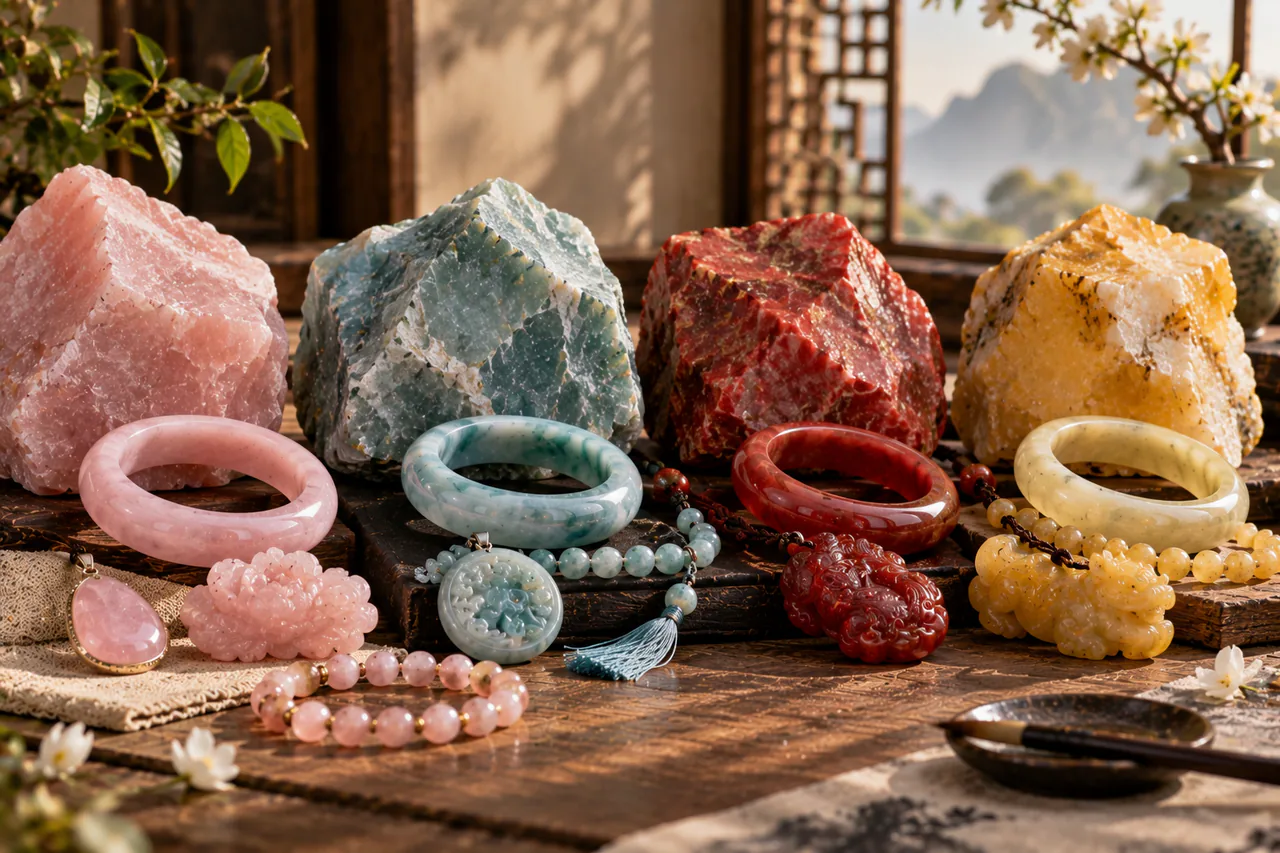
Pink, Blue, Red and Yellow Jade: What the Names Cover
This page untangles four color names the trade lines up as if they were equivalent: pink jade, blue jade, honey yellow and red. Two almost never refer to jade, two really exist, and the same scale tells them apart.
What the trade calls pink jade is, on the pieces whose material I have been able to check, dyed quartzite or colored jadeite, and bright blue follows the same path; honey yellow and red, on the other hand, really do exist.
| Stated color | What it most often is | Density | Product page here |
|---|---|---|---|
| Pink, fuchsia | Dyed quartzite, sometimes colored jadeite | About 2.65 for quartzite | No |
| Bright blue | Dyed quartzite, sometimes colored jadeite | About 2.65 for quartzite | No |
| Honey yellow | Nephrite | 2.90 to 3.03 | Yes, after weighing |
| Red | Oxidized jadeite, or heated jade | 3.25 to 3.36, or 2.90 to 3.03 | Yes, after weighing |
My name is Jade, and I run a jade jewelry workshop: I choose the pieces, have them set, and weigh one example of every piece before it goes on sale. I am neither a gemologist nor a therapist: here the mineralogy is stated as fact, and everything else is attributed.
Four colors, four situations
A color is not a mineral, and a shade name stuck to the word jade says nothing about the stone you are holding. The real palette is covered in jade stone colors; what is at stake here is narrower: four names sold in the same lots, at the same price, that do not cover the same thing.
The sorting is done neither by eye nor by price but on a scale, because the ranges do not overlap: jadeite 3.25 to 3.36, nephrite 2.90 to 3.03, quartzite around 2.65, serpentine around 2.6. A stone weighed in air, then suspended in water, gives its number in a few minutes, and the protocol is on the weighing page. The core of the subject, two minerals under one word, is on the jade stone page.
Pink jade, and what lies underneath
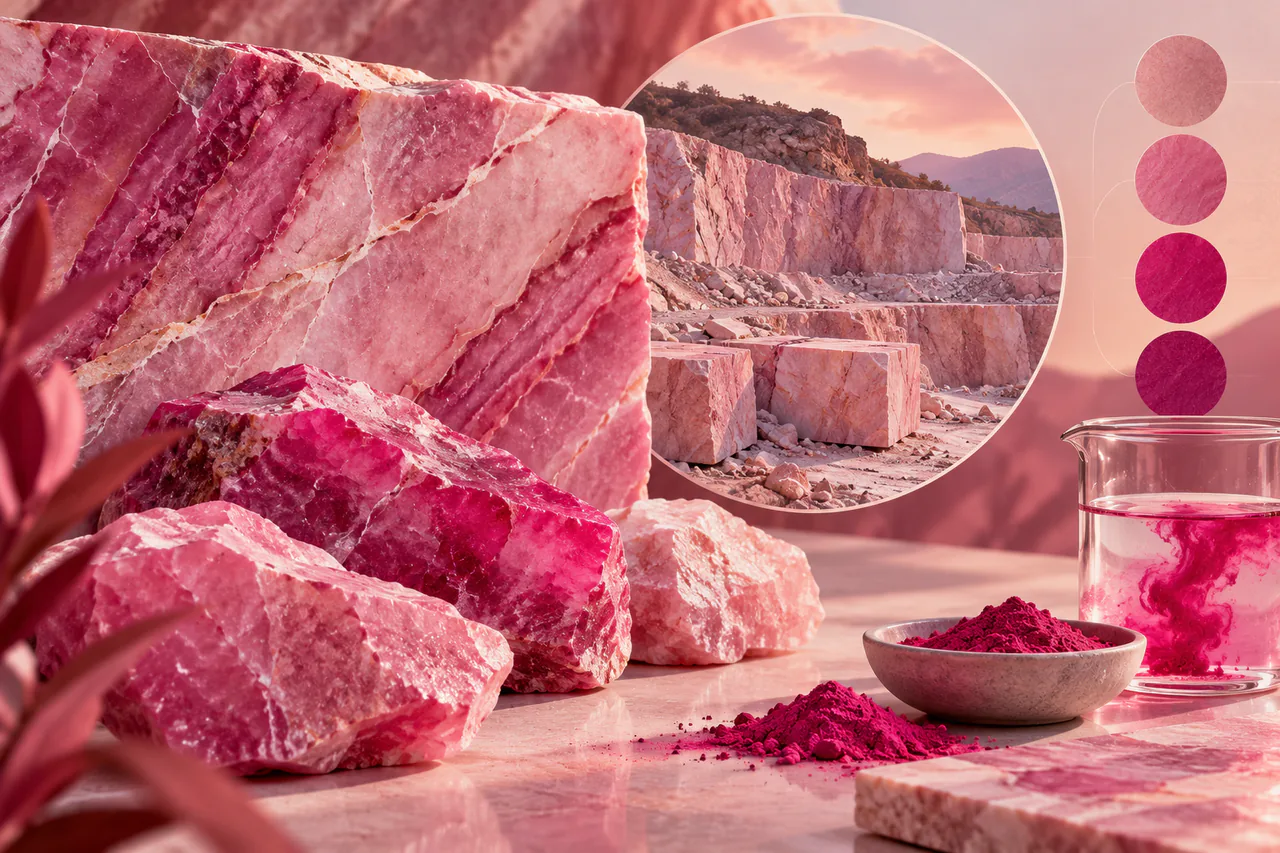
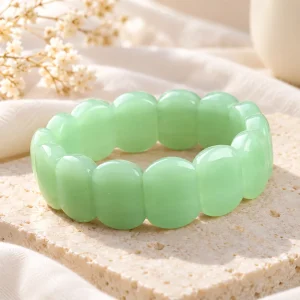
It is the most requested of the four colors, and the one that holds up least. The pink and fuchsia bracelets offered as jade are dyed quartzite, on every piece for which I have been able to obtain a composition or weigh an equivalent. Quartzite is a rock made of quartz grains, white to begin with and porous at the boundaries between its grains: it soaks up dye and costs a fraction of the price of jade. It weighs around 2.65. It circulates under the label “Malaysia jade”, which refers neither to a deposit nor to a mineral species: stones sold as jade.
The second case is rarer: a genuinely dyed jadeite, the C in the A, B, C classification. Dyeing is the only treatment you can spot without a laboratory, because the color collects in cracks instead of spreading through the mass: spotting added color, jade A, B, C.
A close shade does exist in jadeite, though, and it is not the one people are looking for: lavender, a pale mauve that is sometimes pinkish, translucent and understated, with nothing of the candy pink of bead lots.
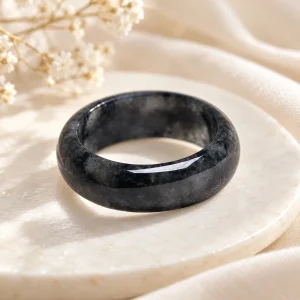
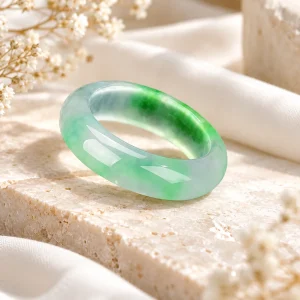
Jade rings available now
Blue, which I have not found in jewelry
Bluish jadeite exists, and mineralogy knows it. What I have not found is a mass-produced piece of jewelry made from it: the bright blue, turquoise or electric blue bracelets I see go by follow the path of pink, most often dyed quartzite.
I give no density here for blue jadeite: I have never had one in my hands, and I do not publish a number I have not recorded. What I can say is more useful anyway: a deep, even blue sold for a few tens of euros should be weighed before it is believed. The checks you can do at home are in how to tell if jade is real.
Honey yellow, very real nephrite
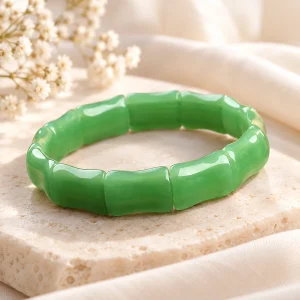
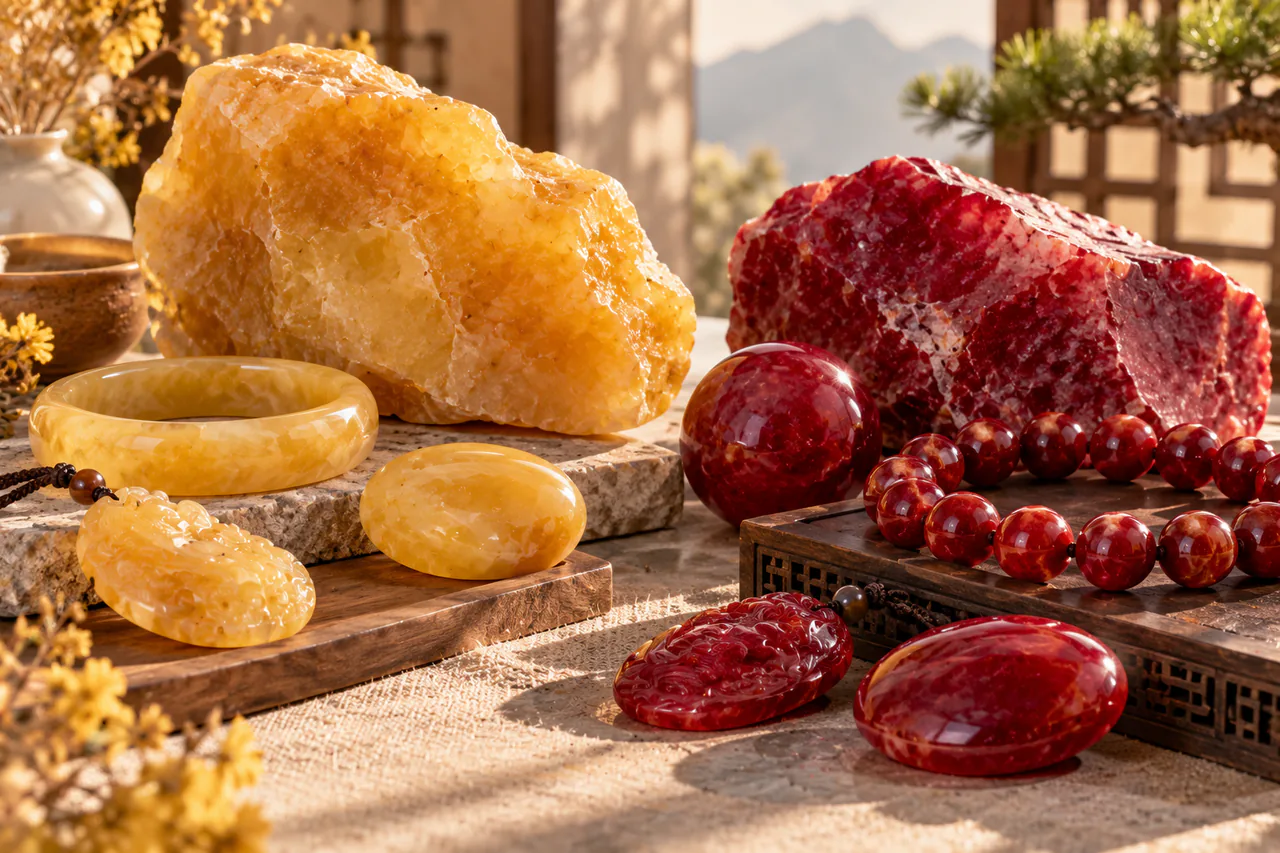
Yellow is the first of the two cases that hold up. Honey nephrite is the same fibrous amphibole as white or green nephrite, colored by iron: opaque to translucent, a warm yellow that sometimes tends toward brown, with the slightly greasy rather than glassy luster that the mineralogical literature describes for this species. It comes from the same deposits as the white known as mutton fat: white jade stone.
It is imitated as much as everything else, and the check does not change: quartzite dyed yellow weighs around 2.65, nephrite between 2.90 and 3.03. The gap is too wide to miss, and that is why a yellow piece can exist here: the honey nephrite bracelet, whose measured density is published on its product page.
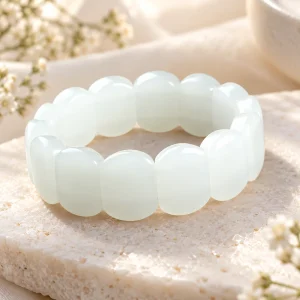
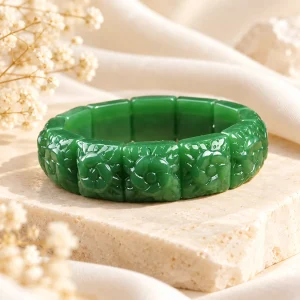
Bracelets whose density I publish
Red: a skin, or a kiln
The red of jadeite is not a color running through the mass, it is a layer. Iron oxidizes on the skin of the block, over a few millimeters, and produces the crust ranging from honey to reddish brown that the Chinese trade calls hong fei. Two consequences can be checked on the piece: the color is rarely even, and it stops at the depth of the oxidation, hence the gradients and the backs that stayed pale.
The second path is the kiln. Controlled heating pushes iron toward red, in jadeite as in nephrite. The result is stable and does not show under a loupe the way a dye does. It is a treatment, but French law puts it in a separate category, which is the subject of the next section. What changes on a stone over time comes from other causes: jade that changes color.
Why there is no pink or blue here
A catalog says as much through what it leaves out as through its pages, provided those gaps are explained. I sell neither pink jade nor blue jade, and it is not a matter of taste: I do not put a stone online under a name that weighing does not support.
The rule comes from the text. Article 9 of French Decree No. 2002-65 forbids selling a stone under another name, on the label as on any commercial or advertising document. A page URL is one of those. These names therefore appear neither in a product title nor in a URL on this site, and this article is the only place they are written.
Pink is nonetheless the most searched of the four, and a product page would rank easily for it. It would be lying. Yellow and red can become product pages, under a condition that is not negotiable: the density of the example I order before the piece goes on sale must fall within the right range. Around 2.65, the piece does not go live. I weigh that example, not the item that ships to you: what I publish on each product page.
What the law says about added color
French Decree No. 2002-65 of January 14, 2002 mentions neither jade, jadeite nor nephrite, and contains no positive list. It does, however, deal with treatments head-on, and three of its articles apply to a question of color.
- Article 2: the name must be completed with “treated”, or with the treatment undergone, whenever a dye or another laboratory method modifies appearance, color or clarity.
- Article 3: three traditional lapidary practices are exempt from this disclosure, including heat treatment.
- Article 9: a ban on selling under another name, on the label and on any commercial document.
The consequence is counterintuitive and worth knowing before you buy: jade reddened in a kiln can be sold without the word “treated”, jade turned pink with dye cannot. The text is covered in detail in jade and the 2002 decree, and the information to give the buyer is on my treatment information sheet.
One honest limit to finish: the scale separates minerals, it says nothing about resin. My supplier does not know the treatment status of its stock, only infrared spectroscopy would settle it, and I do not have that. So I never write that a piece sold here is untreated.
What traditions attribute to these colors
What follows changes register, and I flag it rather than blend it into the rest. Nothing in it is proven: it is what traditions have attributed to this stone.
A stone does not heal anything, and the full disclaimer is here.
Classical Chinese thought is said to have given green and white a place the other shades did not have. Contemporary crystal healing authors are said to associate pink with gentleness, red with drive and yellow with confidence: reported attributions, never established, gathered in what tradition attributes to jade stone.
There is a trap here that I have not read about anywhere else: a good share of what is written about the properties of pink jade actually concerns dyed quartzite. Even within its own framework, a property attributed to a stone other than the one you are holding no longer means much.
The questions I get asked
Does pink jade really exist?
Not in the form people expect. The pink and fuchsia sold by the trade are dyed quartzite, around 2.65, or more rarely colored jadeite. The only close shade that is real is the lavender of jadeite, a pale, translucent mauve.
How can I tell whether my pink bracelet is dyed?
Under a loupe, dye collects in cracks and along grain boundaries instead of being spread evenly. On a scale, hydrostatic weighing gives the density: around 2.65, it is quartzite, whatever the label says.
Is blue jade real jade?
Bluish jadeite exists in mineralogy, but I have not found mass-produced jewelry made from it, and the bright blue bracelets I have examined were dyed quartzite. Faced with a deep, inexpensive blue, weighing settles it before the seller’s opinion does.
Is yellow jade nephrite or jadeite?
Both can be yellow, but the honey yellow sold by the trade is most often nephrite, which weighs 2.90 to 3.03 while jadeite weighs 3.25 to 3.36. The real doubt concerns imitations in dyed quartzite.
Why is red often only on the surface?
Because it comes from iron oxidizing on the skin of the block, over a few millimeters, not from a color spread through the mass. A carver who wants red works that layer, hence the gradients and the faces that stayed pale.
Why don’t you sell pink jade?
Because I do not put a stone online under a name my scale does not support, and because Article 9 of French Decree No. 2002-65 forbids selling under another name on any commercial document, page URLs included.
Where I checked
What comes from a named source. Articles 2, 3, 9 and 10 of French Decree No. 2002-65 of January 14, 2002, read in the original, as well as the absence of any mention of jade in that decree. The density ranges and the description of nephrite’s luster come from the mineralogical literature: their limits vary by a few hundredths from one database to another, and I attribute them to no particular organization, since I did not take them from a single one.
What is a market observation, with a date. On September 8, 2026, looking at the nine French competitors on the first page of results, I did not see a single shop state the mineral of its pieces, or explain what a bracelet sold as pink jade really is. The same day, my supplier confirmed that it cannot say whether its stock has been treated. What I write about pink and blue pieces applies to those for which I was able to obtain a composition or weigh an equivalent, not to a market I have not inventoried.
What is my own reasoning. The refusal of any pink or blue piece in the catalog, the reading that a page URL is a commercial document within the meaning of Article 9, and the refusal to publish a density for blue jadeite without having measured it: these are decisions, not established facts. If you find a mistake here, write to me: I will correct it and note that I did.
In one sentence
Of these four colors, two are trade names put on dyed quartzite and two are real jades that are widely imitated, and nothing separates them by eye: the method is on the weighing page, and the pieces whose number I publish are in the shop.