White Jade Beaded Bracelet in Nephrite

54,90 €

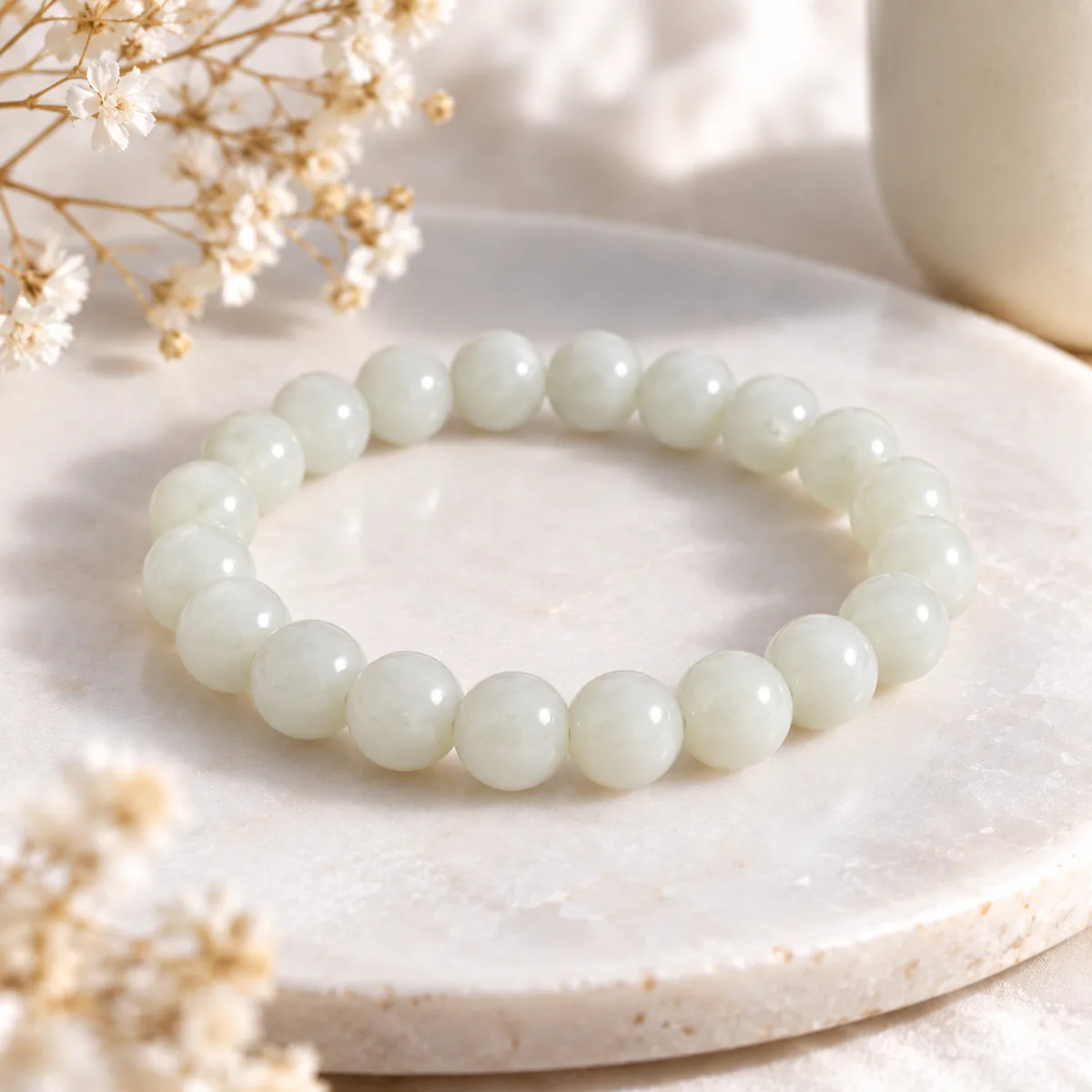
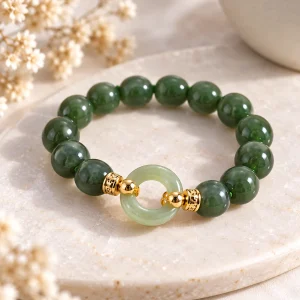
White jade bracelet, one strand of round nephrite beads in a very pale white pulling toward sea green. Greasy luster, not glassy. No clasp, no metal.

Sized by wrist measurement: the strand goes on by stretching. A pale bead shows creams and skin oils, above all around the drill hole: lukewarm water and mild soap.

On a white stone the scale alone does not settle it, and the listing explains why. A bead can be weighed, and this one will be. Treatment status undetermined.

How to Measure Your Size: The Guide, Family by Family

A tape measure right at the wrist bone, laid on without pulling tight.

Category:

A white jade bracelet in a single strand, in round nephrite beads of a very pale white that pulls slightly toward sea green. The luster is greasy rather than glassy, and the light enters a millimeter or two at the edge of the beads. No clasp.

In four lines

  • One strand of round nephrite beads, no clasp, no metal.
  • Very pale white with a slight green cast, greasy luster, not glassy.
  • Sized by wrist measurement: the strand goes on by stretching.
  • White is the color where one measurement is not enough. The listing explains why.

On a White Stone, One Measurement Is Not Enough, and That Is the Useful Part of This Listing

On a green stone the scale settles it fast: serpentine is at 2.6, nephrite at 2.9, and ten percent apart is not up for discussion. On a white stone, two imitations share the market, and each one escapes a different test.

Quartzite, milky white, weighs about 2.65: the scale sends it home immediately. But it is harder than nephrite, 7 against 6 to 6.5, so no scratch test will ever expose it.

Dolomitic marble, sold under invented names, does the opposite. It weighs about 2.85, within two percent of nephrite’s lower bound: the scale alone hesitates. Its hardness, though, sits around 3 to 4, it scratches under a steel point, and the gap with nephrite is enormous.

In other words, density covers hardness’s blind spot, and hardness covers density’s. Taken together, the two close the case; taken alone, neither does. That is why a white jade listing that shows one figure and stops there does not prove what it thinks it proves, even when the figure is true.

On this reference, the shop’s rule is written in advance: if the weighing does not return a nephrite result, the piece takes back its mineral name and the word jade leaves its title. It will not stay online under a name it does not deserve. The names that do not describe jade.

What These Beads Show

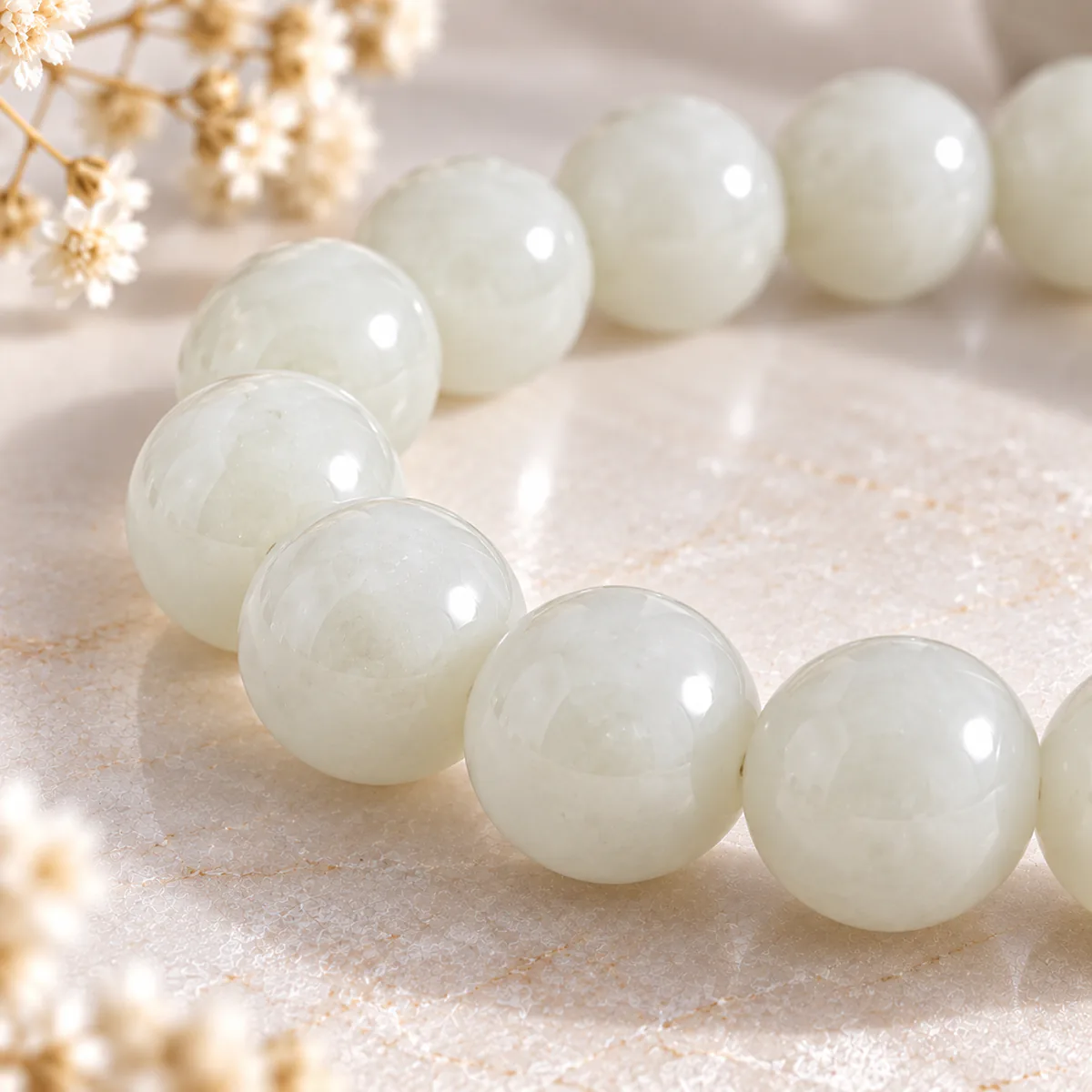
The white is not a chalk white. It pulls discreetly toward sea green, and it is not rigorously the same from one bead to the next: some are a little milkier, others grayer, and a few carry a barely visible cloud inside.

That is the opposite of a warning sign. What should give you pause on a strand is twenty rigorously identical beads: perfect regularity is what a dye bath produces, not what rock produces.

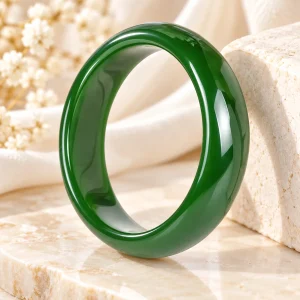
Luster is the other thing to look at, and it shows clearly in the second photograph. Nephrite returns a greasy, slightly soapy light, because it is made of interlocking fibers and not of grains. Marble returns a sugary, grainy light that catches in small points. That is not proof, it is a first sort, and it can be done with the naked eye. The checks that need no equipment at all.

Mutton Fat, the Name I Will Not Write

The finest white nephrites carry in China the name yangzhi yu, translated as mutton fat jade. It is a name of appearance and of quality, not a mineral name: it describes a dense white, very slightly creamy, with no visible structure.

There is no numerical threshold separating a mutton fat nephrite from any other, no laboratory certifies it, and that is exactly why it gets stuck onto anything white. So you will not find it in the title of this listing, nor in any other in this shop. A name that cannot be verified is worth no more than a promise.

Nephrite, and Why White Mattered Before Green

Nephrite is a calcium amphibole, one of the two minerals the word jade covers; the other is jadeite, a pyroxene. The two are entirely unrelated, and Alexis Damour established that in 1863. What sets them apart.

In imperial China the jade that was sought after was for a long time white, not green: the pale nephrite of the Khotan deposits, to the west, supplied court objects for nearly two thousand years. Jadeite’s brilliant green only arrives in the eighteenth century. White is not a discount jade, then, it is the original one. What jade has been in China.

The Strand, the Wrist Measurement and the Elastic

There is no clasp. A strand of beads with no clasp is strung on an elastic cord that does not show between the beads: that is what I will check on the example, like the rest. It goes on by stretching, so it is sized by wrist measurement, not by a chain length. How to measure it in two minutes.

Elastic is the most practical and the least durable way to string beads: it slackens, then it gives way, usually without warning. Put it on by rolling it over your hand rather than pulling on it, and take it off before sports and the shower. When it goes, a jeweler restrings it for a few euros and not one bead is lost.

A White Stone Gets Dirty, and It Shows

That is the practical difference between this strand and a dark green one: a pale bead shows everything. Creams, perfumes and skin oils leave a yellowish film that settles first around the drill hole, where the cord rubs, then spreads across the surface.

The routine is simple and it is enough: lukewarm water, mild soap, a soft cloth, fully dry before putting it back on. Perfume goes on before the bracelet, never over it. Never an ultrasonic cleaner, never steam, never solvents: since the treatment status is unknown, any resin there might be would not survive them, and ultrasound attacks the cord first. Nephrite’s hardness stays ordinary, 6 to 6.5, and it is the quartz in dust, which rates 7, that dulls beads over time. Hardness and toughness, and care in detail.
Additional information

StoneNéphrite
ColorWhite
Stone shapeRound beads
MotifNo motif
MountingElastic
MetalNone
SettingDrilled stone
Worn byUnisex
Paired stonesNone, jade only
Mineral familyCalcic amphibole
Hardness (Mohs)6 to 6.5
Reference density2.90 to 3.03 g/cm³
ToughnessExceptional, interlocking crystals
TreatmentNot determined
OriginOutside Burma, country of extraction not confirmed

What Tradition Attaches to White Jade

What follows changes register, and I flag it rather than blend it into the rest of the listing. None of it is proven. These are customs and beliefs, old and documented, that I report because they are part of this stone's history. No piece in this shop is sold as a remedy, and I claim no effect for this one.

A stone of moral virtue In Confucian thought, jade is associated with qualities of character rather than effects on the body. White held first place there: it is to white that the texts compare uprightness, before any other color.
White is not purity The Western reading of white as innocence does not hold in China, where white is the color of mourning and of the clothes worn to a funeral. The same piece of jewelry does not tell the same story there.
The jade of Khotan The pale nephrite of the Khotan rivers traveled the Silk Road up to the Chinese courts for nearly two thousand years. Imperial jade was white for far longer than it was green.
The left wrist The custom of wearing jade on the left is frequently reported, and tied to the idea of a side that receives. It is a custom, not a rule, and it has never stopped anyone putting it on the right.

These readings are told, not verified. Moral virtue in Confucius, the virtues attributed to jade, honestly stated, and what jade has been in China.

A stone does not replace a doctor and treats nothing: the full disclaimer is here.

Lead Times

Shipped within 48 hours of your order being confirmed, for delivery within 14 days from the day it ships. I keep no buffer stock, and I will not promise a date I cannot meet.

Shipping Costs

€6.99 no matter the destination, and free on orders of €47 or more to France, Belgium, Switzerland, and Luxembourg. The exact amount shows in your cart before you pay.

The Packaging, and Why It Matters

Every piece leaves in its own pouch, kept apart from the others. This is not about presentation: jade’s hardness is ordinary, 6 to 6.5 for nephrite and 6.5 to 7 for jadeite, and the quartz in everyday dust rates 7. Two pieces of jewelry that travel together arrive scratched.

Fourteen Days to Change Your Mind

No reason needed. One email opens a return, and there is no form to fill out. Return shipping is at your expense, unless the piece does not match its listing or arrives damaged.

Getting the size wrong is the leading cause of returns in this category, and jade cannot be resized the way a solid metal band can. Two minutes of measuring almost always prevents it. The size guide.

It is all spelled out here, with no fine print.

The Simple Routine

Lukewarm water, mild soap, a soft cloth. A very soft brush for the hollows of a carving. That is all, and it is enough.

What You Must Never Do, and Why

No ultrasonic cleaner, no steam, no solvent, no heat source. The reason is not caution for its own sake: the treatment status of my pieces is undetermined. My supplier cannot tell me, and the weighing establishes the mineral without saying anything about a possible resin impregnation. Resin withstands neither heat nor solvents, so every piece is handled as though it might contain some. The treatment information page.

The Scratch, and Where It Comes From

Jade is tough, meaning very hard to break: its structure of interlocking crystals resists cracking, and that is what made it possible to turn it into axes in the Neolithic. Its hardness, on the other hand, is ordinary, 6 to 6.5 for nephrite and 6.5 to 7 for jadeite. The quartz in everyday dust rates 7, and that is what dulls a jade, not impacts. The difference between the two.

Day to Day

Put the piece on after perfume and lotion, never before. Take it off for housework, gardening, and sports, where the hard knocks happen. Store each piece on its own, in its pouch. On a strand of beads, the thread wears out before the stone does: it gets restrung, and there is nothing abnormal about that.

Cleaning a jade piece and storing it.

What I Do, and What I Don’t

My name is Jade. I am French, from Morbihan in Brittany, and I live in Tallinn. I choose the pieces and have them set: I mine nothing, I carve nothing, and I do not do the metalwork myself. What I bring is the sorting, and with this material the sorting decides everything.

I am not a gemologist, a lapidary, or a therapist, and I do not claim to be.

I Weigh, I Do Not Certify

Before putting a reference online, I order one example of it for myself. When it reaches me unset, I weigh it in air, then suspended from a thread in a glass of water: the ratio of the two masses gives the density, and that figure separates jadeite, nephrite, serpentine, and dyed quartzite without ambiguity.

One example per reference, and not every piece. I never handle the piece that ships to you, and I would rather say so plainly than let anyone believe otherwise. The method, with its three limitations.

What I Cannot Know

The treatment status of my pieces. My supplier cannot tell me, and neither can the scale: it establishes the mineral, not the resin impregnation. Only laboratory infrared spectroscopy would settle the question, and I do not have that testing done. So you will never read “jadeite A”, “type A” or “untreated” on this site. The information page.

Where My Jade Comes From

No Burmese jadeite, and the first reason is legal. Not the one you read everywhere: the JADE Act of 2008 did ban these stones in the United States, but that ban was lifted on October 7, 2016. What applies today dates from April 8, 2021: the US Treasury sanctioned Myanma Gems Enterprise, the state-owned company that controls the Burmese gem trade. So there is no blanket ban, but an American is not allowed to do business with that entity, and a stone never tells you where it has been. I run one supply chain for ten markets, and it has to stand up to the strictest one. When an origin is not confirmed to me in writing, the listing does not state it. My origin policy.

The whole story.