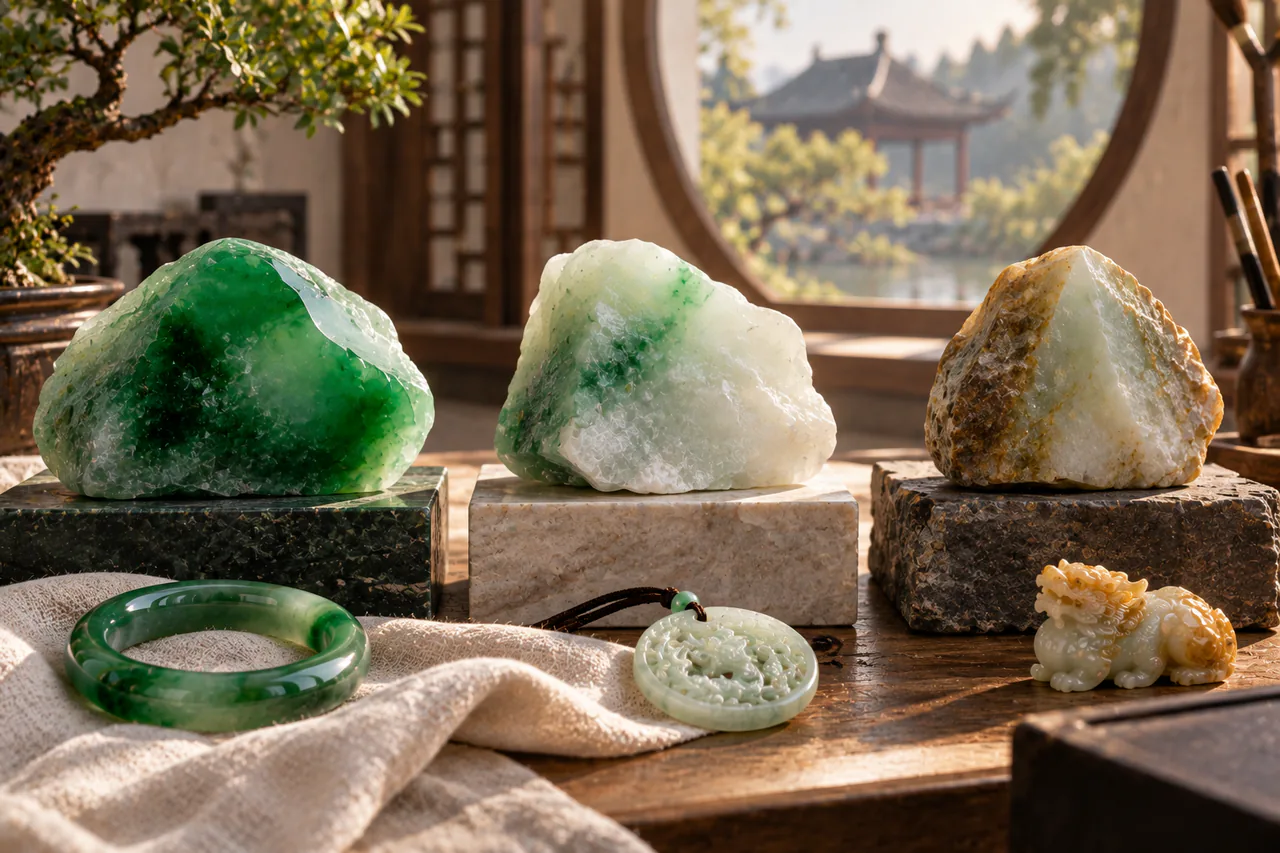
Jade A, B and C: The Only Classification That Exists
This page covers the A, B and C classification of jade from end to end: what each letter describes, how a jadeite is bleached and then impregnated with resin, what French law requires a seller to write, and why the A, AA, AAA scale borrows its first letter.
A, B and C do not rank the beauty of a jade but its treatment: A for a jadeite whose colour and structure have not been modified, B for a jadeite bleached with acid and then impregnated with resin, C for a dyed jadeite.
These three letters are a trade practise, not a published standard. Yet they have one solid quality: each refers to a process a laboratory can detect in the stone.
My name is Jade, and I run a jade jewellery workshop: I choose the pieces, have them set, and weigh one example of every piece before it goes on sale. I am neither a gemmologist, nor a lawyer, nor a therapist: I quote the texts rather than summarizing them from memory.
What A, B and C mean, and what they do not
The classification was born in the jadeite trade, and it answers only one question: what was done to this stone between the block and the display case.
- A: neither the colour nor the structure has been modified. Sawing, cutting, polishing, and the surface finish the trade accepts under this letter, which I come back to below.
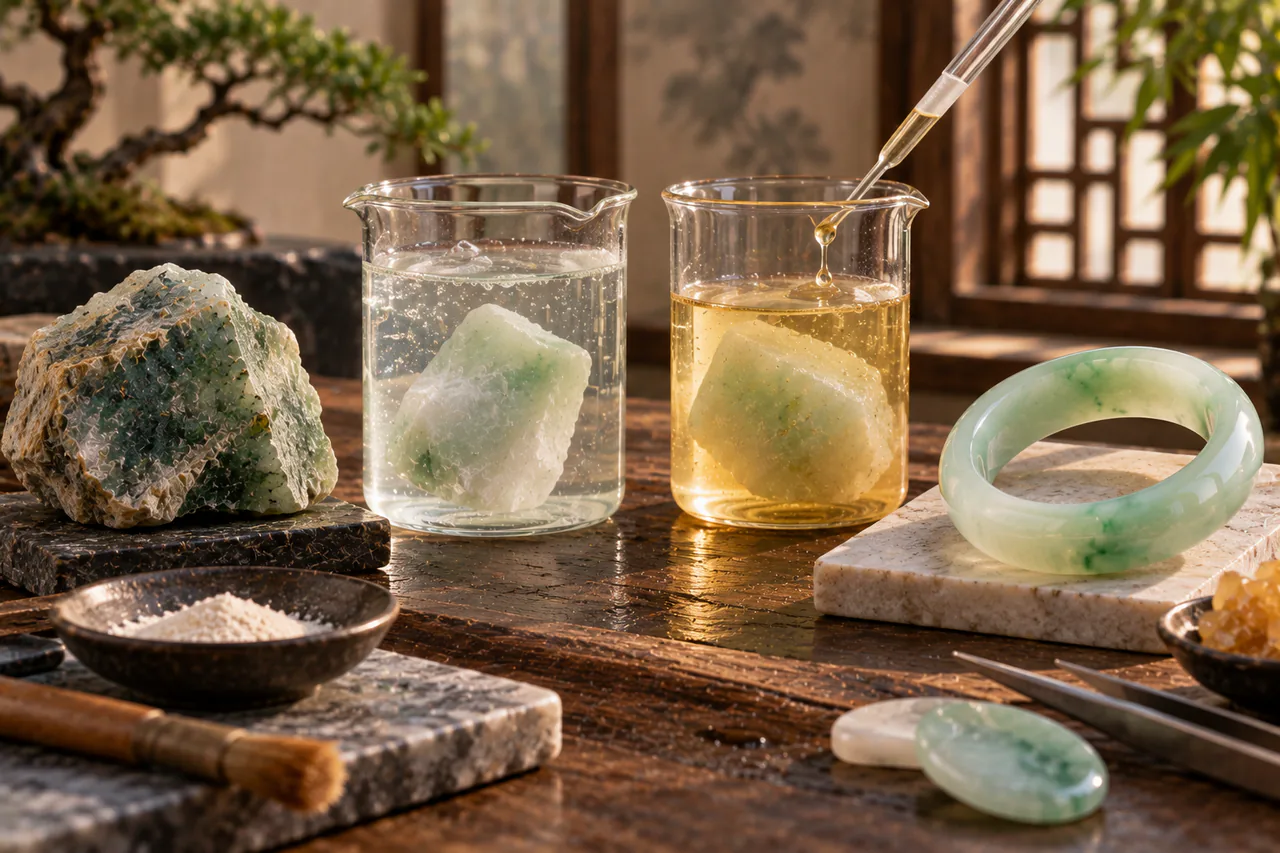
- B: the stone has been bleached in an acid bath, which dissolves brown inclusions, then impregnated with a resin that restores its cohesion and translucency.
- C: colour has been added. A dye penetrates the stone, most often after a B treatment has opened the way. When both are combined, a piece is called B + C, and that is the ordinary case for very green, very cheap jadeites.
Two things these letters do not say, and forgetting both is what makes the A, AA, AAA scale possible. They say nothing about quality: a grey, opaque, cracked A jadeite is still an A, and a B of an admirable green is still a B. And they say nothing about the mineral: they already assume you are dealing with jadeite, which is precisely the first point to establish, by density, on the weighing page. What really makes a piece valuable lies elsewhere: the six criteria.
The letter A never meant that nothing was done
The trade accepts under this letter a traditional wax finish, applied to the surface during polishing: it does not fill the stone, it closes its grain. You may find the convention generous or reasonable, but it exists, and it is one more reason not to read A as a synonym for untouched.
The three letters were made for jadeite
I do not use them for anything else. Nephrite is another mineral, a fibrous amphibole where jadeite is a granular pyroxene, and its felted structure does not lend itself well to the acid bleaching that defines B. That does not make it safe: it can be dyed and waxed like any other stone, and French law does not need the letter C to catch a dye. At bottom, the two minerals under one word leave the buyer in the same position.
How a jadeite becomes a B
Rough jadeite of average quality carries brown spots, iron oxides left by weathering, and a grayish background that eats into its translucency. These flaws are visible, and they bring the price down. B treatment removes them, at the expense of the stone itself.
The principle comes down to two steps that answer each other. The acid bath dissolves the impurities, but not only them: it also attacks the boundaries between the grains, and the stone comes out bleached and weakened, more porous than before. A transparent resin is then injected, under pressure or under vacuum, to fill those voids. The stone regains cohesion, gains a translucency it did not have, and leaves the bath more saleable than it went in.
What the trade reports about what happens next, and what I have not measured myself: the resin ages, yellows in light and shrinks. Above all, it rules out two cleaning habits that have become commonplace, ultrasonic cleaners and steam, whose cavitation and thermal shock attack the binder before they attack the stone. That is why I clean everything with lukewarm water and neutral soap, including pieces whose status I do not know, which is the case for all of them.
The only test that settles it is laboratory infrared spectroscopy: resin leaves a signature there that the stone does not have. No over-the-counter test replaces it, and a scale least of all, for a common-sense reason: the resin fills voids that were already there, and the density does not shift enough to leave the jadeite range.
C, the added colour
Dyeing is the oldest and simplest treatment: a colorant, heat, time. On a jadeite that has already been bleached, it penetrates deeply, and that is why B and C so often go together.
An added colour gives itself away over the years rather than on the day of purchase: it fades in light, it can migrate on contact with a solvent, and it concentrates in micro-fractures instead of spreading through the mass. A green that follows the cracks instead of ignoring them is a warning sign, shade by shade in dyed jade; bright pink and clear blue, for their part, are almost always something other than jade: pink, blue and red jade stone.
One confusion is worth clearing up here, because it empties the word jade of meaning in both cases, but not in the same way. A C jadeite is jade whose colour has been changed. “Malaysia jade” is dyed quartzite, meaning another mineral bearing a name that does not belong to it: stones sold as jade.
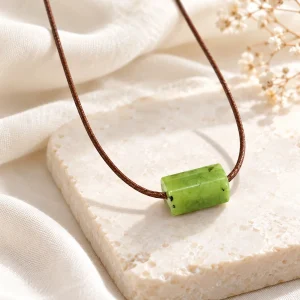
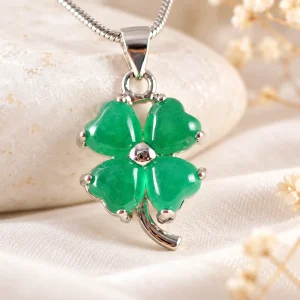
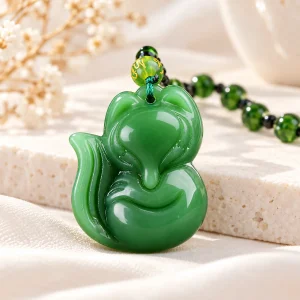
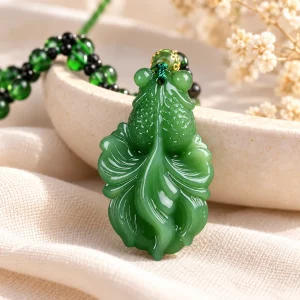
Pendants whose mineral and measurement I publish
What the French decree requires sellers to state
The text is French Decree No. 2002-65 of 14 January 2002, on the trade in gemstones and pearls. It mentions neither jade, jadeite nor nephrite, and contains no positive list of gem names: its general rules apply here, as they do to any other stone within its scope. A full tour of the text is in jade and the 2002 decree.
Three articles deal with treatment, and they have to be read together.
- Article 2 requires the name to be completed with the word “treated”, or with an indication of the treatment undergone, for irradiation, laser, dye, surface diffusion, filling, and any other laboratory method that modifies appearance, colour or clarity.
- Article 3 exempts three traditional lapidary practices from this obligation: impregnation with a colorless fluid substance, heat treatment under certain conditions, and bleaching without the addition of coloring products.
- Article 10 requires the treatment information sheet, made available before the sale and handed over with the invoice. It exists here: the treatment information sheet.
Article 2 settles the case of C beyond discussion: dyeing uses a colorant, colorants are named in the list, and the name must say so. The case of A does not arise. That leaves B, and that is the point I did not want to sidestep.
Does B jadeite escape the disclosure requirement?
The question deserves to be asked out loud, because the wording of Article 3 comes disturbingly close: a B jadeite is bleached, and bleaching is exempt; it is impregnated with a colorless substance, and impregnation is exempt. Taken separately, both steps seem to fall within the exception.
My reading, which is not a court’s, is that it does not: B treatment does not fit within Article 3, for three reasons that do not depend on one another.
- The exemption covers a colorless fluid substance. A resin is fluid when it is injected and solid afterwards, and that is its whole purpose, since it holds together a stone the acid has loosened. The traditional practise the article describes is that of oil and wax, which stay fluid and can leave the stone. A cured resin never leaves it.
- Article 2 names filling among the treatments to be disclosed. Filling voids opened by an acid with resin is exactly that, under another word.
- Article 2 ends with a general clause: any other laboratory method that modifies appearance, colour or clarity. B treatment modifies appearance and clarity, and that is its commercial reason for being. A process cannot be sold for what it changes and presented as changing nothing.
There is a serious objection, and I give it because it is the strong point of the other side: Article 3 sets no limit on the extent of bleaching or impregnation, and a text that did not foresee resin does not explicitly forbid placing it there. Settling the matter would require a court ruling or a published position from the authorities, neither of which I have found.
The most useful point lies elsewhere, and it is what allowed me to close this question: the answer changes nothing about what a seller must do. Article 10 has a second part, quoted less often than the first: for stones that fall precisely under Article 3, a notice must inform the buyer, at the point of sale as in an online offer, that these traditional practices may have been applied. A B jadeite must therefore be disclosed in the name if it falls under Article 2, and announced by a notice if it falls under Article 3. In both branches, silence is the only position the text does not provide for. It was the position held by the pages I opened.
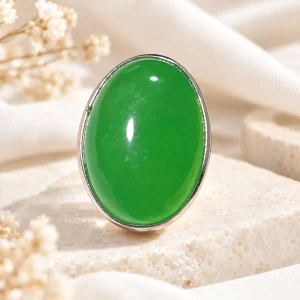
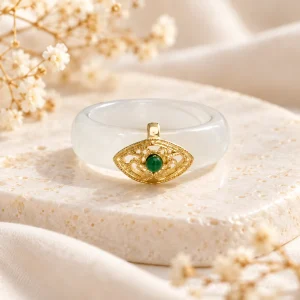
Jade rings, chosen one by one
The A, AA, AAA scale, and the letter it borrows
On the French pages I opened for this subject on 8 September 2026, the A, AA, AAA scale came up five times, applied to beads, bracelets and massage rollers.
I found no organization that publishes this scale, and no grading system that defines it, and two neighboring sellers do not put the same stones behind the same letters. It is a commercial assessment, which remains lawful as long as it is presented as such, and it was not presented that way in any of the five uses I recorded.
So what bothers me is not the vagueness, it is the borrowing. By taking the letter A as its starting point, this scale plants in the buyer’s mind a word that already exists and means something else. “AAA jade” sounds like a superior A jade, when it says nothing about the stone’s treatment: a bleached, impregnated and dyed jadeite can be sold as AAA without the letter lying in the strict sense, since it promises nothing.
The same mechanism is at work with “imperial jade”, which refers to a quality of colour and translucency and which retail readily turns into a label: what the term really means. The reference texts of gemmology, for their part, know neither AA nor AAA: how jade is named.
What I cannot determine about my pieces
I do not know the treatment status of my pieces. Neither does my supplier: I asked on 8 September 2026, and the answer was that it cannot say whether its stock has been bleached, impregnated or dyed. That is not evasion, it is the ordinary state of a market where the stone passes through several hands between the mine and the workshop.
What I can establish is the mineral. Hydrostatic weighing of one example of every piece separates jadeite, between 3.25 and 3.36, nephrite, between 2.90 and 3.03, serpentine around 2.6 and quartzite around 2.65. The measurement, its date and the mineral it concludes are published: what I publish on each product page. That same measurement says nothing about treatment, and its three limits are written on the weighing page.
The consequence is a writing rule I impose on myself, rather than a stylistic precaution: I never write “A jadeite”, “type A” or “untreated” on a product page in this shop, and I do not imply it through a well-placed silence. The word “genuine” stays, and it covers only one thing: real jade rather than serpentine or dyed quartzite, which the scale establishes. It says nothing about resin. On origin, see where my jade comes from.
What this changes when you buy
Three questions to ask, in this order, and it is the vague answers that tell you the most.
- What is the mineral, and what does the seller base that on? Jadeite, nephrite, or something else. A measurement is worth more than an assertion, and the absence of both is an answer in itself.
- Is the treatment status known, and how? A seller who answers A without naming a laboratory is answering with a letter, not a test. A seller who says they do not know tells you more.
- Is the price consistent with the answer? A vivid green, translucent, inexpensive jadeite has rarely gone through life without acid: what makes a hundredfold gap.
One habit then applies to any piece whose status is unknown, which means mine as well as yours: nothing that could attack a binder, no ultrasonic cleaner, no steam, no prolonged soak in a solvent. What you can check at home, and what proves nothing, is in how to recognise genuine jade stone; where to buy, in buying jade jewellery.
The questions I get asked
Is type B jade fake jade?
No. A B jadeite is jadeite: the mineral is real, only its cohesion and appearance have been reworked in a laboratory. Fake jade is serpentine or dyed quartzite sold under the name jade, which is a different problem and a different stone.
How can I tell whether my bracelet is A, B or C?
Through laboratory infrared spectroscopy, and nothing else reliable. The resin from a B treatment cannot be seen with the eye, a loupe or a scale. Some clues draw attention, a colour that follows the cracks, a very vivid green at a very low price, an overly regular look, but a clue is not proof.
Does the weighing you publish prove the stone is untreated?
No, and this matters. It establishes the mineral, jadeite or nephrite rather than serpentine or quartzite. Resin fills voids that were already there and does not shift the density enough to show up: the protocol and its limits.
What does “AAA jade” mean?
Nothing verifiable. I found no published grading system behind this scale: it is the seller’s own assessment, borrowing its letter from the treatment classification. It tells you neither the mineral, nor the treatment, nor quality in the sense a gemmologist means it.
Is a seller required to tell me about treatment?
French Decree No. 2002-65 requires the name to be completed when the stone has undergone a treatment listed in its Article 2, and an information sheet to be made available before the sale. For the traditional practices in its Article 3, a notice must state that they may have been applied. No branch of the text provides for silence.
Can treated jade still make beautiful jewellery?
Yes, and saying so is not a concession. The problem with a B jadeite is not its appearance, which is often superb, but that it ages badly, tolerates ordinary care poorly, and sells at the price of an unmodified stone without the buyer knowing.
Where I checked
What comes from a named source. Articles 2, 3 and 10 of French Decree No. 2002-65 of 14 January 2002, on the trade in gemstones and pearls, whose text I reread on 9 September 2026. The second part of Article 10, the notice that applies to the practices in Article 3, had escaped me until that rereading, and it is what allowed me not to leave the question of B unresolved. The decree provides for no penalty: enforcement goes through the French Consumer Code, Article L.441-1 for deception and Article L.454-1 for the sentence. The density ranges are those of the mineralogical literature, whose limits vary by a few hundredths from one database to another: I repeat them without attributing them to any particular organization, since I did not take them from a single one.
What is a market observation, with a date. On 8 September 2026, I opened the top-ranking French pages in this field. I recorded five uses of the A, AA, AAA scale, including a product title combining “AA quality” with the word genuine. Only one of these pages mentioned the real A, B and C classification, and none published the Article 10 information sheet. I report wording, I name no site and I give no legal characterization of anyone’s practise: I measure, I do not certify, and that applies to the neighbors too. The same day, my supplier confirmed that it does not know the treatment status of its stock.
What is my own reasoning. The reading that excludes B jadeite from the Article 3 exemption is mine: it rests on the word “fluid”, on the presence of filling in Article 2 and on its general clause, and I give the opposing objection rather than keep it quiet. The aging of resin, its yellowing and shrinking are what the trade reports, and I have not measured them. The rule of never writing a classification letter on my own product pages is a decision, not an established fact. If you find a mistake here, write to me: I will correct it and note that I did.
In one sentence
A, B and C describe what was done to a jadeite and nothing else, the A, AA, AAA scale borrows one of their letters to describe nothing at all, and the only honest thing I can write about my pieces is the mineral I weighed, together with what my scale does not tell: the treatment sheet, and the shop.