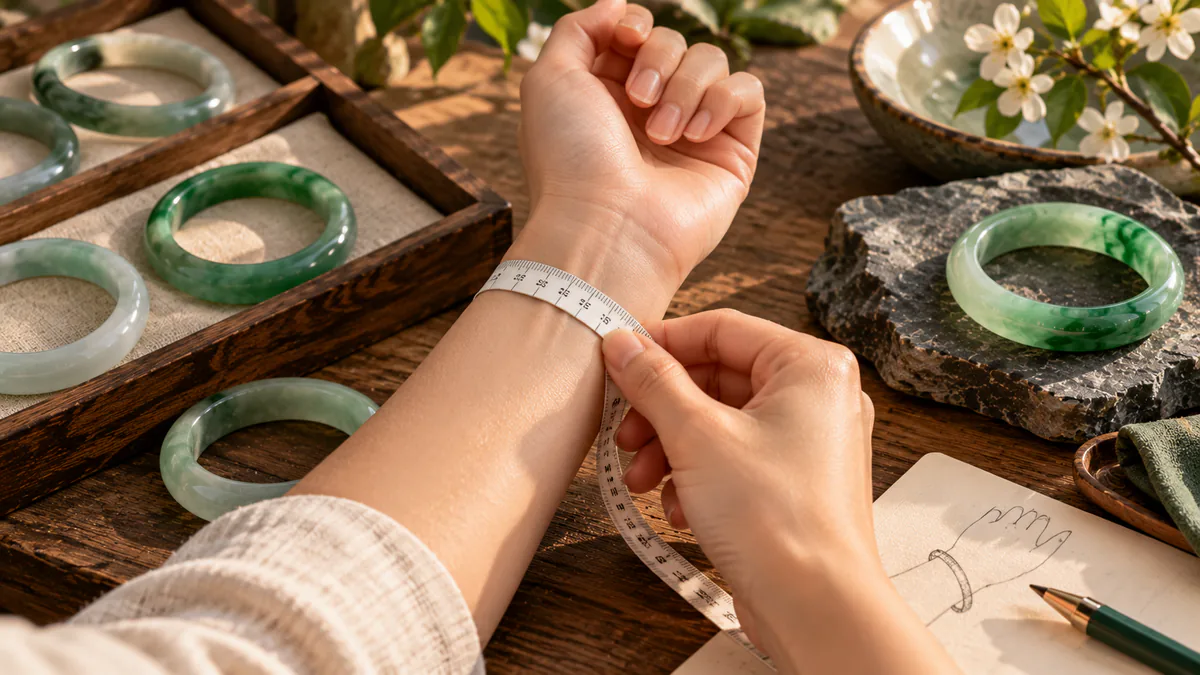
Measuring Your Hand Before Buying a Jade Bangle
This page explains how to work out your jade bangle size: how to measure your wrist and, above all, your hand before ordering, where the measurement that really decides is taken, what to take it with, how to get it from someone else, and why this format gets the size wrong more often than the others.
A bangle is not sized by wrist circumference but by inner diameter, and what that diameter has to let through is not the wrist: it is the hand folded into a cone, at the level of the thumb joint.
| What you measure | What it decides |
|---|---|
| Wrist circumference | nothing, for a bangle |
| Circumference of the hand folded into a cone, at the thumb joint | whether the bangle goes on or not |
| The bangle’s inner diameter | what you order |
Two people with the same wrist can need two different bangles, and the middle row explains why.
My name is Jade, I run a jade jewellery workshop: I choose the pieces, have them set, and weigh one sample of each reference before it goes on sale. I am neither a gemmologist nor a therapist: here, mineralogy is stated as fact, and the rest is attributed.
Why bangle sizing goes wrong so often
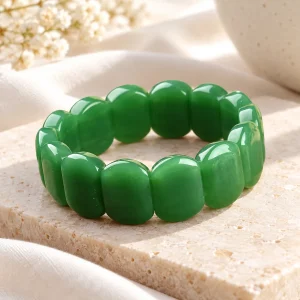
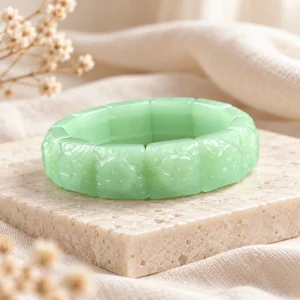
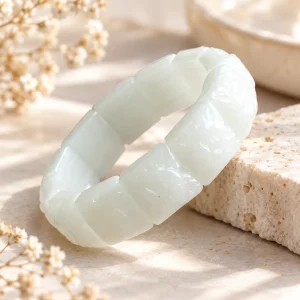
A bangle is a closed ring, carved from a single block. No clasp, no hinge, no thread: nothing opens and nothing can be restrung. A strand of beads that is too long goes back to a jeweller who removes two beads and reties the knots; a bangle that is too small goes nowhere. It is the only format in my catalogue that cannot be adjusted.
This one-piece shape exists because the material allows it. Jade is moderately hard and exceptionally tough, hardness being resistance to scratching and toughness resistance to breaking: it is the latter that makes a whole ring possible, and the confusion between the two shows on most of the pages I opened (why jade almost never breaks).
The purchase itself comes down to a single line of measurement, and that line is almost always chosen badly: people measure their wrist because that is what you do for a bracelet, when the wrist decides nothing here. Size conversions format by format live in the size guide; this page covers the bangle only.
The cone-shaped hand, and getting past the joint
To slip on a bangle, the hand folds in on itself. The thumb tucks into the palm, the four fingers press together and stretch out, and the hand takes the shape of a cone whose tip is the fingertips. The ring slides down this cone until it goes over, or gets stuck.
It gets stuck at one precise spot: the thumb joint, at its base, where the metacarpal meets the palm. On most hands, that is the widest point of the passage, wider than the knuckles and wider than the wrist. Everything happens there.
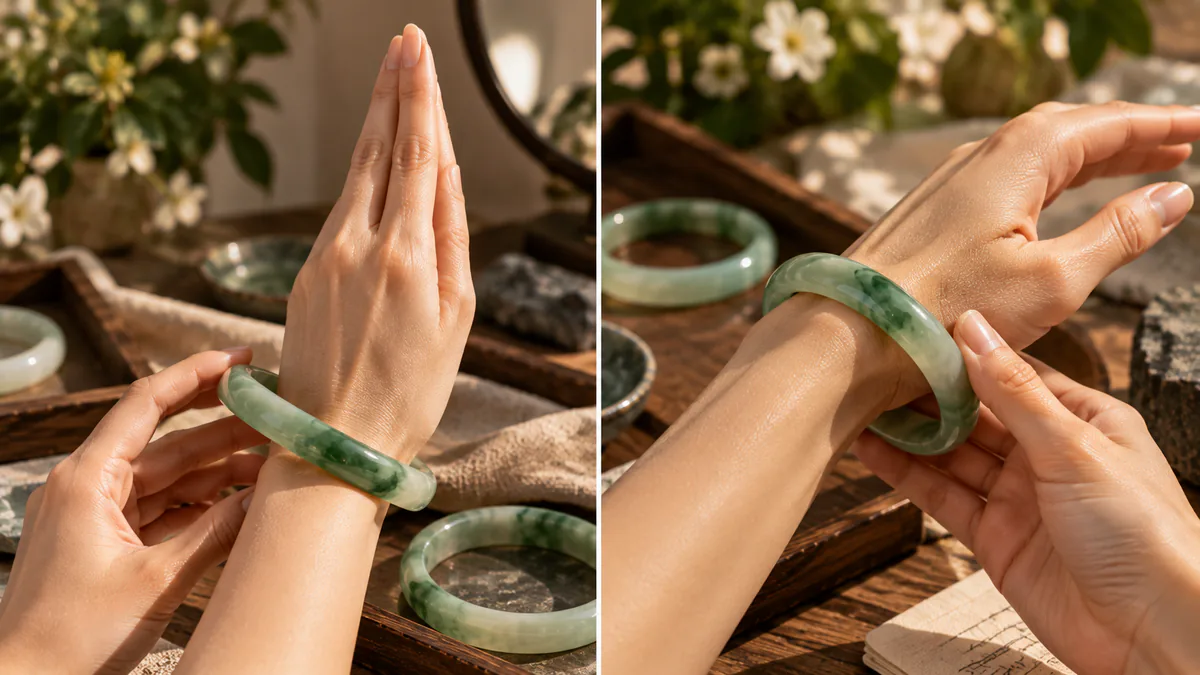
Two practical consequences. A slender wrist does not mean a small bangle: someone with a delicate wrist but a thick thumb joint will need a larger ring than someone with a sturdier wrist. And flexibility matters as much as bone, so a hand that folds poorly, because of stiffness or a damaged joint, narrows the choice accordingly. For that person, a bangle may not be the right format, and it is better to know that before than after.
Too tight, too loose: both ways of getting it wrong
People instinctively reason as if the only risk were a bangle that is too small. Both directions cost you, and not in the same way.
- Too tight. The ring goes over the hand once, with soap, and never comes back over. Hands swell: from heat, from salt, from effort, at the end of the day, over the years. A bangle that will not come off has to be cut, and cutting it means losing the piece.
- Too loose. It slides down to the base of the hand, spins, and knocks against door handles, table corners and the sink. Jade’s toughness absorbs a lot, but an angled blow on an edge remains the risk that matters: what breaks a jade bracelet.
In between, the comfortable margin lets the bangle slide along the forearm when you raise your arm, without being able to come back over the hand unless you work at it. If your measurement falls between two available diameters, I take the larger one: some play is bearable, getting stuck is not.
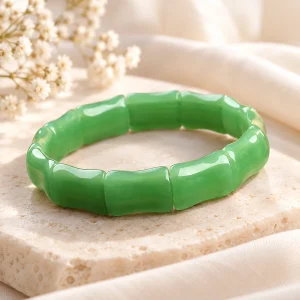
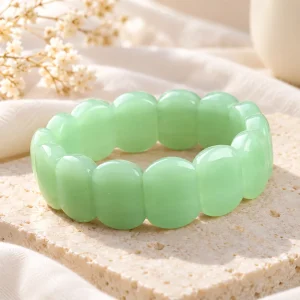
Bangles and bracelets whose density I publish
Tape, string, ruler
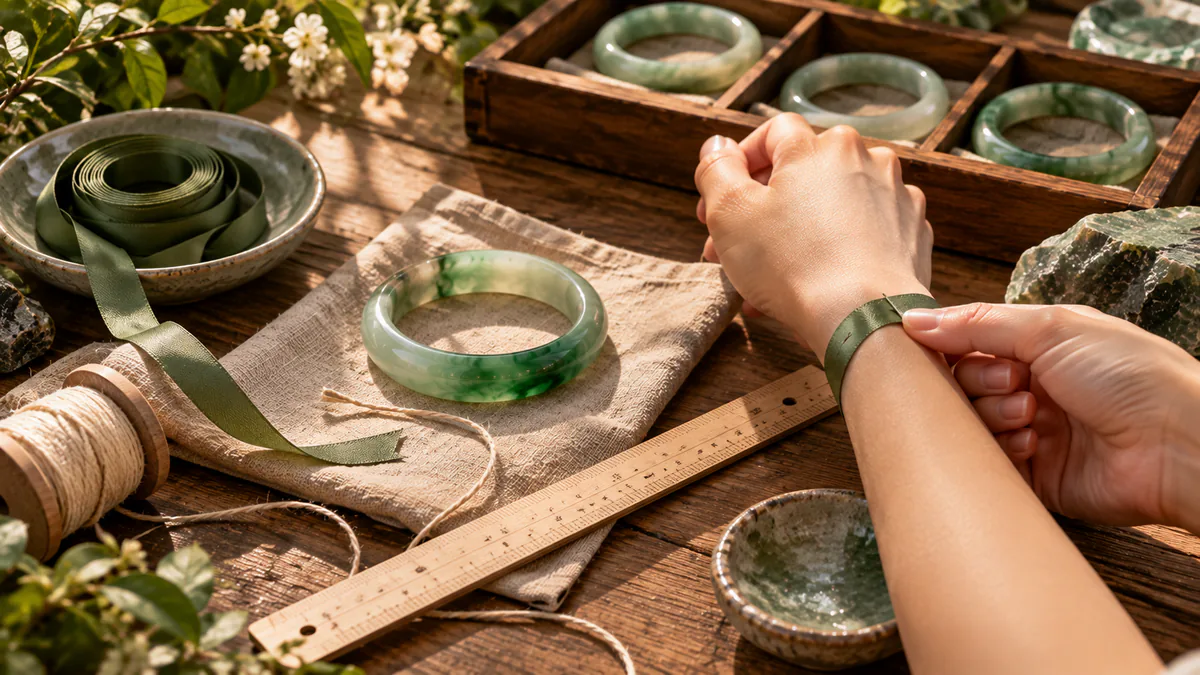
The equipment fits in a drawer. A soft, non-stretch sewing tape measure is enough. Failing that, a thin piece of string or a strip of paper cut straight, and a rigid ruler.
- Fold your hand into a cone, thumb first.
- Wrap the tape around the hand at its widest point, over the thumb joint.
- Pull it as snug as a bangle would sit, without squeezing the flesh.
- Mark the crossing point with a pen rather than holding it between two fingernails: your finger moves as you remove the tape, the mark does not.
- Lay the string flat along the ruler and read off the length.
What you get is a circumference, not a diameter. Bangles are listed by inner diameter, and you go from one to the other by dividing the circumference by π. If a listing gives an in-house size number without saying what diameter it corresponds to, there is nothing to be done with it: that is a question to ask the seller before buying.
Two precautions. Measure twice, at two times of day, on waking and in the evening: the difference is real, and it is the larger of the two values that decides. And measure bare skin, never over a sleeve or a watch strap.
If you already own a bangle that fits, measuring is even simpler: lay it flat and read the inside distance from edge to edge through the centre. That is the inner diameter directly, and it is the most reliable reference you have, since it has already proven itself on that hand.
Measuring someone else’s hand without telling them
This is the most common situation, and the most awkward. Three ways around it, from the most reliable to the roughest.
- Borrow a bangle the person already wears and measure it as above. It is the method least likely to go wrong.
- Have someone in the household take the measurement, under a pretext other than yours. A hand folded while talking about something else measures perfectly well.
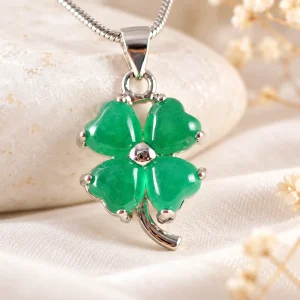
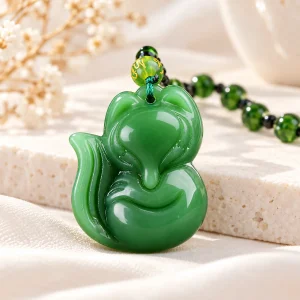
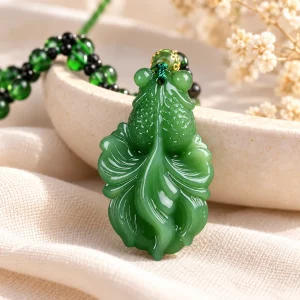
- Give up on measuring and change format. A pendant on a cord and a pair of earrings have no size at all: the full table of formats is in giving jade jewellery as a gift.
What I advise against is deducing a diameter from a photo, a ring or a clothing size. None of the three tells you anything about the thumb joint.
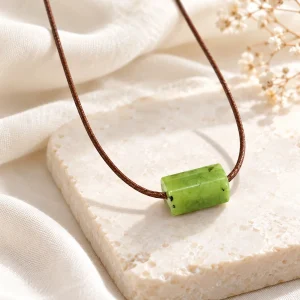
Pendants, when measuring is impossible
Putting on and taking off a bangle without forcing it
A well-measured bangle does not slip on by itself, and that is normal: it should go on with a little effort, and come back off just as well the day you want to remove it. What helps is lubrication and patience, never force. Cool water and a little mild soap on the folded hand reduce friction; a thin plastic bag pulled over the hand before the ring slides even better. Do it over a bed or a towel, because a bangle that slips onto a tiled floor falls from a height.
Removing it follows the reverse path: hand held up for a moment, soap, a slow movement turning the ring rather than pulling straight. If the ring stays stuck and the hand is getting marked, stop and ask for help: it is the only situation where you find yourself choosing between the piece and your hand, and I know no one who hesitates.
The bangle you never take off
What follows changes register, and I flag it rather than blending it into the rest. Nothing in it is proven: it is what traditions have attributed to this stone.
In Chinese tradition, a jade bangle is said to be worn without ever leaving the arm, and many buyers come with that intention. The same stories credit the ring with breaking in place of the person wearing it: that is a reported belief, not a fact, and it has its own article, what a jade bracelet is supposed to mean.
I mention it here because it changes the measurement, which is very concrete. A piece meant never to come off must still fit in ten years, on a hand that will have changed, and no one can promise that, me included. If that is your plan, go with the evening measurement rather than the morning one.
The millimetres I do not write yet
You will notice that this page does not contain a single size figure. It is not an oversight, and I would rather say so than leave you guessing.
I only publish a dimension after having had the piece in hand. Not all my samples have arrived, and a conversion table between a hand circumference and an inner diameter, copied from elsewhere, would be exactly the kind of plausible value that later gets a piece sent back. So the box stays empty until the measurement, here as in the size guide.
What I look at before the size
A size mistake is hard to fix; a material mistake cannot be fixed at all. So before measuring anything, I look at what the piece is made of: the word jade covers two unrelated minerals, jadeite and nephrite, and much of what is sold under that name is neither (jade stone, stones sold as jade).
That is what my scale settles: a stone weighed in air, then suspended in a glass of water, gives its density, and I publish the number for the sample ordered before the reference goes on sale (the weighing page). What it does not tell you is treatment: a jadeite bleached and then impregnated with resin weighs about the same as any other, my supplier does not know the status of their stock, and only infrared spectroscopy in a laboratory would settle it (jade A, B and C, the treatment information sheet).
This has a direct consequence for a bangle, which is why I bring it up on a sizing page: as long as the treatment is undetermined, the piece is handled as if it were impregnated, so no thermal shock, no steam and no ultrasonic cleaning. The soapy water that helps it on stays cool.
The questions I get asked
Should you measure the wrist or the hand for a jade bangle?
The hand. The wrist decides nothing for this format: the ring does not stop there, it first has to get past the hand folded into a cone, whose widest point is the thumb joint. Wrist circumference is only useful for bracelets that open or that slip on because they are flexible.
How can you find out someone’s size without asking them?
The safest way is to borrow a bangle they already wear and measure its inner diameter with a ruler, laid flat, from edge to edge through the centre. Failing that, have someone close to them take the measurement. Otherwise, choose a format without a size, a pendant or earrings.
Should a bangle be snug or have some play?
Neither entirely. It should slide freely along the forearm when the arm is raised, and not be able to come back over the hand without the cone movement, soap and patience. If it comes off on its own, it is too big; if it will not come off at all, it is too small.
What if the bangle I receive is too small?
Nothing on a ring carved from a block can be enlarged: no heating, no stretching, no adjustment at a jeweller’s. If the piece has not been worn, it can be returned or given to someone else. The terms are on the delivery and returns page.
My measurement falls between two diameters; which should I choose?
The larger one. A slightly loose bangle spins and knocks, which you can manage by wearing it on the arm you use less; a slightly tight bangle cannot be corrected, and it becomes a problem the day your hand swells.
Can you wear a jade bangle all the time?
Many people do, and the material handles it better than most stones. Two caveats: the size has to stay right over the years, which no one can guarantee, and knocks from housework, sports or carrying things damage a piece far more surely than constant wear.
Where I checked
What comes from a named source. Very little, which is normal for a method page. The only outside information I use is the distinction between hardness and toughness, which comes from the mineralogical literature and which I develop in another article rather than copying the figures here. I found no public standard setting bangle diameters, and French Decree No. 2002-65, which regulates the gemstone trade, says nothing about jewellery sizes. I note this rather than letting you believe an official scale exists.
What is a market observation, dated. On 8 September 2026, while preparing this site, I noted that a bangle’s inner diameter was the leading reason for returns reported for this format. That is a preparation observation, not a statistic of my own: I do not yet have enough orders behind me to confirm it with my own figures, and I will rewrite it the day I do.
What is my own reasoning. The order of the two cone movements, the rule of keeping the larger of the two measurements, the advice to take the larger diameter when in doubt, the idea that a hand that folds poorly rules out the format, and the refusal to publish a conversion table before my samples arrive: these are decisions drawn from the shape of the object, not established facts. If your experience contradicts any of these points, write to me: I will correct it and note the correction.
In one sentence
A jade bangle is ordered on a measurement taken from the hand folded into a cone, at the thumb joint, and never from the wrist, because it is the only format in my catalogue that cannot be fixed once received. The method format by format is in the size guide, and the pieces are among the bracelets and in the shop.