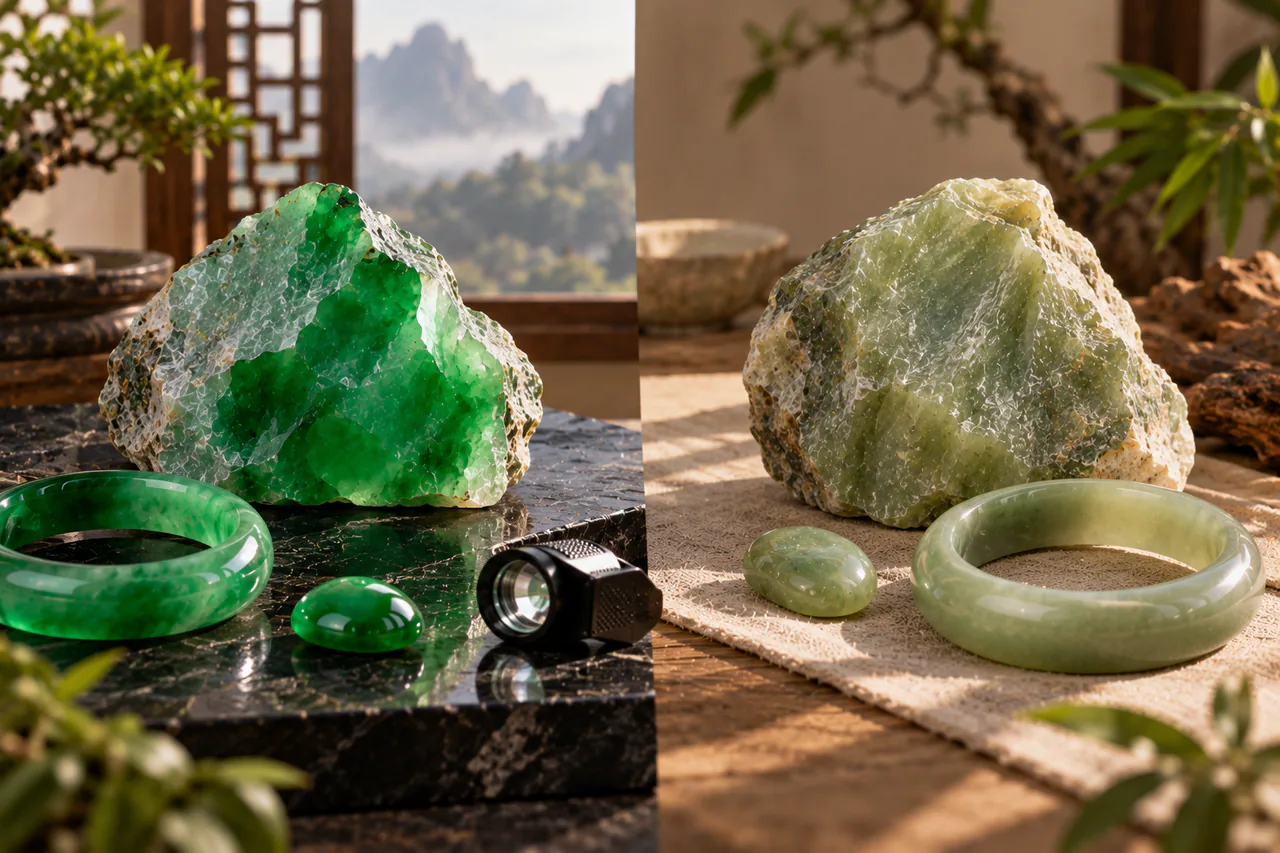
Jadeite or Nephrite: Two Unrelated Minerals
This page puts jadeite vs nephrite side by side, the two stones the word jade covers: their mineral family, what separates them on a scale, what the eye can tell and what it cannot settle, the history of each, and what choosing one or the other changes on a piece of jewellery you wear.
Jadeite and nephrite are not two grades of the same stone: they are two mineral species from different families, a pyroxene and an amphibole, and their densities do not overlap.
| Mineral | Family | Density |
|---|---|---|
| Jadeite | Sodium-aluminum pyroxene | 3.25 to 3.36 |
| Nephrite | Amphibole of the tremolite-actinolite series | 2.90 to 3.03 |
Both are rightfully called jade, and that is the problem: the name is a trade category, not a species.
My name is Jade, and I run a jade jewellery workshop: I choose the pieces, have them set, and weigh one example of every piece before it goes on sale. I am neither a gemmologist nor a therapist: here the mineralogy is stated as fact, and everything else is attributed to someone.
A Frenchman told them apart in 1863
Before that date, jade meant a green stone that was hard and difficult to break, and nobody asked whether Chinese discs, European axes and Mesoamerican ornaments came from the same material. They did not.
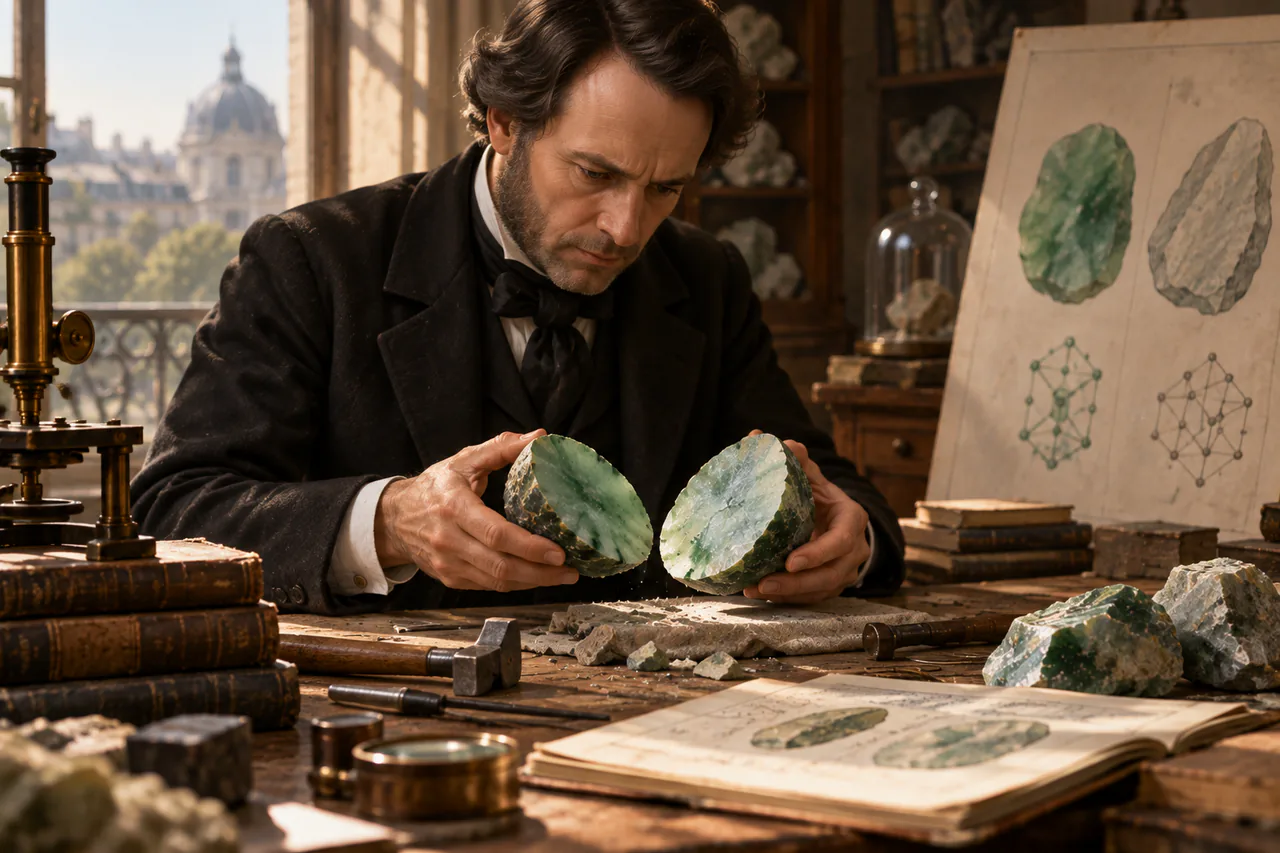
In 1863, the mineralogist Alexis Damour (1808-1902) analyzed green jades brought back from the looting of the Summer Palace in Beijing in 1860, and showed that two chemical compositions were hiding under the same word. He coined the name jadeite for the one that had no name. His note appeared in the Comptes rendus hebdomadaires of the French Academy of Sciences, volume 56; I do not give page numbers, as I have not read it.
Two years later, he applied the same analysis to the polished axes of Celtic monuments and found jadeite in them. The 1863 split was made in the laboratory, not by eye, and that is why it has held: the full guide to the stone.
A pyroxene and an amphibole
Jadeite is a sodium-aluminum pyroxene with the formula NaAlSi2O6: sodium, aluminum, silicon, and single chains of silica tetrahedra.
Nephrite is a calcium amphibole of the tremolite-actinolite series: calcium, magnesium, iron, double chains, and hydroxyl groups, meaning water bound into the structure. Jadeite contains none.
So these are not two shades of the same thing: two crystal architectures, two chemistries, two sets of formation conditions, and the difference in density follows from that (how jade stone forms). Nomenclatures also accept two more names on the pyroxene side, omphacite and kosmochlor, which the trade does not count: how jade is named.
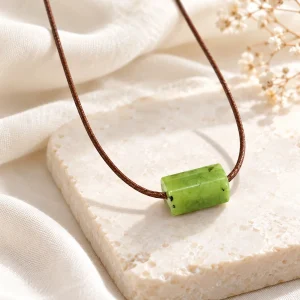
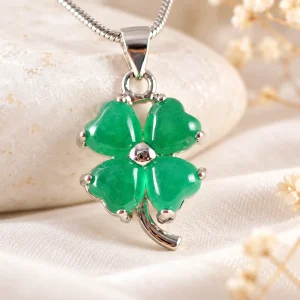
Jade pendants available now
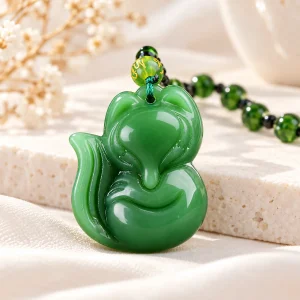
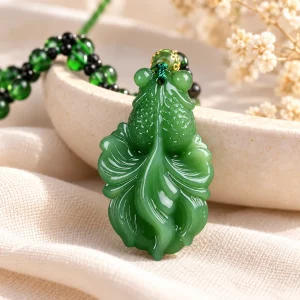
The grain of one, the felt of the other
The difference in structure shows in the material. Jadeite is granular: fine interlocking grains, a fracture surface that catches the light, and a translucency that can go far, to the point of showing the shape of a finger behind a thin slab.
Nephrite is fibrous: microscopic fibers tangled together like felt. That felted structure gives it its slightly greasy luster, closer to wax than to glass, and a fracture that frays instead of breaking cleanly.
On the examples I have weighed since September 2026, the look of the polish under raking light reads better than colour: silky on nephrites, crisper on jadeites. That is an observation, not a test: a very careful polish erases the clue.
The only difference I can measure at home
The two ranges in the table do not overlap, and the gap between them is what makes the measurement usable: between 3.03 and 3.25, neither mineral falls. A scale, a thread and a glass of water are enough to know which side of the gap you are on, and the protocol is published.
The same step also rules out what is neither one: serpentine sits around 2.6 and dyed quartzite around 2.65, both well below nephrite (stones sold as jade, how to tell if jade is real).
Three limits, which I prefer to write down. I weigh one example per piece, the one I order before the piece goes on sale, never the item that ships to you. The measurement applies to the bare stone: a setting or a cord goes onto the scale and skews it. And it tells you the mineral, not the treatment: a resin-impregnated jadeite weighs about the same as any other, only infrared spectroscopy would settle it, and my supplier does not know that status either. See jade A, B, C and the treatment information sheet.
What colour tells you, and what it cannot settle
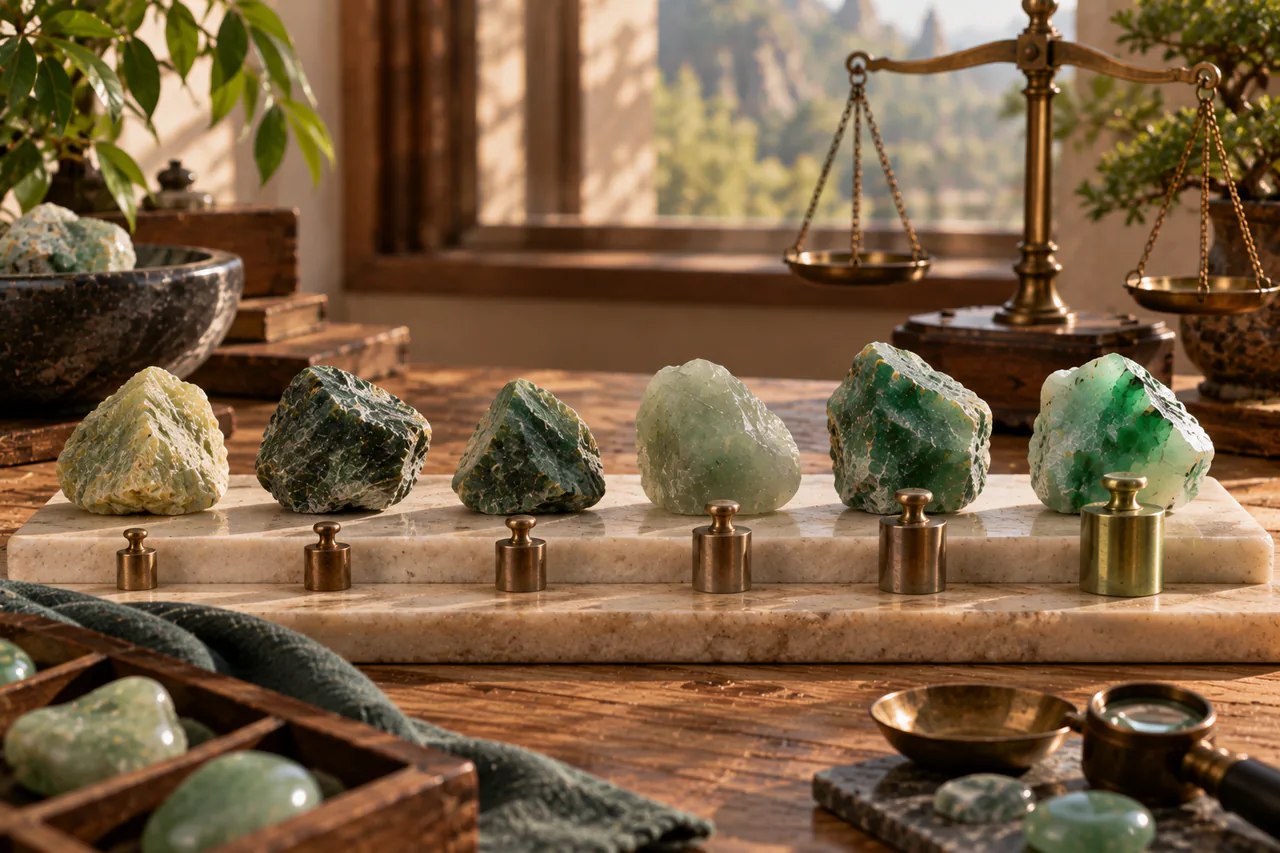
Both come in green, white, black and yellow: sorting by colour does not work. The chemistry behind the green is not the same, though: in jadeite, bright vivid green comes from chromium and the more common green from iron; in nephrite, iron alone gives the so-called spinach green. The details are in green jade stone and jade stone colours.
Two clues do lean one way. Lavender is found on the jadeite side. The white known as mutton fat, highly prized in China, is a nephrite: white jade stone.
Translucency is the marker people use most often, and it misleads: jadeite goes further toward transparency, but there are opaque jadeites and nephrites that let light through. By eye, you get a presumption, and it takes a number to turn it into an answer.
Each has its own history, and people mix them up
One misunderstanding comes up often: giving jadeite the antiquity of nephrite. In China, the material worked since the Neolithic is nephrite: bi discs, cong tubes, Liangzhu ornaments. Jadeite arrived late, imported from Burma, and its imperial vogue dates from the 18th century: jade jewellery from China.
In Europe, it is the reverse. The Neolithic quarries of the Monte Viso massif and Beigua, identified in June 2003 by Pierre and Anne-Marie Pétrequin, are quarries of Alpine jadeite, and their axes travelled up to 3,300 kilometres: jade in Europe. Mesoamerican jadeite from the Motagua and pounamu nephrite from New Zealand complete the map: where jade comes from.
What these cultures share is therefore not a species but a property: toughness, which makes it possible to polish a thin blade without it shattering.
What follows changes register, and I flag it rather than blend it into the rest. Nothing in it is proven: it is what traditions have attributed to this stone.
A stone does not heal anything, and the full disclaimer is here.
These attributions follow history rather than mineralogy: classical Chinese thought is said to link jade with moral qualities, and it was talking about nephrite; Mesoamerican tradition is said to connect the stone with water and breath, and that was jadeite. Contemporary authors rarely tell the two apart. These attributions are gathered in what tradition attributes to jade stone.
What the choice changes on a piece you wear
On hardness, they are not equal: nephrite sits around 6 to 6.5 on the Mohs scale, jadeite at 6.5 to 7. Quartz rates 7 and makes up a good share of ordinary dust, so a dusty cloth dulls a nephrite faster than a jadeite. Toughness, on the other hand, is exceptional in both: why jade almost never breaks.
Care is the same for both: lukewarm water, neutral soap, a soft cloth, immediate drying, and no ultrasonic cleaner or steam as long as the treatment has not been determined (how to clean jade stone).
Then there is availability. Nephrite is the more common of the two and supplies most of the jade jewellery in everyday retail: a necklace sold as jade that really is jade has a good chance of being nephrite. That is not a flaw, it is information, and it is what I publish rather than the word jade alone. On the jadeite side, I refuse Burmese origin for a legal reason before an ethical one: where my jade comes from, my jade necklaces.
Necklaces whose mineral and density I publish
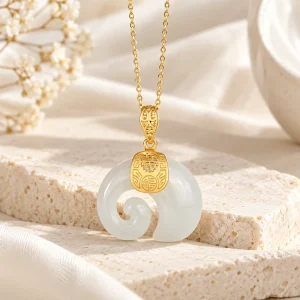
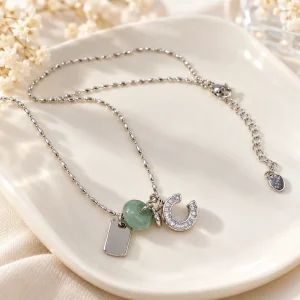
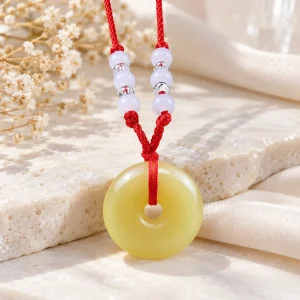
Why they do not sell at the same price
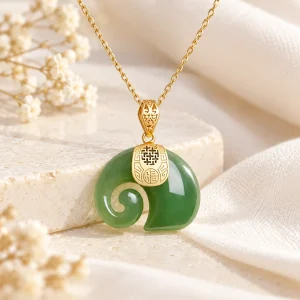
The top of the market belongs to jadeite, and to one specific jadeite: translucent, a vivid chromium green, even in colour. Nephrite rarely reaches those levels, and that is where most of the price gap opens up.
That does not mean jadeite is always worth more than nephrite. A fine white nephrite, dense and even, sells above a dull, opaque, stained jadeite. Species is only one variable, alongside translucency, colour evenness, fineness of grain, size of the piece and treatment: judging jade quality, the price of jade stone.
Two phrases to set aside. Imperial jade refers to a quality of jadeite, not an origin or a label (what the term means). And the A, AA, AAA scale has no standard behind it: it borrows its letters from the treatment classification, which is the real one, and the resemblance does all the work.
The questions I get asked
Is jadeite real jade, and nephrite too?
Yes, both. The word jade covers these two species, and the trade counts no others: it is a recognized category within which mineralogy distinguishes a pyroxene and an amphibole. What is not jade is serpentine and dyed quartzite sold under that name.
How can I tell whether my jewellery is jadeite or nephrite?
Weigh the bare stone in air and then suspended in water, and calculate the ratio. Above 3.25, jadeite; between 2.90 and 3.03, nephrite. On a set or strung piece, the metal and the cord skew the measurement, and you need a laboratory.
Which of the two is stronger?
It depends on what you mean by strong. Jadeite resists scratching better, 6.5 to 7 against 6 to 6.5. Against impact, both are exceptionally tough, and it was that toughness, not their hardness, that made Neolithic polished axes possible.
Is a nephrite jade necklace real jade?
Yes. Nephrite is one of the two species the word jade covers, and it supplies most of the jewellery on the market. The useful question is not whether it is jade, but whether the seller can say which mineral they mean and what they base that on.
Why does jadeite cost more?
Because its most sought-after grades, translucent and chromium green, have no equivalent in nephrite. At everyday grades, the gap narrows a great deal, and a good nephrite beats a mediocre jadeite.
Is Chinese jade jadeite or nephrite?
Historically nephrite, and for a very long time nephrite alone: jadeite arrived through Burma and only became a court object in the 18th century. Using “Chinese jade” as the name of a material therefore tells you nothing reliable, and the label also covers dyed quartzite.
Where I checked
What comes from a named source. The separation of the two species and the word jadeite come from Alexis Damour’s note in the Comptes rendus hebdomadaires of the French Academy of Sciences, volume 56, 1863, whose page numbers I do not publish since I have not read it. Monte Viso, Beigua and the 3,300 kilometres come from the work of Pierre and Anne-Marie Pétrequin, the CNRS JADE project, June 2003. The formulas, mineral families and ranges of density and hardness are those of the mineralogical literature: I repeat them, I did not establish them, and their limits vary by a few hundredths from one database to another. I therefore attribute them to no particular organization, since I did not take them from a single one.
What is a market observation, with a date. On 8 September 2026, I opened the nine French competitors on the first page of results: one was offline, none of the others states the mineral of its pieces, and only one, run by a qualified gemmologist, really separates jadeite and nephrite. The same day, my supplier confirmed that it cannot say whether its stock has been treated. The description of the polish above covers the examples I have weighed since September 2026, and those alone.
What is my own reasoning. The link between nephrite’s hardness and wear from quartz dust, the idea that the empty gap between the two ranges makes home weighing usable, and the choice never to write that a piece is untreated without spectroscopy: these are decisions, not established facts. If you find a mistake here, write to me: I will correct it and note that I did.
In one sentence
Jadeite vs nephrite comes down to two minerals with nothing in common but a trade word, and the gap between their densities is enough to tell which one you are holding. The method is on the weighing page, the full guide on the jade stone page, and the pieces in the shop.