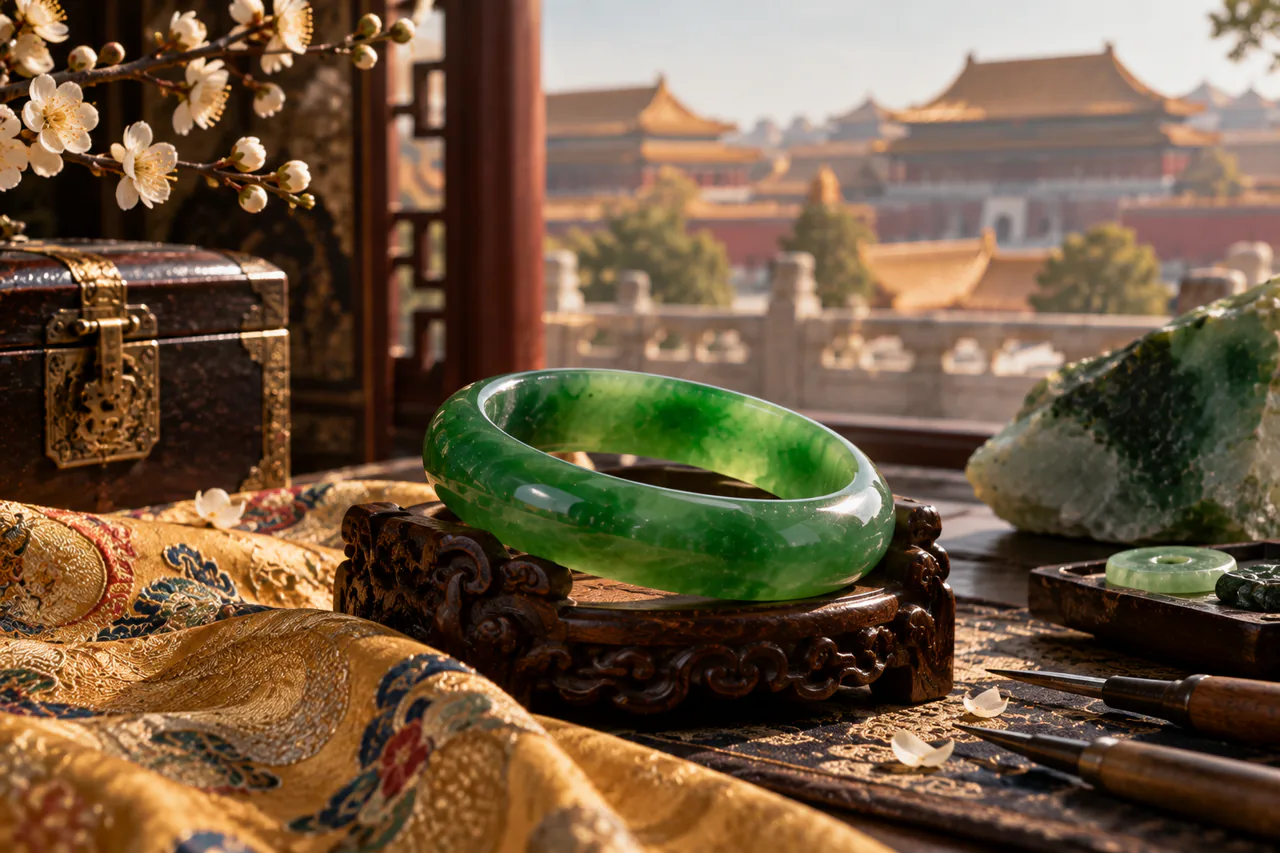
Imperial Jade Bracelet: What the Term Really Means
This page covers the search for an “imperial jade bracelet”: where the adjective comes from, what it tells you about neither the mineral nor the treatment, what my scale can rule out, and why none of my pieces carries it.
“Imperial jade” is not a grade issued by anyone: it is a traders’ word for a jadeite of an intense chromium green, translucent and even in color, and the material that truly deserves the word comes, in practice, from Burma.
Three questions arise about a bracelet, and the adjective settles only one of them, the least verifiable.
| The question | What it settles | Who can answer it |
|---|---|---|
| The species | jadeite, nephrite, or neither | a scale and a glass of water, in my workshop |
| The treatment | A, B or C | infrared spectroscopy, in a laboratory |
| The quality, including “imperial” | color, translucency, grain | the seller, and I found no one else |
My name is Jade and I run a jade jewelry workshop, with pieces set or chosen one by one, and I weigh one example of each reference before it goes on sale. I am neither a gemologist nor a therapist: here, mineralogy is stated as fact, and everything else is attributed.
What the word means in the trade
The word jade covers two unrelated minerals, jadeite and nephrite, and “imperial” applies only to the first (jade stone, jadeite or nephrite). A green nephrite can be very beautiful, but it does not belong in the category, whichever seller puts it there.
Among traders, the expression brings together three characteristics that must all be present on the same stone:
- An intense, saturated green, neither pale nor grayish, and not leaning toward blue or yellow.
- Strong translucency, letting light through over several millimeters and giving a jelly-like look rather than that of an opaque stone.
- An even color, with no clouds, pale veins or darker patches.
The criteria are cumulative, and that is where the adjective degrades into advertising: a stone that meets one criterion out of three is sold under the same word. The variables that make a piece’s value are in judging the quality of a jade.
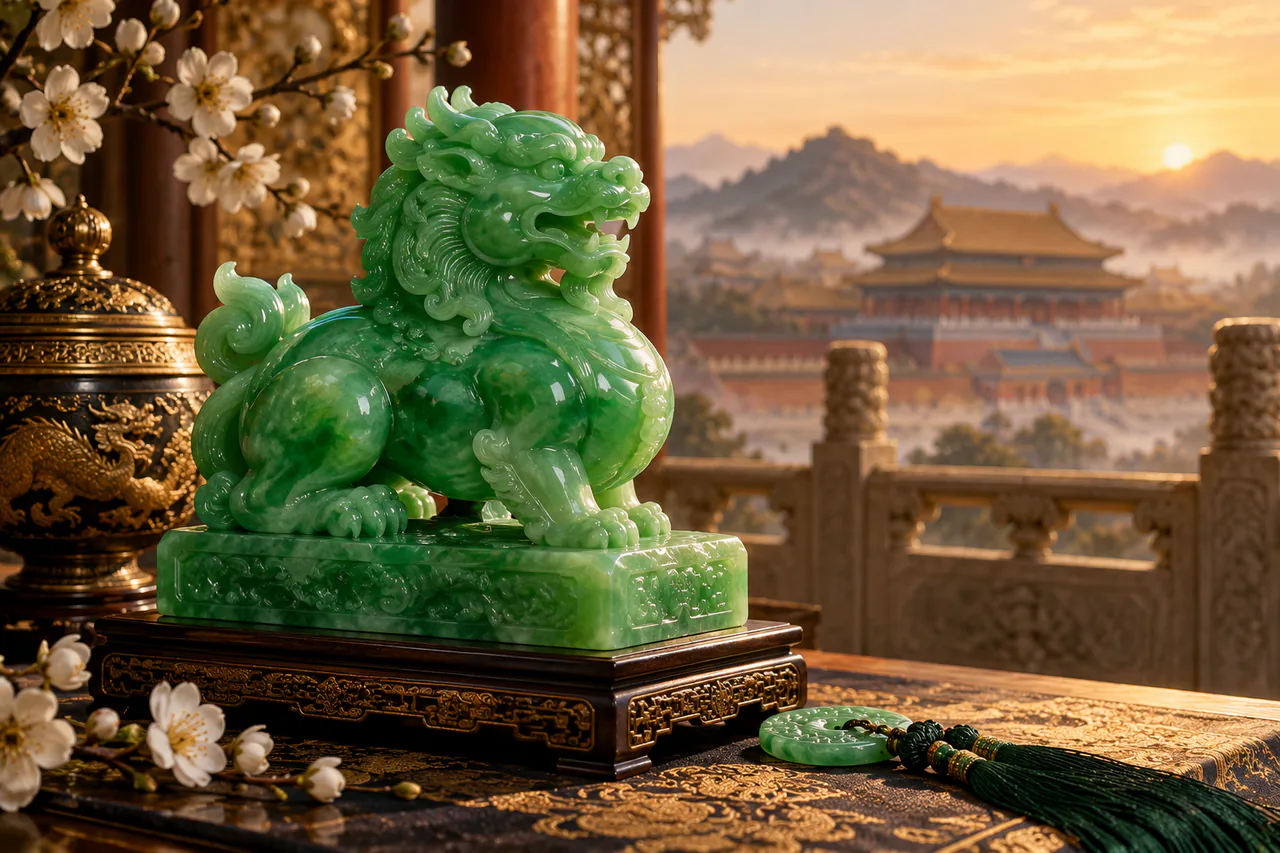
There is no imperial grade, and no one issues it
I looked for a quantified definition of the term: a translucency threshold, color coordinates, a protocol. I found none in the sources I opened. What exists are descriptions in words, and intense or even cannot be measured. So the word travels without a reference framework, and the seller remains its only authority.
It is not the A, AA, AAA scale, but it works the same way
The A, AA, AAA scale has no normative existence and borrows its alphabet from the only real classification, the one for treatments (jade A, B, C). “Imperial” is not that scale, and no rule prohibits it. But both share the same flaw: a superlative I have not seen defined anywhere, applied to a stone the seller does not measure.
French law does not fill that gap. French Decree No. 2002-65 of January 14, 2002 mentions neither jade, jadeite nor the word imperial, and it does not regulate commercial descriptors: what it requires is the name of the mineral and a statement of treatment (jade and the 2002 decree, is jade a precious stone). A flattering adjective replaces neither.
Jade bracelets, chosen one by one
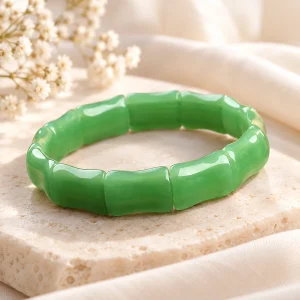
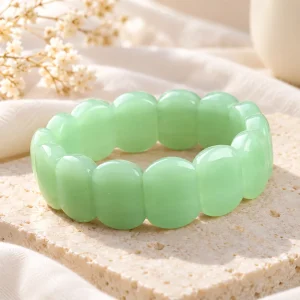
Where the adjective imperial comes from
The adjective refers to the Chinese imperial court, and it matters which stone is meant. What China has worked since the Neolithic and placed in its tombs is nephrite. Jadeite arrived late, imported from Burma, and its favor at the Qing court dates from the 18th century (jade jewelry from China, jade in Chinese tombs).
So the word does not refer to four thousand years of Chinese jade, but to a fashion of two and a half centuries, for an imported material. As for its origin, I stop at what I have read: the sources I opened present it as a trade term coined after the fact, and I write that as an uncertainty, lacking a text from the period.
The green in question comes from chromium
In jadeite, two elements give two greens that do not look alike. Iron gives the common greens, somewhat dull, often leaning toward gray or olive. Chromium gives the bright, saturated green the word imperial is aiming at. This is chemistry, and it explains the rarity of that color: it depends on a trace of chromium that is not always there.
Two consequences. First: nephrite’s green, which owes nothing to chromium, does not reach that saturation according to what I have read, which closes the door mentioned above (green jade stone, the colors of jade stone). Second: an intense green obtained other than through chromium does exist, and it is called a dye.
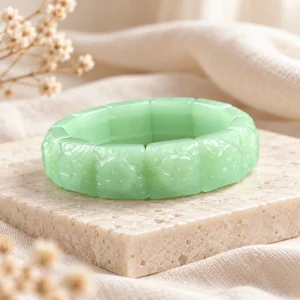
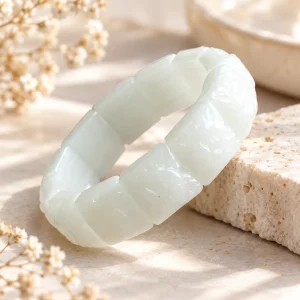
Bracelets whose mineral I publish, with the figure behind it
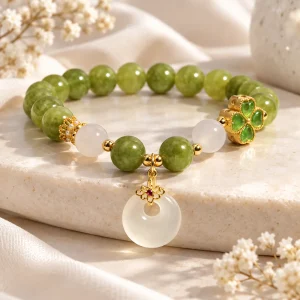
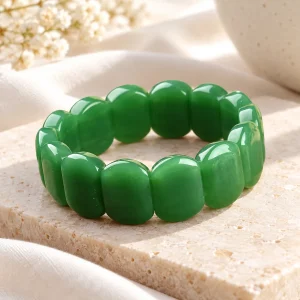
What my scale says, and what it will never say
Weighed in air, then suspended underwater, a stone gives its density. The ranges from the mineralogical literature read without ambiguity: jadeite 3.25 to 3.36, nephrite 2.90 to 3.03, serpentine about 2.6, quartzite, dyed or not, about 2.65. The protocol and its limits are on the weighing page.
Applied to this subject, it gives just one thing, but it is clear-cut: my scale does not say a stone is imperial, it says when it cannot be. A bracelet sold under that word that weighs in at 2.95 is a nephrite, and therefore outside the category. Below 2.7, it is no longer jade but one of the materials the trade sells under that name (stones sold as jade, dyed jade).
Three caveats, which matter for a bracelet. The measurement applies to the bare stone: a bangle carved from a single block weighs very well, a strand of strung beads does not, because the thread and clasp go onto the scale. It loses its value on very small pieces, where uncertainty swallows the gap between 2.95 and 2.65. And it says nothing about treatment, the subject of the next section (how to tell if jade is real).
The word says nothing about treatment, and that is the real trap
A jadeite can be bleached with acid, which clears out brown impurities and leaves the material porous, then impregnated with resin, which restores translucency and strength. The result is green, clear, even and luminous: exactly the three characteristics of the first section, and a dyed jadeite adds the green itself. So the word imperial rules nothing out; it attracts what it should exclude (jade A, B, C).
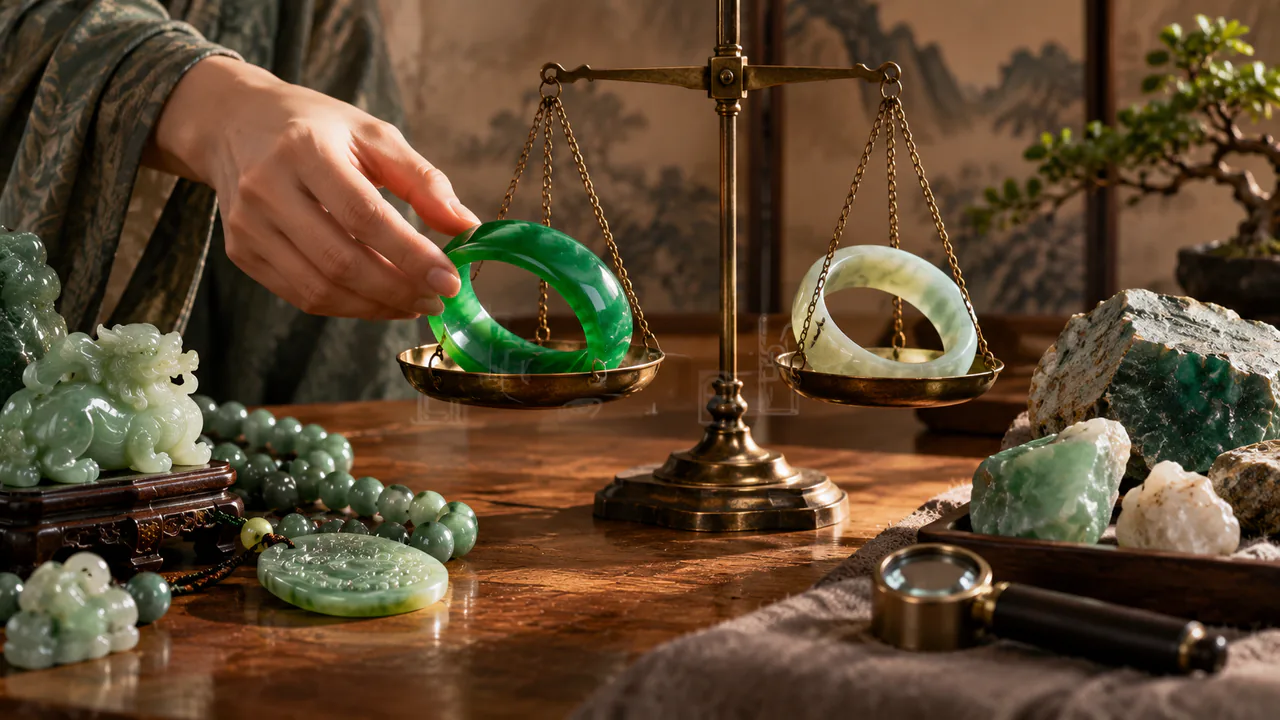
My scale does not see resin: it does not change the mass enough. Only infrared spectroscopy in a laboratory settles it, and I do not have that. My supplier does not know the treatment status of the goods either, and I would rather write it: a silence reads as a guarantee (the treatment information sheet, what I publish on each product page).
That is why I never write that one of my stones is untreated or natural. The word real, on the other hand, remains legitimate: it sets true jade against serpentine and quartzite, which weighing establishes.
Why this word leads to Burma, and why I stop there
According to the deposit lists I have read, gem-quality jadeite comes mostly from Burma; the second source, the Motagua Valley in Guatemala, remains far behind (where jade comes from). Looking for the material that deserves the word therefore means looking for Burmese jade.
It is an origin this catalog refuses: the state enterprise that controls Burmese jade has been sanctioned by the United States and the European Union since 2021, and the human cost of this mining is reason enough. The American import ban, in force from 2008 to 2016, has been lifted. The whole file is in Burmese jade bracelet, and what I know about my own stones in the origin of my jade.
The direct consequence: none of my pieces carries the word imperial, and none ever will. I can neither prove it nor source it without an origin I refuse. This page explains a term; it does not sell it.
A bracelet advertised as imperial jade: what to ask
Faced with a listing, four questions are worth more than the adjective, and they should be asked before buying (buying jade jewelry).
- Which mineral, spelled out? Jadeite or nephrite. A seller who answers “jade” is talking about the category, not the stone (how jade is named).
- What density, and measured when? It is the only figure that decides, and a bangle carved from a single block can be checked at home.
- What treatment status? A, B or C. “I don’t know” is an honest answer; silence is not.
- What origin? For the reason above, it changes more than the price.
That leaves the amount, and I will not answer it with a figure: I have not recorded any price myself that I could publish here. What I can say is shorter: a bracelet sold at an online shop’s usual price and presented as imperial promises what its price contradicts. The orders of magnitude are in the price of jade stone and real jade bracelet price.
The questions I get asked
Is imperial jade a third species of jade?
No. There are only two minerals called jade, jadeite and nephrite. “Imperial” describes a jadeite of a very deep chromium green: a trade word applied to a species, not an additional species.
How can you recognize a genuine imperial jade bracelet?
At home, you do not recognize it, you rule it out. Hydrostatic weighing tells you whether the stone is jadeite, nephrite or something else; it tells you neither quality nor treatment. Beyond that, you need a laboratory, and I am not one.
Does imperial jade necessarily come from Burma?
No written rule says so, but gem-quality jadeite comes overwhelmingly from Burma. A piece that deserves the word is therefore very likely to be Burmese, which ties it to a state enterprise under sanctions since 2021.
Are imperial jade and type A jadeite the same thing?
No, they are two different axes. Imperial concerns color, translucency and grain; A, B and C concern treatment, bleaching, resin, dye. A stone can be very green and impregnated: the first word says nothing about the second.
Why can you find imperial bracelets at low prices?
Because the word is protected by no one and costs nothing to write: the 2002 French decree does not regulate adjectives, only the mineral name and the statement of treatment. The price is not proof, but an unexplained gap is a warning sign.
Do you sell imperial jade bracelets?
No, and I will not. I cannot prove that quality with a scale, and the material that truly has it comes from an origin I refuse. My bracelets are listed by their mineral and by the density measured on one example.
Where I checked
What comes from a named source. The separation of jadeite and nephrite goes back to Alexis Damour’s note in the Comptes rendus hebdomadaires de l’Académie des sciences, volume 56, 1863; I do not give the page numbers, as I have not read it. The density ranges, the role of chromium and iron, bleaching and resin impregnation come from the mineralogical and gemological literature: I repeat them without having measured them, and their bounds vary enough from one database to another that I attribute them to no particular body. The legal texts are named in the body: French Decree No. 2002-65 of January 14, 2002; the Tom Lantos Block Burmese JADE Act of 2008, lifted by Executive Order 13742 of October 7, 2016; the 2021 sanctions against Myanma Gems Enterprise.
What is an observation, dated. On September 8, 2026, the first page of French results for “bracelet jade impérial” gave me only sales pages, eight out of eight, and none wrote what the term means. The same day, of the nine French competitors I opened, none stated the mineral of its pieces, one used the A, AA, AAA scale, and my supplier confirmed to me that they cannot say whether their goods are treated.
What is my own reasoning. The idea that the adjective imperial works like the A, AA, AAA scale, a superlative with no published reference framework, is mine. The fact that my scale can only rule out, never confirm, is a consequence of the method, not a test result. And the absence of a quantified definition of the term is an observation from my reading, not proof that none exists anywhere. If you know of a text that defines the word, or if you find a mistake here, write to me: I will correct it.
In one sentence
“Imperial jade” refers to a chromium-green jadeite, translucent and even in color, without any quantified definition to guarantee it: the only verifiable element of a listing remains the mineral and its figure. The method is on the weighing page, trade terms in the jade glossary, and the pieces in the shop.