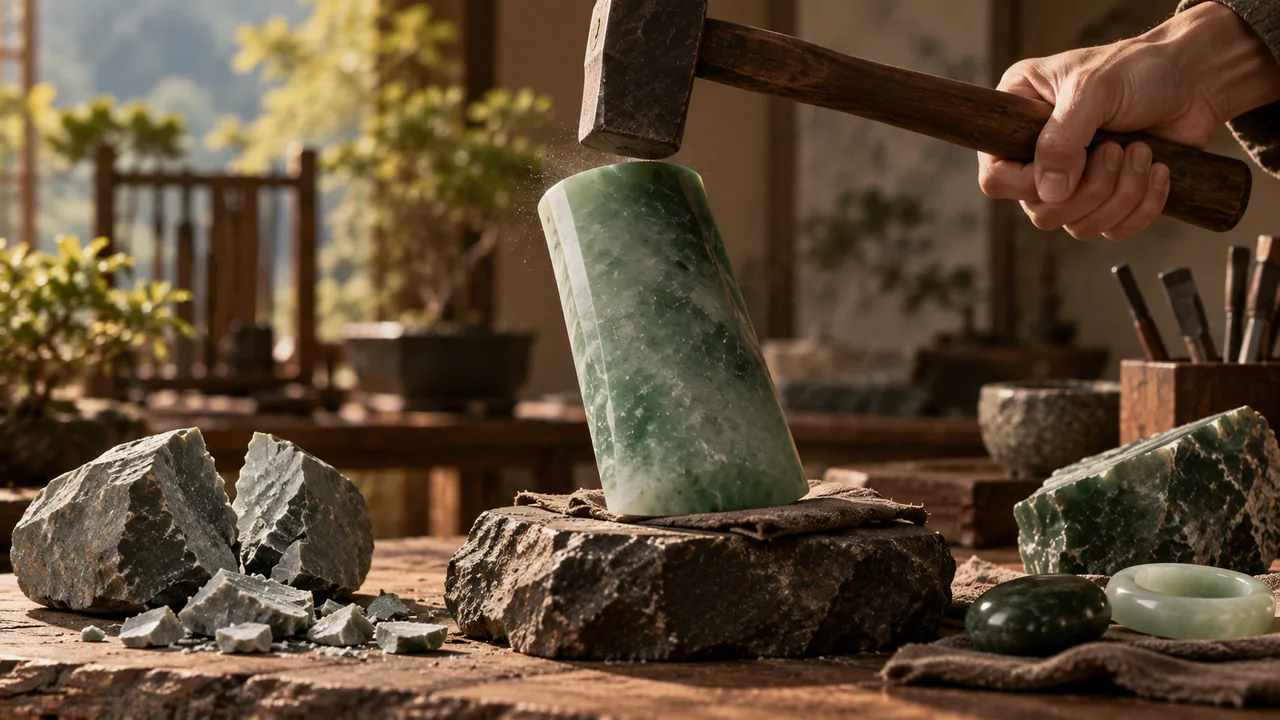
Why Jade Almost Never Breaks
This page separates two words that are used interchangeably, hardness and toughness, gives jade’s rating on each, explains what its internal structure changes, and shows what that resistance has made possible, from Neolithic axes to the bangle carved from a single block.
Jade almost never breaks because its toughness, its resistance to fracture, is very high, while its hardness, its resistance to scratching, is only ordinary: these are two distinct properties, and confusing them leads people to believe that a stone hard to break must also be hard to scratch.
| Property | What it measures | Where jade stands |
|---|---|---|
| Hardness | Resistance to scratching | Nephrite 6 to 6.5 and jadeite 6.5 to 7 on the Mohs scale |
| Toughness | Resistance to fracture and chipping | High in both, remarkable in nephrite |
Diamond is the opposite example: 10 in hardness, yet it splits along a well-placed cleavage plane. The two properties do not vary together, and no single scale sums them up.
My name is Jade and I run a jade jewellery workshop: I choose the pieces, have them set, and weigh one example of each reference before putting it on sale. I am neither a gemmologist nor a therapist: mineralogy is stated here as fact, and I flag the moment I change register.
Hardness and toughness do not measure the same thing
Hardness answers a single question: what scratches what. The Mohs scale, which dates from the early 19th century, is a ranking, not a measurement: each mineral scratches the one before it, and the scale says nothing about the real gap between two ranks. The jump from corundum to diamond is out of all proportion to the one from quartz to topaz, and yet each counts as one rank.
Toughness answers another question: how much energy it takes to open a crack and make it run. It is not graded from 1 to 10 or on any simple counter scale, and gemmology most often describes it in words rather than with a number. So I give no figure for it here: I have not read one I could cite.
A material can therefore be hard and brittle, soft and tough, or both. I read these two words used interchangeably on most of the French pages I opened while preparing this one, and that is where the false idea of an indestructible jade that never scratches comes from.
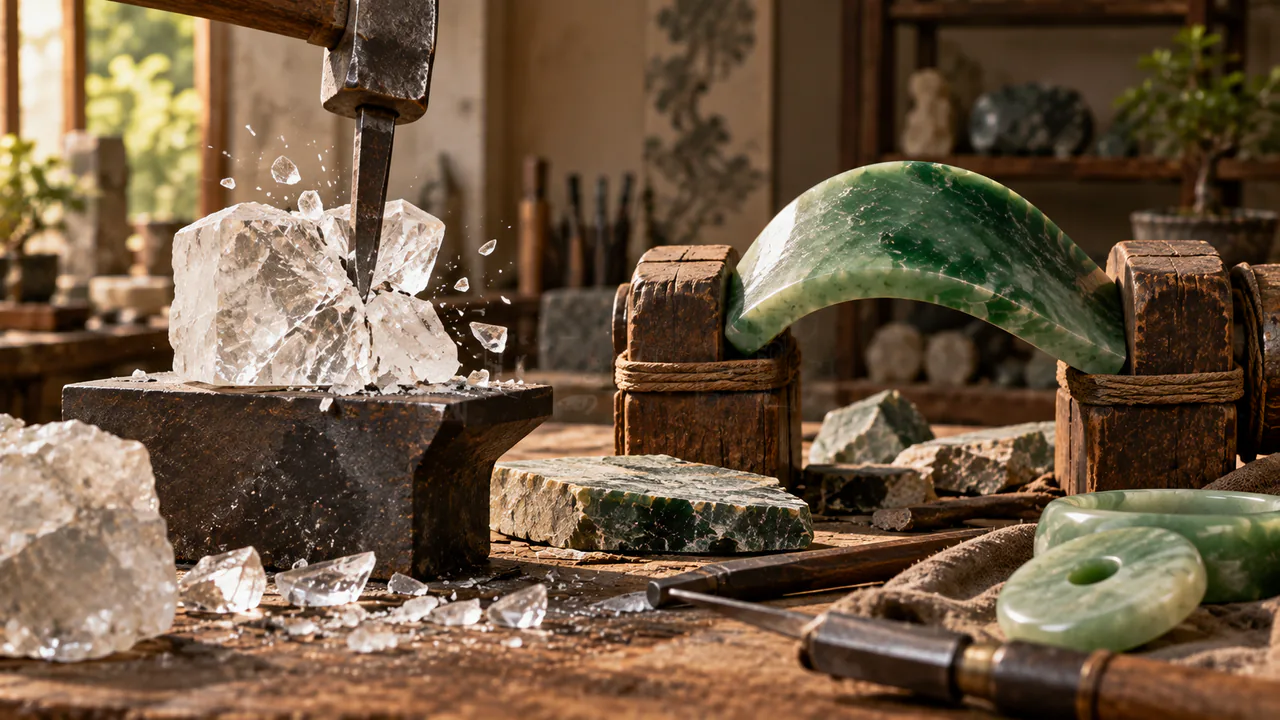
How jade rates for scratching, and what dust does to it
The two minerals covered by the word jade are not equal on this point, and merging them into a single figure, as many product pages do, erases the only useful information. Nephrite sits between 6 and 6.5 on the Mohs scale, jadeite between 6.5 and 7. They are two unrelated species, an amphibole and a pyroxene, not two grades of the same stone: jadeite or nephrite, and the complete overview of jade stone.
The benchmark that matters is not in a table, it is in the air. Quartz rates 7, and it makes up a large share of ordinary dust, the kind that settles on furniture and gets caught in a cloth. Nephrite stays below that value across its whole range; jadeite only reaches it at the top of its own.
The practical consequence, and this is my reasoning rather than a measurement: what dulls a jade worn every day is almost never an impact, it is the repeated rubbing of a dust harder than the stone. A dry cloth wiped over a dusty stone is an abrasive; lukewarm water, mild soap and storage away from other jewellery slow that wear: how to clean jade, storing a jade piece.
Jade pendants available now
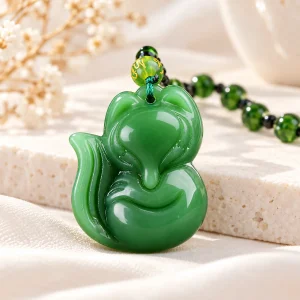
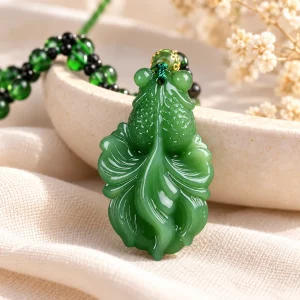
The felt of nephrite, the grains of jadeite
Jade’s toughness does not come from the strength of its crystals, it comes from the way they are assembled. In a single crystal, a crack that has found its direction runs through the stone without meeting anything. Jade does not offer it that path, for two different reasons depending on the species.
Nephrite is an amphibole of the tremolite-actinolite series, and it does not occur as grains but as interlocking microscopic fibers, tangled like felt. For a crack to progress, it has to go around or tear through each fiber one after another, losing energy at every obstacle. It is this architecture that places nephrite among the toughest natural materials known.
Jadeite is a pyroxene, made of fine grains tightly interlocked with one another. The principle is the same, a crack forced to change direction constantly, but the tangle of a felt slows it better than a stack of grains: jadeite is less tough than nephrite, while beating it for scratch resistance. The two properties cross over, which is why neither species is simply the best. Their formation explains these textures: how jade stone forms.
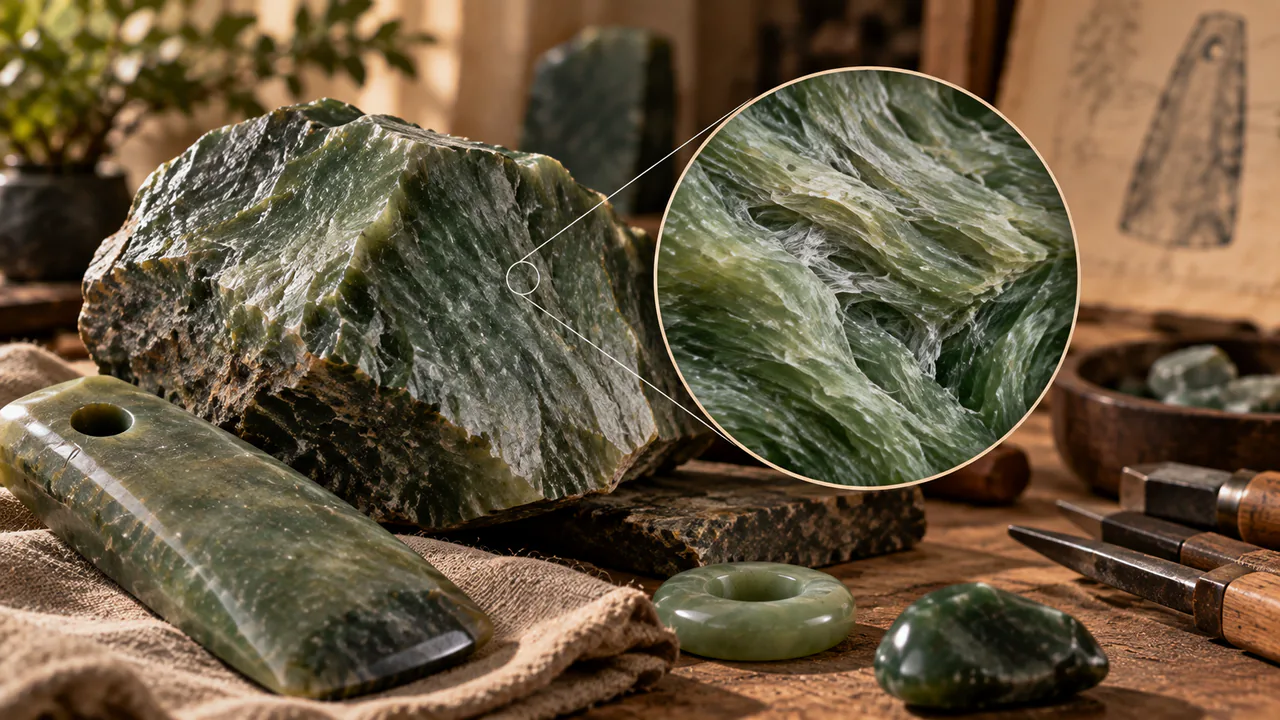
Polished axes, the oldest demonstration
This resistance is not a catalogue property: entire societies tested it in use, long before anyone could name it. In the Neolithic, jade was used to make polished axes, the tool that took the most violent impacts in the technical repertoire of the time.
One detail many texts gloss over deserves to be kept: it is not the same species on both sides of the world. In China, the material worked since the Neolithic is nephrite, and its felted structure goes a long way toward explaining how long those tools lasted. In Europe, it is Alpine jadeite, less tough but tough all the same, and it was Alexis Damour who identified it in the axes from Celtic monuments in 1865, two years after separating the two minerals.
In June 2003, Pierre and Anne-Marie Pétrequin identified the Neolithic quarries that supplied this jadeite, in the Monte Viso massif in Piedmont, between 1,500 and 2,400 metres, and in the Beigua massif. In the 5th and 4th millennia BCE, they supplied large polished axes that spread over 3,300 kilometres, from Ireland to Bulgaria. The Carnac Museum of Prehistory, in Morbihan, displays some, and I grew up near those cases: jade in Europe.
What toughness allows in a piece of jewellery
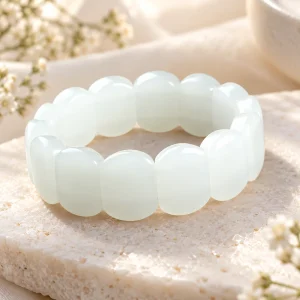
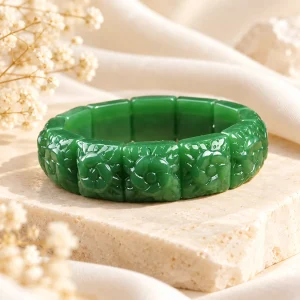
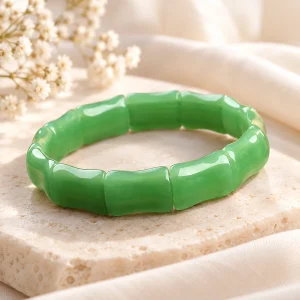
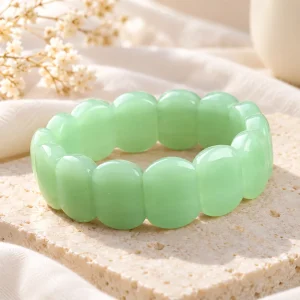
The shape that owes everything to this property is the bangle: a closed ring, carved from a single block, with no clasp, no hinge and no metal. The piece has no point of articulation, and the wrist twists it with every movement. Most gemstones used in jewellery cannot take that shape.
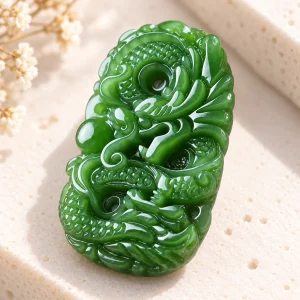
The same resistance allows thin-walled carved objects and deep openwork that a brittle material would rule out: jade objects, jade motifs.
It has a downside worth knowing before you buy: a bangle carved from a single block cannot be resized. It passes over the thumb joint or it does not, and no jeweller can fix a diameter that is too tight. The measurement is taken before, never after: measuring your wrist before buying a jade bangle. What otherwise sets a fine piece apart from an ordinary one depends on criteria other than its resistance: judging the quality of a jade.
Bangles and bracelets whose density I publish
Tough does not mean unbreakable
Jade does break, and I would rather write that than let you believe otherwise. Three situations come up. An impact on an edge or a thin spot concentrates energy on a tiny surface, and the toughness of the material is no longer enough. An old crack, often invisible under the polish, gives a fracture a ready-made starting point. And a stone impregnated with resin no longer behaves like an intact stone: the gemological literature describes acid bleaching that removes material between the grains before a resin fills the voids, and a hollowed-out structure no longer has the tangle that gave it its strength.
That last point concerns me directly. My weighing tells the mineral, not the treatment: an impregnated stone weighs about the same as another, only infrared spectroscopy would settle it, and my supplier does not know that status either. So I cannot grade any of my pieces, and I say so rather than stay silent: jade A, B, C, the treatment information sheet, and the weighing protocol.
What follows changes register, and I flag it rather than blending it into the rest. Nothing in it is proven: it is what traditions have attributed to this stone.
A widespread belief holds that a bangle that breaks has taken a stroke of bad luck in place of its wearer. It is a reported belief whose origin I have not found, and I cover it elsewhere rather than here: a jade bracelet that breaks.
The questions I get asked
Is jade a hard stone?
Moderately, and less than people say: 6 to 6.5 on the Mohs scale for nephrite, 6.5 to 7 for jadeite. What is remarkable about it is not hardness but toughness, resistance to fracture.
Why did my jade get scratched when it is supposed to be so resistant?
Because its reputation concerns toughness, not scratching. Quartz, very common in ordinary dust, rates 7: it sits above nephrite’s entire range and matches the top of jadeite’s. A dusty cloth is enough to dull a polish.
Is nephrite stronger than jadeite?
It depends what you mean by strong. Nephrite resists fracture better, thanks to its felt of fibers. Jadeite resists scratching better, at 6.5 to 7 against 6 to 6.5. Neither wins on both counts.
Can a jade bangle break if it falls?
Yes. A thin ring that hits a tiled floor on an edge concentrates the whole impact there, and the toughness of the material no longer compensates. An old crack or resin impregnation makes a break more likely still.
Why does a bangle hold together without a clasp?
Because the material can be carved into a closed ring from a single block and take the twisting of the wrist without splitting. It is a direct consequence of its toughness, and it is also why the diameter has to be right the first time.
Is jade the toughest natural material?
It is among the toughest, nephrite first, and that is how the mineralogical literature presents it. I have not read a numerical ranking that would decide between the leaders of that list, so I will not invent one.
Where I checked
What comes from a named source. The hardness ranges, 6 to 6.5 for nephrite and 6.5 to 7 for jadeite, and quartz’s value of 7, are those of the mineralogical and gemological literature, the kind published by the GIA, the Mindat database and, for species names, the International Mineralogical Association. I repeat them, I did not measure them, and their bounds vary by a few hundredths from one database to another: so I do not pin a figure on one body rather than another, not having taken it from a single one. The separation of the two minerals, then the identification of jadeite in the axes from Celtic monuments, come from Alexis Damour, Comptes rendus hebdomadaires de l’Académie des sciences, volume 56, 1863, then 1865; I do not give the page numbers, as I have not read them. Monte Viso, Beigua, the altitude, the 3,300 kilometres and the Morbihan deposits come from the work of Pierre and Anne-Marie Pétrequin, the CNRS JADE project, June 2003.
What is an observation, dated. On 8 September 2026, opening the French pages on the first page of results about this stone, I noted that most use hardness and toughness interchangeably, and that several give a single Mohs figure for jade without distinguishing the two species. The same day, my supplier confirmed to me that they cannot say whether their goods are treated.
What is my own reasoning. The link between a hardness lower than quartz and the wearing of the polish by dust is a deduction, not a test I have carried out. The idea that the bangle’s shape is a consequence of toughness is mine. And the refusal to put forward a toughness figure is deliberate: I have no value I could cite. If you find a mistake here, write to me: I will correct it and note that I did.
In one sentence
Jade holds up because its crystals are tangled, not because they are hard, which gives it rare resistance to impact and only ordinary sensitivity to scratching, and that single distinction explains both Neolithic axes and the bangle carved from a single block. The method that tells you which mineral it is is on the weighing page, and the pieces are in the shop.
Pieces carved from a material that allows fine work