A Jade Bracelet That Breaks
This page takes the search “broken jade bracelet” from both ends: what tradition says about a bangle that breaks, what actually gave way in the stone or the cord, what resin changes, and what to do with a piece of jewellery in pieces.
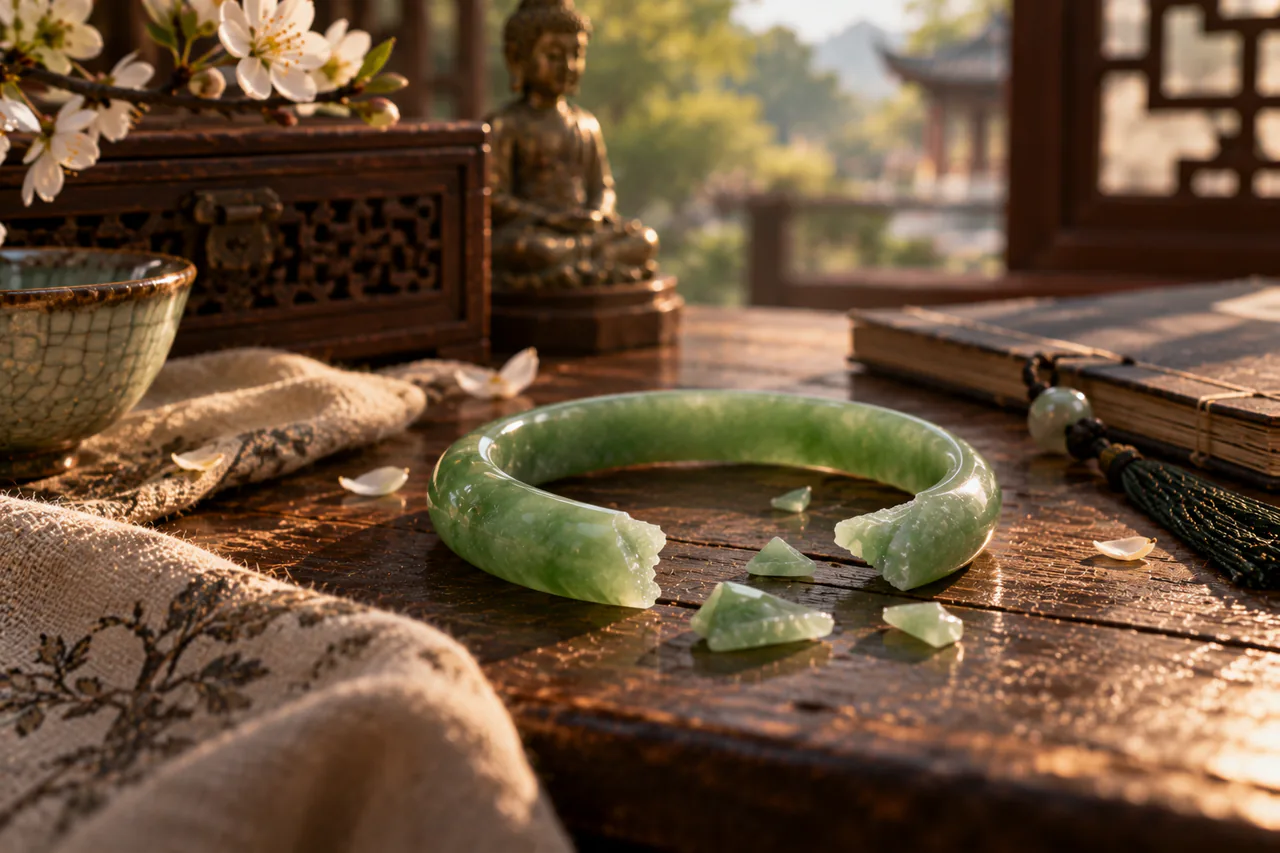
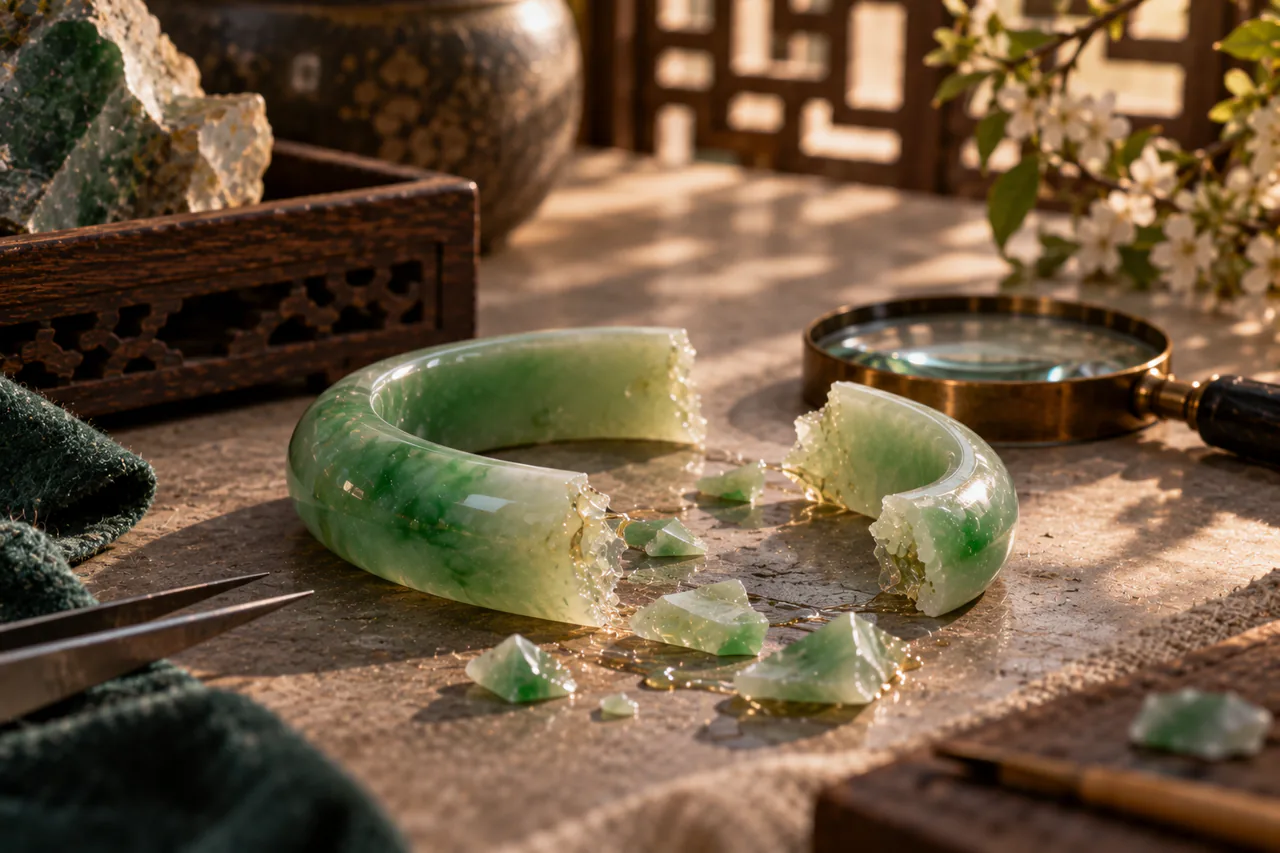
A jade bracelet breaks for physical reasons, a sharp knock on a hard corner, an old crack that had been spreading for months, a worn cord or a stone impregnated with resin, and the belief that it breaks in place of its wearer is a very widespread custom for which I have found no named source.
Jade’s reputation for being indestructible comes from a real quality with the wrong name: it is not very hard, it is tough, difficult to break rather than difficult to scratch. Tough does not mean unbreakable, and the two minerals the word jade covers are not tough to the same degree.
My name is Jade, and I run a jade jewellery workshop where pieces are set or chosen one by one, and I weigh one example of every piece before it goes on sale. I am neither a gemmologist nor a therapist: what is established is stated here as fact, what is believed is attributed.
What the belief says about a bangle that breaks
What follows changes register, and I flag it rather than blend it into the rest. Nothing in it is proven: it is what traditions have attributed to this stone.
A stone does not heal anything, and the full disclaimer is here.
The phrasing comes back almost word for word on the French pages I opened: the jade is said to have broken in place of its wearer, to have taken the blow for them. It circulates mostly in the Chinese world and its diasporas, and goes along with the other custom attached to the same object, that a bracelet should be received rather than bought (jade bracelet meaning). I have never seen it tied to a text or an author I could check, which does not prove there is none: a family rule is passed down at the dinner table, not in a bibliography. What that rules out is a page that states it as fact.
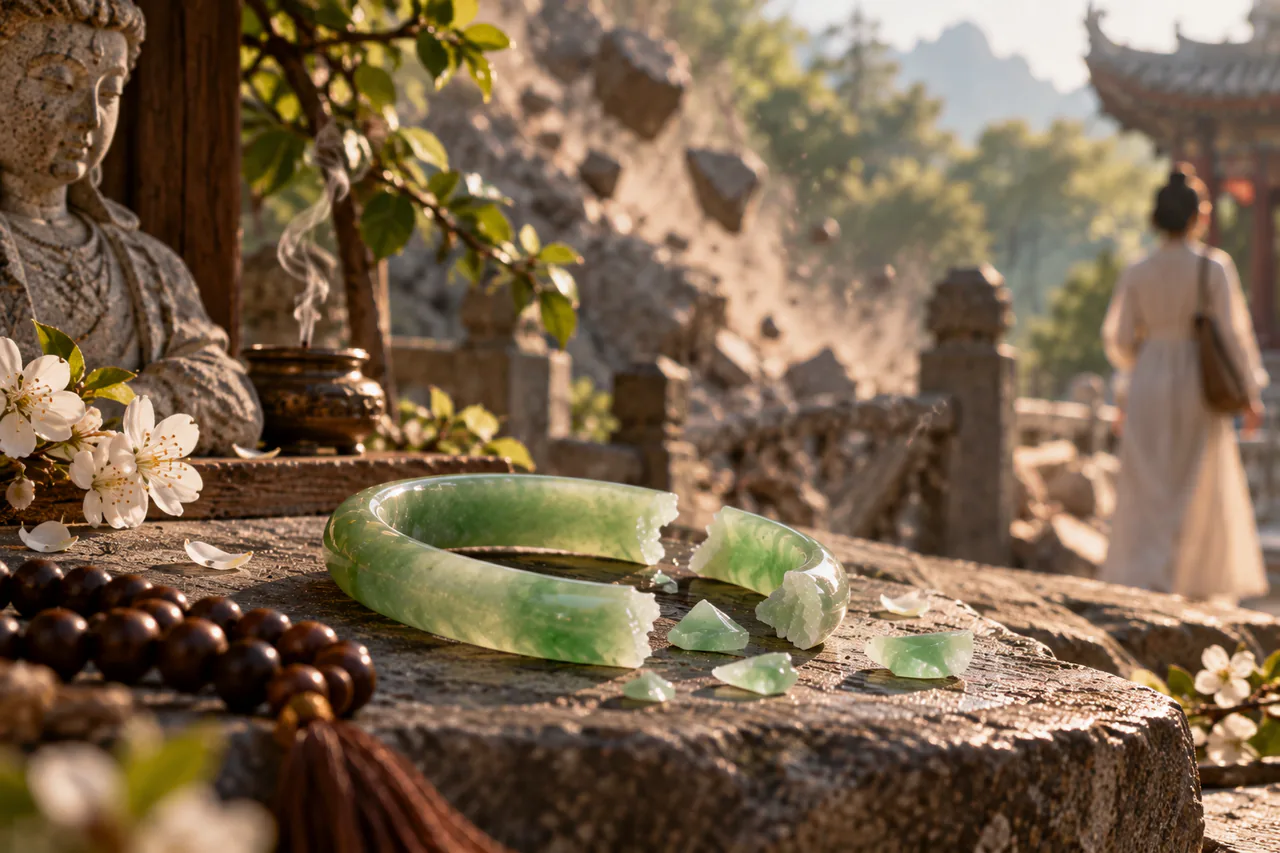
An observation that is mine and not tradition’s: a bangle breaks during an incident, a fall, a door, a countertop, in other words at the moment its wearer also takes a hit. The coincidence is real and it gets told; the thousands of uneventful days do not.
What really breaks a jade bracelet
Back to what can be measured, starting with two words most pages confuse. Hardness measures resistance to scratching, toughness resistance to breaking: jade is average on the first and remarkable on the second, exactly the opposite of a diamond (why jade almost never breaks). A tough stone absorbs a lot before it gives way, and gives way cleanly when it does. What finishes off a bangle:
- A sharp knock on a hard corner. A bangle is rigid and worn all the time: the edge of a sink, a door handle, a tiled floor.
- A crack that keeps spreading. A first knock leaves an invisible starting point, and the break comes weeks later during some ordinary movement.
- A thin cross-section. For the same material, a thin bangle breaks before a thick one: that is geometry, not quality.
Then there is the most common case at the low end of the market: many bracelets sold as jade are not jade. Serpentine sits around 2.6 and dyed quartzite around 2.65, far from nephrite at 2.90 to 3.03 and jadeite at 3.25 to 3.36; neither has jade’s toughness, and a bracelet that shattered after a short fall first raises the question of what it is made of (the weighing protocol, stones sold as jade).
Nephrite and jadeite do not break the same way
The word jade covers two unrelated minerals, told apart in 1863 by the French mineralogist Alexis Damour, and the way they break is one of their most concrete differences (the jade stone page).
Nephrite is a fibrous amphibole, made of fibers tangled together like felt: a crack spreading through it has to go around or tear through thousands of fibers, which makes it one of the toughest natural materials known and made the polished axes of the Chinese Neolithic possible. Jadeite is a pyroxene of fine interlocking grains, very tough as well, the material of the Alpine axes that spread as far as Brittany (jade in Europe), but less tough than felted nephrite.
On the Mohs scale the order is reversed, with nephrite around 6 to 6.5 and jadeite at 6.5 to 7: the harder one to break is the easier one to scuff. Two opposite behaviors under a single trade name.
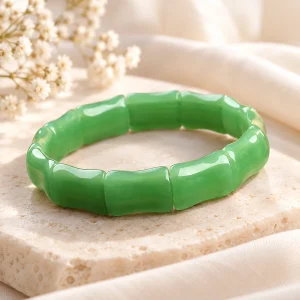
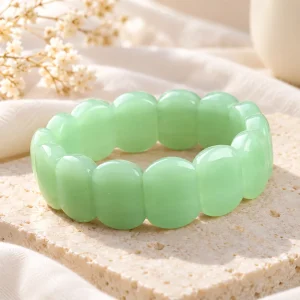
Bracelets whose mineral and density I publish
A resin-impregnated stone breaks differently
This is the part I did not see anywhere on the pages I opened that same day, and it explains some of the breaks that take their owners by surprise. The real classification of jade is not a scale of quality but a scale of treatment: A for an untreated stone, B for a stone bleached with acid and then impregnated with resin, C for a dyed stone (jade A, B, C).
The process described in the gemological literature attacks the stone between its grains to remove brown impurities, then fills the voids left by the acid with a polymer. The colour gains, the structure does not: a material that has been hollowed out and then filled back in does not regain the toughness of an intact stone, and the polymer ages. A B jadeite can therefore give way on a knock that a stone left whole would have taken.
What I can say about my own pieces stops right here, and I would rather write it down than leave you to guess. My scale gives a density: it proves the mineral, jadeite or nephrite as opposed to serpentine or dyed quartzite, and it does not detect resin, whose presence changes the mass too little. My supplier does not know the treatment status of its stock, only laboratory infrared spectroscopy would settle it, and I do not have that: so I never write that one of my pieces is untreated (treatment information sheet).
When it is not the stone that gave way
Before concluding that a stone has broken, it is worth looking at what was holding it. On a bead strand, what snaps first is almost always the cord, worn against the drill holes, or the elastic of a cheap assembly; the beads themselves are intact (thread and cord for jade jewellery). On a set piece, the break can come from the metal or from glue. The distinction is not fussiness: a cord can be replaced, a stone cannot.
Two common cleaning habits also do more harm than good, ultrasonic cleaners and steam, which should be avoided as long as you do not know whether a piece is impregnated (how to clean jade stone), and storing pieces separately prevents as many knocks as scratches (storing jade jewellery).
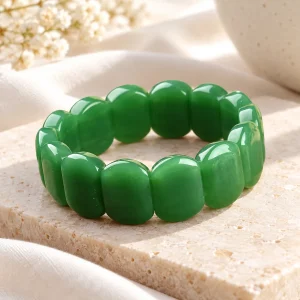
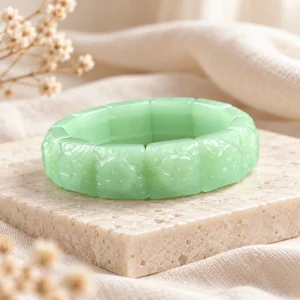
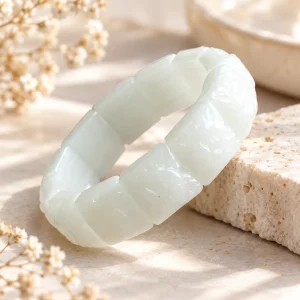
Jade bracelets, chosen one by one
What to do with a broken bracelet
A broken bangle does not become a bangle again. You sometimes come across old bangles repaired with a metal band placed over the break: that is not a restoration, it is a different object, one that owns its repair. A stone in two pieces can also be recut into a pendant, at the cost of the material lost. I do not do this work and I do not sell repairs: so I will give you neither a price nor a lead time, having recorded none. You need a jeweller or a lapidary, and the pieces should each be kept wrapped in cloth while you wait for the quote.
If the bracelet needs replacing, measure your wrist again rather than copying the size of the old one, since a bangle is sized by its inner diameter (measuring your wrist). And if the break has made you doubt the material, the fresh edge is a good place to look at the stone without its polish (how to tell if jade is real).
The questions I get asked
What does it mean when a jade bracelet breaks?
The most widespread belief is that it broke in place of its wearer, and I report it without having seen it tied to a named source. Physically, a break comes down to a knock, an old crack or resin.
Can a broken jade bracelet be repaired?
Not by becoming what it was. A jeweller can place a metal band over the break in a bangle, or have the pieces recut. Ask for a quote first, and keep the fragments wrapped in cloth in the meantime.
Is jade fragile?
No, but it is not unbreakable. Its toughness comes from its structure, tangled fibers in nephrite and interlocking grains in jadeite. Its hardness is more ordinary: 6 to 6.5 for nephrite, 6.5 to 7 for jadeite.
Does a visible line in my bangle mean it is about to break?
Not necessarily. Jade often carries veins and old fractures that geology has healed, visible under the polish. A line that does not catch your fingernail and does not show on the edge was most often already there when the piece was carved. If in doubt, have the piece looked at.
Does treated jadeite break more easily?
That is what the process described in the gemological literature would lead you to expect: the acid removes material between the grains before resin fills the voids, and that structure does not regain the toughness of an intact stone. My weighing does not detect resin, so I cannot grade a piece.
Should a broken jade bracelet be thrown away?
Nothing requires it, and customs vary from one family to another, between keeping the pieces, having them reset and parting with them. The only precaution is practical: keep the fragments safe from knocks until the decision is made.
Where I checked
What comes from a named source. The separation of jadeite and nephrite goes back to Alexis Damour’s note in the Comptes rendus hebdomadaires of the French Academy of Sciences, volume 56, 1863; I do not give page numbers, as I have not read it. The density and hardness ranges are those of the mineralogical literature: I repeat them, I did not measure them, and their limits vary by a few hundredths from one database to another, which prevents me from attributing them to a specific organization. The description of acid bleaching and impregnation comes from the gemological literature, and I draw no figures from it.
What is an observation, with a date. On 8 September 2026, I opened the nine French competitors on the first page of results for this stone: one was offline, three sell almost no jade, and none of the remaining ones states the mineral of its pieces or links the way a stone breaks to its treatment. The same day, my supplier confirmed that it cannot say whether its stock has been treated, and I looked for the origin of the protective bracelet belief without finding it.
What is my own reasoning. The idea that the coincidence between the break and the incident feeds the belief is mine. The way of telling a vein from a crack with a fingernail and raking light is my practise, not a protocol. And the link between impregnation and breaking is an expected consequence of the process, not a result I measured. If you find a mistake here, or if you know the source of the belief, write to me: I will correct it and note that I did.
In one sentence
A broken jade bracelet tells a story about material first, a knock, a crack that had been spreading or a stone hollowed out by acid, and the belief that it took the blow for you is a custom I report without being able to back it up. The method that at least tells you which mineral it was is on the weighing page, and the pieces are in the shop.