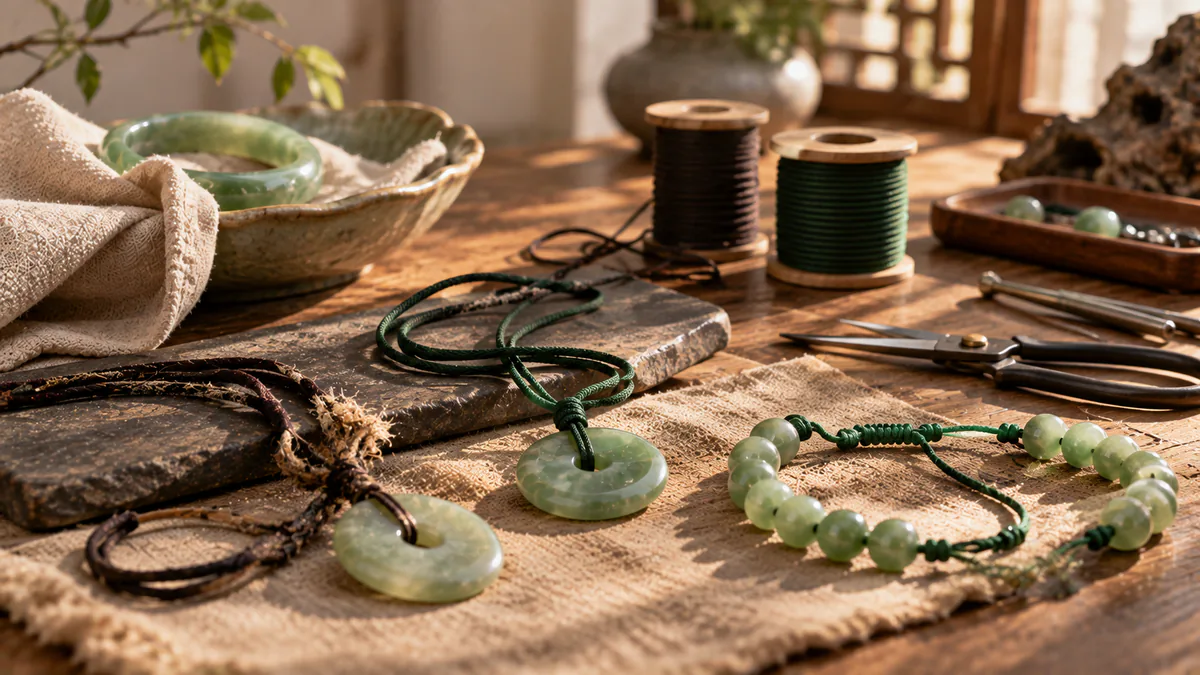
The Thread and Cord of Jade Jewellery: When to Change Them
This page explains how to read the thread of a strand of jade beads and the cord of a jade pendant: the three signs visible to the naked eye, what wears a thread without anyone noticing, when to have it restrung, and why this thread explains that some of my product pages publish no number.
On jade jewellery, it is almost never the stone that gives way, it is the thread that carries it, and the thread warns you before it lets go. The time to have it restrung is when one of the three signs below appears, not the day it breaks.
| What you can see | What it means |
|---|---|
| The thread turns grey or fuzzy between two beads | it is fraying where it bends |
| Slack appears, the beads slide | the knots have compacted, or the thread has stretched |
| A cord’s knot slips on its own | the cord has flattened and no longer grips |
My name is Jade, and I run a jade jewellery workshop: I choose the pieces, have them set, and weigh one example of each reference before it goes on sale. I am not a gemmologist or a therapist, and I do not string the strands myself: what follows describes what I observe, not a craft I do not have.
What gives way first is not the stone
The stone is moderately hard and remarkably tough, hardness being resistance to scratching and toughness resistance to breaking: why jade almost never breaks. The thread, on the other hand, bends with every movement of the wrist, always in the same places, and a material that bends wears through fatigue rather than impact. Fatigue only shows at the very end.
The consequence is reassuring: when a strand gives way, the stone is intact. The reflex is to worry about the stone and forget what holds it.
The strung strand, and the number I do not publish
My method comes down to a scale, a thread and a glass of water: I weigh the stone in air, then suspended underwater, and the ratio gives its density, which I compare with the published ranges, jadeite from 3.25 to 3.36, nephrite from 2.90 to 3.03. The protocol is on the weighing page, and the split between the two minerals is on jade stone.
A strung strand cannot be weighed. The thread absorbs water and has its own density, so does the clasp, and the result would describe an assembly rather than a stone. So I weigh a bare bead from the example I ordered, and when that example arrives already strung, the product page says so instead of showing an empty value. A second reason: on a very small stone, my scale’s uncertainty swallows the gap between 2.95 and 2.65, which is exactly the gap I am trying to read.
The thread is therefore at the centre of this site twice over: the part that breaks first, and the reason part of my catalogue says less than the rest.
Bracelets set or chosen one by one
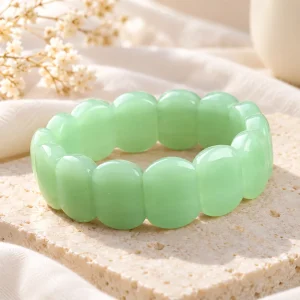
Reading a strand of beads
The thread stays hidden as long as the piece is taut. Give it back its curve: hold the strand by one end, let it hang, roll it between your thumb and index finger. The beads part at each bend and the thread shows, a few millimetres at a time.
Look for three things. The colour: a tired thread turns grey or brown, in places rather than along its whole length. The fuzz, those fine fibers standing up from the strand, visible in raking light. The stray fibers, when the thread comes apart.
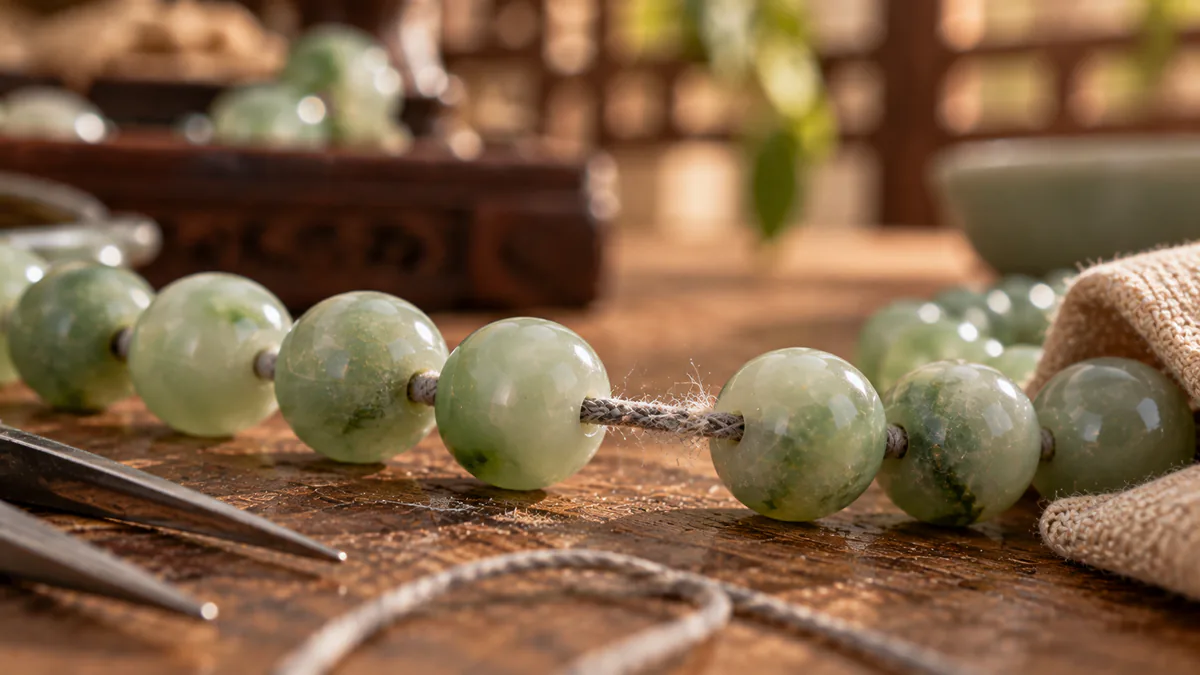
Slack is checked flat. Lay the strand out straight and push the beads toward one end: if a gap opens and does not close, the stringing has loosened, compacted knots on a knotted strand, a stretched thread on one without knots. Two spots deserve a separate look: the beads on either side of the clasp, and the lowest bead on a necklace.
Reading a pendant cord
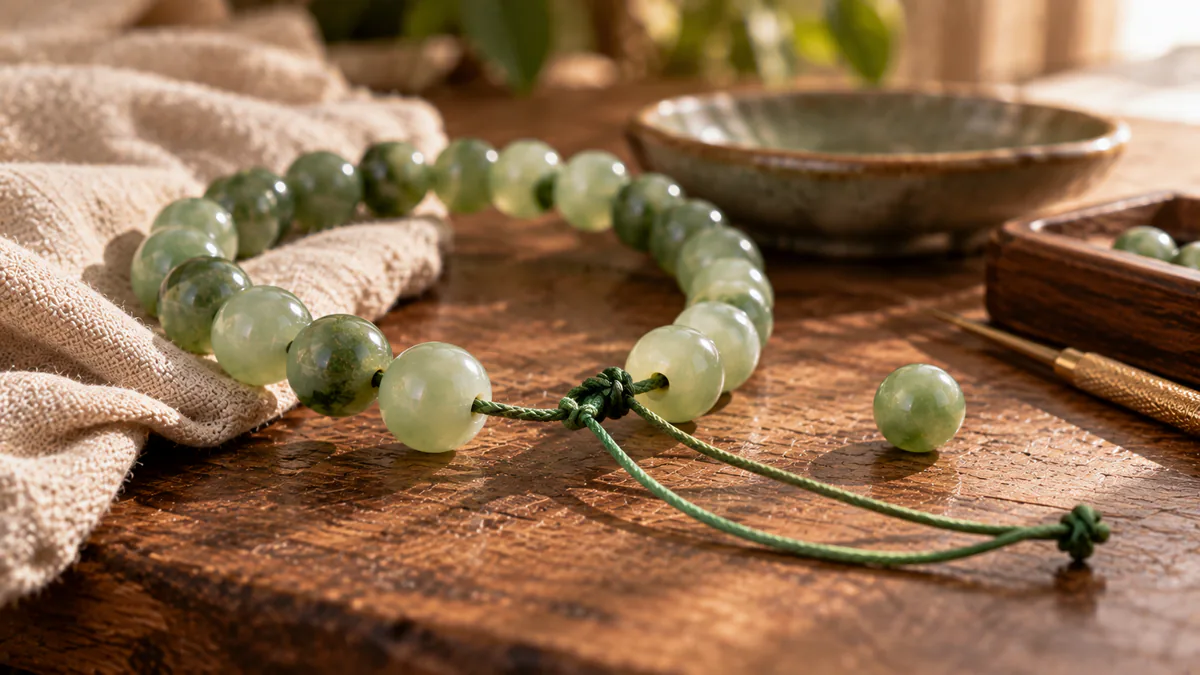
A cord works mainly in three places: where it passes through the bail or the hole in the stone, rubbing against an edge much harder than itself, the closing knot, and the sliding knot.
The signs differ from those of a strand. A tired cord flattens and turns shiny where it rubs; it stiffens, or loses all its spring; on a braided cord, strands work loose and form a loop that snags.
A sliding knot that slips is the most misread sign: people take it for a setting that is too loose, tighten it, and it slips again. It holds by the friction of the cord on itself, and a flattened cord has lost that grip; tightening it only speeds up the flattening.
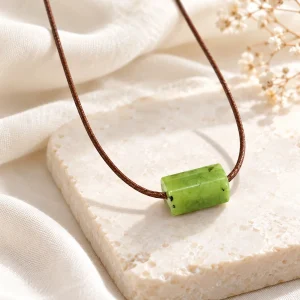
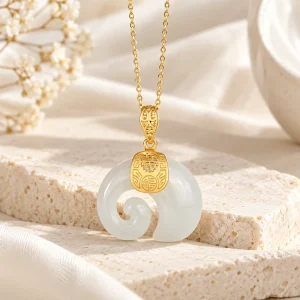
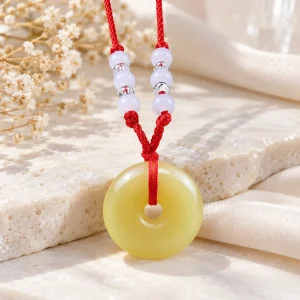
On the pendant on a braided cord as on the flat pendant necklace, the cord will be replaced several times on a stone that will not change.
What a knot between each bead does
On many strands, a knot separates each bead from the next, and it is not decoration.
- It limits the loss. When the thread breaks, one or two beads escape and the rest stay put long enough to close your hand. Without knots, everything goes at once.
- It keeps the beads from touching, and so from wearing down each other’s polish and the edges of their holes. Polish is one of the six criteria I look at in a piece: judging jade quality.
A strand without knots is not sloppy work for all that: it drapes more softly, and on very small beads the knot would be bigger than the bead. The case of the mala is in the jade mala.
Necklaces set or chosen one by one
What wears a thread without showing
- The edge of the bead’s hole, the file that none of the pages I opened mentions. Nephrite sits around 6 to 6.5 on the Mohs scale and jadeite 6.5 to 7, while no jewellery thread even appears on it. A sharp-edged hole saws the thread from the inside, where the eye does not go.
- Water and what it leaves behind. A thread that absorbs water swells, then dries stiff, and soap, chlorine and salt stay inside. The stone itself has nothing to fear: how to clean jade stone.
- Perfume, creams and sweat, applied to the skin, right under the jewellery. One simple habit protects a lot, putting it on last and taking it off first: how to use jade stone.
- Hanging storage. A strand hung on a hook keeps its whole weight on the thread, including the months when nobody wears it: storing jade jewellery.
Finally, no ultrasonic cleaner and no steam. They would be hard on the thread, but that is not my main reason: as long as a stone’s treatment has not been determined, you have to assume resin, which withstands neither cavitation nor thermal shock (type A, B, C jade, treatment information sheet).
When to have it restrung
A visible sign means a decision. As soon as the thread turns grey, gets fuzzy or comes apart, as soon as slack sets in or a sliding knot no longer holds, the piece goes in for restringing. A thread is not repaired, it is replaced, and leaving it late sometimes costs a bead.
An incident means an inspection. The piece stayed wet for a long time, it was dropped, it spent months hanging on a hook or at the bottom of a bag: take a look at it. One case is less obvious, when you want to wear it for a specific occasion; the restringing is done beforehand.
The work goes to a jeweller or a bead stringer, who will replace the thread and, if needed, the clasp, often the most worn part after the thread.
When the thread has already broken
Stay where you are and crouch down: beads roll, and taking one step sends them under the furniture. On a rug, a flat palm swept across finds them better than the eye. A knotted strand rarely loses more than one or two beads; a strand without knots means searching everywhere.
Put everything in a soft, closed pouch, away from other jewellery: loose beads scratch one another. Do not restring with whatever is lying around the house: sewing thread or elastic lets the beads rub.
Finally, look at the edge of each bead’s hole, where hitting the floor may have knocked off a chip. The stone rarely breaks, which does not mean never: a broken jade bracelet. If the piece came from me, the terms are on the delivery and returns page.
What I put no number on, and why
Three gaps on this page are deliberate, and I would rather name them.
No lifespan, no interval in months or years. I have read round numbers on this subject, they clearly rest on nothing, and I have no measurement of my own. A piece worn every day and the same piece taken out twelve times a year do not age at the same pace.
No restringing prices. I do not do this work, the prices are not mine, and they depend on the number of beads as much as on the setting.
No thread names. My pieces are set or chosen one by one, and I do not string them myself: my supplier does not tell me the reference of the threads it uses, and I am not going to guess it by eye. It is the principle I already hold for stone treatment: I say I do not know, rather than stay silent, which would read as a guarantee. The day I have feedback over several years, I will rewrite this section with my own numbers, dated.
Questions I get asked
How often should a jade bead bracelet be restrung?
I give no interval: I have not measured one, and wear depends on how the piece is worn. The signs decide, and checking the thread two or three times a year takes the place of a schedule.
Can a thread break with no warning at all?
Yes, in two cases. When the wear comes from the edge of a bead’s hole, it happens on the inside and cannot be seen. And when the strand is yanked, by a sleeve or a car door: it gives way where it was weakest.
Can I restring my strand myself?
Nothing stops you. But the knot between each bead takes a steady hand to land in the same place every time, and a makeshift thread wears the holes. I prefer to take it to a jeweller or a bead stringer.
Is a pendant on a cord more fragile than a pendant on a chain?
A cord wears faster, a chain gives less warning: a cord shows readable signs for weeks, a chain breaks at a link or at the clasp with no notice. Neither is better in itself.
Should I take off my bead bracelet to wash my hands?
It is better, and the stone is not the issue: water and soap stay in the thread after the surface dries, and a thread that swells and then stiffens ages faster. Dry the strand flat by patting it, without hanging it up.
Why do some of your product pages show no density?
Because my weighing is done on the bare stone, and a strung strand cannot be weighed: the thread and clasp enter the measurement and distort it. When the example arrives already strung, or when the bead is too small for my scale to tell 2.95 from 2.65, the product page says so.
Where I checked
What comes from a named source. The density ranges and the Mohs hardness values are those of the mineralogical literature: I repeat them, I have not measured them, and their limits vary by a few hundredths from one database to another, which is why I attribute them to no organization. On jewellery threads, I found no public standard, and French Decree No. 2002-65 of 14 January 2002 says nothing about stringing: I note it rather than let anyone believe an official standard exists.
What is a dated market observation. On 8 September 2026, I opened the nine French competitors on the first page of results: their care advice all stopped at the stone, lukewarm water and soap, and none mentioned the thread, the part that gives way. The same day, my supplier confirmed that it cannot say whether its goods are treated, and it did not give me the reference of the threads.
What is my own reasoning. The three signs I keep, the order of the causes of wear and the refusal to give a numbered interval are decisions drawn from the mechanics of the object, not established facts. I suspect the edge of the hole counts for more than the number of movements, and I write it as a suspicion: I have not measured it. If your experience contradicts one of these points, write to me: I will correct it and note the change.
In one sentence
A thread wears out long before the stone it carries, it tells anyone who looks between two beads, and the right time to have it restrung is when it turns grey. What I measure is on the weighing page, and the pieces are in the shop.