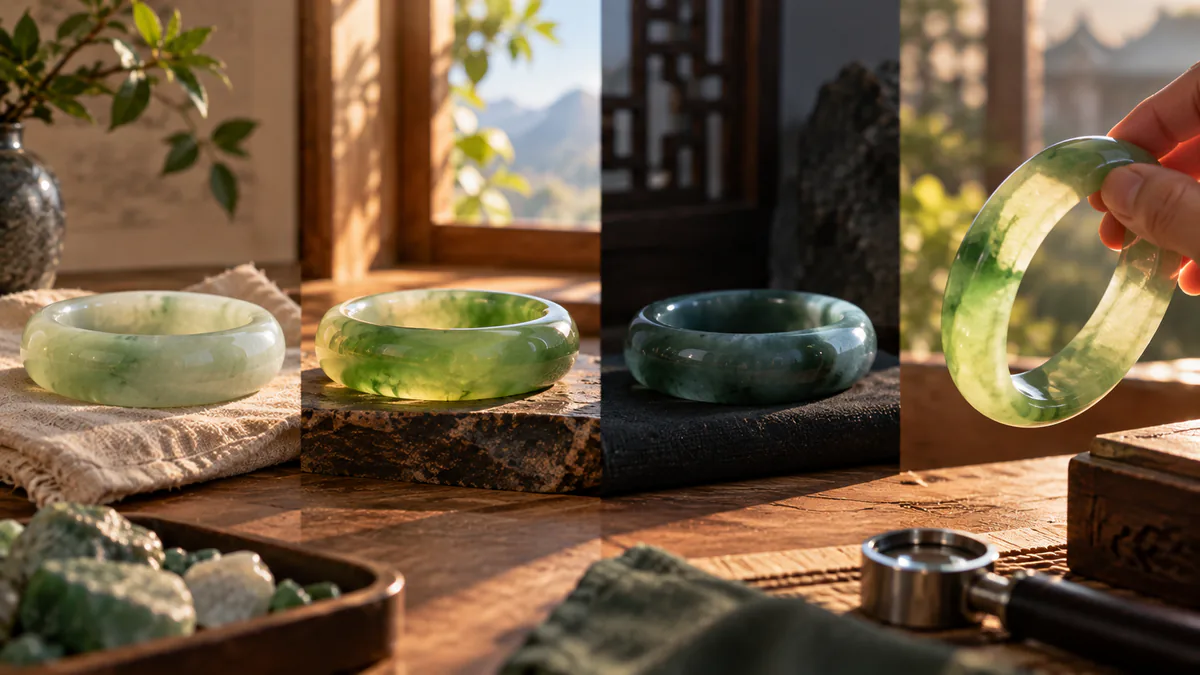
A Jade That Changes Colour: What Explains It
Behind searches for “jade changing colour” there is usually one situation: a jade piece that no longer looks like the one you received. This page sorts out the reasons: what its surface builds up, what skin and products leave on it, and what an impregnation resin turns into as it ages.
A jade changes in appearance far more often than it changes colour: its hue comes from elements lodged in the structure of the mineral, which do not move, and what does change is whatever has been added to it, a greasy film, badly rinsed soap, or a resin that yellows.
The distinction is not a matter of vocabulary. In jadeite, vivid green comes from chromium and ordinary green from iron; in nephrite, from iron alone. These elements are locked into the mineral’s crystal lattice, and nothing in a bathroom will dislodge them (the colours of jade stone).
My name is Jade, and I run a jade jewellery workshop: I choose the pieces, have them set, and weigh one example of each reference before it goes on sale. I am not a gemmologist or a therapist: here, the mineralogy is stated as fact, and everything else is attributed.
Darkening, fading, staining
The sentence people write to me covers three observations that do not have the same cause, and it is worth knowing which one you are describing.
- It has darkened, and the green looks duller than before.
- It has faded, or rather it has lost its depth: the colour is there, but it no longer seems to come from inside.
- It has stained: a dark line along an engraving, a ring around the drill hole of a bead.
The three causes below are listed in the order I come across them, and I keep them separate: mixing them up leads to washing a piece that does not need it, or the reverse.
What comes from the stone
Neither jadeite nor nephrite is porous like turquoise, but neither of them is glass. The first is made of fine interlocking grains, the second of fibers matted together like felt (jadeite or nephrite). Between the grains, within the fibers, and in the micro-cracks open at the surface, tiny pockets remain.
What fills them is almost always the same thing: a greasy film loaded with everyday dust. It is thin and even, and that is what makes it misleading: it does not make a stain, it makes a tone. A stone that is evenly duller may simply be dirty.
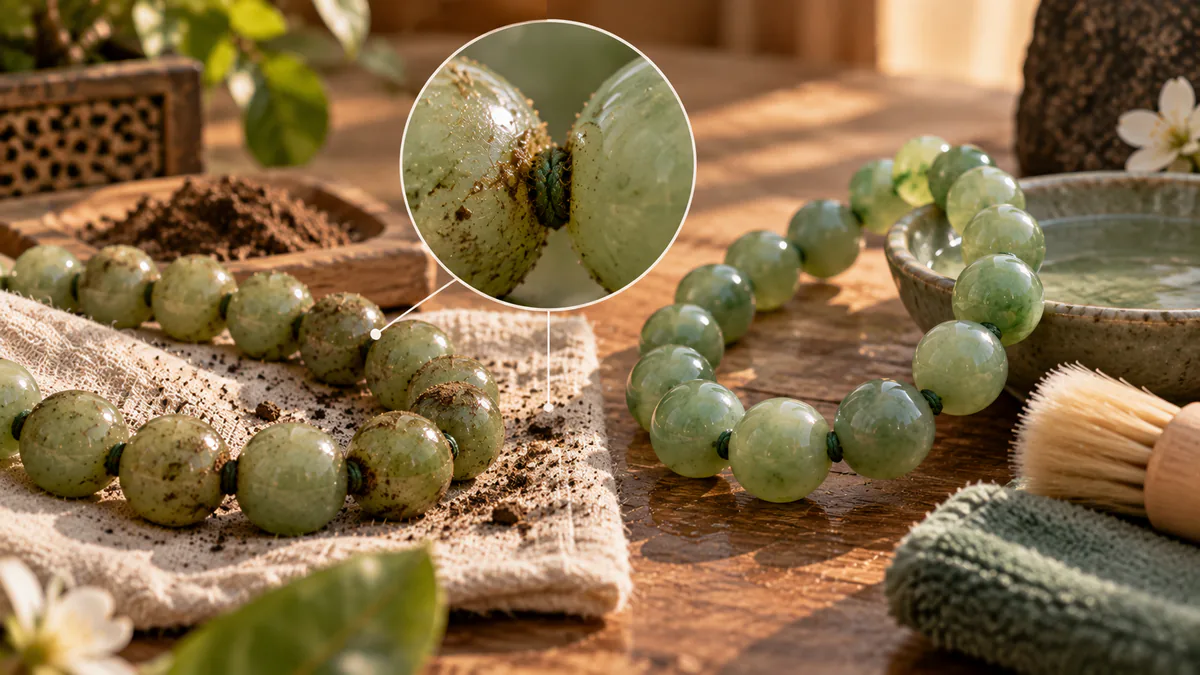
The polish, on the other hand, really does wear. Household dust contains a good share of quartz, which rates 7 on the Mohs scale, while nephrite sits at 6 or 6.5 and jadeite at 6.5 or 7: wiping it dry amounts to rubbing an abrasive over a polish. Jade’s toughness protects it from breaking, not from scratching (judging the quality of a jade).
What comes from the body and from products
A piece of jewellery that is worn lives in a modest but constant chemical environment. Nothing below attacks jadeite or nephrite. All of it leaves deposits.
- Lotion and skin oil make the greasy film described above. On a bangle, the inside darkens before the outside, which gives a two-toned piece.
- Badly rinsed soap dries into a whitish haze in the hollows of a setting, and it dulls faster than the dirt it replaced.
- Perfume and hairspray leave alcohol, oils and dyes on a narrow area: their mark is local, and it is the one people mistake for a stain in the stone.
- Sweat, chlorine and seawater mostly work on the metal, the glue and the thread (thread and cord).
There is one case where the stone really is innocent: when it is the setting that has changed. Sterling silver tarnishes and turns black on contact with air and skin; under a bezel, that black runs right along the edge of the stone and blends into it. The routine that solves most of these cases is in how to clean jade stone.
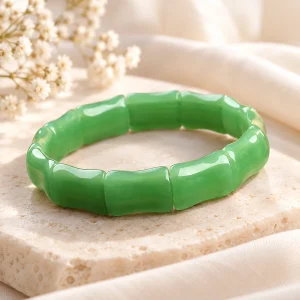
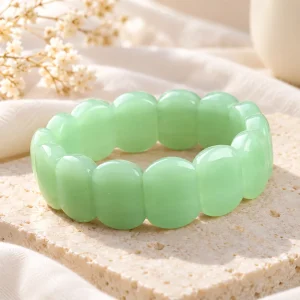
Bracelets whose mineral and density I publish
What comes from a resin
The two previous causes can be fixed with lukewarm water. This one cannot, and it is the only one that tells you something about what the stone went through before it reached you.
A so-called type B jadeite has been bleached with acid, then impregnated with a polymer resin that restores its cohesion and its wet look. Type C has received a dye, in addition or instead. What these treatments introduce is not mineral: it is an organic material, and it ages (type A, B and C jade).
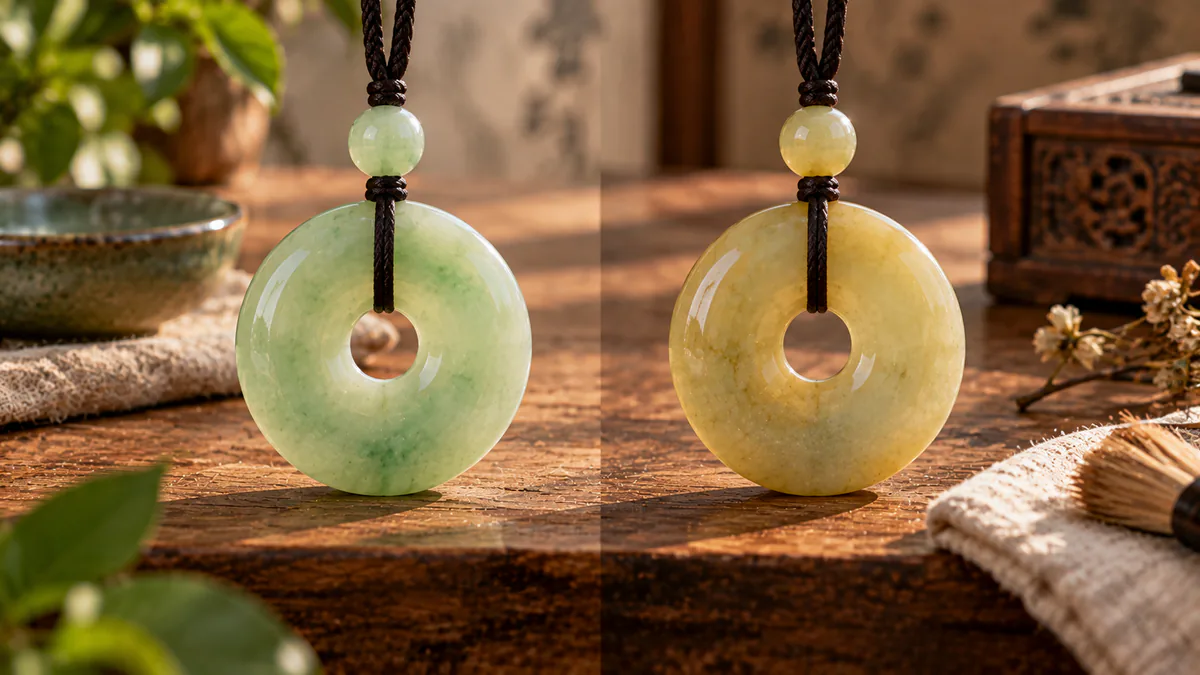
A resin yellows under ultraviolet light and heat, and it clouds. The change it produces therefore has its own signature: it is in the body of the stone, not on the surface, it is even, it leans toward yellow, and above all it does not wash off. A piece that comes out of the soap looking just as it went in points me toward impregnation, without proving it.
My hydrostatic weighing establishes the mineral, jadeite or nephrite rather than serpentine or dyed quartzite, and nothing more: resin does not shift the density enough to show up on a scale. My supplier does not know the treatment status of their goods, only infrared spectroscopy would settle it, and I do not have that (the treatment information sheet).
Dye, which does the opposite
A dye, instead of spreading through the whole stone, concentrates where the material is open, cracks and grain boundaries, and then fades where the light hits. A colour that recedes unevenly, faster on the exposed side, points toward added colour (dyed jade).
“My jade stone has turned black”
That is exactly how the question reaches me, and the word black steers toward worry rather than examination. Four ordinary explanations first.
- A greasy film loaded with dust, settled into an engraving or around a thread, which reads as black when it is grey.
- A tarnished silver setting, which darkened first and drags the way you see the stone along with it.
- Worn polish on an already dark stone: it does not get blacker, it gets matte, and matte looks duller.
- A dye that has shifted, or a resin that has clouded, on a piece whose treatment was unknown.
The test that separates the first two cases from the last two is further down. What is not on this list is the health of the person wearing the stone, and I will not put it there.
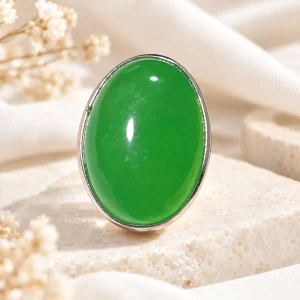
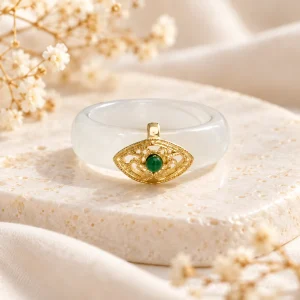
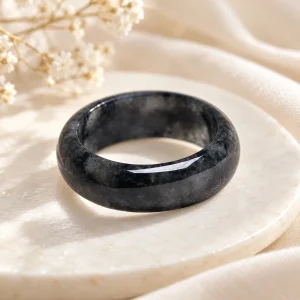
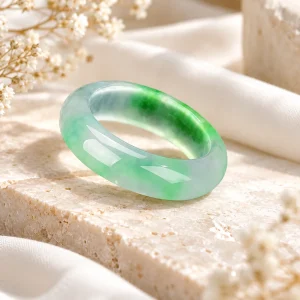
Jade rings, chosen one by one
A jade that fades
The opposite direction has a different explanation. A stone that seems to have lost its colour has most often lost its ability to let light through. An intact polish lets light in, lets it travel through the material and come back out: the hue seems to come from deep inside. A worn polish sends it back from the surface, and the same stone looks milky, lighter, flatter.
Two explanations need to be ruled out before drawing a conclusion. Oil first: it gives a jade depth for a while, and it comes off at the first wash. Memory next: you are not comparing the stone to itself but to the image you kept of it, under a shop’s lighting (how to recognise genuine jade).
What tradition says about it
What follows changes register, and I flag it rather than blending it into the rest. Nothing in it is proven: it is what traditions have attributed to this stone.
The belief is old. A stone worn for a long time would “nourish” its wearer and be nourished by them in return; it would darken when health declines and brighten when luck returns. These are reported attributions, never established, gathered in what tradition attributes to jade stone. The same family of stories surrounds the bracelet said to break in place of its wearer: a jade bracelet that breaks.
I report this belief, I do not use it, and the reason is practical: someone who attributes a darkening to their own health does not wash their stone and does not ask whether it was impregnated, which means they set aside the only two questions that have an answer.
When a stone has changed
In this order, and the first step alone rules out most of the cases people send me.
- Wash it properly, once: lukewarm water, mild soap, a long rinse, immediate drying. No ultrasonic cleaners, no steam, no toothpaste, no vinegar, and the reason for each is in how to clean jade stone.
- Look at the stone wet, then dry, in the same place and at the same time of day: water does what a fresh polish does, it restores depth.
- Take a photo of the piece next to a sheet of white paper, noting the date: that is what lets you compare something other than a memory later on.
- Do not try anything else. Repolishing removes material, and it does not reach what has yellowed within the stone.
| After washing | What it points toward | What it does not prove |
|---|---|---|
| The colour has come back | a greasy film, soap, dust | that it will not get grimy again |
| A dark line remains in the hollows | settled grime, or a dye | which of the two, to the naked eye |
| The yellow is even and has not moved | an impregnation that is aging | the treatment type |
| The stone stays matte even when wet | worn polish | that the colour itself has changed |
Questions I get asked
Why has my jade stone turned black?
Most often because a greasy film loaded with dust has settled into the grain and the engravings, or because a silver setting next to it has tarnished. Wash the piece in lukewarm water: if the tone comes back, the question is settled.
Does real jade change colour over time?
Its colour, no: it comes from elements lodged in the structure of the mineral, which do not migrate. Its appearance, yes: the surface gets grimy, which can be fixed; the polish wears, which can only be fixed by repolishing.
Does jade change colour depending on the wearer’s health?
That is an old belief, which I report in the conditional and which is not established. Nothing I can measure supports it, and it distracts from the two ordinary explanations, dirt and an impregnation that is aging.
My jade bracelet has yellowed: what should I make of it?
If the yellow is even, spreads across the whole piece and survives washing, it points toward an impregnation resin that is aging. It does not prove it: only infrared spectroscopy would settle it, and no one can read it by eye.
Can jade lose its colour in the sun?
The natural colour of a jadeite or a nephrite does not fade. An added colour can: some dyes fade in light, faster on the exposed side. A piece that loses colour on one side therefore gives you a clue.
Should I worry if a jade I was given changes in appearance?
Not before you have washed it and looked at it wet: a piece worn every day builds up a greasy film within a few weeks, and that is the ordinary case. From then on, photograph the piece and note the date.
Where I checked
What comes from a named source. Chromium and iron as the sources of green, the structure of the two minerals, and the hardness values I give, quartz 7, nephrite 6 to 6.5, jadeite 6.5 to 7, come from the mineralogical literature: I cite them, I did not measure them, and their limits vary by a few tenths from one database to another. So I do not attribute them to any single organization. The description of types B and C is the one used in jade gemmology, and the legal text that governs it is cited in type A, B and C jade.
What is a dated observation. On 8 September 2026, my supplier confirmed that they cannot say whether their goods are treated. The same day, while building this site’s plan, I found the French question “pourquoi ma pierre de jade est-elle devenue noire” (why has my jade stone turned black) listed by keyword tools with a published volume of zero: asked often enough to appear in their lists, too rarely to be counted. Of the nine French competitors I noted that day, none states the mineral of its pieces.
What is my own reasoning. The order in which I list the three causes comes from the photos people send me, not from a count. The link between worn polish and a stone that looks lighter, the link between tarnished silver and a stone that seems to have blackened, and the rule that an even yellow that survives washing points toward impregnation: these are reading decisions, not established facts. I have not aged any impregnated piece to check, so I publish no time frame, nor any number of years after which a resin yellows. If you find an error here, write to me: I will correct it and note the change.
In one sentence
A jade that changes colour has almost always changed at the surface, and washing it tells you within a minute what can be fixed and what had been added to the stone before it reached you. The two minerals are told apart on the main page, and the pieces are in the shop.