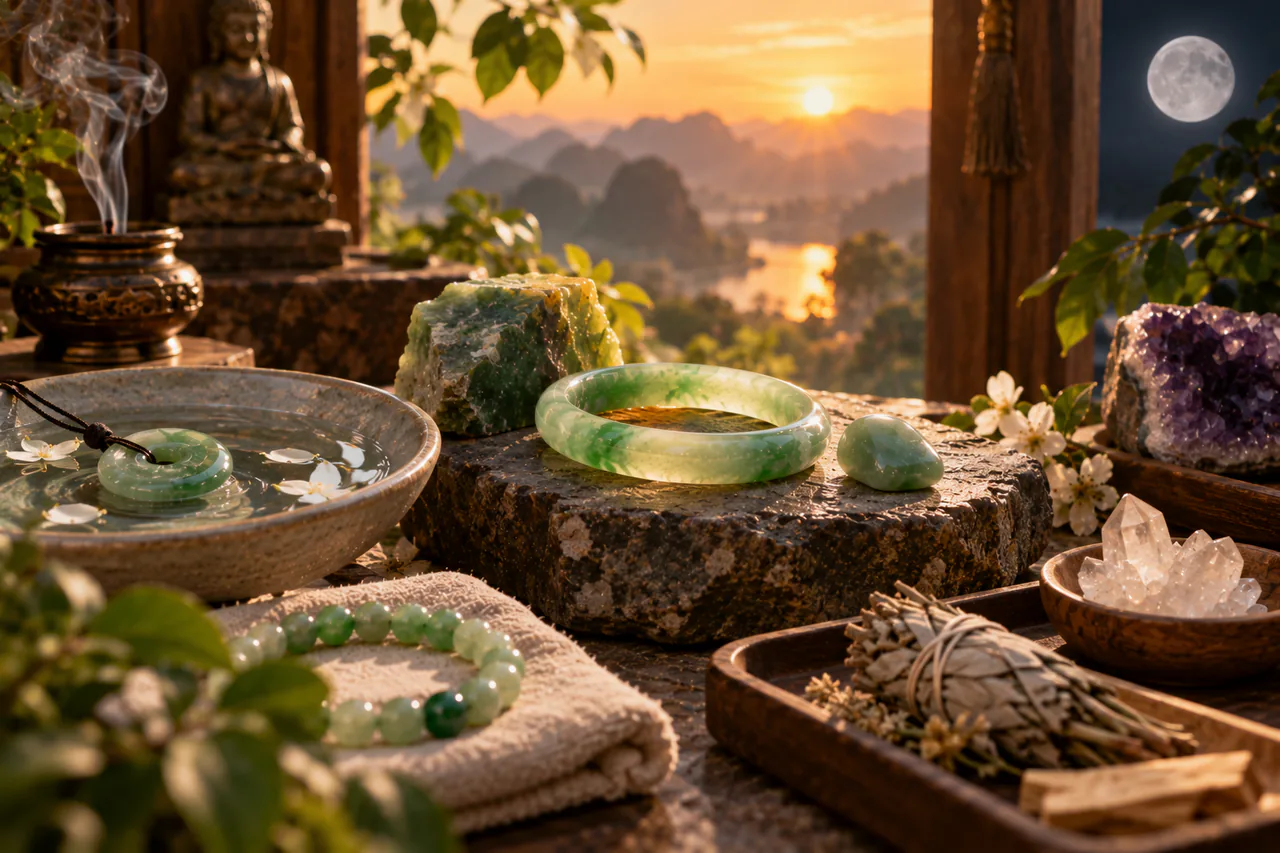
How to Charge a Jade Stone, and What the Word Covers
How to charge jade: this page breaks the word down into separate gestures, then looks method by method at what actually happens to the stone, the metal and the thread. Salt, for its part, really does damage, and it is not the stone it attacks.
Charging a jade stone is a matter of belief, not an operation on the material: the common methods add nothing to jadeite or nephrite, and what they reach most often is the metal, the glued joints and the thread of the jewellery, with salt at the top of the list.
Three words travel together without meaning the same thing. Cleaning is a physical act. Cleansing and charging come from another register: they assume that a stone accumulates something and then gives it back, which is not established. I cover them anyway, because the gestures recommended to carry them out have perfectly real effects on a piece of jewellery.
My name is Jade and I run a jade jewellery workshop: I choose the pieces, have them set, and weigh one example of each reference before it goes on sale. I am neither a gemmologist nor a therapist: here, mineralogy is stated as fact, and everything else is attributed.
Cleansing, charging, cleaning: three words that get mixed up
In everyday vocabulary, cleansing means taking away and charging means giving back. People almost always look for the two together, and often in the same sentence as cleaning, which has nothing to do with either: cleaning removes cream, soap and dust, and it has its own page, how to clean jade.
Someone who types how to charge jade is therefore looking for two things at once: a ritual, and the reassurance that they will not damage their jewellery while performing it. I answer the second, which is my trade, and I place the first in a flagged section further down, worded as attribution.
The caution is practical rather than theoretical: the word jade covers two unrelated minerals, jadeite and nephrite, and a good share of what is sold under that name is neither. The distinction is laid out on the main page.
The methods you come across, and what they touch
Here are the eight gestures I see come up again and again. The right-hand column is the one I have read nowhere, and yet it is the one you pay for in repairs.
| Gesture | On the stone | On the rest of the piece |
|---|---|---|
| Clear water, a few minutes | nothing | thread and glued joints, if the soak drags on |
| Salt water, coarse salt | nothing | tarnished silver, breached plating, stressed glued joints |
| A night outdoors, moonlight | nothing | dew, temperature swings, a piece gone missing |
| Full sun, several hours | colour, if the piece is dyed | heat on the glued joints |
| Burying in soil | polish dulled by the grains | moisture, salts, rotted thread |
| Incense or sage smoke | a film to wipe off afterwards | residue in the recesses of the setting |
| Singing bowl, sound | nothing | nothing |
| Quartz or amethyst cluster | possible scratches | nothing |
Salt, and what it attacks before the stone
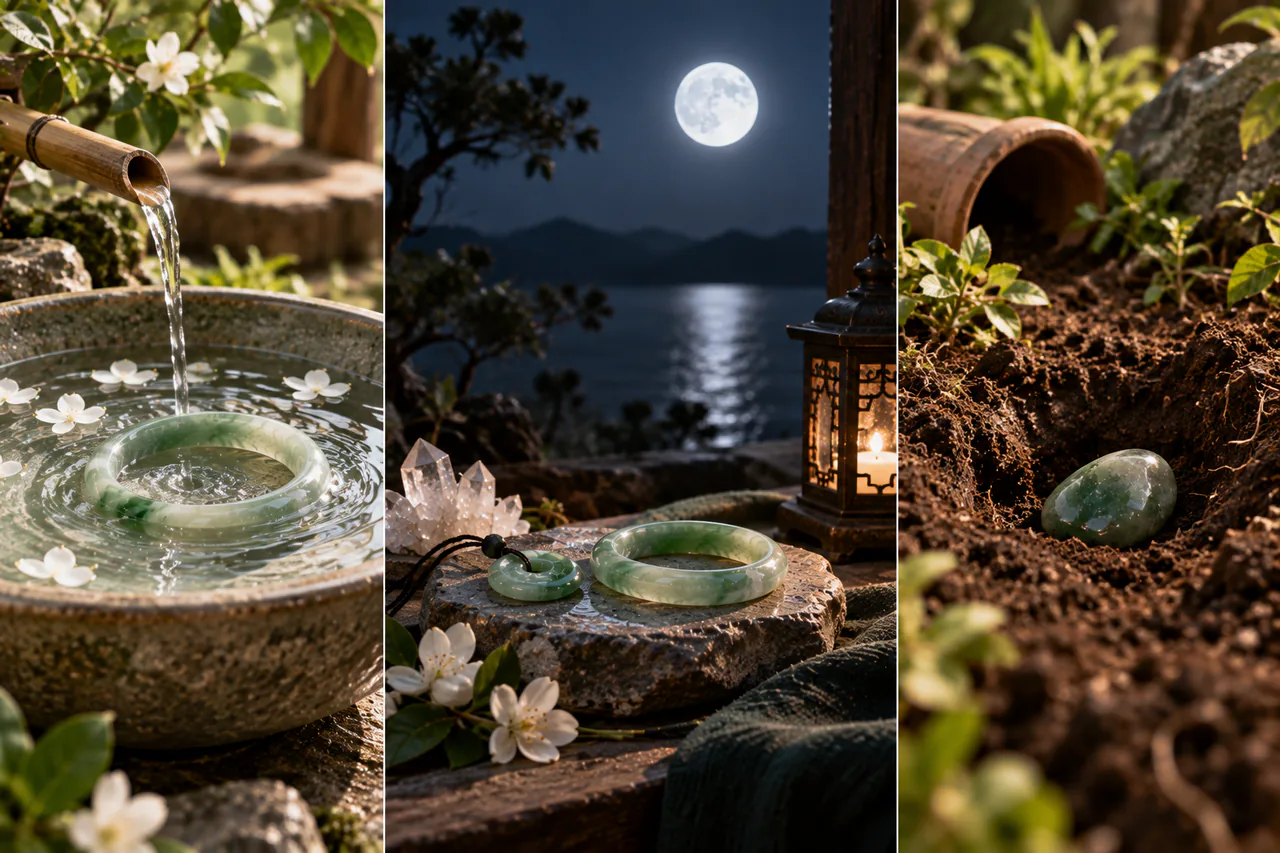
Salt is the most recommended method on the pages I have read, and the one that worries me most for a set piece. Much softer than jade, it does not scratch it: the stone comes out of the bowl unchanged. It is not the stone I am watching.
Dissolved, salt makes an electrolyte, which is to say the medium corrosion needs. On a 925 silver setting, it speeds up tarnishing; on a plated metal, it works on the base metal through the slightest pore, and the plating lifts off in patches. This is not an opinion, it is ordinary corrosion, and you can see it with the naked eye on the setting. That is where the choice of metal plays out: jade jewellery in gold or in 925 silver.
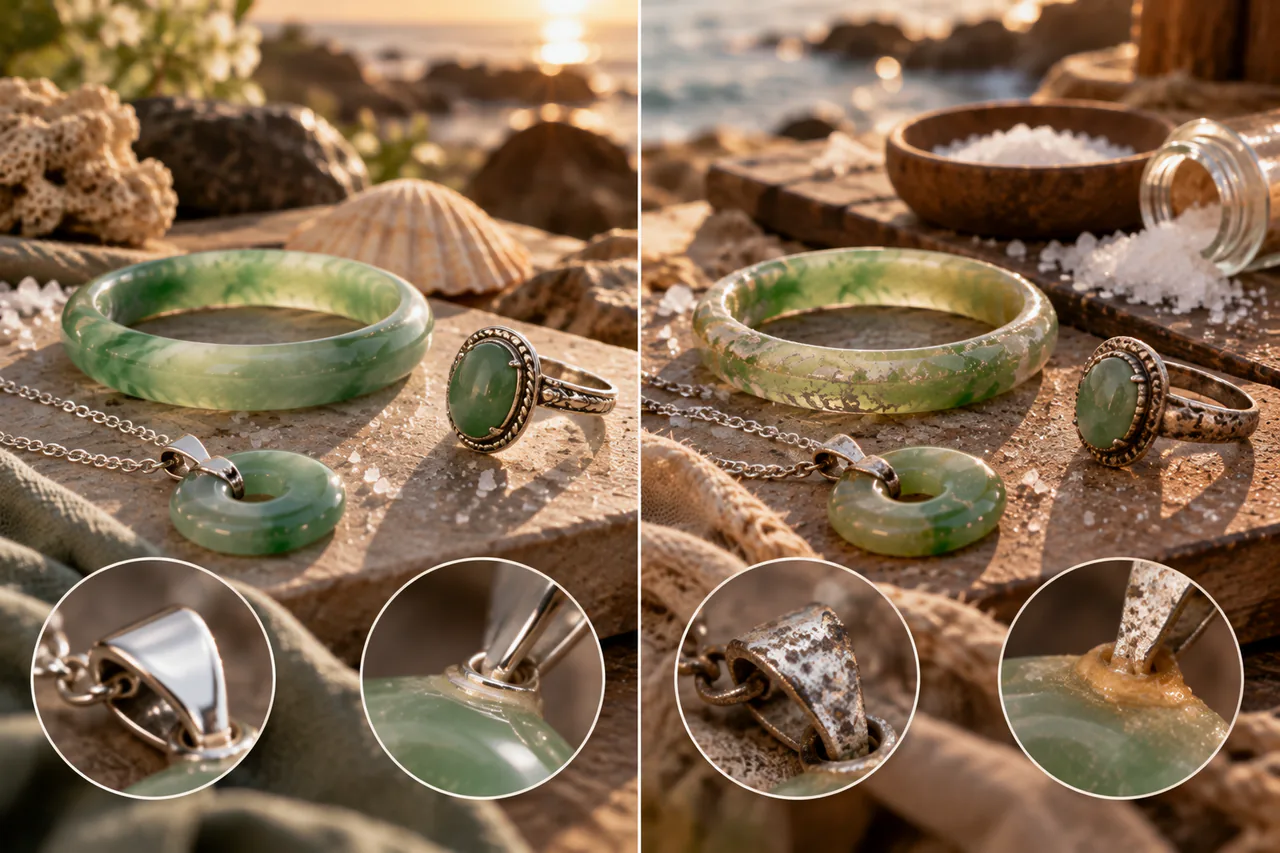
Two less visible kinds of damage follow. Salt seeps into a glued setting and crystallizes as it dries, the crystals grow in the joint, and a stone that moves in its bezel cannot always be glued back. On a strung strand, salt water stiffens the thread, silk or elastic, which then snaps all at once: the thread and cord of a jade piece, a jade bracelet that breaks.
Dry salt is no way out: it is hygroscopic, and the humidity of a lived-in room is enough for it to form the salty film that does the rest. If the ritual matters to you, put the salt in a small dish and the stone next to it. The gesture stays intact, and so does the jewellery.
Bracelets whose density I publish
Clear water, the moon, the sun
Neither jadeite nor nephrite dissolves, and a rinse under clear water does nothing to them. What suffers from a long soak is the thread, the glue, and a clasp you forget to dry. Water in daily life, the shower, the pool and the sea, has its answer in how to use jade stone.
Moonlight is reflected sunlight, incomparably weaker: nothing happens through it. What does happen during a night outdoors is more prosaic: dew, the temperature swing, and the piece you cannot find in the grass. An indoor windowsill gives you the same ritual without the risk.
The sun deserves a real reservation. I do not know whether my stones are dyed: my supplier does not know the treatment status of the goods, my scale does not say, and only infrared spectroscopy would settle it. So I treat every piece as if it could be, and an added colour can fade under prolonged ultraviolet light: dyed jade, jade A, B, C, the treatment information sheet.
Soil, smoke, sound, the quartz cluster
Soil is the gesture that goes after the polish most directly. Ordinary soil contains grains of quartz, which rates 7 on the Mohs scale, whereas nephrite sits at 6 or 6.5 and jadeite at 6.5 or 7. Burying a polished stone and then wiping it means rubbing an abrasive over a polish, and nephrite loses out faster than jadeite: why jade almost never breaks.
Smoke from incense or sage leaves a greasy film and soot, which settle in the recesses of a setting. Nothing serious, but the paradox is worth noting: you end a cleansing gesture with some cleaning to do. Sound from a bowl, on the other hand, touches nothing: it is the only one of these gestures I can call physically neutral, and that is what makes it advisable when the ritual matters to you.
The quartz or amethyst cluster is the trap I have seen flagged nowhere. People set the stone on it to charge it, which means against quartz, harder than nephrite and level with jadeite: the point of a druse scratches whatever rubs against it. A square of fabric between the two settles the question, just as it does in a jewellery box: storing a jade piece.
Jade rings, chosen one by one
What traditions attribute to the gesture
What follows changes register, and I flag it rather than blending it into the rest. Nothing in it is proven: it is what traditions have attributed to this stone.
Contemporary crystal healing authors describe, by their own account, a stone that takes on a charge through contact and would need to be discharged and then restored. That is where salt, water, the moon and the soil come from, along with the idea that timing matters. None of the methods I have read is dated or compared from one author to the next: durations and moon phases vary from one book to another.
The vocabulary of charging is recent and Western. I do not find it in what I know of Chinese thinking about jade, which attributes moral qualities to the stone rather than a reserve of energy to top up: the moral virtues of jade, and what tradition attributes to jade stone. What I will never write: that a charged piece of jewellery protects, heals or brings luck.
What I do when a piece comes back to me
Lukewarm water, mild soap, a soft cloth, immediate drying, and nothing else. Never ultrasound, never steam: as long as the treatment has not been determined, you have to assume resin, which withstands neither cavitation nor thermal shock. Then a soft pouch, on its own, because what scratches a jade is almost always another piece of jewellery.
What I do before a piece goes on sale is of another order: I weigh one example of each reference in air and then immersed, and I publish the figure. The protocol and its limits are on the weighing page. It tells you the mineral, not the treatment.
The questions I get asked
How do you cleanse and charge a jade stone at the same time?
Both serve the same purpose, that of a ritual, and the same gesture can carry both intentions. A rinse under clear water followed by immediate drying carries no risk. What matters is what you avoid: salt, burying and full sun.
Can you put a jade stone in coarse salt?
The bare stone risks nothing, since salt is too soft to mark it. A set piece does: salt speeds up the tarnishing of silver, works on plating through its pores, crystallizes in a glued setting and stiffens a silk thread. Put the jewellery next to the dish rather than in it.
Do you have to wait for the full moon?
Nothing in the material calls for it: moonlight is reflected sunlight, far too weak to act on a mineral. If the date matters to you, it matters as a marker, and an indoor windowsill keeps the dew away.
How long does it take?
I have no duration to give you, and I would rather say so than invent one: the books that offer one do not agree with each other. The durations that have a physical effect are those of a soak, a burial and sun exposure, and all three work against the jewellery.
How do you cleanse a jade stone without water?
The sound of a bowl touches nothing, so it suits perfectly. Incense smoke works too, provided you wipe off the film it leaves. Avoid the quartz or amethyst cluster: those crystals are harder than nephrite and can scratch it.
And a bangle that will not come off?
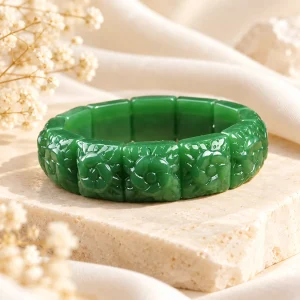
Treat it like the skin wearing it: lukewarm water, mild soap, a rinse and careful drying, without taking it off. A bangle carved from a single block has no thread and no glue, which removes most of the risks listed here. Salt and soil remain.
Where I checked
What comes from a named source. The hardness values I cite, quartz 7, nephrite 6 to 6.5, jadeite 6.5 to 7, come from the mineralogical literature: I repeat them, I did not measure them, and their bounds vary by a few tenths from one database to another. So I do not attribute them to any particular body. The refusal of ultrasound and steam rests on a material fact: a type B jadeite is impregnated with resin, which withstands neither cavitation nor thermal shock.
What is an observation, dated. On 8 September 2026, my supplier confirmed to me that they cannot say whether their goods are treated. On the charging pages I opened, salt and burying come up almost every time, and I read none that says what those gestures do to a silver setting or a silk thread.
What is my own reasoning. Applying to jewellery what chemistry says about an electrolyte, treating dry salt as risky on the grounds that it is hygroscopic, ruling out the quartz cluster because of a difference in hardness, treating every piece as if it could be dyed: these are decisions, not established facts. I have not timed any tarnishing on a test piece, so I publish no timeframe. If you find a mistake here, write to me: I will correct it and note that I did.
In one sentence
How to charge jade comes down to this: the gesture adds nothing to jadeite or nephrite, but most of the methods on offer change something about the jewellery, and salt is the one that costs the setting the most. Cleaning, for its part, has a method: how to clean jade, and the pieces are in the shop.
Pendants, with one named mineral per piece