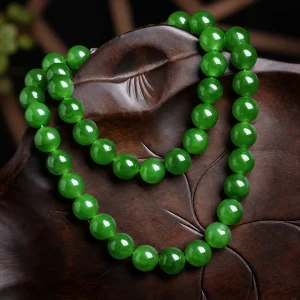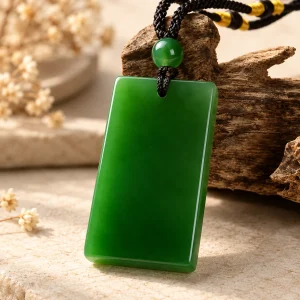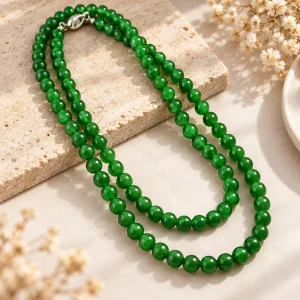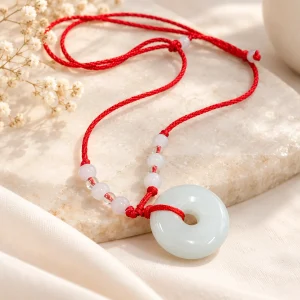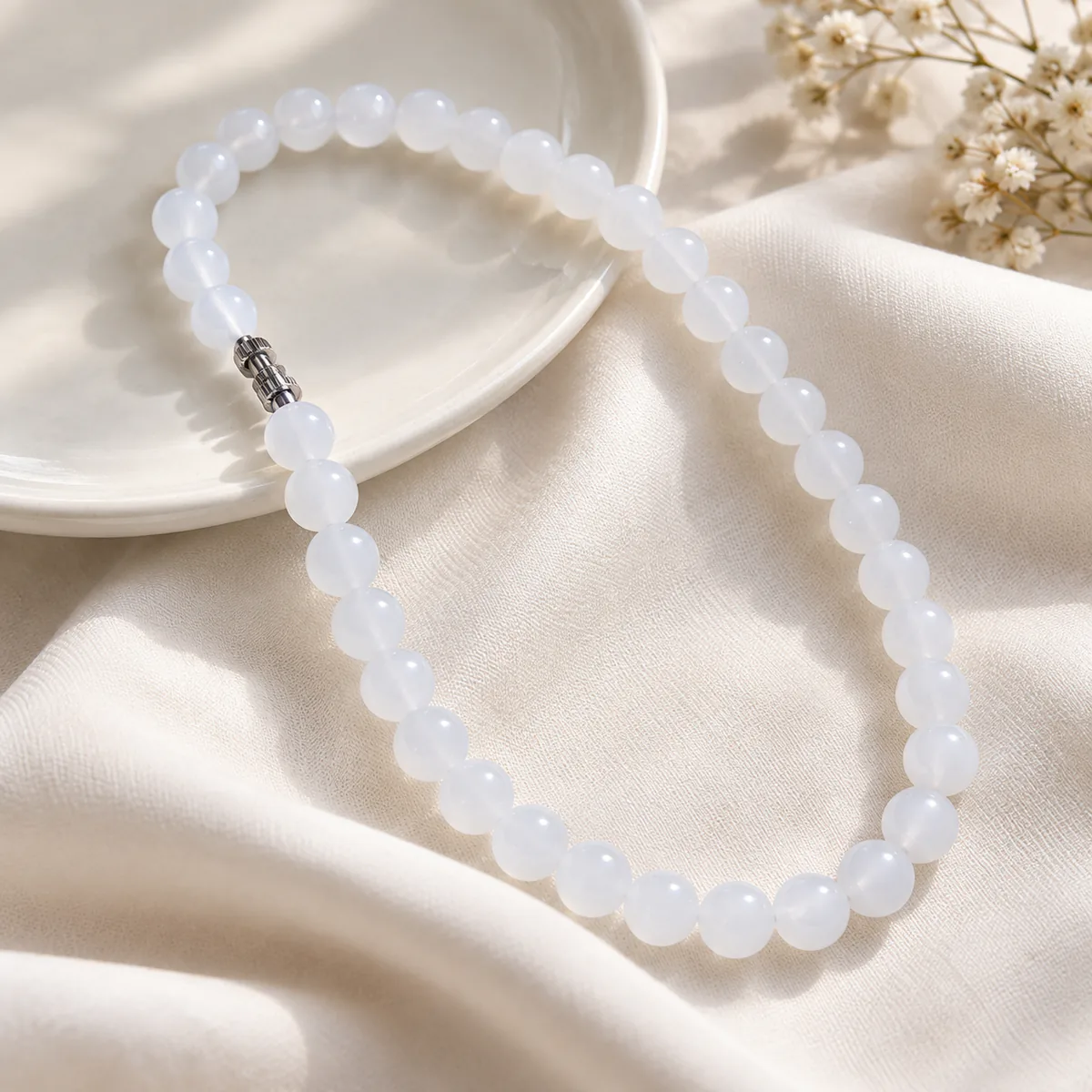
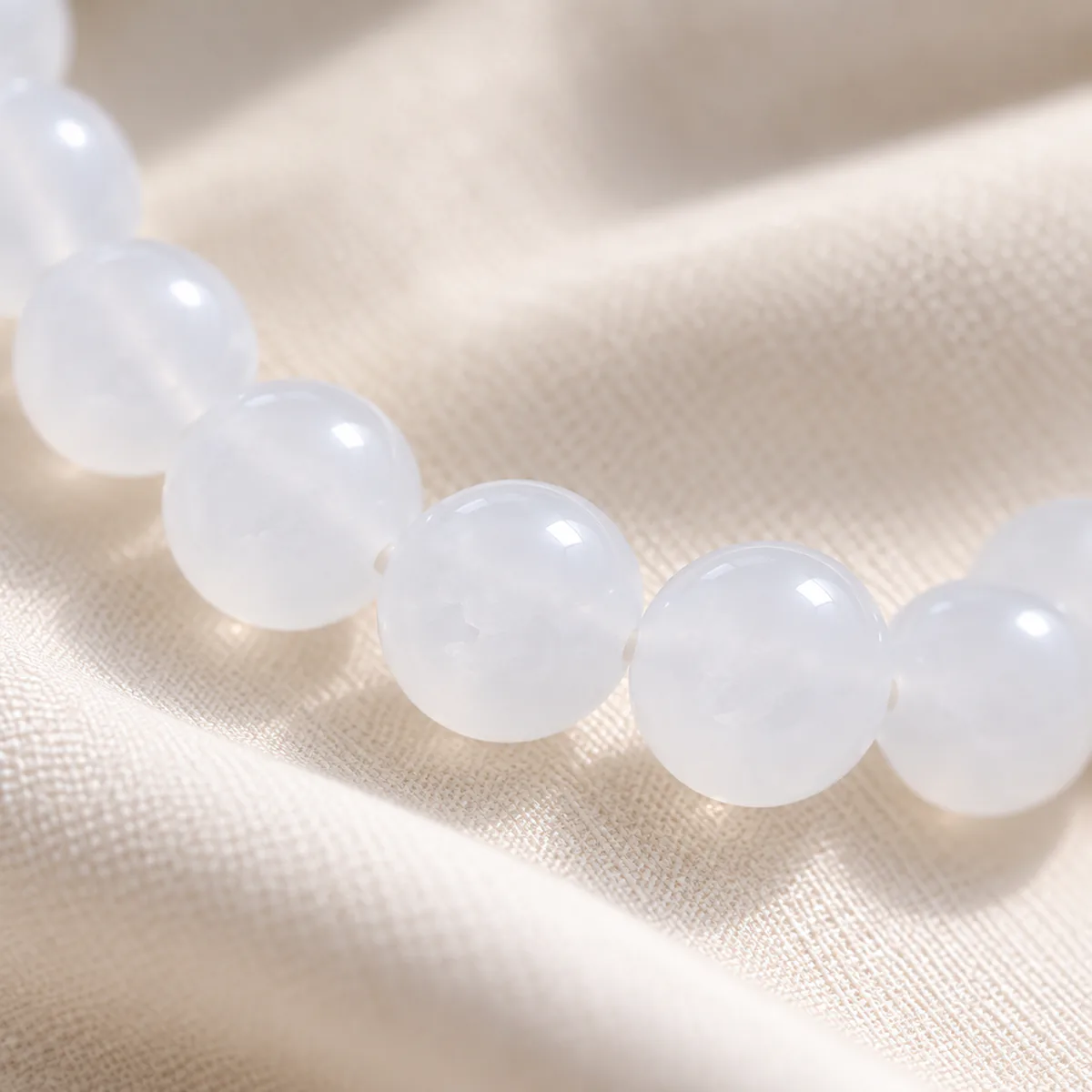
A white jade necklace strung as a strand of round nephrite beads, a milky white and clearly translucent, closed by a small cylindrical metal clasp. The beads are of an even diameter and the white is almost identical from one to the next.
In four lines
- A strand of round nephrite beads, milky white and translucent.
- Cylindrical metal clasp, alloy not specified by my supplier.
- White and strung: no figure will be published on this reference.
- This page explains why white is the hardest colour to judge.
Why white is the hardest colour
On a green, the gap in density between jade and its imitations is comfortable: serpentine sits around 2.6, quartzite around 2.65, nephrite starts at 2.90. A kitchen scale is enough to separate them.
On a white, the imitation is no longer called serpentine or dyed quartzite: nobody dyes a stone white. It is called dolomitic marble, often sold under flattering geographic names, and its density sits around 2.85. Against 2.90 for the bottom of the nephrite range: four or five hundredths of a gap, where green offers thirty.
And on this one, the scale will not even speak: a strung strand cannot be weighed, the clasp being metal and the thread absorbing water. I do not cut a necklace to weigh a bead. In other words, my method does not apply here, and I am not going to pretend otherwise in order to sell a piece. The three limits of the weighing.
What is left to look at, and what it is worth
What the scale loses, the eye partly recovers on this colour. A white nephrite is translucent over a few millimetres: held before a lamp, the bead lights up and the light passes through, softening. A marble is more opaque, its light stops sooner, and it shows crystalline grains instead, like sugar.
Look also at the drill hole, the only place where the inside of the stone is visible, and at the grain against the light: nephrite is made of interlocking fibres, which often gives a cloudy or slightly fibrous look in the mass. None of these signs is a proof, and I will not present them as such. The checks that need no equipment.
White, an old colour
Today’s market overvalues intense green. Ancient China placed white jade very high, and for centuries: jadeite, the stone of clear greens, only reaches China in the 18th century, and everything before that is nephrite. The hierarchy of colours is a matter of period, not of nature. The colours of jade.
The two minerals are moreover not related at all: jadeite is a pyroxene, nephrite an amphibole, and it was a Frenchman who separated them, Alexis Damour, in 1863. What sets them apart.
The thread, and why it gets redone
On a strand worn often, the thread wears out before the stone: that is normal, and any jeweller can redo it. A necklace that lengthens or whose beads start to turn freely is a necklace to restring. The length is chosen above the buy button.
On a white, one more precaution: oils and cosmetics mark a pale stone more than a dark one. Put the necklace on after the perfume and the cream, never before, and store it flat. Warm water, a mild soap, a soft cloth. Never ultrasonic, never steam, never solvent. Care in detail.