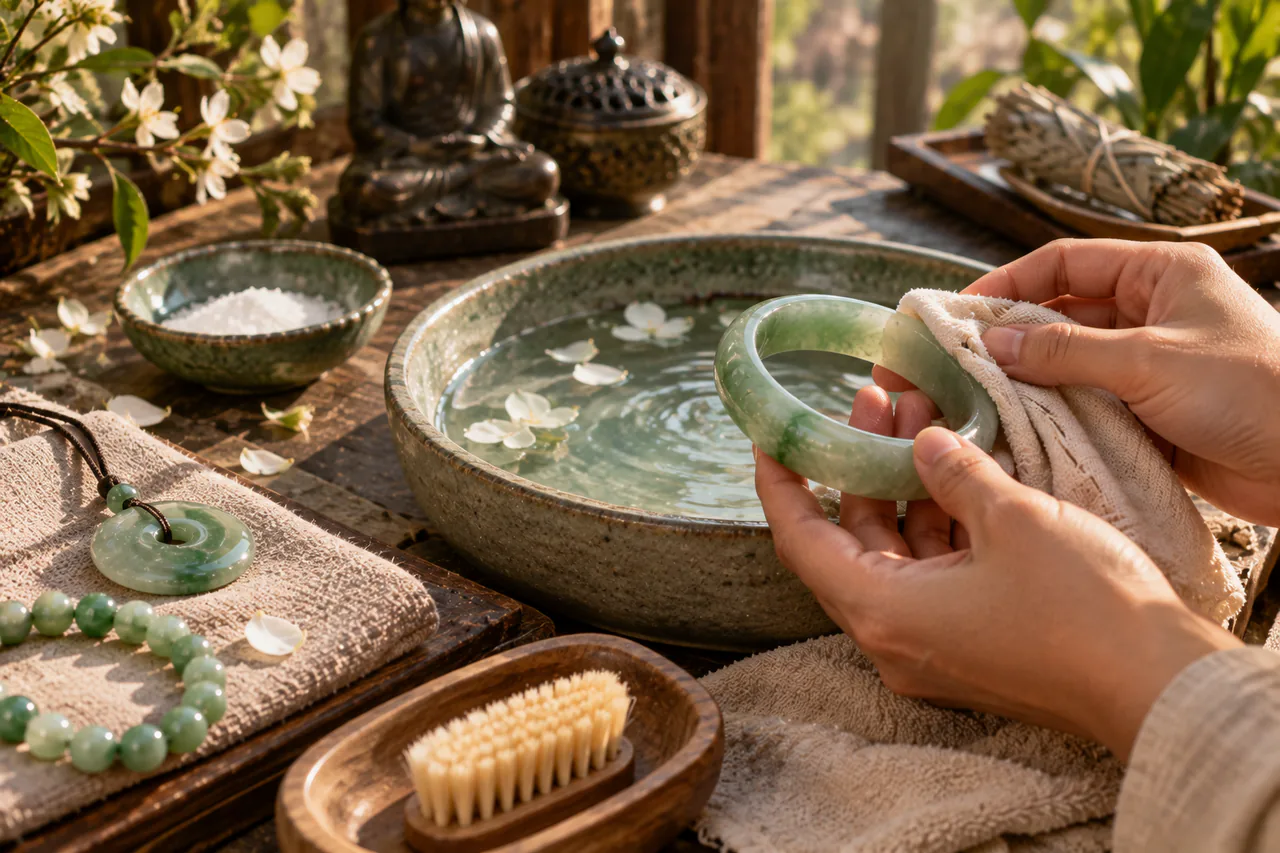
How to clean jade stone, and the jewellery around it
How to clean jade without damaging anything: the routine with three items, the products I rule out and why, what the setting changes, the case of the strung necklace that does not forgive soaking, and the two machines that should never go near a piece whose treatment is unknown.
Jade stone is cleaned with lukewarm water, a mild soap and a soft cloth, then dried right away: nothing else, and this minimal routine is not token caution, it is the one that suits the worst case, since nothing tells me whether the piece you are holding is impregnated with resin or dyed.
A piece of jade jewellery is rarely just a stone: around it there is a cord, glue, a bail, a clasp, sometimes plating. Jadeite and nephrite have almost nothing to fear from a bathroom, and most of what breaks, tarnishes or comes unstuck on this page belongs to what holds them. The rest belongs to what was done to the stone before it reached you, and that is the part nobody can read by eye.
My name is Jade, and I run a jade jewellery workshop: I choose the pieces, have them set, and weigh one example of every piece before it goes on sale. I am neither a gemmologist nor a therapist: here, the mineralogy is stated as fact, and everything else is attributed.
What makes jade jewellery dirty, and what wears it
What builds up on a stone you wear is nothing exotic: skin oil, hand cream, a trace of dried soap in the recesses of a setting. The deposit is greasy, it is thin, and it is enough to make a translucent surface look lifeless. Many stones people think are scratched are simply dirty.
Real wear comes from elsewhere. Household dust contains a good share of quartz, which rates 7 on the Mohs scale, while nephrite sits at 6 or 6.5 and jadeite at 6.5 or 7: wiping a dusty stone dry means dragging an abrasive across a polish. Hence the first rule, which reverses the reflex: rinse before you wipe, never the other way around. Water carries the grains away, a cloth just drags them (storing jade jewellery).
Lukewarm water, a mild soap, a cloth
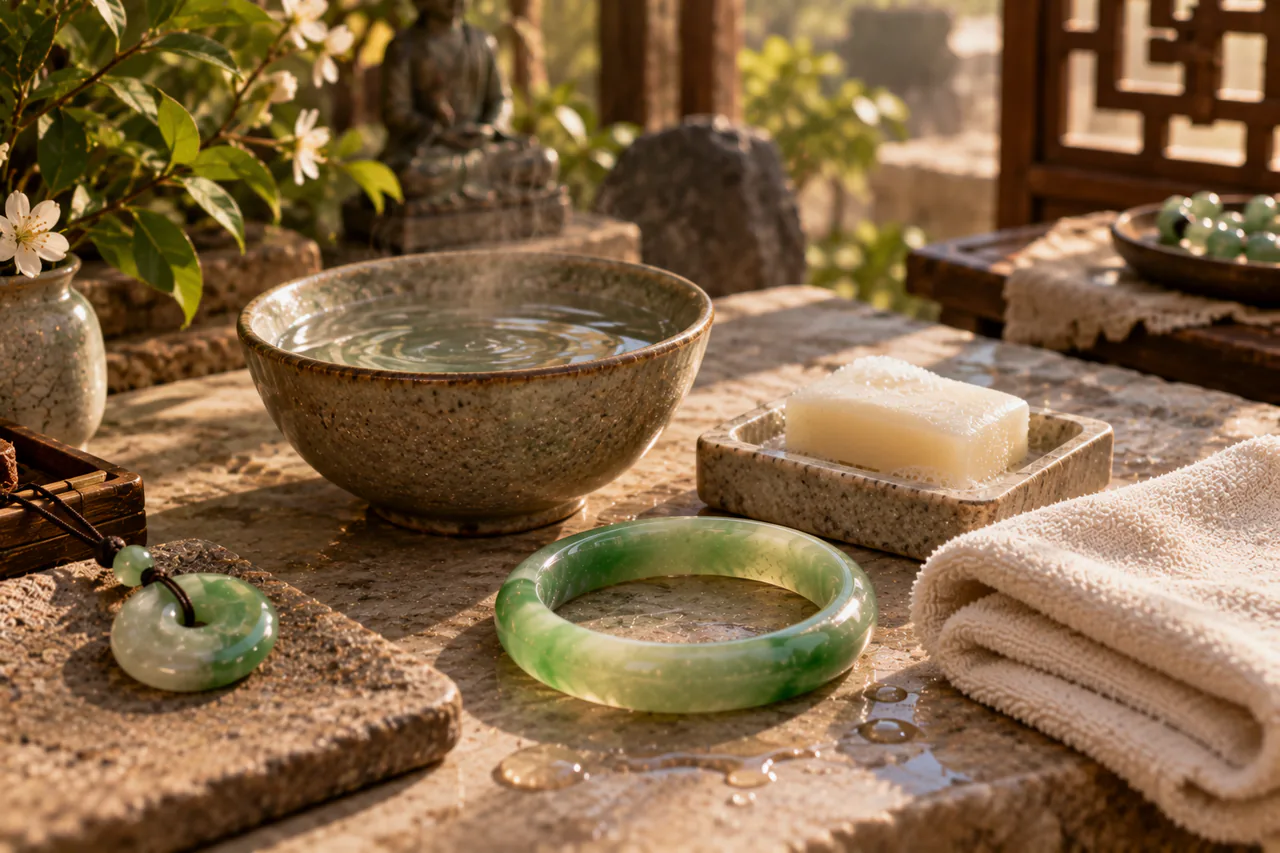
Here is the entire routine. It fits in five lines because I do nothing more.
- Rinse first, under a trickle of lukewarm water, without rubbing, to carry away the dust before you touch the stone.
- A drop of mild soap on your fingers, hand soap will do, and not on the stone. Wash briefly, without pressure.
- A soft brush only in the recesses of a setting or a carved motif. An old toothbrush still carries toothpaste, which is an abrasive paste: rinse it before it gets anywhere near.
- Rinse thoroughly. A film of soap left behind dulls the surface in turn, and faster than the dirt it replaced.
- Dry right away by patting, then leave it flat to finish, away from a radiator and out of the sun.
The routine is short, and on purpose: I never soak. A long bath does not clean better, it gives water time to get in where it will not come back out, under a bezel, in a bead’s drill hole, in a knot. And put the plug in the sink before you start: it is the least elegant advice on this page.
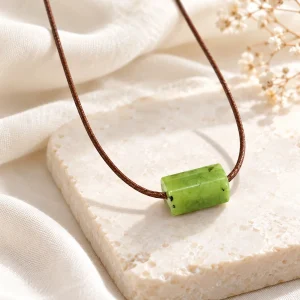
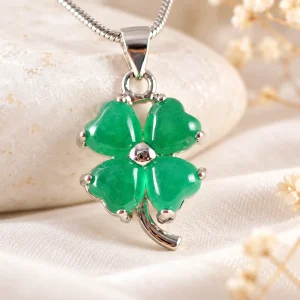
Jade pendants available now
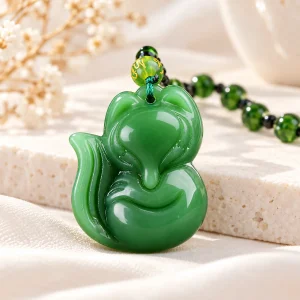
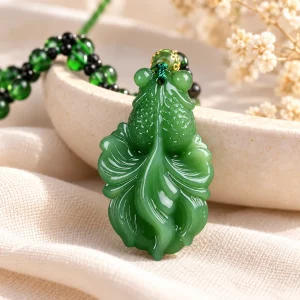
The products people mention, and what I do with them
People regularly suggest something better than soap. Here is my answer, with the reason rather than a flat ban.
| Product | What it is meant to do | What I do with it |
|---|---|---|
| Toothpaste, baking soda | make it shine by rubbing | ruled out: abrasives, whose job is to remove material |
| Vinegar, lemon, alcohol, acetone | descale, degrease quickly | ruled out: acids and solvents attack glue before they attack dirt |
| Silver dip | dissolve silver sulfide | ruled out: designed for bare metal, not for contact with an unknown resin |
| Oil, wax, polishing product | give the stone depth | ruled out: they mask rather than clean, and the film holds dust |
The last one is not a mistake but a trade practise: oiling jade restores some translucency for a while and optically closes micro-fractures. That is makeup, not care (dyed jade).
Setting by setting, what changes the routine
The routine does not change, the points to watch do, and in this section they all have to do with the setting rather than the stone.
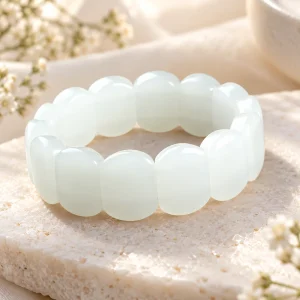
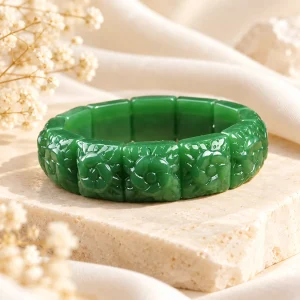
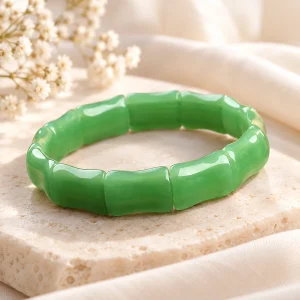
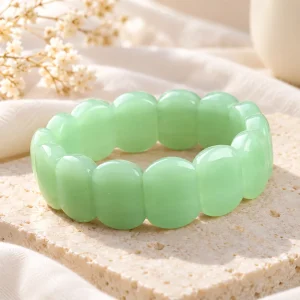
- A bangle carved from a single block is the simplest case: no cord, no glue, no metal. It can be washed on the wrist, in the shower, and dried there too.
- A set ring traps soap under the stone and in the prongs: rinsing matters more than washing. The metal has its own reactions to sweat (jade and gold, or sterling silver).
- A pendant with a glued bail means keeping the water on the stone side. If the drill hole has taken on water, dry it upside down and leave it flat before wearing it again.
- A roller or a gua sha is used on skin with oil and so gets dirty much faster than the rest; it is also the category where the object is most often not jade at all (roller and gua sha).
Caring for a jade necklace, strung or knotted
This is the question people ask right after the one about products. A strung necklace is never soaked. Never, not even for a few minutes.
The reason is not the stone, which will not budge, it is the thread. Wet silk slackens and does not tighten again as it dries: the strand gets longer, gaps appear between the beads, the knots slip. Water held in a drill hole then seeps out slowly and leaves the thread grey between two beads, a sign that it needs restringing, not cleaning (thread and cord, a jade bracelet that breaks).
The right method is therefore slower: a barely damp cloth and a touch of soap, wiped bead by bead, a second damp cloth to remove the soap, a third dry one. Then leave the necklace flat, never hanging, where its own weight would stretch a thread that is still damp.
Necklaces whose mineral and density I publish
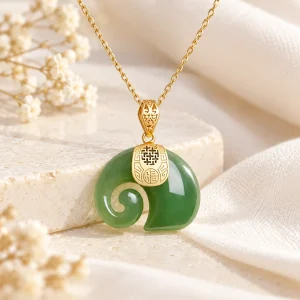
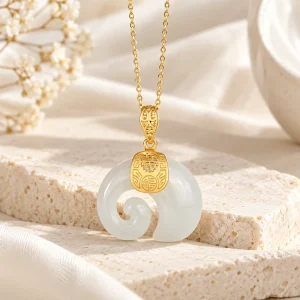
No ultrasonic cleaner or steam on a piece you know nothing about
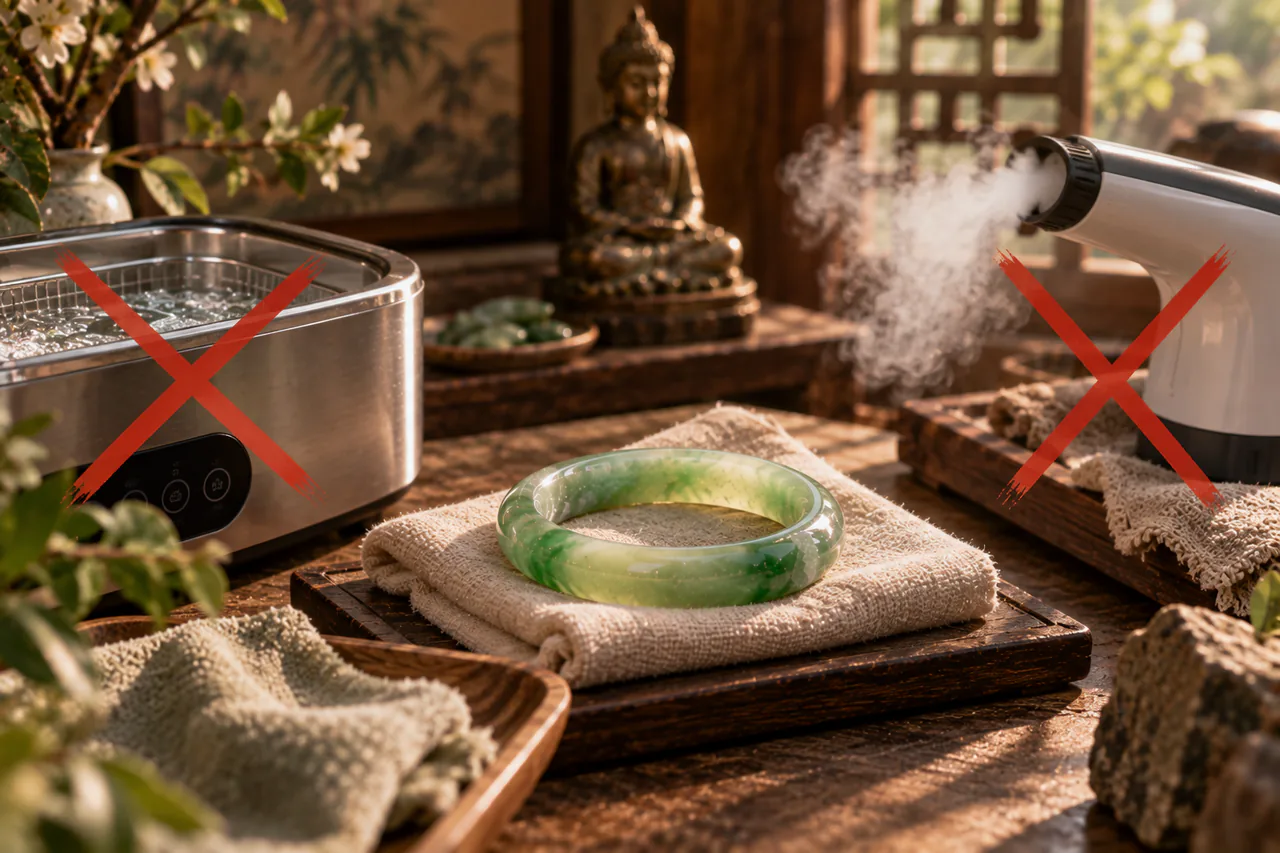
An ultrasonic tank cleans by cavitation, making micro-bubbles implode against the object; a steam cleaner blasts hot, pressurized steam. Excellent on bare metal, both are ruled out here for a reason of material: a so-called grade B jadeite has been bleached and then impregnated with resin, and that resin tolerates neither cavitation nor thermal shock. It crazes, and the piece comes out covered in a network of fine lines that cannot be undone (jade A, B, C).
And I cannot know. My supplier does not know the treatment status of its stock, my scale does not tell me, and only infrared spectroscopy would settle it. What I weigh establishes the mineral, jadeite or nephrite rather than serpentine or dyed quartzite, and nothing more: the weighing page, the treatment information sheet. Faced with your piece, I know even less, since I have not weighed it (how to tell if jade is real).
A legal detail makes the ban even more useful. French Decree No. 2002-65 of 14 January 2002 requires the name to be completed with the treatment, but its Article 3 exempts three traditional lapidary practices, including impregnation with a colorless fluid substance and bleaching without dye or varnish. My reading, which is not a court’s: a piece can be sold without any disclosure and still carry what ultrasonic cleaners destroy.
The consequence is not in your kitchen, where nobody has a tank, but at the jewellery counter: the free cleaning offered while you wait very often goes through an ultrasonic cleaner. You need to be able to say no, and why.
How often, and why drying matters
I do not set a schedule, because a schedule gets followed for its own sake. Two markers are enough: a rinse in clean water followed by drying the same day after the sea, the pool or gardening, and a proper wash with soap when the surface has visibly lost its luster, which never happens on a fixed date. What is better taken off beforehand than cleaned afterwards is in how to use jade stone.
Drying is not a courtesy step: what damages a piece of jewellery over time is almost never the water from the minute of washing, it is the water that stays, in a bead’s drill hole, under a bezel, against glue.
Cleaning, cleansing, recharging: three acts people mix up
What follows changes register, and I flag it rather than blend it into the rest. Nothing in it is proven: it is what traditions have attributed to this stone.
A stone does not heal anything, and the full disclaimer is here.
The three words often turn up in the same sentence without meaning the same thing. Cleaning removes cream and dust, and that is all this page covers; cleansing and recharging would assume that a stone builds up and then releases something, which has not been established.
I do not dismiss them for all that, because the methods suggested for them do have very real effects on a setting, and sometimes costly ones. Method by method, that is in how to recharge a jade stone; the attributions themselves are in what tradition attributes to jade stone.
The questions I get asked
Can jade stone be cleaned with tap water?
Yes. Neither jadeite nor nephrite dissolves, and lukewarm water does nothing to them. What does not tolerate water is duration: in a bathroom, soaking is the act that costs you, and it costs the thread and the glue.
How do you clean a jade necklace without damaging it?
Bead by bead, with a barely damp cloth and a touch of soap, then a dry cloth right after. Do not soak it: wet silk slackens and does not tighten again, the strand gets longer and the knots slip. Dry it flat, never hanging.
Can jade jewellery go in an ultrasonic cleaner?
No, with no exceptions. A grade B jadeite is impregnated with resin, which does not tolerate cavitation, and nothing lets you tell from the outside whether a piece is. Turn down the free cleaning at a jewellery counter too.
What product makes jade stone shine?
None. What looks like a lack of shine is almost always a greasy film or poorly rinsed soap, and a thorough rinse fixes it. Polishing products leave a layer that masks for a while and then holds dust.
How do you clean a bangle you cannot take off?
Like the skin it sits on: lukewarm water, mild soap, a rinse, then careful drying under the bangle and not just on top. Carved from a single block, it has no cord or glue, which removes most of the risks listed here.
My stone has gone dull: is it dirty or scratched?
Wash it, then look at it while wet. A stone that regains its depth under water and loses it again as it dries is dirty or poorly rinsed. A stone that stays dull even when wet has lost its polish, and a cloth will not bring that back: it needs repolishing, which is a lapidary’s job.
Where I checked
What comes from a named source. French Decree No. 2002-65 of 14 January 2002 is cited in the body, and its Article 3 does exempt three traditional lapidary practices from the disclosure requirement. The hardness figures I give, quartz 7, nephrite 6 to 6.5, jadeite 6.5 to 7, come from the mineralogical literature: I repeat them, I did not measure them, and their limits vary by a few tenths from one database to another. I therefore attribute them to no particular organization.
What is an observation, with a date. On 8 September 2026, my supplier confirmed that it cannot say whether its stock has been treated. The same day, while planning this site, I opened the group of pages that keyword tools file under jade care: the category exists, so does the demand, and I found no complete written routine there. That is the reason this page exists. Of the nine French competitors on the first page of results, none states the mineral of its pieces, which is the information better-tailored care would depend on.
What is my own reasoning. Treating every piece as if it might be impregnated or dyed, reading Article 3 of the decree as letting a piece that is sensitive to ultrasonic cleaning be sold without disclosure, refusing to soak a strung necklace on the grounds that wet silk slackens: these are decisions, not established facts. I have not broken any stone in a tank to check, so I publish no numerical threshold, exposure time or temperature. If you find a mistake here, write to me: I will correct it and note that I did.
In one sentence
How to clean jade comes down to three items and two refusals: lukewarm water, mild soap, a cloth, no soaking and never an ultrasonic cleaner or steam, because that is the only routine that stays right when you do not know what the stone went through before you. What separates the two minerals is on the main page, and the pieces are in the shop.