How to tell if jade is real: what you can check at home
This page covers how to tell if jade is real with what you have at home: what the scratch, sound, cold and lamp tests are worth, which number separates jade from what gets sold in its place, and what no measurement made at home will ever tell you.
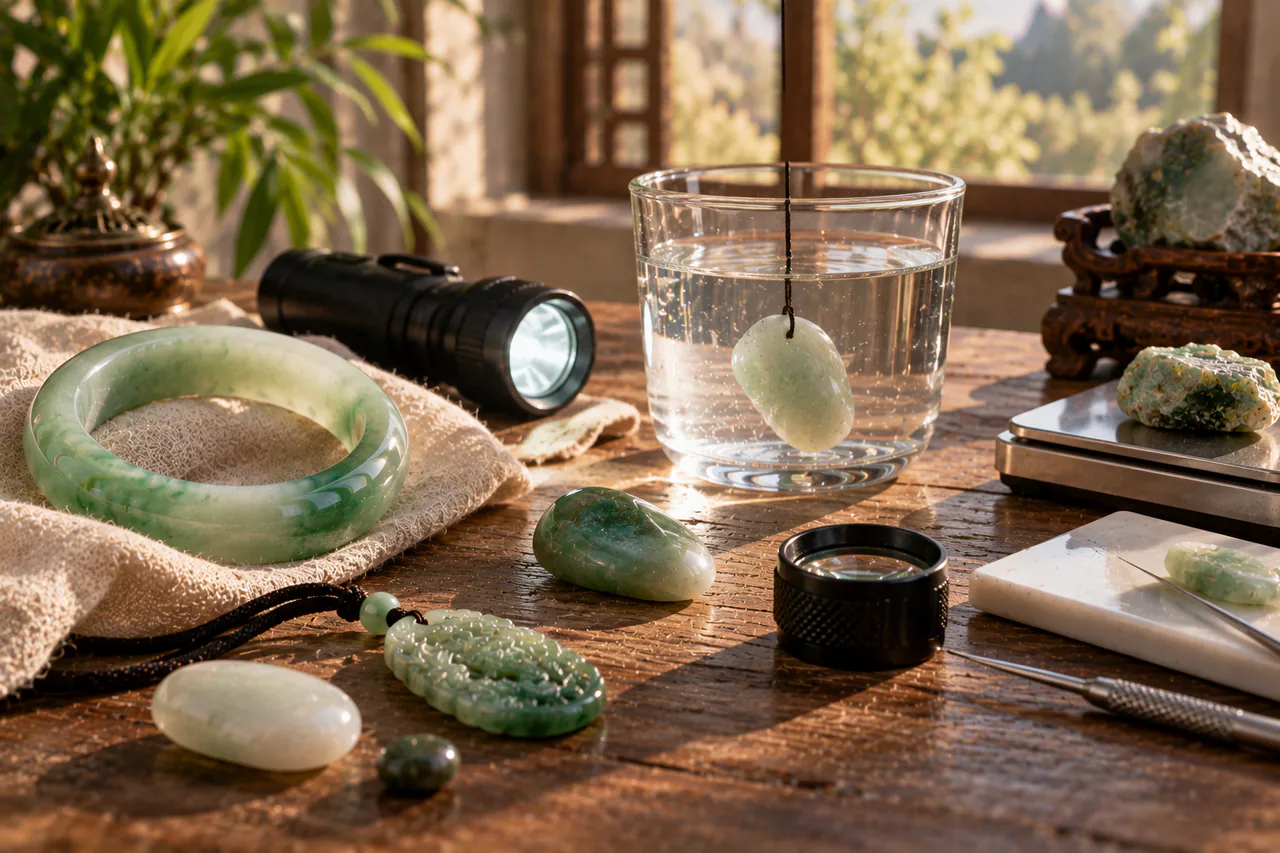
Only one test settles it at home, and that is weighing: a stone weighed in air, then suspended in a glass of water, gives its density, and that ratio separates jadeite and nephrite from the serpentine and dyed quartzite sold under their name. Scratching, sound, cold and a lamp do not settle anything.
The word jade covers two unrelated minerals: jadeite, a pyroxene, and nephrite, an amphibole. Both are real jade, and that is already something the trade explains badly: the jade stone page, and the two species in detail in jadeite or nephrite.
My name is Jade, and I run a jade jewellery workshop: I choose the pieces, have them set, and weigh one example of every piece before it goes on sale. I am neither a gemmologist nor a therapist, and I do not have a laboratory.
What “genuine” means, and what it does not say
Two questions hide behind this word, and mixing them up is costly. The first: is this stone jade, or another material sold under that name? The second: has it been bleached and then impregnated with resin? The first can be measured at home, the second cannot.
“Genuine” answers only the first. It sets jade against serpentine and dyed quartzite, which a scale establishes on a bare stone, and it says nothing about resin.
French law points the same way. French Decree No. 2002-65 of 14 January 2002 mentions neither jade, jadeite nor nephrite, but its Article 4 forbids “true”, “genuine”, “natural”, “fine” and “precious” to describe a reconstituted, composite, synthetic, artificial or imitation product. The word is legitimate on jade and forbidden on what imitates it: jade and the 2002 decree.
Home tests, and what each one proves
They circulate everywhere, they cost nothing, and none of them gives you the name of a mineral. What follows says what each one really rules out, because ruling something out is not nothing.
The scratch test, which damages the piece and reads backwards
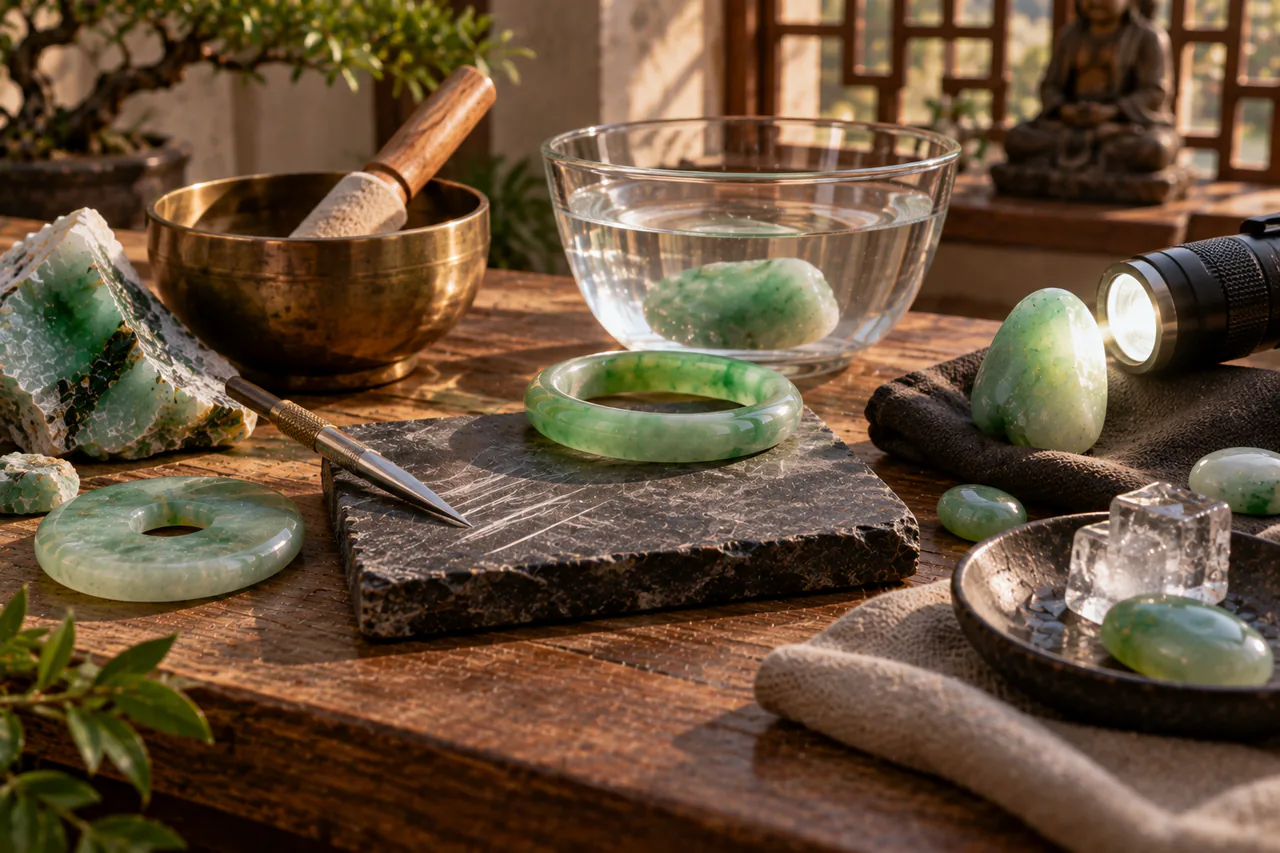
The principle sounds solid: if a blade scratches the stone, it is not jade. First obstacle: the two jades do not have the same hardness. Nephrite sits around 6 to 6.5 on the Mohs scale, jadeite at 6.5 to 7: two genuine stones, two possible answers to the same blade, and the test can declare an authentic nephrite fake (the hardness and toughness of jade).
Second obstacle: the mark you see is not always what you think. A metal softer than the stone leaves a grey deposit on it that looks like a scratch and wipes off with a cloth. And when the test does work, it marks the jewellery for good. I do not use it.
The sound test, which depends mostly on shape
You hang the bangle from a thread, tap it with a coin, and a clear, long ring is supposed to mean jade. That sound depends on the bangle’s thickness, its diameter, where you tap and how you hold the thread, more than on the mineral species: two bracelets made of the same material do not ring the same way.
The test does detect something real, just not what you are looking for: a cracked bangle sounds dull, which is useful to anyone buying secondhand (a broken jade bracelet). I have found no way to turn a sound into the name of a mineral.
The cold test, which every polished stone passes
A stone feels cold because it draws heat from your skin faster than your skin replaces it. Glass, metal, serpentine and quartzite do this as well as jade, and the sensation fades within seconds. This test rules out cast resins and plastics; against a polished serpentine, it is useless.
The lamp test, which shows without naming
A light held behind a thin enough piece reveals its structure, and sometimes how it was made, as long as you do not ask it to reach a conclusion. It clearly shows colour collected along cracks, the signature of added dye (dyed jade). It does not show a colorless resin, and a well-polished translucent serpentine looks very much like jade under it.
Weight in the hand, which is the right test done badly
Hefting a piece means estimating its density blind, and the instinct is sound: at the same size, jade weighs noticeably more than serpentine or quartzite. The problem is the instrument, because a hand can only compare two pieces of the same shape and volume. A scale and a glass of water are enough to turn that impression into a number.
Jade rings available now
The number that separates jade from what is sold in its place
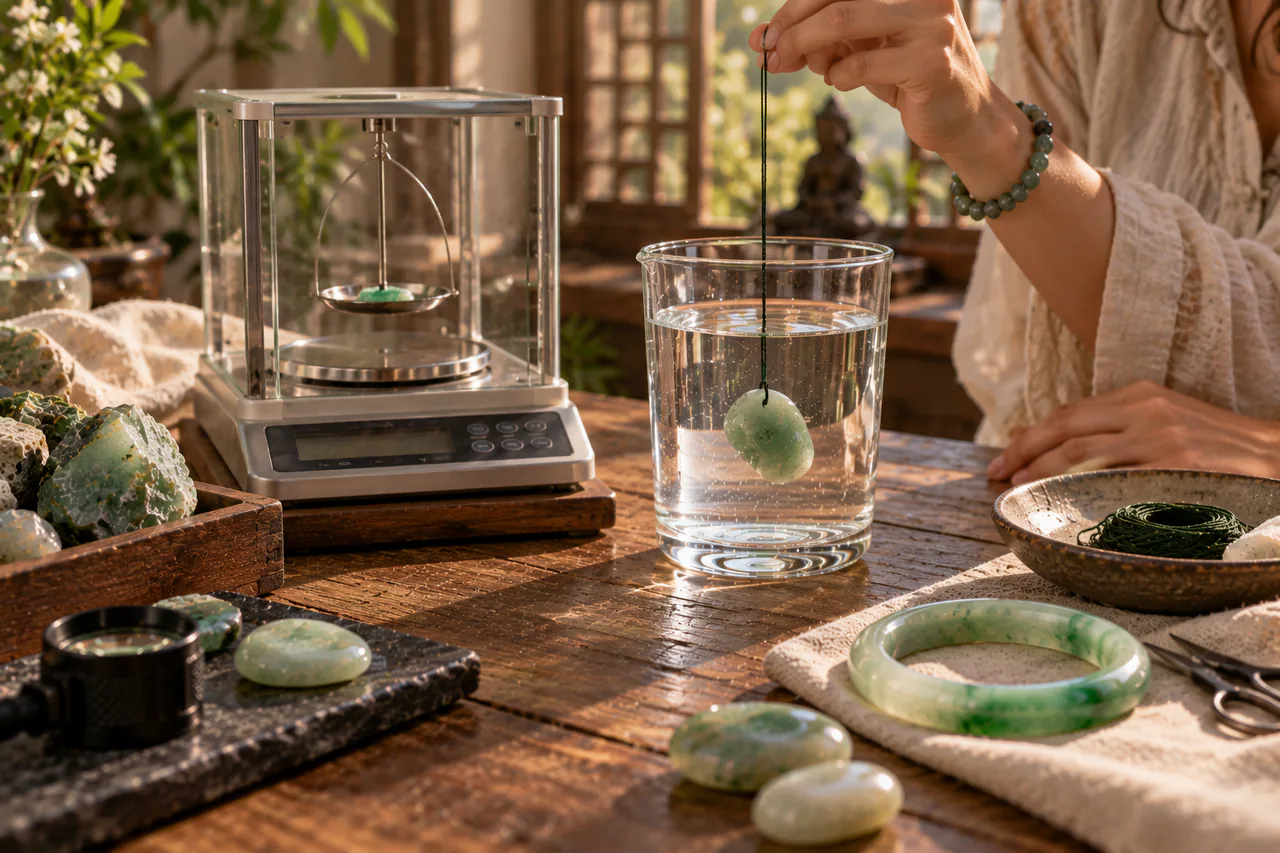
Hydrostatic weighing comes down to three steps: weigh the bare, dry stone in air, hang it from a fine thread in a glass of water without letting it touch the bottom or sides, then read the second mass. The density is the first mass divided by the difference between the two. Repeat measurements, the air bubble that throws everything off and the limits of the method are on the weighing page.
The result is compared against four reference ranges taken from the mineralogical literature: I repeat them, I did not establish them, and their limits vary by a few hundredths from one database to another.
| Material | Density |
|---|---|
| Jadeite | 3.25 to 3.36 |
| Nephrite | 2.90 to 3.03 |
| Serpentine | about 2.6 |
| Quartzite, dyed or not | about 2.65 |
The gap that matters is visible at a glance: between a nephrite at 2.95 and a serpentine around 2.6 there is a third of a point, far beyond the margin of error of a kitchen scale.
One caveat matters more than the others: the measurement applies to the bare stone, because the metal of a bezel or the cord of a strand goes onto the scale too and skews it.
What the scale does not tell you
It tells you the mineral. It says nothing about treatment, and I would rather write that limit down before anyone asks.
A jadeite bleached with acid and then impregnated with resin is still a jadeite, and the resin does not change its mass enough to show up on a scale. Only laboratory infrared spectroscopy settles that, and I do not have access to it. My supplier does not know the status of its stock, which is the ordinary state of this market rather than an incident: jade A, B, C, and the treatment information sheet.
On my product pages, I therefore publish the mineral and the number it rests on, and I state that the treatment status has not been determined. That sentence is better than silence, which would read as a promise.
The certificate people ask me to include with the jewellery
The request comes up mostly for bracelets, and it is a fair one: people would like a document saying, in black and white, that the stone really is jade. I do not provide one, and I explain why rather than leave the question unanswered.
Such a document is only worth something if it comes from an independent laboratory, and it then covers one object, not one product line: you would need one for every piece sold. A certificate issued by the seller adds nothing to what the seller already claims, and only gives that claim the look of a check.
What I publish instead can be verified: the two masses, the resulting density, the date and the mineral I conclude from them, taken on the example I order before the piece goes online (what each product page shows). You can repeat the measurement and prove me wrong. I measure, I do not rule.
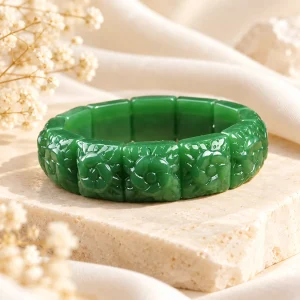
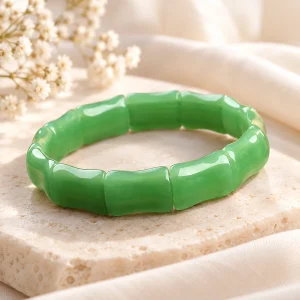
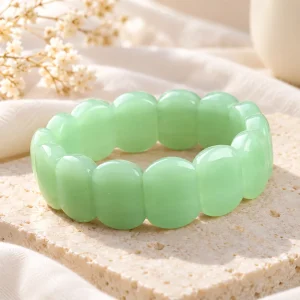
Bracelets whose mineral is written on the product page
What “natural” means in a listing
Many people look for a “natural” jade pendant thinking it means no resin. The word does not say that.
In the 2002 decree, “natural” appears in Article 4, alongside “true” and “genuine”: it is forbidden there to describe a reconstituted, composite, synthetic, artificial or imitation product. It sets a mined stone against a manufactured one, and nothing more.
Treatment falls under Article 2, which requires the name to be completed with “treated” or with the treatment undergone: dye, filling, irradiation, laser, surface diffusion. “Natural” and “untreated” are therefore not the same word, and I do not use the first myself, since I cannot establish the second.
What I look at in a listing before buying
Five points, in the order I read them. They do not replace a scale: they tell you whether the seller knows what they are talking about.
- The name of the mineral. Jadeite or nephrite. If it is not written anywhere, nothing entitles you to assume it.
- A compound name. “Malaysia jade”, “new jade”, “olive jade” and “Korean jade” refer to dyed quartzite or serpentine: stones sold as jade.
- The A, AA, AAA scale. It has no standard behind it and borrows its letters from the real classification, the one for treatments.
- “Imperial jade”. A quality of jadeite, not an origin or a label: what it really means.
- The price, read last. A price that does not fit the stated mineral is a question worth asking: the price of jade stone, and what makes a piece valuable in judging jade quality.
The full buying process is in buying jade jewellery.
The questions I get asked
How do I know if a jade stone is genuine?
Weigh it twice, in air and then suspended in water, and divide. From 3.25 to 3.36, it is jadeite; from 2.90 to 3.03, nephrite; around 2.6 or 2.65, serpentine or quartzite, and the word jade does not apply.
Can the knife test damage my bracelet?
Yes, and that is its first consequence. Nephrite, at 6 to 6.5 on the Mohs scale, scratches more easily than jadeite: the test can mark a genuine stone and lead you to the wrong conclusion. You would still need to tell a scratch from the grey metal deposit that wipes off with a cloth.
Is there a certificate that proves a bracelet is jade?
An independent laboratory report analyzes one specific piece and says what it is. A document written by the seller only repeats the listing in another form. I do not include one with my jewellery: I publish the masses recorded, the date and the mineral I conclude from them.
Is a pendant sold as “natural” free of resin?
Nothing allows you to conclude that. The word sets a mined stone against a manufactured one; it does not say whether the stone has been bleached and then impregnated. Only laboratory infrared spectroscopy answers that question.
Is serpentine fake jade?
It is a real stone, often beautiful, with its own name and its own place. It is simply not jade, and its density of about 2.6 shows that in one measurement. The fault lies not with the stone but with the label put on it.
My jade feels cold to the touch. Is that a good sign?
It is a very weak sign. Any dense, polished stone, and glass along with them, draws heat from your finger the same way. Cold rules out plastics and cast resins; it does not separate jade from serpentine.
Where I checked
What comes from a named source. Articles 2, 3 and 4 of French Decree No. 2002-65 of 14 January 2002 are cited in the body of this page, and it is indeed that text which mentions neither jade, jadeite nor nephrite. The separation of the two minerals goes back to Alexis Damour’s note published in the Comptes rendus hebdomadaires of the French Academy of Sciences, volume 56, 1863; I do not give page numbers, as I have not read it. The density and hardness ranges come from the mineralogical literature: I repeat them without having measured them, and I attribute them to no particular organization.
What is a market observation, with a date. On 8 September 2026, I opened the nine French competitors on the first page of results. None stated the mineral of its pieces, and one used the A, AA, AAA scale. The same day, my supplier confirmed that it cannot say whether its stock has been treated.
What is my own reasoning. The grey metal deposit mistaken for a scratch, the sound that depends on the shape of the bangle more than on the species, the decision not to include a certificate with my jewellery: these are choices and observations, not established facts. If you find a mistake here, write to me: I will correct it and note that I did.
In one sentence
How to tell if jade is real at home comes down to a single step, weighing the stone in air and then in water, and everything else is about knowing what that number does not say. The method is on the weighing page, and the pieces are in the shop.
Pendants, with a number and a date for each piece