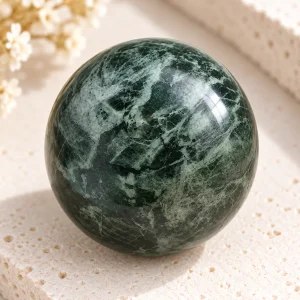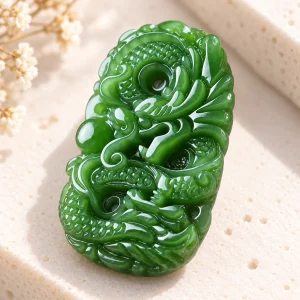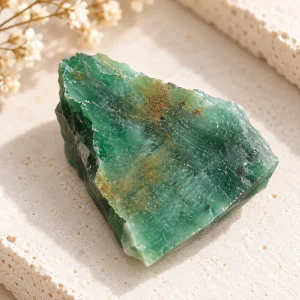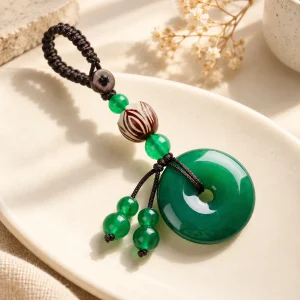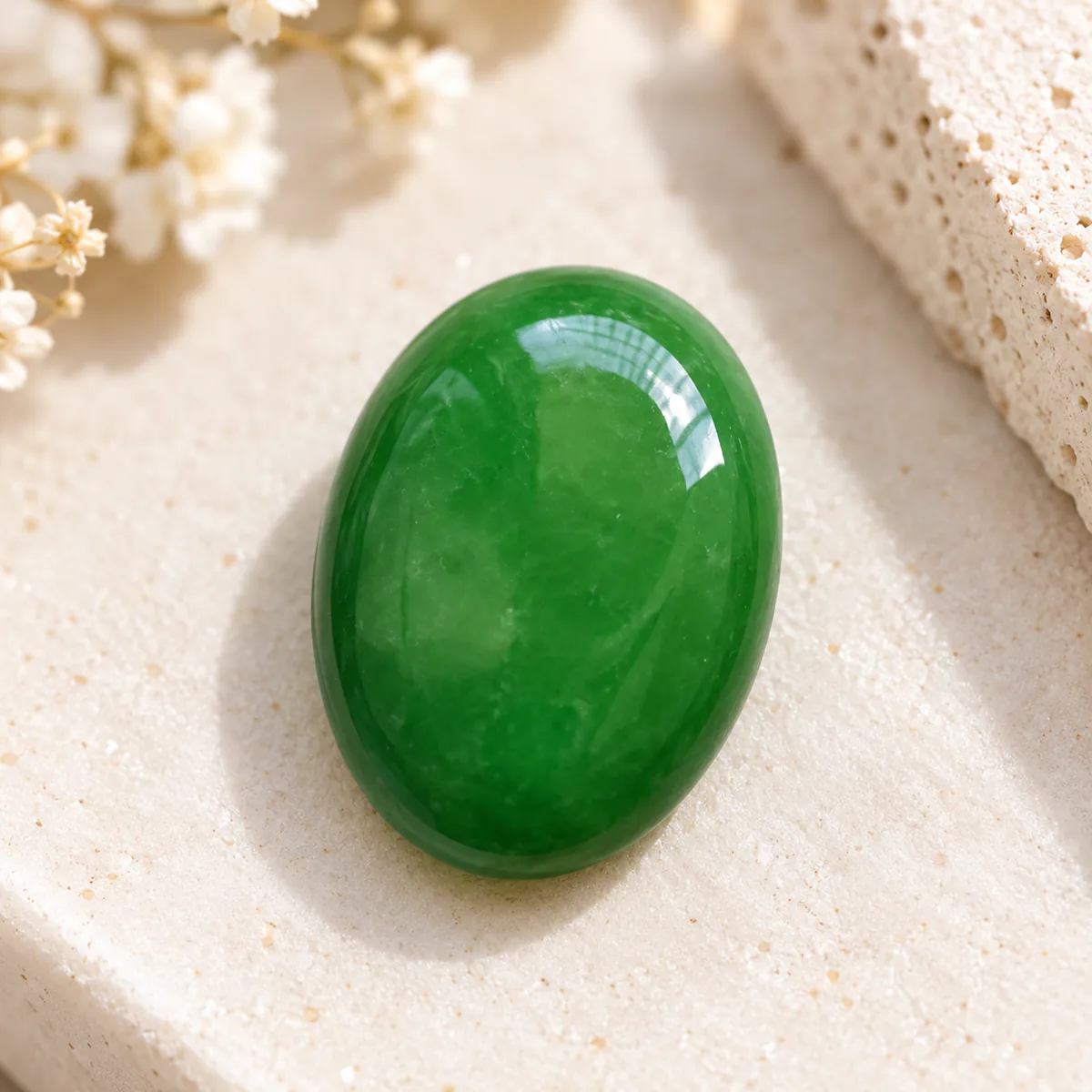
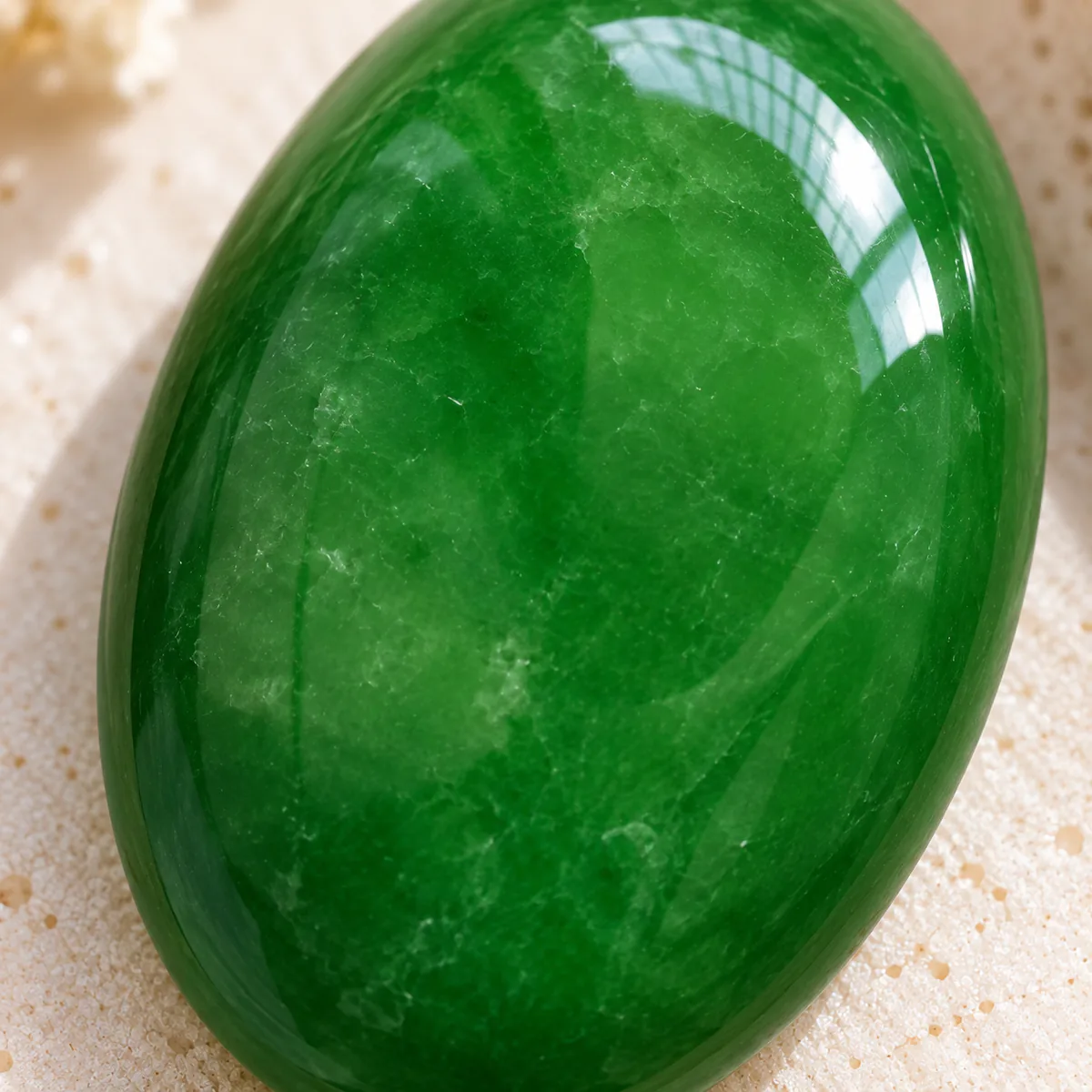
A loose jade cabochon: an oval of green jadeite, domed on top, flat underneath, fully polished with no facets. No prongs, no bezel, no bail, no glue. It is the only piece in this shop you can weigh yourself the day it arrives.
In four lines
- A bare stone: no prongs, no bezel, no bail, no glue.
- An oval domed on top, flat underneath, fully polished with no facets.
- The figure will be published here, and you can repeat it at home.
- To have set, or to keep as it is: it stands on its own.
The only piece you can check for yourself
Every other piece in this shop arrives mounted: set, strung, riveted, capped. On each one, I write that weighing is impossible, because metal has its own density and thread soaks up water. Here, there is nothing but the stone.
In practise, this means that the day it arrives, you can repeat my measurement. A kitchen scale that reads to the gram, a glass of water, a sewing thread. You weigh the stone in air, then hanging in the water without touching the bottom, and divide the first mass by the difference between the two. The result falls between 3.25 and 3.36 for jadeite, between 2.90 and 3.03 for nephrite, around 2.6 for serpentine. The method, with its three limits.
I do not know many shops that invite their customers to repeat the check. Yet it is the only tenable position when you refuse to write the words certified, guaranteed and appraised. I weigh, I do not certify.
What to do with a loose cabochon
A loose cabochon can be set: in a ring, in a pendant, on a bail. A jeweller will ask for its exact dimensions and dome height, and will choose a bezel or prongs accordingly. Just know that a bezel setting will make the stone impossible to weigh forever, which only matters if you want to be able to repeat the measurement.
It can also be kept as it is. A polished stone held in the hand is a complete object: it is even the oldest form of our relationship with jade, long before jewellery.
A clear green, and where it comes from
The green of jadeite comes from chromium, whereas nephrite’s comes from iron and leans toward spinach. The two minerals are not related at all: jadeite is a sodium aluminum pyroxene, nephrite a calcium amphibole, and it was Alexis Damour who told them apart in 1863. What sets them apart.
On this cabochon, the green is not uniform: it is denser in patches, lighter elsewhere, with a visible grain when light skims across it. That is what a natural material does, and it is the opposite of the signal that should raise concern, a colour that is exactly the same everywhere. It is not proof for all that, and the treatment status of this piece remains not determined. The checks that need no equipment.
Handling it without damage
Jade is tough: its structure of interlocking crystals resists the spread of a crack, which is what made Neolithic axes possible. Its hardness, however, is ordinary, 6.5 to 7 for jadeite, and the quartz in household dust rates 7: that is what dulls a dome, not knocks. The difference between hardness and toughness.
A bare stone has no mounting to protect it: keep it in a pouch, on its own, not at the bottom of a box with other stones. Lukewarm water, a mild soap, a soft cloth. Never ultrasonic cleaners, never steam, never solvents: since the treatment status is unknown, any resin would not withstand them. Care in detail.