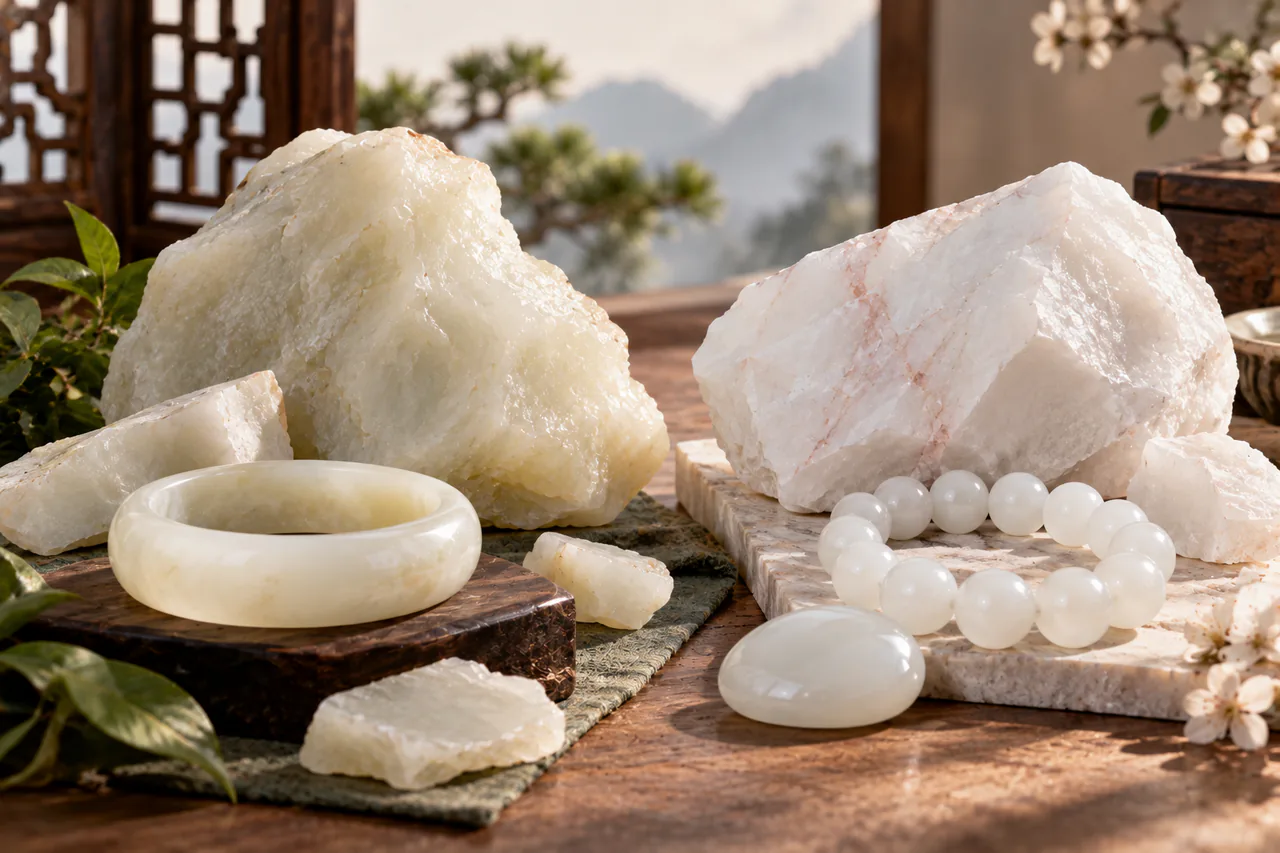
White Jade Stone: Mutton Fat Nephrite or Quartzite
A search for “white jade stone” brings up stones that are not the same material. This page explains what makes a nephrite white, what the trade shelves next to it under the same word, the number that separates them, and why a label can legally stay silent about lightening.
White jade exists: most often it is a nephrite almost free of iron, the kind Chinese usage calls mutton fat; what is sold next to it under the same name is generally quartzite, and density separates them, 2.90 to 3.03 against about 2.65.
| Material sold as white | Density | Is it jade |
|---|---|---|
| White nephrite | 2.90 to 3.03 | yes |
| White jadeite | 3.25 to 3.36 | yes |
| Quartzite, dyed or not | about 2.65 | no |
My name is Jade, and I run a jade jewelry workshop: I choose the pieces, have them set, and weigh one example of every piece before it goes on sale. I am neither a gemologist nor a therapist: I weigh a stone and name a mineral, I certify nothing about what it has been through.
The white of nephrite, known as mutton fat
Nephrite is an amphibole of the tremolite-actinolite series, white at its magnesium end: green only appears as iron takes the place of magnesium. White is therefore not a fading, it is the state of a nephrite that lacks the element that colors it. Its felt of microscopic fibers scatters light and gives it a white that is softer than porcelain, slightly greasy, close to wax (the main guide, jadeite vs nephrite).
Mutton fat comes from Chinese usage, where the name refers to the finest white nephrites, historically those of Hotan, in Xinjiang. It is a dealer’s term that rates a quality, not a species: two stones given this name can show two different numbers on the scale (jade stone colors).
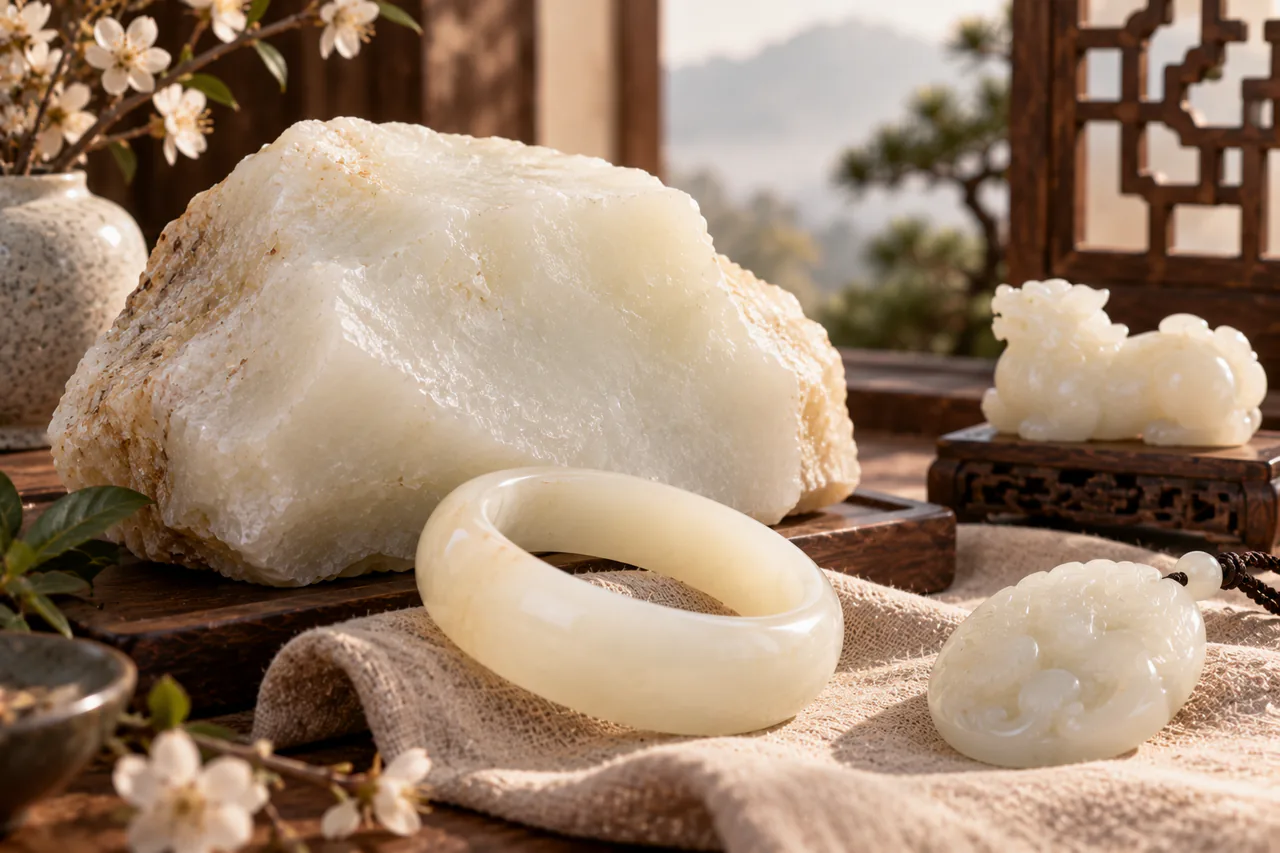
What is sold as white without being jade
Under the label white jade stone, quartzite beads also turn up, around 2.65, and white is particularly convenient ground for this substitution.
In other colors, the imitation has to be dyed, and the dye sometimes collects in cracks, where it shows. In white, it can do without: a pale quartzite passes without anything added to it, and the most common clue disappears along with the dye. The word dyed in the title comes from habit, since that is how this material arrives in the other colors (dyed jade).
Compound names do the rest: “Malaysia jade” refers to dyed quartzite, “new jade” and “Korean jade” to serpentine (stones sold as jade). French Decree No. 2002-65 does not name jade, but its Article 9 forbids selling a stone under another name (jade and the 2002 decree).
2.90 or 2.65: what I weigh to decide
A scale, a thread, a glass of water: the stone is weighed in air, then suspended underwater, and the ratio of the two masses gives the density, which you then only have to compare with the table at the top of the page. It is the only method I have at home, and its protocol is published.
The gap between 2.65 and 2.90 is well above what my scale can confuse on an ordinary bead; it closes on very small pieces, where uncertainty swallows the difference. I weigh one example per piece, the one I order before the piece goes on sale, not every order that ships, and the measurement applies to the bare stone: otherwise the metal of a ring or the cord of a strand would go onto the scale.
What you can look at without a scale
A white nephrite feels heavier in the hand than a quartzite of the same volume and, under raking light, shows a cloudy background rather than sparkling grains. None of these clues proves anything on its own: they only tell you it is worth weighing (how to tell if jade is real).
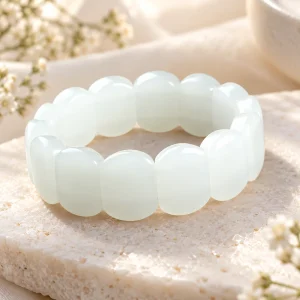
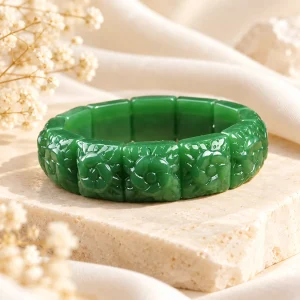
Bracelets whose density I publish
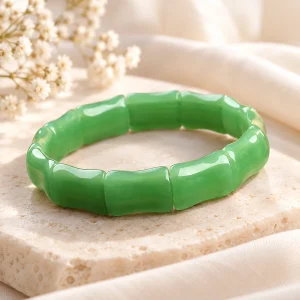
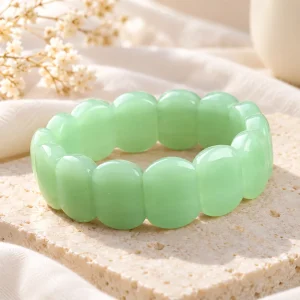
The other legitimate white, jadeite
Jadeite without chromium or iron is white too, and that is its starting state: green and lavender come from foreign atoms lodged in the lattice. On the scale, it cannot be confused with any of the materials in the table, at 3.25 to 3.36; by eye, it stands out through a finer grain and a translucency that can go further. Its hardness, 6.5 to 7, puts it a notch higher, which matters on a light-colored stone.
In the white jewelry I have seen go by, nephrite dominates by far, but I do not know whether that holds for the whole market.
Bleached, and sold without the word treated
This is the point on this page that matters most to a buyer, and it rests on two articles of French Decree No. 2002-65 that have to be read together.
Article 2 requires the name to be completed with “treated”, or with the treatment undergone, for irradiation, laser, dye, surface diffusion, filling and any other laboratory method that modifies appearance, color or clarity. Article 3 exempts three traditional lapidary practices from this obligation: impregnation with a colorless fluid substance, heat treatment, and bleaching without dye or varnish.
In other words, a stone lightened by bleaching can legally be sold without the word treated appearing anywhere, and on a stone whose whiteness is the selling point, the exemption concerns exactly what the buyer thinks they are buying. It is not a scandal, it is a text, and it is better to know it than to rely on a label’s silence.
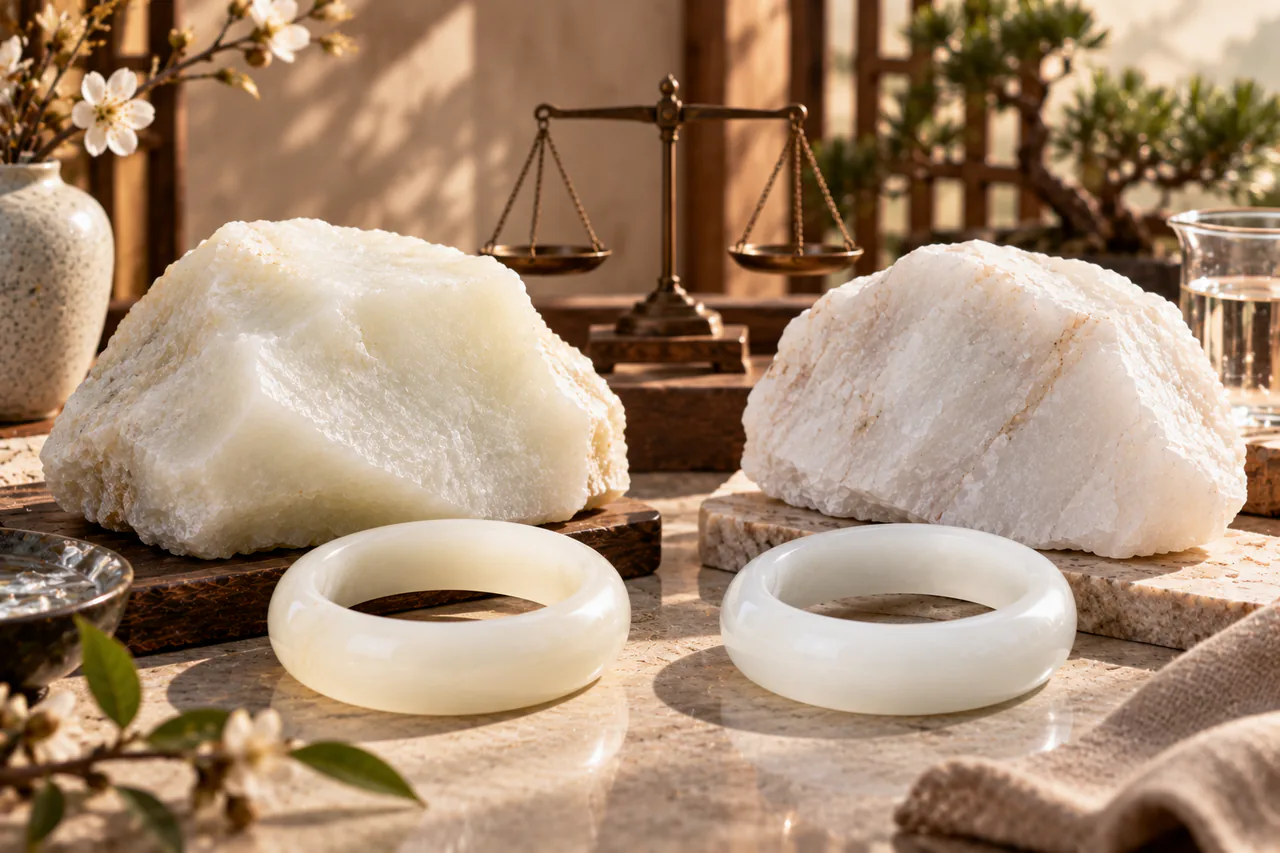
My scale does not fill this gap, and I write that rather than take advantage of it: a jadeite bleached and then impregnated with resin, the one the classification calls B, weighs about the same as a stone that has been through nothing. Only infrared spectroscopy would settle it, I do not have that, and my supplier does not know the treatment status of its stock. So I never write “untreated” or “natural” on a piece (the A, B, C classification, the treatment information sheet), and weighing tells you the mineral, not the quality (judging jade quality).
Jade rings, chosen one by one
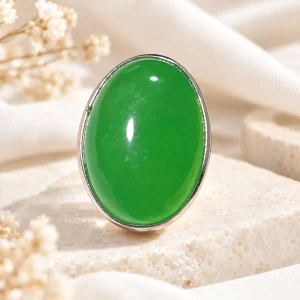
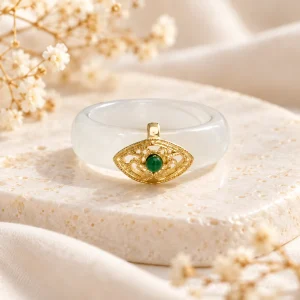
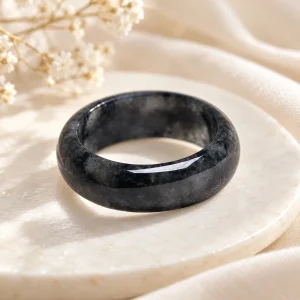
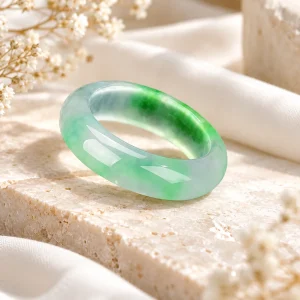
Choosing and caring for a white piece
In my shop, a white piece does not go online before its example has been weighed. If the number falls between 2.90 and 3.03, the product page opens with the mass in air, the mass in water, the density and the date of the measurement. If it falls around 2.65, the piece carries its real mineral name and the word jade comes out of the title.
Four types of piece are waiting for that number: a bead bracelet, a necklace, a mutton fat colored ring and a teardrop pendant, all set or chosen one by one. The white nephrite bangle is the simplest case, since the example I receive is already the bare stone.
White shows dirt sooner than green
Nephrite’s hardness, 6 to 6.5, puts it below quartz, which rates 7 and makes up a good share of ordinary dust: a dusty cloth dulls its polish. On spinach green the haze shows late, on white it shows at once, and that is a serious reason to prefer jadeite for a light-colored piece worn every day (jade hardness and toughness).
Lukewarm water, neutral soap, a soft cloth, immediate drying, and nothing else (how to clean jade stone). Never an ultrasonic cleaner or steam as long as the treatment has not been determined: resin tolerates neither cavitation nor thermal shock. And the piece is stored on its own (storing jade jewelry).
What traditions have attributed to white
What follows changes register, and I flag it rather than blend it into the rest. Nothing in it is proven: it is what traditions have attributed to this stone.
A stone does not heal anything, and the full disclaimer is here.
Classical Chinese thought is said to have made jade a vehicle for moral qualities rather than a power, with white standing for uprightness: a material to describe the accomplished person, not to act on them. That is philosophy, not crystal healing (the moral virtues of jade). Contemporary authors are said to associate white more with calm and clarity of mind: reported attributions, never established (what tradition attributes to jade stone).
What I will not write: that a white piece of jewelry purifies, protects or heals anything at all.
The questions I get asked
Does white jade really exist?
Yes, and it is even the base state of both jade minerals. What does not exist is a guarantee that the white sold under that name is one of them.
How can I tell whether my white jade is quartzite?
By weighing it in air and then suspended in water, on the bare stone. Around 2.65, it is quartzite; between 2.90 and 3.03, nephrite; above 3.25, jadeite. Weight in the hand gives an impression, not proof.
What is mutton fat jade?
A name from Chinese usage for the finest white nephrites, dense and slightly translucent at the edges. It describes an appearance, not a species or a guaranteed origin, and has no standard behind it.
Does white jade scratch faster than green?
It does not scratch faster, it shows it sooner: for the same mineral, the hardness is the same, only the contrast changes. Jadeite, at 6.5 to 7, still holds up better than nephrite at 6 to 6.5.
Can white jade turn yellow?
Nephrite does not turn yellow by itself from being worn. What yellows is around it: a thread or cord that absorbs sweat and creams, or a greasy deposit lodged in micro-scratches. Shades that change for a reason tied to the stone are a different subject (jade that changes color).
Does white jade cost more than green?
That depends on everything except color alone: the mineral, the fineness of the grain, translucency, evenness, weight and treatment. I give no range here, since it would be made up (the price of jade stone).
Where I checked
What comes from a named source. Articles 2, 3 and 9 of French Decree No. 2002-65 of January 14, 2002 are cited from the text, and the exemption for bleaching without dye or varnish does appear in Article 3. The separation of jadeite and nephrite comes from Alexis Damour’s note in the Comptes rendus hebdomadaires of the French Academy of Sciences, volume 56, 1863; I do not give page numbers, as I have not read it. The tremolite-actinolite series and the density and hardness ranges come from the mineralogical literature: I repeat them without having measured them and without attributing them to any organization. The name mutton fat and its link to Hotan nephrites come from trade usage, and I have not weighed any piece sold under that name.
What is a market observation, with a date. On September 8, 2026, I looked at the nine French competitors on the first page of results. None states the mineral of its pieces, so none lets you know whether the white it sells is nephrite or quartzite. The same day, my supplier confirmed that it cannot say whether its stock has been treated.
What is my own reasoning. That white is the easiest shade to imitate because the imitation needs no dye, that wear shows sooner on a light stone, and the rule of opening a white product page only after its example has been weighed: these are deductions, not established facts. If you find a mistake here, write to me: I will correct it and note that I did.
In one sentence
A white jade stone is most often a nephrite lacking iron, a quartzite looks like it without even needing to be dyed, and it is the scale, not the label, that tells you which of the two you are holding. The method is on the weighing page, and the pieces are in the shop.