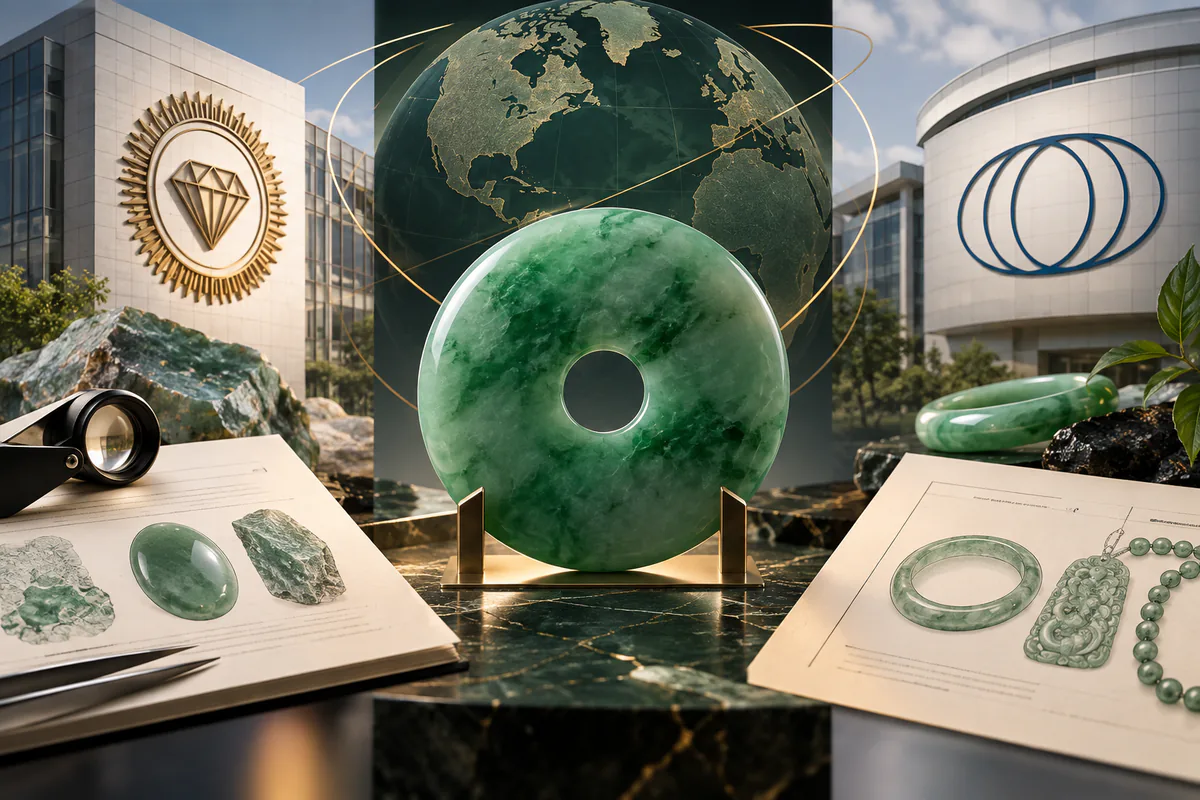
How Jade Is Named: What the GIA and CIBJO Say
Who decides that a stone is entitled to be called jade: what CIBJO writes in its gemstone book, what the GIA places under the word, how seven laboratories phrase it, and what French law does not say anywhere.
The text that governs the gemstone trade in France does not name jade: French Decree No. 2002-65 mentions neither jade, nor jadeite, nor nephrite. The name is written by professional organizations, CIBJO and the GIA foremost among them, which do not place quite the same minerals under the word and have no power to impose penalties.
So there are two levels that people often confuse: a professional level that writes what should be said without being able to enforce it, and a legal level that has written nothing about jade yet still punishes, on the grounds of deception.
My name is Jade, I run a jade jewelry workshop, and I weigh one example of each reference before it goes on sale. I am neither a gemologist nor a lawyer: what follows is what I read in the texts, with the date I opened them.
Who writes a stone’s name
Four organizations matter here, and they do not do the same job.
- The IMA, the International Mineralogical Association, approves species names. Jadeite, actinolite, tremolite, omphacite and kosmochlor are species; jade is not one, it is a trade word, as the core of the subject explains.
- CIBJO, the World Jewellery Confederation, publishes the Blue Books, including the gemstone book: the names under which the trade sells.
- The GIA, the Gemological Institute of America, teaches and analyzes; its public pages state the meaning it gives the word.
- The LMHC, a committee of seven laboratories, harmonizes the exact wording that appears on an identification report.
None of them is a state, none of them issues rulings. Everything else follows from that.
What a professional rule is worth
CIBJO says so in its foreword: its task is to record the accepted practices of the global trade. These practices supplement a country’s legislation, or stand in for it where there is none. It relies on its members to apply them, and its standards are subject to the regulations of the jurisdictions where those members operate.
The book therefore gives way to the law, and no one is responsible for enforcing it. The confederation was founded in 1926 and printed its first deliberations on terminology in 1968: nearly sixty years of work without any power of sanction. That is not a weakness, it is its status, and it owns that status more honestly than those who cite it.
What CIBJO writes on the jade line
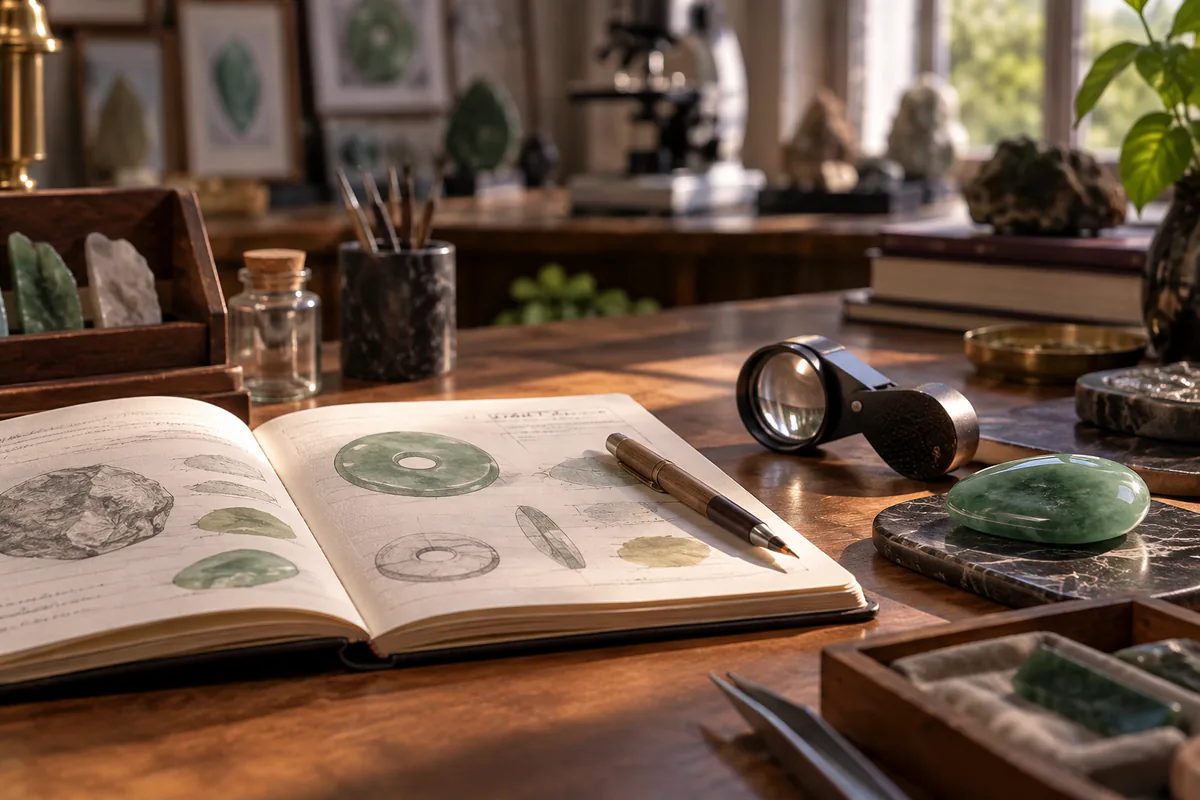
I opened the trade names appendix of the gemstone book, the edition dated December 22, 2022. Three columns: species, variety, trade name.
| Mineral species | Variety | Trade name |
|---|---|---|
| Jadeite | Jadeite, Jadeite-jade | |
| Jadeite | Chloromelanite | Chloromelanite |
| Actinolite, actinolite-tremolite, tremolite | Nephrite | Nephrite, Nephrite-jade |
On these lines, the word jade never stands alone: it only appears attached to the mineral, and in second place. The same appendix lists Fei Cui, terminology specific to the Chinese market, referred back to jadeite for everything else.
A column then lists commonly encountered treatments: for jadeite, polymer impregnation, polymer and dye impregnation after acid treatment, dyeing, and more rarely heating; for nephrite, most often nothing, sometimes dyeing, and very commonly a surface wax. It is a watch list; the treatment classification has its own article.
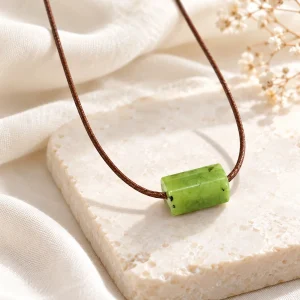
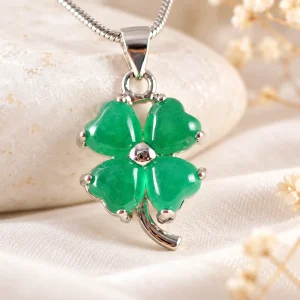
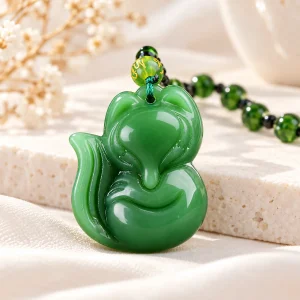
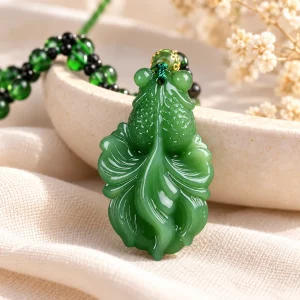
Pendants whose product page names the mineral
The GIA’s generic jade
The GIA does not keep a trade names appendix. Its jade description page sets out a working definition: modern gemologists use the word jade as a generic term for nephrite, jadeite and, under certain conditions, green omphacite.
So the word is openly treated as a trade word. It covers two species, as at CIBJO, and allows a third under conditions: that is where the texts stop lining up.
Omphacite, the word on which the texts diverge
Omphacite is a pyroxene from the same family as jadeite. The GIA writes that a green omphacite seen in its laboratory had the color of a fine green jadeite and the same gemological properties. Hence the door left ajar.
In the CIBJO gemstone book I read, the word omphacite does not appear even once. This is not an impression: I ran a full-text search on the whole document, and it returned zero. Kosmochlor, on the other hand, appears under its own name, with no jade attached. The laboratory committee decides differently again: it defines both, but denies them the word jade, which it reserves for jadeite and nephrite.
Three texts from the same profession, three positions, and no higher authority to settle it. My scale does not help: these pyroxenes all sit around 3.3, and weighing gives me the family, not the species.
How seven laboratories write the name
The LMHC brings together the GIA laboratory, CGL in Japan, CISGEM in Italy, DSEF in Germany, GIT in Thailand, and Gübelin and SSEF in Switzerland. Its information sheet No. 11, December 2011 version, is narrower than the GIA: jade is a trade name covering only jadeite and nephrite.
It also explains a distinction I have not seen made anywhere in French. Jadeite is the mineral; what the trade sells is a rock, made of aggregated jadeite crystals and other minerals. “Jadeite-jade” is therefore not redundant: the first word names the species, the second the stone that is cut.
Then comes the vocabulary of treatment. A piece that was bleached then impregnated is written as impregnated, one whose cracks received a colored agent is written as dyed, and one on which nothing was detected is written as: no indications of impregnation.
Read that wording again: it is negative. A fully equipped laboratory writes what it did not see rather than what the stone supposedly is. If they take that precaution, a seller with a scale and a glass of water has no reason to be more assertive: that is the principle behind what I publish on every product page.
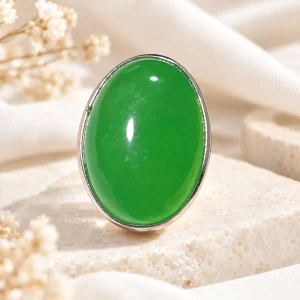
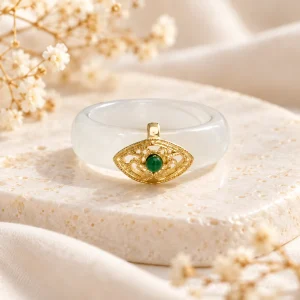
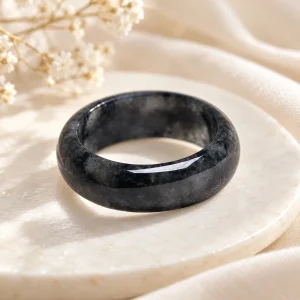
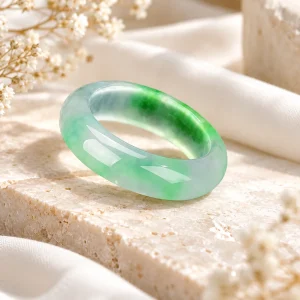
Jade rings, chosen one by one
French law, for its part, names nothing
This is the nuance I have not seen written on any of the French pages I opened, and it can be checked in ten minutes. French Decree No. 2002-65 of January 14, 2002, which governs the trade in gemstones and pearls, mentions neither jade, nor jadeite, nor nephrite, and contains no positive list of gemstone names.
It does something else: it requires treatment to be disclosed, prohibits selling a stone under any name other than its own, and bans two descriptive terms across its whole scope. Penalties come from the French Consumer Code, on the grounds of deception. The details are in what a seller must disclose, and the word precious in is jade a precious stone.
On one point the two worlds agree without having consulted each other: the descriptive term the decree bans is also listed by the gemstone book among misleading terms. The same conclusion, reached by two paths that never cross.
The side doors the nomenclature closes
These texts are less useful for saying what jade is than for closing the side routes, through which a kind of fraud passes that rarely lies head-on.
- A geographical name may only be used for the place of extraction, and a cutting or export center does not count as an origin. “Malaysian jade” fails on both counts, and so-called Vietnamese jade jewelry works the same way.
- Two gemstone names may not be joined in a way that makes the material unrecognizable.
- Every substitute already has its own name in the book. Serpentine, antigorite, lizardite, bowenite, quartzite and aventurine each appear under their own, and none carries the word jade: there is no gap to fill.
The labels and their densities are in stones sold as jade, and what you can check yourself is in how to recognize genuine jade.
What this changes on my product pages
I name the mineral before the word jade. That is the form CIBJO records, and the one that tells the reader something: jadeite, or nephrite, with the number behind it. Hydrostatic weighing separates 3.25 to 3.36 for one from 2.90 to 3.03 for the other, far from serpentine at around 2.6 and quartzite at around 2.65. What it does not settle, I write down: jadeite or nephrite.
I do not use any of the letters. The trade’s A, B and C come from laboratory vocabulary, which rests on instrumental observation beyond my reach. My supplier does not know how their goods have been treated, and I would rather say so than keep quiet: the treatment information sheet says it with every sale.
I do not use the A, AA, AAA scale, which is absent from every text read here and borrows its alphabet from the real one used for treatments. The value of a piece is judged elsewhere: the six criteria.
Questions I get asked
Is there a legal definition of jade in France?
No, not in French Decree No. 2002-65, the reference text for the gemstone trade: it mentions neither jade, nor jadeite, nor nephrite. What does exist are professional rules without binding force, and the general prohibition on deceiving the buyer.
Is “jadeite-jade” redundant?
No. Jadeite is a mineral species; what gets cut is a rock made of aggregated jadeite crystals and other minerals. The first word names the species, the second the stone.
Is omphacite jade?
It depends on which text you open. The GIA accepts it under certain conditions when it is green. The CIBJO gemstone book I read does not mention it, and the laboratory committee gives it a line under its own name, without the word jade.
What does the term “Fei Cui” refer to?
It is the Chinese name for jadeite, listed in the gemstone book as terminology specific to the Chinese market and referred back to the jadeite line. Using it as if it meant a superior quality has no basis in the text.
Can the GIA or CIBJO penalize a seller?
No, and CIBJO writes as much in its foreword: it records practices, relies on its members to apply them, and its standards are subject to the regulations of the countries concerned. In France, penalties come from the Consumer Code.
Why don’t these texts ever use just “jade”?
Because the word does not refer to a single material: it covers two unrelated species. The nomenclatures resolve this by placing it after the mineral name. A seller who writes “jade” and nothing else has not yet said what they are selling.
Where I checked
What comes from a named source. Three documents, read in full. The CIBJO gemstone book, Coloured Stone Commission, edition dated December 22, 2022: the foreword, the dates, the trade names appendix and its treatment column, and the clauses on geographical and combined names. The jade description page published by the GIA: the generic meaning of the word and green omphacite. LMHC information sheet No. 11, December 2011 version: how the report is structured, the narrow definition, the distinction between mineral and rock, and the wording for treatment. The density ranges come from the mineralogical literature: I cite them, I did not measure them, and I do not attribute them to any organization.
What is a dated observation. I opened these documents on September 10, 2026. The absence of the word omphacite is the result of a full-text search on the entire file, that day, on that edition: the next one may add it. The GIA page on jadeite versus omphacite was unavailable every time I tried, so I summarize nothing from it. The LMHC announces a more recent version of its sheet, which its website was not serving that day.
What is my own reasoning. Saying that none of these organizations has any power of sanction is a conclusion drawn from their status, not a sentence read as such. The comparison between the laboratories’ caution and my own is a position, and refusing the letters is a decision. If you find an error, or an edition that says something different, write to me: I will correct it and note the change.
In one sentence
The French decree does not name jade: its name is written by professional texts that do not fully agree, that all place the mineral before the word jade, and that have no power over anyone, which leaves it to the seller to say what they are selling. That is what I try to do with a scale and a catalog.