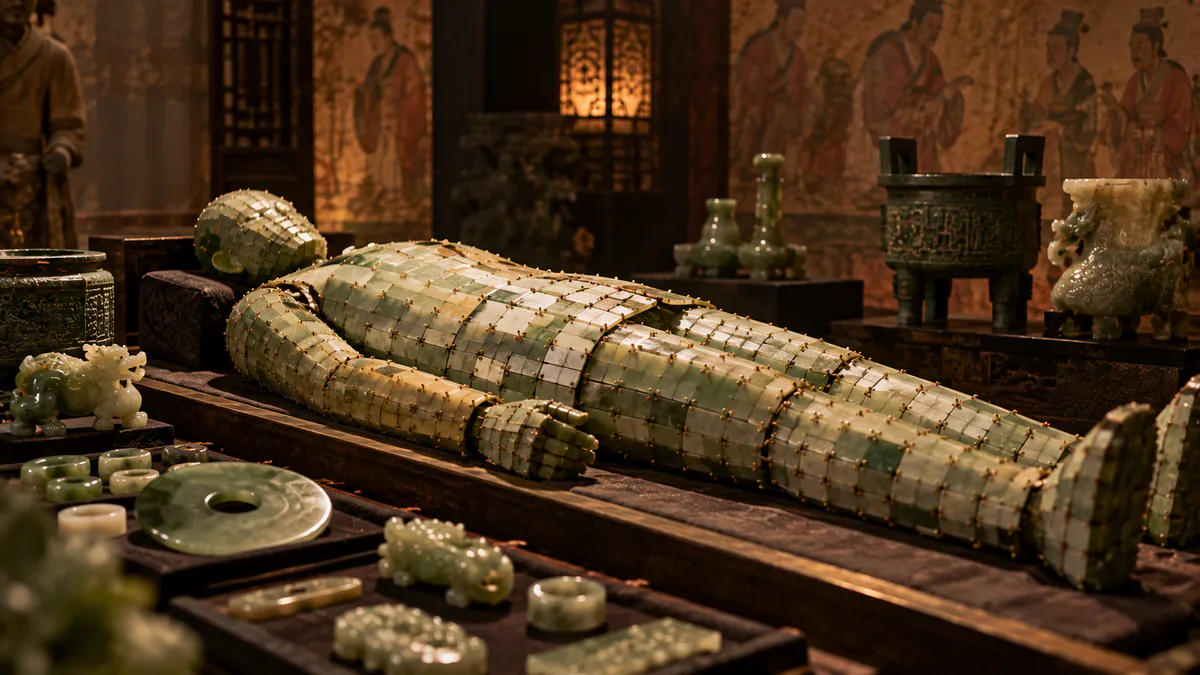
Jade in Chinese Tombs: The Burial Suit of Liu Sheng
This page tells the story of an object rather than a civilization: the jade burial suit of small plaques sewn with gold thread found on Liu Sheng at Mancheng, what the excavation revealed about it, which mineral it contains, and which of its figures I put my name to.
Jade in Chinese tombs was not only placed beside the dead, it dressed them: under the Han, princely bodies were enclosed in garments made from thousands of drilled plaques sewn together with metal thread, and that material is nephrite, the ancient Chinese jade, not the jadeite that would only arrive much later.
My name is Jade, and I run a jade jewelry workshop: I choose the pieces, have them set, and weigh one example of each reference before it goes on sale. I am not a gemologist, an archaeologist or a therapist: what is established is stated here as fact, and what was believed is attributed.
A suit, not a shroud
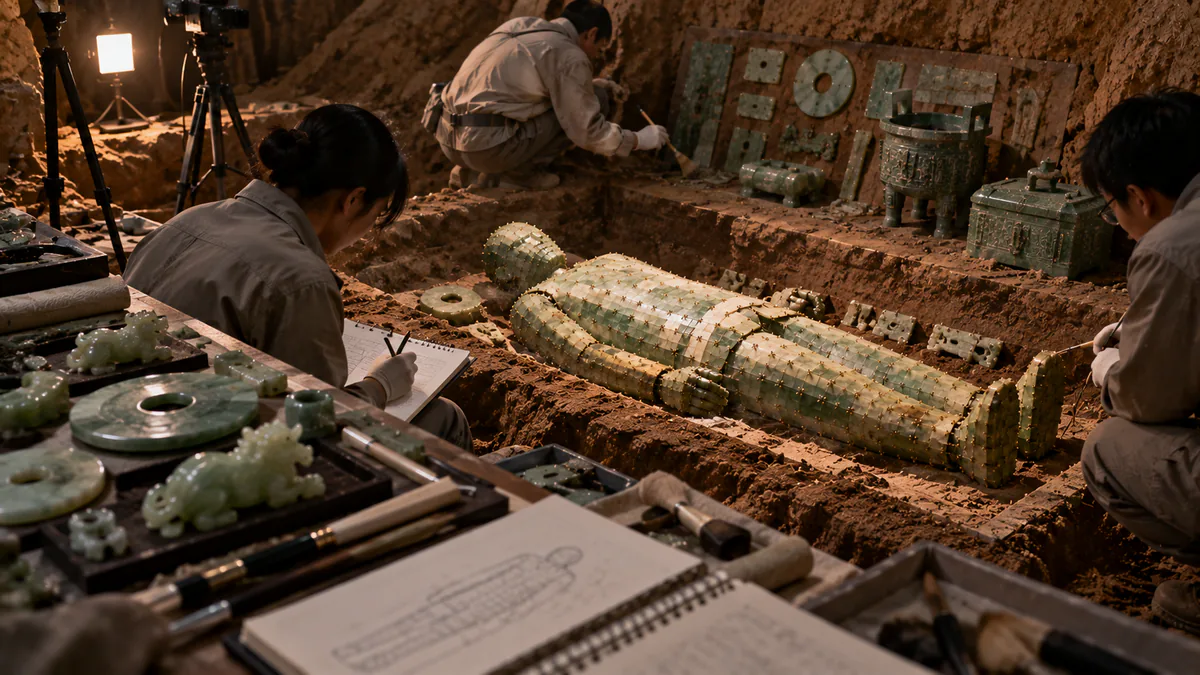
Shroud suggests a cloth wrapped around the dead. This object is nothing like a cloth: it is a closed, fitted garment, made in five parts according to the notes I read, a hood, a jacket, trousers, gloves and foot coverings. One exhibition note gives an example a length of 176 centimeters, the height of a man lying down: it does not wrap, it dresses.
The distinction is not a matter of vocabulary. A shroud is laid over a body; a jade suit is made for it, plaque by plaque, which implies a workshop, a design and a commission. Before it is an object of belief, it is a state expense that very few of the dead could justify.
The other ancient forms of the material, bi discs and cong tubes, are in jade motifs, the broader Chinese story in jade jewelry in China, and this object’s place among the meanings of the stone in the meaning of jade stone.
The suit of sewn jade plaques
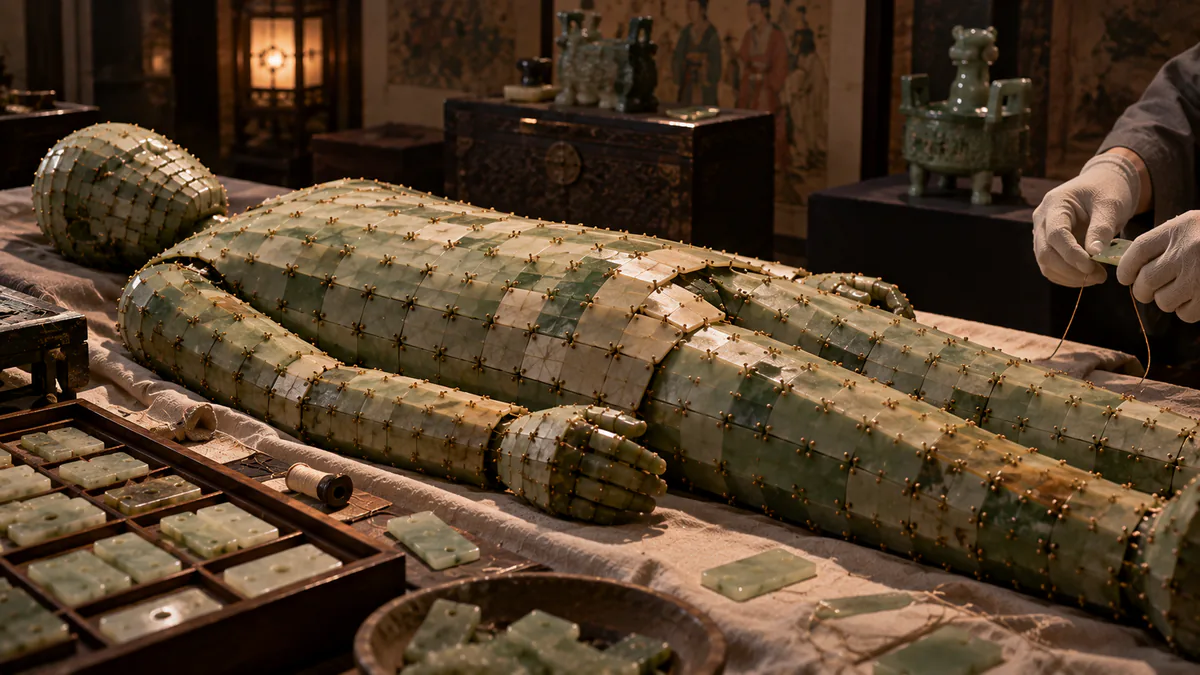
The principle is simple, the work immense. The stone is sawn into thin plaques, each one is drilled near its corners, metal thread is passed through the holes, and the plaques are assembled row by row until they form a flexible panel that closes around the body.
The thread is not always gold. The Book of the Later Han, as reported by the general notes I read, is said to reserve gold for the emperor, silver for kings, queens, princes, marquises and imperial consorts, and bronze for the ranks immediately below. That hierarchy has the flaw of rules written after the fact: Liu Sheng is a king, he dies in 113 BCE, and he wears gold.
What makes the object possible comes down to the mineral. Nephrite is a fibrous, felted amphibole: it can be sawn into thin slices and drilled without shattering, where a more brittle stone would make the whole operation absurd. It is not especially hard, but it is tough enough to have made the polished axes of the Neolithic: why jade almost never breaks.
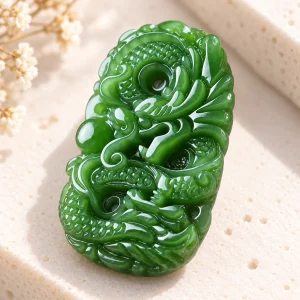
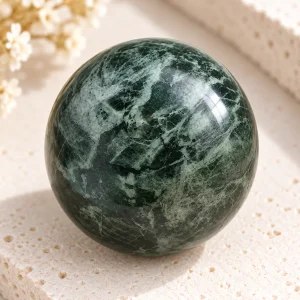
The jade objects available now
The Mancheng excavation, and what it brought to light
These suits were known from texts long before anyone had seen one. National Geographic sums up the situation in a word: they were considered a rumor.
In June 1968, an army unit digging an air-raid shelter on the slopes of Mount Lingshan, in Hebei, brought down a rock wall. Behind it was an intact tomb, which is the exception: that of Liu Sheng, King of Zhongshan, whose reign the exhibition note cited below gives as 154 to 113 BCE. Next to it was a second, separate tomb, that of his wife Dou Wan. Each wore a complete suit.
These two neighboring tombs matter, and not only for history: most of the errors in figures you read on this subject come from the two suits existing side by side. Both are said to be held at the Hebei Museum in Shijiazhuang; I have not seen them and I have not opened the museum’s website, a limit I would rather state.
The figures in circulation, and those I do not vouch for
The magazine The World of Chinese, in an August 2024 article, gives 2,498 plaques and 1,100 grams of gold thread for Liu Sheng’s suit, and 2,160 plaques and 700 grams for Dou Wan’s.
On the other pages I opened the same day, the plaque count does not change. The weight of gold, however, does: 1,100 grams on some, about two and a half pounds on others, which comes to the same thing, and 700 grams on others still, which does not come to the same thing at all. The simplest explanation is right there: 700 grams is Dou Wan’s figure, and it slipped onto her husband’s line.
Even so, I do not vouch for any of these numbers as established fact. I did not read them in the excavation report or on the label of the museum that holds the pieces: I read them in a magazine, and I say so as I write them. It is the rule I apply elsewhere, where I publish the density I measured and not one reported to me: the weighing page.
The only suit for which I have a museum label’s figures
A jade suit did come to Paris. The Guimet Museum presented Splendeurs des Han, essor de l’empire céleste (Splendors of the Han) until March 1, 2015, and the piece on show was not Liu Sheng’s: it came from the princely tomb of Chu, in Xuzhou, and it dressed Liu Wu, King of Chu.
The note published by the Friends of the Cernuschi Museum gives it 4,248 plaques of Khotan jade, gold thread weighing 1,576 grams, and a length of 176 centimeters. These three numbers are not of the same order as the previous ones: they come from an exhibition note, backed by the museum that holds the object.
Along the way, they defuse a common mix-up. When a page announces more than four thousand plaques for Liu Sheng, it has taken Liu Wu’s suit. Two kings, two tombs, two museums. What jade you can see without leaving France is elsewhere: jade in French museums.
Which mineral, and why the question is not neutral
Khotan jade means nephrite: the material comes from Hotan, in Xinjiang, the classic source of Chinese jade. The review of this exhibition in the Asian Art Newspaper in fact describes this suit as white, green and brown nephrite.
Yet the word jade covers two unrelated minerals, which density separates unambiguously: nephrite falls between 2.90 and 3.03, jadeite between 3.25 and 3.36. That is the subject of this site’s main guide, detailed in jadeite or nephrite.
What the confusion costs can be measured here better than anywhere. Jadeite arrived late in China, imported from Burma, and its imperial vogue dates from the 18th century: writing that the Han wore jadeite shifts the history of one mineral by eighteen centuries to lend it to the other. One note on color, in passing: white, green and brown on the same garment, when uniformly green jade in the trade is a recent idea (the colors of jade stone).
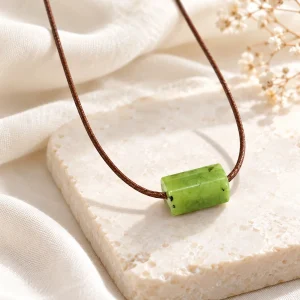
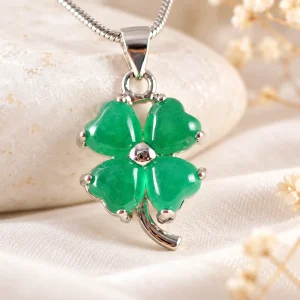
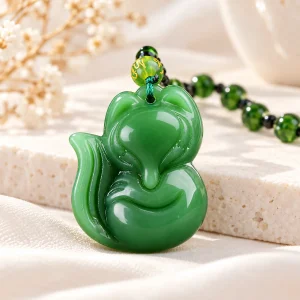
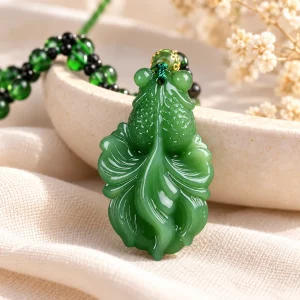
Pendants whose mineral I publish
What the Han attributed to the stone
What follows changes register, and I flag it rather than blending it into the rest. Nothing in it is proven: it is what traditions have attributed to this stone.
The reason given is said to be preservation of the body. Ge Hong, author of the Baopuzi under the Jin, writes that gold and jade placed in the nine orifices would make the dead imperishable: that is the phrase the notes quote to explain these suits. It postdates Liu Sheng by several centuries, and I have not read it in an edition of the text.
The result points the other way, and I state it as fact because it is an observation and not a belief: none of the suits brought to light preserved any flesh, writes the source I cite below.
I stop there, deliberately. This article does not say that jade protects: it says that people believed it and what they did with that belief. What Chinese thought otherwise put into this stone belongs to ethics rather than healing (the moral virtues of jade), and what contemporary crystal healing adds is elsewhere (what tradition attributes to jade stone).
Why the practice stopped
It stopped, and for a very material reason. The gold sewn into a suit was worth more than the suit: looters opened the tombs and burned the plaques to recover the thread. A garment designed to preserve a body attracted precisely what would destroy it.
Cao Pi, Emperor Wen of Wei, banned jade suits. The source I cite above gives the year 222 CE; another note gives 223, and I have no way of settling it. Four centuries of funerary use end there, which is why so few remain. What survives applies to a piece today too: the value of a jade lies not in a label but in what can be said about it with a source in front of you (judging the quality of a jade).
Questions I get asked
Are the Han jade suits jadeite or nephrite?
Nephrite. The note for the Chu suit shown in Paris speaks of Khotan jade, that is, nephrite from Hotan, in Xinjiang. Jadeite only reached China much later, imported from Burma: jadeite or nephrite.
How many plaques did Liu Sheng’s suit have?
The figure in circulation is 2,498 plaques and 1,100 grams of gold thread, against 2,160 plaques and 700 grams for Dou Wan’s suit. I read it in a magazine and not in an excavation report: it is a reported figure, and I present it as such.
Where can you see a jade suit?
The two from Mancheng are said to be held at the Hebei Museum in Shijiazhuang. Liu Wu’s belongs to the Xuzhou Museum and came to Paris, to the Guimet Museum, until March 1, 2015. I know of no example on permanent display in France: jade in French museums.
Does jade really preserve a body?
No. None of the suits brought to light preserved any flesh, according to the source I cite at the end of the article. The belief is documented, the effect is not, and no page on this site attributes any power to a stone: the full disclaimer is here.
Why gold for a king, if gold was reserved for the emperor?
Because the rule is later than the tomb. It is reported by the Book of the Later Han, whereas Liu Sheng died in 113 BCE, under the Former Han. A hierarchy written down after the fact does not necessarily describe the practice of the century before.
Can you buy a plaque from a burial suit?
I do not offer any, and I have no expertise to authenticate an archaeological object: in that field, I cannot measure anything. What I sell is contemporary, and I publish its density: what I publish on every product page.
Where I checked
What comes from a named source. June 1968, the army unit, the air-raid shelter and the slopes of Mount Lingshan come from a National Geographic article on the Han jade tombs. The figures for Liu Sheng and Dou Wan, the hierarchy of gold, silver and bronze thread, Ge Hong’s phrase, the absence of preserved flesh under the suits and the ban of 222 come from an August 2024 article in the magazine The World of Chinese: a magazine, not an excavation report, and I present it as such. The 4,248 plaques of Khotan jade, the 1,576 grams of gold thread and the 176 centimeters of the suit of Liu Wu, King of Chu, at the Xuzhou Museum, come from the note by the Friends of the Cernuschi Museum for the exhibition Splendeurs des Han, essor de l’empire céleste; the review of the same exhibition in the Asian Art Newspaper gives its closing date as March 1, 2015 and Liu Sheng’s reign as 154 to 113 BCE, and describes the Chu suit as white, green and brown nephrite. The density ranges are those of the mineralogical literature: I cite them, and I have measured them on none of these objects.
What is a dated observation. On September 10, 2026, I opened the French and English pages dealing with Liu Sheng’s suit. The count of 2,498 plaques appears everywhere; the weight of gold does not. I read 1,100 grams and 700 grams for the same suit, and the second value is the one the most complete source attributes to Dou Wan. None of these pages says where it got its numbers.
What is my own reasoning. That the 700 grams is Dou Wan’s figure slipped onto her husband’s line is the simplest hypothesis, not a proof. That the thread hierarchy describes an ordering later than Liu Sheng’s reign is a reading of dates, not a historian’s conclusion. Linking Khotan jade to nephrite is established; extending it to every suit brought to light, for which I have read no analysis, remains caution on my part, as does the place where the two Mancheng suits are held, taken from general notes I have not cross-checked. If you find an error here, write to me: I will correct it and note the change.
In one sentence
The Han tombs did not just contain jade, they contained people dressed in jade, and the most famous suit is the one whose figures travel worst, because no one says where they got them. What the word jade covers is on jade stone, and what I sell is in the shop.