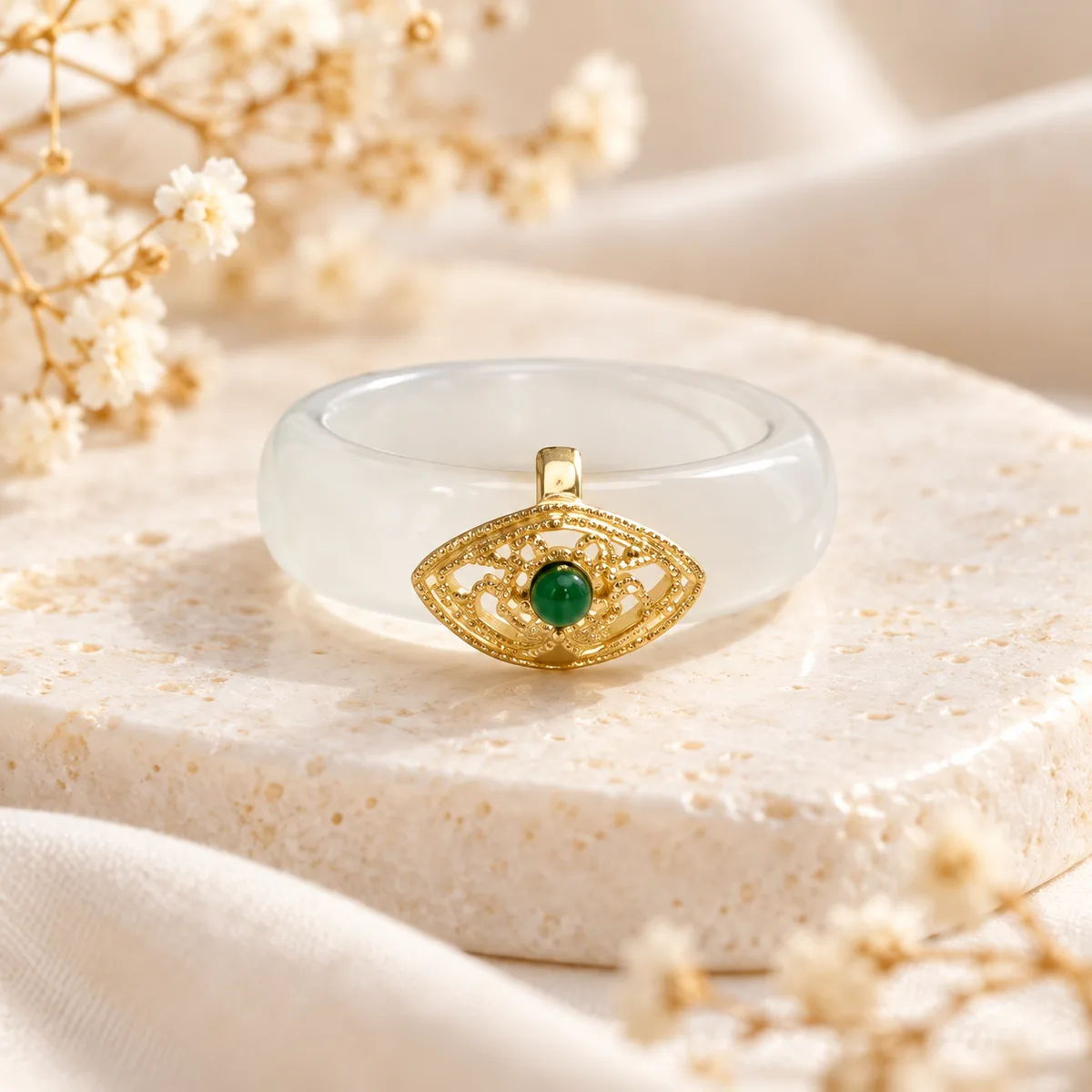
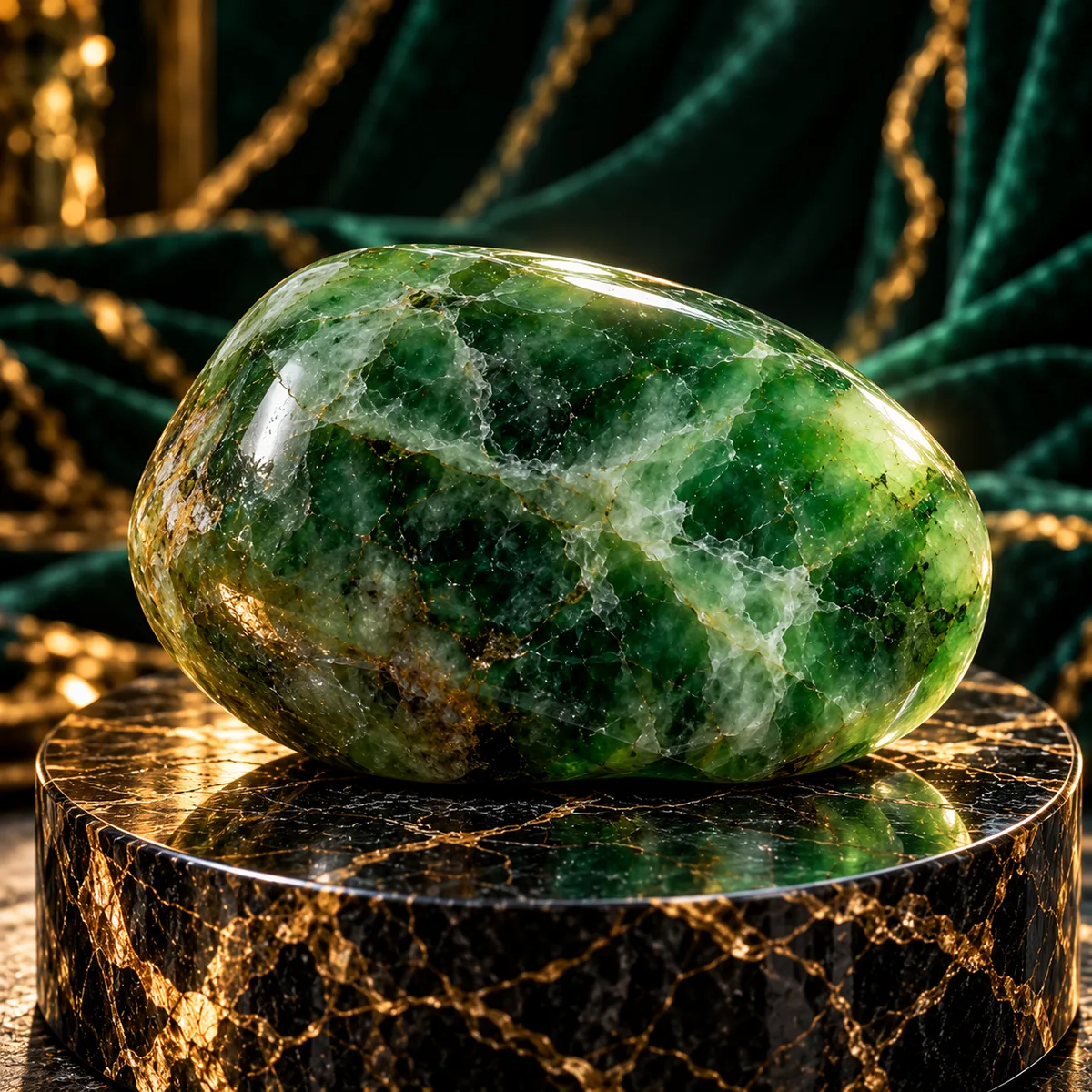
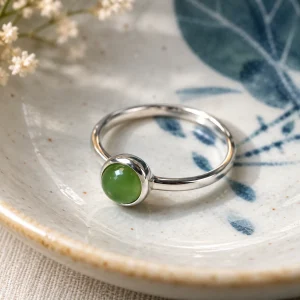
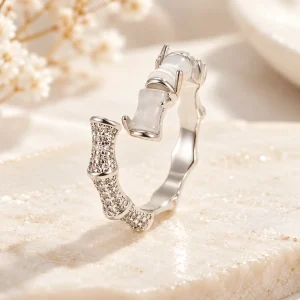
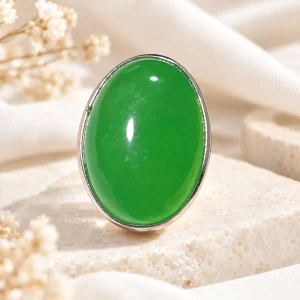
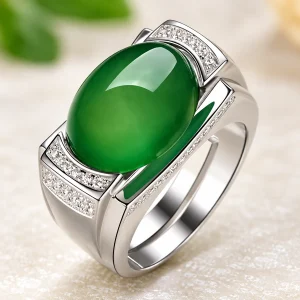
Evil eye jade ring in white stone, cut from one piece
40,90 €
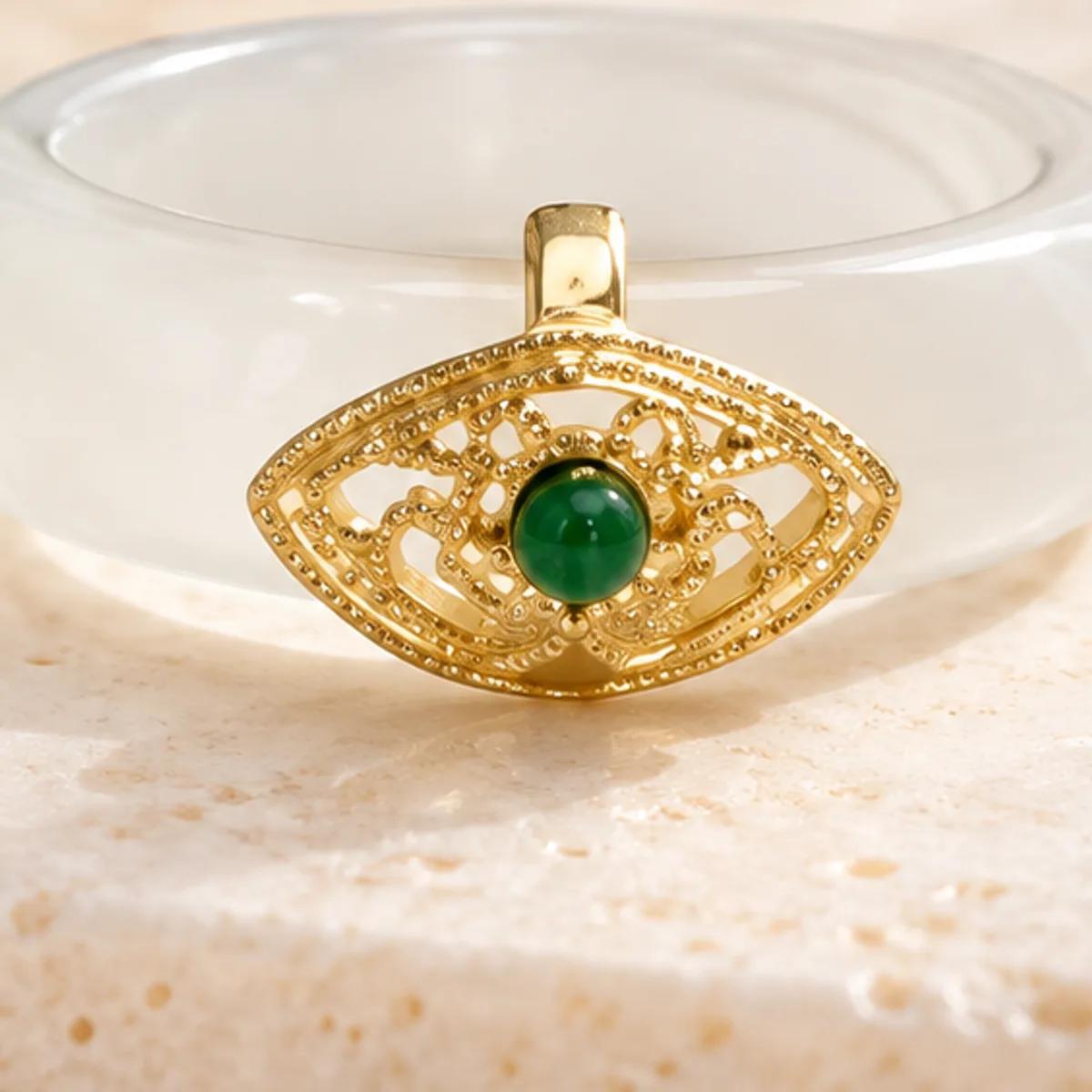
Evil eye jade ring in white stone: a solid band cut from a single piece, with an almond shaped gold tone motif set with a green stone at its centre.
The protective eye comes from the Mediterranean basin, not from the tradition of Chinese jade. The pairing is contemporary, and I would rather write that than invent a lineage for it.
A stone ring cannot be resized: it has to be right first time. The size guide.
An evil eye jade ring in white stone: a solid band cut from a single piece, on which an almond shaped gold tone motif is set with a green stone at its centre. The motif does not come from the tradition of jade, and that is the first thing this page says.
In four lines
A solid band, cut from one block: no seam, no join.
An almond shaped gold tone motif, set with a small green stone.
It cannot be resized: a stone ring does not adjust.
The gold tone is a plating on an unspecified alloy.
The evil eye is not a Chinese motif
The protective eye, the nazar, comes from the Mediterranean basin and the Near East: it is found in Greece, in Turkey, in the Levant, since antiquity. It does not belong to the repertoire of Chinese jade, which does not use it.
This ring therefore puts together an Asian stone and a Mediterranean motif, and it is a contemporary creation. I would rather write that than invent a lineage for it: it would be easy to speak of ancestral protection and let it be believed that the two have always gone together. They have not.
What remains true is that the design works: a gold tone almond on a white band is a clean contrast, and a jewel that is noticed without being large.
A solid band, and what that implies
The ring is not a metal shank carrying a stone: the stone is the band, cut and drilled in one piece. Jade allows that because it is tough, that is to say its interlocked crystals resist the spread of a crack. The difference between hardness and toughness.
The consequence is practical and it matters: a stone ring cannot be resized. You do not file it, you do not tighten it, you do not stretch it. It has to be right first time, and that is why the size guide counts for more here than on a metal mount. The size guide.
The other consequence is that it breaks if it falls on a tiled floor. Jade is tough, not unbreakable, and a thin band is still a thin band.
White, and why it is the hard case
On a green, the weighing settles things broadly. On a white the intervals brush against each other: dolomitic marble reaches 2.85, nephrite starts at 2.90. And since a stone is not dyed white, examining the hole or the rim, which works on a coloured stone, gives nothing here.
What you look at then is the translucency at the edge of the band: jade lets daylight through over a few millimetres, giving a diffuse and warm glow, where marble stays milky right through. The checks that need no equipment.
Outside Burma, country of extraction not confirmed
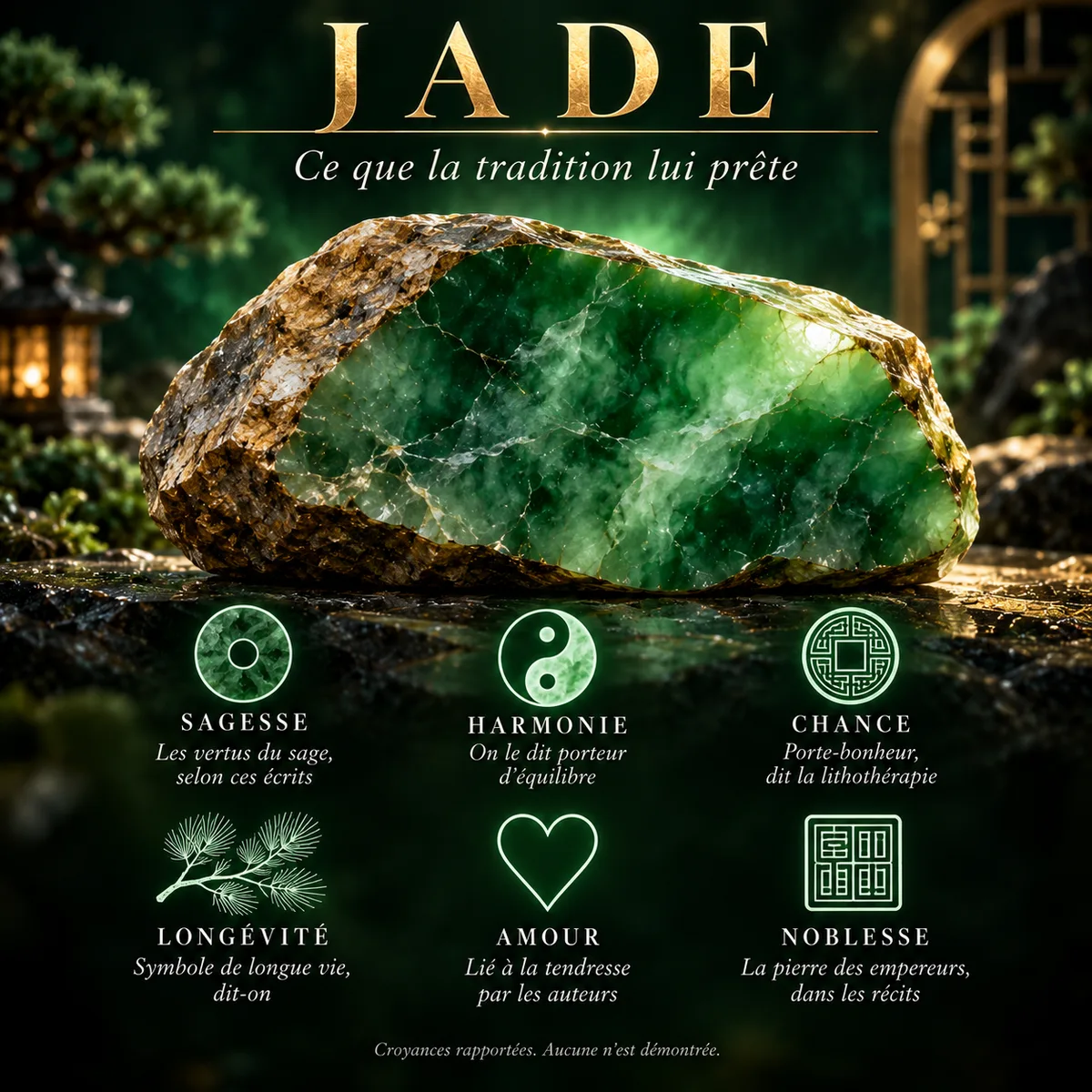
What tradition attributes to the evil eye and to jade
What follows changes register, and I flag it rather than blending it into the rest of the page. Nothing here is demonstrated. These are customs and beliefs, which I report because they are part of the history of this stone. No piece in this shop is sold as a remedy, and I claim no effect for this one.
The Mediterranean nazarThe blue eye against the evil eye is attested around the Mediterranean since antiquity, in Greece, in Anatolia and in the Levant. Its colour is traditionally blue, not green, and it has no Chinese equivalent. What tradition puts into a jade bracelet.
White before greenCultivated Chinese taste long placed white nephrite at the top, well above green. The present hierarchy comes from the trade in Burmese jadeite, from the eighteenth century onward, and it is a matter of fashion rather than of quality.
The jade you patinate by handChinese usage holds that a jade worn every day becomes warmer and brighter with the years. What changes is the surface, polished by friction and by the natural oils of the skin: the effect is real, the explanation is mechanical.
A stone of moral virtueIn Confucian thought, jade is associated with qualities of character rather than effects on the body: uprightness, constancy, restraint. It is the best documented meaning of them all.
Dispatched within 48 hours of your order being confirmed, for delivery within 14 days from dispatch. I keep no buffer stock, and I won’t promise a timeframe I couldn’t meet.
Postage charges
€6.99 to any destination, free on orders of €47 or more to France, Belgium, Switzerland and Luxembourg. The exact amount appears in the cart before you pay.
The packaging, and why it matters
Every piece ships in its own pouch, kept apart from the others. This isn’t about presentation: the hardness of jade is ordinary, between 6 and 6.5 for nephrite and 6.5 to 7 for jadeite, and the quartz in everyday dust sits at 7. Two pieces of jewellery that travel together end up scratching each other.
Fourteen days to change your mind
With no need to explain yourself. An email is enough to open a return, there is no form to fill in. Return postage is at your expense, unless the piece doesn’t match its listing or arrives damaged.
The wrong size is the main reason for a return in this category, and jade cannot be resized the way a solid metal band can. Two minutes of measuring almost always prevents it. The size guide.
Warm water, mild soap, a soft cloth. A very soft brush for the hollows of a carving. That’s all, and it’s enough.
What you must never do, and why
No ultrasonic cleaner, no steam, no solvent, no heat source. This isn’t a token precaution: the treatment status of my pieces is not established. My supplier doesn’t know, and weighing establishes the mineral without saying anything about a possible resin impregnation. Resin tolerates neither heat nor solvents, so every piece is handled as though it might contain some. The information sheet on treatments.
Scratches, and where they come from
Jade is tough, meaning very hard to break: its interlocking crystal structure resists fracturing, and that is why axes could be shaped from it in the Neolithic. Its hardness, on the other hand, is ordinary, 6 to 6.5 for nephrite and 6.5 to 7 for jadeite. The quartz in everyday dust sits at 7: that is what dulls jade, not knocks. The difference between the two.
Day to day
Put the piece on after perfume and cream, never before. Take it off for housework, gardening and sport, where the knocks against corners happen. Store each piece on its own, in its pouch. On a strand of beads, the thread wears out before the stone: it gets restrung, and there is nothing abnormal about that.
My name is Jade. I’m French, from Morbihan, and based in Tallinn. I choose the pieces and have them set: I mine nothing, I cut nothing, and I don’t do the metalwork myself. The work I do is the sorting, and with this material that is what decides everything.
I am neither a gemmologist, nor a lapidary, nor a therapist, and I don’t claim to be.
I weigh, I don’t certify
Before putting a reference online, I order one example of it for myself. When it reaches me unset, I weigh it in air, then suspended from a thread in a glass of water: the ratio of the two masses gives the density, and that figure separates jadeite, nephrite, serpentine and dyed quartzite without ambiguity.
One example per reference, not every piece. I don’t handle the piece that goes out to you, and I would rather say so than let you believe otherwise. The method, with its three limits.
What I can’t know
The treatment status of my pieces. My supplier doesn’t know, and the scales say nothing about it: they establish the mineral, not the resin impregnation. Only infrared spectroscopy in a laboratory would settle it, and I don’t have that done. So you will never read “jadeite A”, “type A” or “untreated” on this site. The information sheet.
Where my jade comes from
No Burmese jadeite, and the first reason is a legal one. Not the reason you read everywhere: the JADE Act of 2008 did indeed ban these stones in the United States, but that ban was lifted on 7 October 2016. What applies today dates from 8 April 2021: the US Treasury sanctioned Myanma Gems Enterprise, the state-owned company that controls the Burmese gem trade. So there is no general ban, but an American is not allowed to trade with that entity, and a stone never tells you where it has passed through. One single supply chain for ten markets: it has to hold up for the most demanding of them. When an origin isn’t confirmed to me in writing, the listing doesn’t state it. My sourcing policy.